PUBLISHER: Mordor Intelligence | PRODUCT CODE: 2125275

PUBLISHER: Mordor Intelligence | PRODUCT CODE: 2125275
Indonesia Mobile Payments - Market Share Analysis, Industry Trends & Statistics, Growth Forecasts (2026 - 2031)
According to Mordor Intelligence, the Indonesia mobile payments market size is projected to expand from USD 40.97 billion in 2025 and USD 48.39 billion in 2026 to USD 98.87 billion by 2031, registering a CAGR of 15.36% between 2026-2031.
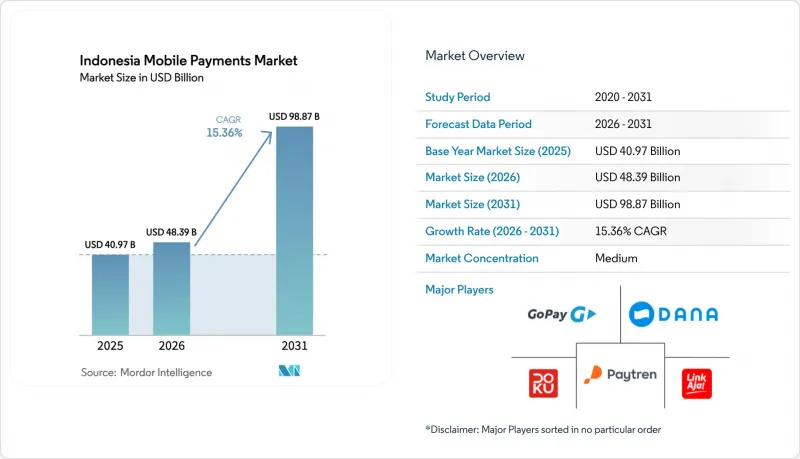
This report is Segmented by Mode of Payment (Point of Sales, and Online Sales), Payment Type (NFC, QR-Based, and More), Transaction Type (Peer-To-Peer, and Person To Business), Application (Retail and E-Commerce, Transportation and Logistics, Hospitality and Food-Service, Government and Public Sector, and More), and Geography. The Market Forecasts are Provided in Terms of Value (USD).
Indonesia Mobile Payments Market Trends and Insights
Bank Indonesia's Nationwide QRIS Mandate Accelerating Merchant On-Boarding
The zero-MDR policy for sub-IDR 500,000 (USD 29.7) transactions removed cost barriers for micro-merchants, adding 34.23 million new outlets and lifting quarterly QR volumes by 148.5% in 2025. Standardized QR formats now let consumers pay with any wallet using a single scan, pushing providers to compete on loyalty perks and credit add-ons rather than exclusivity. Closed-loop operators are therefore leveraging transaction data to launch working-capital loans and inventory-planning dashboards that sit inside the payment flow, reinforcing stickiness among small retailers while offsetting lost interchange revenue.
Social-Commerce Boom in Tier-2/3 Cities Expanding Wallet GMV
Live-stream retail on Shopee Live and TikTok Shop created an impulse-buy channel in secondary cities where logistics costs once restrained e-commerce adoption. ShopeePay's one-click integration cut cart abandonment by 28% in 2025, and social-commerce GMV in Makassar, Pontianak and Manado grew 62% year on year as buyers settled within the video feed instead of switching apps. Relaxed KYC thresholds for low-ticket sellers lowered entry hurdles for informal entrepreneurs, fostering a fresh long-tail of merchants that feed recurring wallet inflows.
Persisting OTP and Social-Engineering Fraud Undermining Consumer Trust
Fraud losses reached IDR 7 trillion (USD 0.42 billion) between late 2024 and 2025, with OTP phishing and SIM-swap schemes representing 68% of cases. Biometric logins and transaction velocity caps have reduced incident severity, but older users in tier-3 cities still favor cash due to fear of digital theft. OJK's September 2024 mandate for real-time fraud monitoring adds compliance costs for wallets, though conviction rates below 12% continue to hinder deterrence.
Other drivers and restraints analyzed in the detailed report include:
- Government Cashless Incentives in Public Transport (JakLingko) Driving Daily Use-Cases
- BI-FAST Real-Time Transfer Fee Reduction Stimulating Account-to-Wallet Payments
- High MDR for Micro-Merchants Outside Subsidized Schemes
For complete list of drivers and restraints, kindly check the Table Of Contents.
Segment Analysis
Point of Sales accounted for 67.59% of 2025 volume, anchoring the Indonesia mobile payments market on in-store groceries, fuel and quick-service restaurants. QRIS's zero-fee regime below IDR 500,000 lets small vendors accept wallets without margin sacrifice, preserving cashflow certainty. Online Sales, though smaller today, is forecast to compound at 17.43% as social-commerce embeds one-tap checkouts and subscription platforms scale video, software and cloud storage packages. The divergence signals that while brick-and-mortar will keep headline volume, digital channels will capture a larger slice of discretionary spending value over the forecast horizon, expanding total addressable reach for the Indonesia mobile payments market.
Physical retail also benefits from behavioral overlap: shoppers who scan a QR code to pay for groceries often top up their wallets via BI-FAST in the same session, closing a data loop that enables targeted promotions on their next store visit. Conversely, online users generate richer SKU-level insights, letting marketplaces bundle pay-later offers and loyalty cashbacks that lift average order value. Together, the two channels reinforce a blended payment habit, cushioning seasonality shocks and widening reachable GMV for the Indonesia mobile payments industry.
Legacy text-based options such as USSD and SMS held 48.67% share in 2025, reflecting continued feature-phone usage and consumer preference for visible confirmation messages. However, QR-Based flows are on track for a 16.24% CAGR, energized by QRIS interoperability and bilateral links that let Malaysian and Singaporean tourists pay Indonesian merchants in native wallets. The simplicity of printed codes, costing a fraction of NFC terminals, keeps merchant capex minimal and accelerates rural rollout.
NFC lags because sub-USD 125 devices lack chipsets, and merchants resist buying dedicated readers when QR achieves network ubiquity. Yet as handset prices fall and mass-market Android models add NFC modules, tap-to-pay could emerge for transit gates and high-footfall retail, particularly where speed trumps camera alignment. Over the forecast period, QR will remain the universal denominator, but NFC may carve premium urban niches, nudging blended acceptance that further enlarges the Indonesia mobile payments market.
Complete Report Scope:
- By Mode of Payment
- Point of Sales
- Online Sales
- By Payment Type
- NFC
- QR-Based
- Other Payment Types
- By Transaction Type
- Peer-to-Peer (P2P)
- Person to Business
- By Application
- Retail and e-Commerce
- Transportation and Logistics
- Hospitality and Food-Service
- Government and Public Sector
- Other Applications (Education, Healthcare)
List of Companies Covered in this Report:
- PT Visionet Internasional (OVO)
- PT Dompet Karya Anak Bangsa (GoPay)
- SeaMoney Singapore Pte. Ltd. (ShopeePay)
- PT Espay Debit Indonesia Koe (DANA)
- PT Fintek Karya Nusantara (LinkAja)
- PT Nusa Satu Inti Artha (DOKU)
- PT Bank Central Asia Tbk - Sakuku
- PT Bank Tabungan Pensiunan Nas-ional Tbk - Jenius Pay
- PT Indosat Tbk - i.saku
- PT Bank Rakyat Indonesia (Persero) Tbk - BRImo
- PT Bank Mandiri (Persero) Tbk - Livin' by Mandiri
- PT Akulaku Silvrr Indonesia - Akulaku PayLater
- PT Finaccel Teknologi Indonesia - Kredivo PayLater
- GrabPay Holdings Pte. Ltd.
- PT Veritra Sentosa Internasional (PayTren)
- BluePay Private Ltd.
- Tencent Holdings Ltd. - WeChat Pay (Cross-Border)
- Ant International Co. - Alipay+ (Cross-Border)
- PayPal Pte. Ltd.
- Fave Asia Technologies - FavePay
- Xendit Indonesia Pte. Ltd.
Additional Benefits:
- The market estimate (ME) sheet in Excel format
- 3 months of analyst support
TABLE OF CONTENTS
1 INTRODUCTION
- 1.1 Study Assumptions and Market Definition
- 1.2 Scope of the Study
2 RESEARCH METHODOLOGY
3 EXECUTIVE SUMMARY
4 MARKET LANDSCAPE
- 4.1 Market Overview
- 4.2 Market Drivers
- 4.2.1 Bank Indonesia's Nationwide QRIS Mandate Accelerating Merchant On-Boarding
- 4.2.2 Social-Commerce Boom in Tier-2/3 Cities Expanding Wallet GMV
- 4.2.3 Government Cashless Incentives in Public Transport (JakLingko) Driving Daily Use-Cases
- 4.2.4 BI-FAST Real-Time Transfer Fee Reduction Stimulating Account-to-Wallet Payments
- 4.2.5 Cross-Border QR Code Linkages with Malaysia and Singapore Boosting Inbound Tourist Spend
- 4.2.6 Rise of Embedded Finance in Indonesian Super-Apps Unlocking New Merchant Categories
- 4.3 Market Restraints
- 4.3.1 Persisting OTP and Social-Engineering Fraud Undermining Consumer Trust
- 4.3.2 High MDR for Micro-Merchants Outside Subsidized Schemes
- 4.3.3 Low NFC-Enabled Smartphone Penetration in Rural Indonesia
- 4.3.4 Regulatory Ceiling on E-Money Float Balances Limiting Ticket Size
- 4.4 Industry Value Chain Analysis
- 4.5 Regulatory Outlook
- 4.6 Technological Outlook
- 4.7 Porter's Five Forces Analysis
- 4.7.1 Bargaining Power of Suppliers
- 4.7.2 Bargaining Power of Consumers
- 4.7.3 Threat of New Entrants
- 4.7.4 Threat of Substitute Products
- 4.7.5 Intensity of Competitive Rivalry
- 4.8 Impact of Macroeconomic Factors on the Market
5 MARKET SIZE AND GROWTH FORECASTS (VALUE)
- 5.1 By Mode of Payment
- 5.1.1 Point of Sales
- 5.1.2 Online Sales
- 5.2 By Payment Type
- 5.2.1 NFC
- 5.2.2 QR-Based
- 5.2.3 Other Payment Types
- 5.3 By Transaction Type
- 5.3.1 Peer-to-Peer (P2P)
- 5.3.2 Person to Business
- 5.4 By Application
- 5.4.1 Retail and e-Commerce
- 5.4.2 Transportation and Logistics
- 5.4.3 Hospitality and Food-Service
- 5.4.4 Government and Public Sector
- 5.4.5 Other Applications (Education, Healthcare)
6 COMPETITIVE LANDSCAPE
- 6.1 Market Concentration
- 6.2 Strategic Moves
- 6.3 Market Share Analysis
- 6.4 Company Profiles (includes Global Level Overview, Market Level Overview, Core Segments, Financials as available, Strategic Information, Market Rank/Share, Products and Services, Recent Developments)
- 6.4.1 PT Visionet Internasional (OVO)
- 6.4.2 PT Dompet Karya Anak Bangsa (GoPay)
- 6.4.3 SeaMoney Singapore Pte. Ltd. (ShopeePay)
- 6.4.4 PT Espay Debit Indonesia Koe (DANA)
- 6.4.5 PT Fintek Karya Nusantara (LinkAja)
- 6.4.6 PT Nusa Satu Inti Artha (DOKU)
- 6.4.7 PT Bank Central Asia Tbk - Sakuku
- 6.4.8 PT Bank Tabungan Pensiunan Nas-ional Tbk - Jenius Pay
- 6.4.9 PT Indosat Tbk - i.saku
- 6.4.10 PT Bank Rakyat Indonesia (Persero) Tbk - BRImo
- 6.4.11 PT Bank Mandiri (Persero) Tbk - Livin' by Mandiri
- 6.4.12 PT Akulaku Silvrr Indonesia - Akulaku PayLater
- 6.4.13 PT Finaccel Teknologi Indonesia - Kredivo PayLater
- 6.4.14 GrabPay Holdings Pte. Ltd.
- 6.4.15 PT Veritra Sentosa Internasional (PayTren)
- 6.4.16 BluePay Private Ltd.
- 6.4.17 Tencent Holdings Ltd. - WeChat Pay (Cross-Border)
- 6.4.18 Ant International Co. - Alipay+ (Cross-Border)
- 6.4.19 PayPal Pte. Ltd.
- 6.4.20 Fave Asia Technologies - FavePay
- 6.4.21 Xendit Indonesia Pte. Ltd.
7 MARKET OPPORTUNITIES AND FUTURE OUTLOOK
- 7.1 White-Space and Unmet-Need Assessment

