PUBLISHER: Mordor Intelligence | PRODUCT CODE: 2125336

PUBLISHER: Mordor Intelligence | PRODUCT CODE: 2125336
China Mobile Payments - Market Share Analysis, Industry Trends & Statistics, Growth Forecasts (2026 - 2031)
According to Mordor Intelligence, China mobile payments market size in 2026 is estimated at USD 21.54 billion, growing from 2025 value of USD 15.86 billion with 2031 projections showing USD 99.43 billion, growing at 35.80% CAGR over 2026-2031.
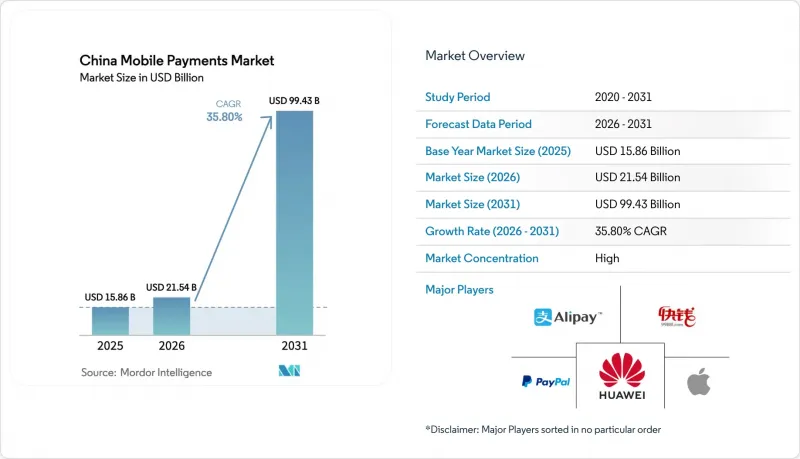
This report is Segmented by Payment Type (Proximity Payments, Remote Payments), Transaction Type (Peer-To-Peer (P2P), In-Store Point-Of-Sale (POS), Person-To-Merchant (P2M/Checkout), Other Transaction Types), Application (Retail and ECommerce, Transportation and Logistics, Hospitality and Food-Service, and More), End-User (Personal, Business). The Market Forecasts are Provided in Terms of Value (USD).
China Mobile Payments Market Trends and Insights
Ubiquity of QR-code ecosystems & near-universal merchant acceptance
QR codes enjoy 92.7% penetration, transforming them into the default interface for everything from street-food stalls to luxury boutiques. Regional interoperability has enabled outbound Chinese travelers to settle purchases across Southeast Asia and Japan, further reinforcing the technology's utility at home. With foreign-visitor mobile-payment volumes quadrupling in 1H-2024, merchants perceive QR acceptance as essential for retaining foot traffic and eliminating cash-handling costs. The resulting network effect entrenches platform loyalty, raises daily payment frequency, and lifts the average fee pool without an equivalent rise in marketing spend.
Government push for cashless society & digital-yuan integration
The digital yuan processed USD 250 billion by mid-2023, validating state ambitions to embed programmable money within retail payment rails. Salary disbursements in e-CNY across pilot cities showcase new public-sector use cases, though immediate cash conversion by some recipients highlights lingering trust and interest-bearing gaps. By running a parallel state-backed system, the PBOC pressures private wallets to elevate compliance while promoting universal access for the 11.3% unbanked adult cohort.
Regulatory tightening on FinTech giants raising compliance costs
Minimum registered-capital rules of RMB 1 billion (USD 139 million) triple entry barriers, forcing sub-scale PSPs to exit or merge. Even incumbent leaders have posted volatile quarterly earnings as remediation budgets balloon, diverting resources from product R&D to audit and risk controls.
Other drivers and restraints analyzed in the detailed report include:
- Super-app lifestyle ecosystems boosting daily payment frequency
- Expansion of NFC/QuickPass contactless transit acceptance
- Personal Information Protection Law heightening data-use limitations
For complete list of drivers and restraints, kindly check the Table Of Contents.
Segment Analysis
Remote Payments unlocked a 42.60% forecast CAGR by leveraging China's outbound e-commerce surge and the Alipay+ acceptance network connecting 88 million merchants in 57 countries. The segment thrives on friction-free checkout, dynamic FX conversion, and a unified refund process that reduces chargeback risk for merchants. Strategic alignment with tourism recovery allows platforms to monetize spending beyond China's borders while collecting data to refine loyalty programs.
Proximity Payments retain 69.35% dominance due to QR ubiquity and minimal hardware cost, yet margins tighten as global schemes slash foreign-card fees to 1.5%. Alipay's NFC push attempts to future-proof the segment, promising sub-second tap speeds that outpace QR scanning in busy transit hubs. Future revenue depends on layering value-added services such as in-app marketing, instant invoice issuance, and loyalty integration inside the China mobile payments market.
Person-to-Merchant (P2M) checkout is on course for 40.90% CAGR, energized by group-buy and hyperlocal delivery models that batch orders for last-mile efficiency. The integration of American Express cards into Alipay widens consumer choice, removing a key barrier for high-spend inbound travelers.
In-store POS upholds a 34.60% share, fortified by mature NFC terminals and campus-card systems that cultivate habitual tapping among students. Peer-to-Peer transfers remain foundational inside WeChat groups for bill-splitting and social gifting, while utility-bill and public-sector payments piggyback on digital-yuan rollouts that trim cash-handling overhead for municipal agencies.
Complete Report Scope:
- By Payment Type
- Proximity Payments
- Remote Payments
- By Transaction Type
- Peer-to-Peer (P2P)
- In-store Point-of-Sale (POS)
- Person-to-Merchant (P2M/Checkout)
- Other Transaction Types
- By Application
- Retail and eCommerce
- Transportation and Logistics
- Hospitality and Food-Service
- Government and Public Sector
- Other Applications (Education, Healthcare)
- By End-user
- Personal
- Business
List of Companies Covered in this Report:
- Alipay (Ant Group Co., Ltd.)
- WeChat Pay (Tencent Holdings Ltd.)
- China UnionPay Co., Ltd. (QuickPass)
- Huawei Technologies Co., Ltd. (Huawei Pay)
- Apple Inc.
- Samsung Electronics Co., Ltd. (Samsung Pay)
- Xiaomi Corp. (Mi Pay)
- JD.com, Inc. (JD Pay)
- Baidu, Inc. (Baidu Wallet)
- Paypal Inc.
- 99Bill Corporation
- Suning.com Co., Ltd. (Suning Pay)
- Ping An Insurance (Grp) Co. of China, Ltd. (Ping An Pay)
- Meituan Corp. (Meituan Pay)
- DiDi Global Inc. (DiDi Pay)
- Bestpay Co., Ltd. (China Telecom)
- China Mobile Ltd. (AndPay)
- UnionMobile Financial Technology Co., Ltd. (UMF Pay)
- Yinshang Digital Technology Co., Ltd.
Additional Benefits:
- The market estimate (ME) sheet in Excel format
- 3 months of analyst support
TABLE OF CONTENTS
1 INTRODUCTION
- 1.1 Study Assumptions and Market Definition
- 1.2 Scope of the Study
2 RESEARCH METHODOLOGY
3 EXECUTIVE SUMMARY
4 MARKET LANDSCAPE
- 4.1 Market Overview
- 4.2 Market Drivers
- 4.2.1 Ubiquity of QR-code Ecosystems and Near-Universal Merchant Acceptance
- 4.2.2 Government Push for Cashless Society and Digital Yuan Integration
- 4.2.3 Super-App Lifestyle Ecosystems Boosting Daily Payment Frequency
- 4.2.4 Expansion of NFC/QuickPass Contactless Transit Acceptance
- 4.2.5 BNPL Micro-Credit Features Driving Gen Z Spend Growth
- 4.2.6 PBOC Unified Barcode Interoperability Reducing Friction
- 4.3 Market Restraints
- 4.3.1 Regulatory Tightening on FinTech Giants Raising Compliance Costs
- 4.3.2 Personal Information Protection Law Heightening Data-Use Limitations
- 4.3.3 Merchant Discount Rate (MDR) Caps Compressing PSP Margins
- 4.3.4 Rural-Elderly Digital Divide Hindering Full Adoption
- 4.4 Value Chain Analysis
- 4.5 Regulatory Outlook
- 4.6 Porter's Five Forces Analysis
- 4.6.1 Threat of New Entrants
- 4.6.2 Bargaining Power of Buyers
- 4.6.3 Bargaining Power of Suppliers
- 4.6.4 Threat of Substitutes
- 4.6.5 Intensity of Competitive Rivalry
- 4.7 Assessment of Macro Economic Trends on the Market
- 4.8 Analysis of Business Models in the Industry
- 4.9 Analysis on Enabling Technologies (NFC, QR, etc.)
- 4.10 Commentary on Growth of Mobile Commerce and Influence on the Market
5 MARKET SIZE AND GROWTH FORECASTS (VALUES)
- 5.1 By Payment Type
- 5.1.1 Proximity Payments
- 5.1.2 Remote Payments
- 5.2 By Transaction Type
- 5.2.1 Peer-to-Peer (P2P)
- 5.2.2 In-store Point-of-Sale (POS)
- 5.2.3 Person-to-Merchant (P2M/Checkout)
- 5.2.4 Other Transaction Types
- 5.3 By Application
- 5.3.1 Retail and eCommerce
- 5.3.2 Transportation and Logistics
- 5.3.3 Hospitality and Food-Service
- 5.3.4 Government and Public Sector
- 5.3.5 Other Applications (Education, Healthcare)
- 5.4 By End-user
- 5.4.1 Personal
- 5.4.2 Business
6 COMPETITIVE LANDSCAPE
- 6.1 Market Concentration
- 6.2 Strategic Moves
- 6.3 Market Share Analysis
- 6.4 Company Profiles (includes Global Level Overview, Market Level Overview, Core Segments, Financials as available, Strategic Information, Market Rank/Share, Products and Services, Recent Developments)
- 6.4.1 Alipay (Ant Group Co., Ltd.)
- 6.4.2 WeChat Pay (Tencent Holdings Ltd.)
- 6.4.3 China UnionPay Co., Ltd. (QuickPass)
- 6.4.4 Huawei Technologies Co., Ltd. (Huawei Pay)
- 6.4.5 Apple Inc.
- 6.4.6 Samsung Electronics Co., Ltd. (Samsung Pay)
- 6.4.7 Xiaomi Corp. (Mi Pay)
- 6.4.8 JD.com, Inc. (JD Pay)
- 6.4.9 Baidu, Inc. (Baidu Wallet)
- 6.4.10
Paypal Inc.
- 6.4.11 99Bill Corporation
- 6.4.12 Suning.com Co., Ltd. (Suning Pay)
- 6.4.13 Ping An Insurance (Grp) Co. of China, Ltd. (Ping An Pay)
- 6.4.14 Meituan Corp. (Meituan Pay)
- 6.4.15 DiDi Global Inc. (DiDi Pay)
- 6.4.16 Bestpay Co., Ltd. (China Telecom)
- 6.4.17 China Mobile Ltd. (AndPay)
- 6.4.18 UnionMobile Financial Technology Co., Ltd. (UMF Pay)
- 6.4.19 Yinshang Digital Technology Co., Ltd.
7 MARKET OPPORTUNITIES AND FUTURE OUTLOOK
- 7.1 White-Space and Unmet-Need Assessment

