PUBLISHER: Mordor Intelligence | PRODUCT CODE: 2125345

PUBLISHER: Mordor Intelligence | PRODUCT CODE: 2125345
Europe Mobile Payments - Market Share Analysis, Industry Trends & Statistics, Growth Forecasts (2026 - 2031)
According to Mordor Intelligence, the Europe mobile payments market size was valued at USD 136.45 billion in 2025 and estimated to grow from USD 174.05 billion in 2026 to reach USD 587.95 billion by 2031, at a CAGR of 27.55% during the forecast period (2026-2031).
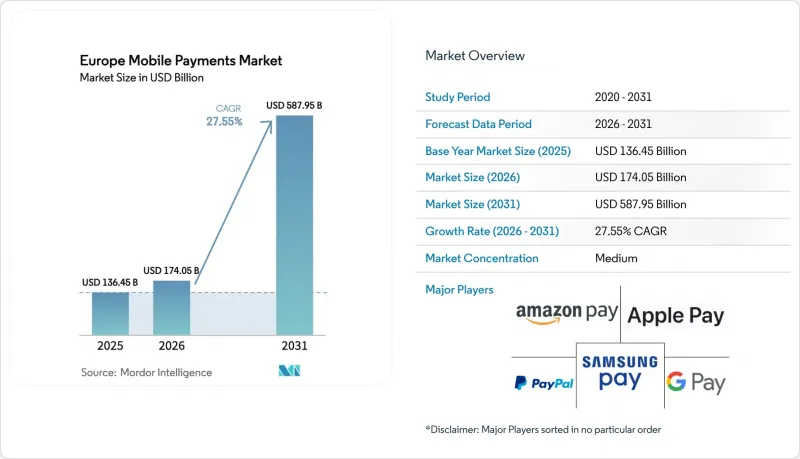
This report is Segmented by Payment Type (Proximity Payments, Remote Payments), Transaction Type (Peer-To-Peer (P2P), In-Store Point-Of-Sale (POS), Person-To-Merchant (P2M/Checkout), Other Transaction Types), Application (Retail and ECommerce, Transportation and Logistics, Hospitality and Food-Service, and More), End-User (Personal, Business) and Country. The Market Forecasts are Provided in Terms of Value (USD).
Europe Mobile Payments Market Trends and Insights
PSD2-driven open-banking mandates accelerating instant account-to-account mobile payments
The EU Instant Payments Regulation requires every euro-denominated account in the Single Euro Payments Area to support real-time transfers by October 2025. Banks must clear <= EUR 100,000 (USD 110,000) in <=10 seconds and verify payee details before posting funds. Wero, the European Payments Initiative's wallet, already counts 14 million users in Germany, France, and Belgium and processes cross-border payments via the EuroPA alliance. These measures lower scheme fees, reduce settlement risk, and give merchants an alternative to card rails, adding structural lift to the Europe mobile payments market.
Contactless adoption surging with >90% NFC-enabled POS penetration across eurozone
European Central Bank data show that 53.8% of all card transactions in 2024 were contactless, up nearly 20 percentage-points year on year. Denmark leads with 90% contactless share, followed by Norway at 87%, supported by over 90% NFC-enabled POS coverage. Apple's Tap to Pay on iPhone arrived in nine more European countries in March 2025, giving small merchants an in-hand acceptance option without extra hardware. The European Commission accepted Apple's commitment to open NFC to third-party wallets, which is expected to intensify competition among wallet providers.
Regulatory fragmentation post-Brexit & in non-EU states elevates integration complexity
Divergent frameworks between the EU's PSD2 regime and the UK's Financial Services and Markets Act 2023 create parallel compliance tracks, forcing processors to maintain dual authorisations and distinct strong-customer-authentication flows. Switzerland and Norway are outside SEPA Instant's mandatory scope, requiring bespoke bilateral agreements that extend onboarding timelines for pan-European wallets. This fragmentation raises cost-to-serve and tempers cross-border adoption within the Europe mobile payments market.
Other drivers and restraints analyzed in the detailed report include:
- Integration of mobile wallets into urban transport ticketing ecosystems
- BNPL expansion within mobile checkout flows in DACH & Nordic countries
- Higher merchant service fees for wallet transactions in Southern Europe
For complete list of drivers and restraints, kindly check the Table Of Contents.
Segment Analysis
Proximity transactions captured a dominant 67.18% share of the Europe mobile payments market in 2025 as retailers capitalised on >90% NFC penetration and consumer confidence in tap-and-go checkout. NFC-enabled wearables and Apple's Tap to Pay expansion further reduce friction at physical touchpoints. Contactless validation in transit systems such as Tisseo is adding new high-frequency use cases that cement daily habits. Remote payments, while representing a 32.82% slice, are scaling at a 30.48% CAGR as mobile-optimised eCommerce, tokenised card-on-file, and open-banking pay-by-bank offers gather steam. BNPL integration inside remote mobile flows lifts basket sizes and conversion. The widening reach of Wero's account-to-account rail and Worldline's Bank Transfer product across 14 markets augments remote acceptance breadth. Tokenisation commitments from Mastercard and Visa promise lower fraud and higher approval rates, reinforcing remote momentum.
Despite faster growth, proximity retains a structural edge through omnichannel acceptance and tactile immediacy. Merchants use SoftPOS and Tap on Mobile to turn smartphones into terminals, shrinking hardware costs. Conversely, remote transactions benefit from higher margins and richer data for loyalty orchestration. Over the forecast period, channel convergence will blur distinctions as super-apps offer both in-store QR or NFC and in-app checkout anchored on a single credential. Nevertheless, proximity is expected to remain the anchor channel owing to Europe's dense physical retail footprint and accelerating transport integrations.
POS transactions accounted for 44.60% of the Europe mobile payments market size in 2025, reflecting deep merchant acceptance and consumer familiarity. Retailers continue to replace legacy terminals with cloud-based, Android-powered devices that natively run loyalty, inventory, and payments, boosting in-store operational agility. Widespread EU regulations mandating real-time account crediting enhance settlement certainty for merchants, encouraging further POS digitisation.
Peer-to-peer (P2P) flows, while smaller, are projected to surge at a 31.40% CAGR as domestic wallet schemes interconnect through the EuroPA framework. Bizum in Spain, BANCOMAT Pay in Italy, and Vipps MobilePay in the Nordics are moving from domestic P2P into retail and micro-merchant acceptance, widening addressable volume. Instant settlement, zero or low fees, and ease of entry make P2P an accessible alternative to cash for informal exchanges. Over time, as QR codes and alias-based identifiers proliferate, P2P volumes will spill into person-to-merchant micro-payments, further diminishing cash usage.
Complete Report Scope:
- By Payment Type
- Proximity Payments
- Remote Payments
- By Transaction Type
- Peer-to-Peer (P2P)
- In-store Point-of-Sale (POS)
- Person-to-Merchant (P2M/Checkout)
- Other Transaction Types
- By Application
- Retail and eCommerce
- Transportation and Logistics
- Hospitality and Food-Service
- Government and Public Sector
- Other Applications (Education, Healthcare)
- By End-user
- Personal
- Business
- By Country
- United Kingdom
- Germany
- France
- Italy
- Spain
- Netherlands
- Rest of Europe
List of Companies Covered in this Report:
- Apple Inc. (Apple Pay)
- Google LLC (Google Pay)
- PayPal Holdings, Inc.
- Klarna Bank AB
- Samsung Electronics Co., Ltd. (Samsung Pay)
- Amazon.com, Inc. (Amazon Pay)
- Worldline SA
- Adyen N.V.
- Stripe, Inc.
- FIS Global (Worldpay)
- PayU S.A.
- Revolut Ltd. (Revolut Pay)
- Block, Inc. (Square/Cash App)
- Twint AG
- Vipps MobilePay AS
- Satispay S.p.A.
- Nets A/S (Nexi Group)
- Lydia Solutions SAS
- BitPay, Inc.
- Blue Code International AG
- Garmin Ltd. (Garmin Pay)
- Fitbit LLC (Fitbit Pay)
Additional Benefits:
- The market estimate (ME) sheet in Excel format
- 3 months of analyst support
TABLE OF CONTENTS
1 INTRODUCTION
- 1.1 Study Assumptions and Market Definition
- 1.2 Scope of the Study
2 RESEARCH METHODOLOGY
3 EXECUTIVE SUMMARY
4 MARKET LANDSCAPE
- 4.1 Market Overview
- 4.2 Market Drivers
- 4.2.1 PSD2-Driven Open-Banking Mandates Accelerating Instant Account-to-Account Mobile Payments
- 4.2.2 Contactless Adoption Surging with more than 90% NFC-Enabled POS Penetration Across Eurozone
- 4.2.3 Integration of Mobile Wallets into Urban Transport Ticketing Ecosystems
- 4.2.4 BNPL Expansion within Mobile Checkout Flows in DACH and Nordic Countries
- 4.2.5 Cross-Border E-commerce Growth under EU Digital Single Market Rules
- 4.2.6 Tokenisation and Biometric SCA Lowering Fraud and Raising Consumer Trust
- 4.3 Market Restraints
- 4.3.1 Regulatory Fragmentation Post-Brexit and in Non-EU States Elevates Integration Complexity
- 4.3.2 Higher Merchant Service Fees for Wallet Transactions in Southern Europe
- 4.3.3 Cash Preference among Micro-Merchants in Italy and Spain
- 4.3.4 Escalating Cyber-Attacks on Soft-POS and Wallets Impacting Senior Demographics
- 4.4 Value Chain Analysis
- 4.5 Regulatory Outlook (PSD2, GDPR, Digital Euro Pilot)
- 4.6 Technological Outlook (5G, Tokenisation, HCE)
- 4.7 Porter's Five Forces Analysis
- 4.7.1 Threat of New Entrants
- 4.7.2 Bargaining Power of Buyers/Consumers
- 4.7.3 Bargaining Power of Suppliers
- 4.7.4 Threat of Substitute Products
- 4.7.5 Intensity of Competitive Rivalry
- 4.8 Assessment of Macro Economic Trends on the Market
5 MARKET SIZE AND GROWTH FORECASTS (VALUES)
- 5.1 By Payment Type
- 5.1.1 Proximity Payments
- 5.1.2 Remote Payments
- 5.2 By Transaction Type
- 5.2.1 Peer-to-Peer (P2P)
- 5.2.2 In-store Point-of-Sale (POS)
- 5.2.3 Person-to-Merchant (P2M/Checkout)
- 5.2.4 Other Transaction Types
- 5.3 By Application
- 5.3.1 Retail and eCommerce
- 5.3.2 Transportation and Logistics
- 5.3.3 Hospitality and Food-Service
- 5.3.4 Government and Public Sector
- 5.3.5 Other Applications (Education, Healthcare)
- 5.4 By End-user
- 5.4.1 Personal
- 5.4.2 Business
- 5.5 By Country
- 5.5.1 United Kingdom
- 5.5.2 Germany
- 5.5.3 France
- 5.5.4 Italy
- 5.5.5 Spain
- 5.5.6 Netherlands
- 5.5.7 Rest of Europe
6 COMPETITIVE LANDSCAPE
- 6.1 Market Concentration
- 6.2 Strategic Moves
- 6.3 Market Share Analysis
- 6.4 Company Profiles (includes Global-level Overview, Market-level Overview, Core Segments, Financials, Strategic Information, Market Rank/Share, Products and Services, Recent Developments)
- 6.4.1 Apple Inc. (Apple Pay)
- 6.4.2 Google LLC (Google Pay)
- 6.4.3 PayPal Holdings, Inc.
- 6.4.4 Klarna Bank AB
- 6.4.5 Samsung Electronics Co., Ltd. (Samsung Pay)
- 6.4.6 Amazon.com, Inc. (Amazon Pay)
- 6.4.7 Worldline SA
- 6.4.8 Adyen N.V.
- 6.4.9 Stripe, Inc.
- 6.4.10 FIS Global (Worldpay)
- 6.4.11 PayU S.A.
- 6.4.12 Revolut Ltd. (Revolut Pay)
- 6.4.13 Block, Inc. (Square/Cash App)
- 6.4.14 Twint AG
- 6.4.15 Vipps MobilePay AS
- 6.4.16 Satispay S.p.A.
- 6.4.17 Nets A/S (Nexi Group)
- 6.4.18 Lydia Solutions SAS
- 6.4.19 BitPay, Inc.
- 6.4.20 Blue Code International AG
- 6.4.21 Garmin Ltd. (Garmin Pay)
- 6.4.22 Fitbit LLC (Fitbit Pay)
7 MARKET OPPORTUNITIES AND FUTURE OUTLOOK
- 7.1 White-Space and Unmet-Need Assessment

