PUBLISHER: Mordor Intelligence | PRODUCT CODE: 2125358

PUBLISHER: Mordor Intelligence | PRODUCT CODE: 2125358
Germany Mobile Payments - Market Share Analysis, Industry Trends & Statistics, Growth Forecasts (2026 - 2031)
According to Mordor Intelligence, Germany mobile payments market size in 2026 is estimated at USD 2.51 trillion, growing from 2025 value of USD 2.12 trillion with 2031 projections showing USD 5.91 trillion, growing at 18.64% CAGR over 2026-2031.
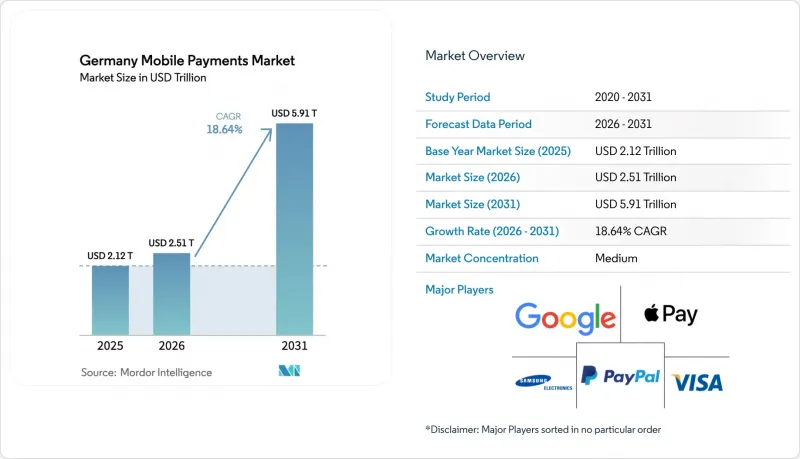
This report is Segmented by Payment Type (Proximity Payments, Remote Payments), Transaction Type (Peer-To-Peer (P2P), In-Store Point-Of-Sale (POS), Person-To-Merchant (P2M/Checkout), Other Transaction Types), Application (Retail & ECommerce, Transportation and Logistics, Hospitality & Food-Service, and More), End-User (Personal, Business). The Market Forecasts are Provided in Terms of Value (USD).
Germany Mobile Payments Market Trends and Insights
Surge in Contactless POS Infrastructure Penetration
Nationwide terminal density has reached a point where availability no longer restricts proximity payments. Contactless card transactions rose 13.2% year-on-year during H1 2024, with Germany contributing a notable share of the 25.8 billion payments recorded. Retailers such as REWE use computer-vision formats that combine cashierless checkout with mobile apps, shifting competition toward user-experience optimisation. Sparkasse's Alipay+ integration illustrates how established banks leverage upgraded terminals to capture cross-border flows during large events. Greater confidence in contactless reliability speeds merchant onboarding, strengthening the Germany mobile payments market.
E-commerce Expansion Among SMEs Adopting Mobile Checkout
SMEs account for 99% of German businesses and are central to domestic commerce digitisation. Government "go-digital" subsidies lower adoption barriers, allowing providers such as Stripe and Commerz Globalpay to package mobile checkout with value-added analytics for smaller merchants. Partnerships between incumbent banks and fintechs-exemplified by Commerzbank's digital card launch-target cost reduction and working-capital optimisation for merchants with limited IT resources. The Germany mobile payments market therefore captures incremental volumes from previously cash-centric micro-merchants.
Security & Privacy Concerns Under PSD3
Stronger authentication rules add friction if poorly implemented. Emerging social-engineering attacks generate consumer anxiety, especially while reimbursement frameworks remain patchy. Bundeskriminalamt highlights increased malware and phishing aimed at mobile devices, prompting providers to add biometric safeguards that can extend checkout times. Adoption may slow among older consumers who already prefer cash, though sustained education campaigns could soften the impact on the Germany mobile payments market.
Other drivers and restraints analyzed in the detailed report include:
- Real-time TIPS Integration into Mobile Wallets
- Digital ID & eIDAS 2.0 Wallet Enabling Frictionless KYC
- Interchange-fee Caps Squeezing Provider Margins
For complete list of drivers and restraints, kindly check the Table Of Contents.
Segment Analysis
Remote payments held 64.20% of Germany mobile payments market share in 2025, driven by entrenched e-commerce behaviour and strong digital banking penetration. Proximity transactions are catching up quickly, expanding at 20.5% CAGR as merchants deploy NFC-enabled terminals nationwide. Younger cohorts champion tap-to-pay convenience, while older groups still favour remote channels for online shopping. Contactless reliability, QR-code acceptance, and patent-led innovations that enable low-battery NFC transactions together stimulate proximity uptake. Domestic players integrate reward schemes into in-store apps, while global wallets leverage OS-level enrolment to scale at minimal marginal cost. The dual-track growth amplifies total Germany mobile payments market capacity rather than cannibalising existing remote volumes.
Proximity momentum is also reinforced by mandatory instant settlement, which reduces perceived risk for merchants accepting high-ticket face-to-face payments. Retailers bundle digital-receipt issuance and buy-now-pay-later options at POS, further enhancing perceived value. For remote channels, marketplace platforms focus on stored-credential optimisation and chargeback mitigation to maintain customer trust. Both modalities converge on a unified customer-identity layer, anchored by the eIDAS 2.0 wallet, that could blur distinctions over the long run within the Germany mobile payments market.
In-store point-of-sale retained 45.40% of Germany mobile payments market size in 2025, underscoring the resilience of physical retail. However, non-POS categories-peer-to-peer, subscription, and embedded-finance flows-are forecast to grow 22.6% CAGR as consumers adopt super-apps that package transfers, loyalty, and micro-investing. Real-time payments infrastructure incentivises billers and utilities to embed instant pay-by-link options, displacing legacy direct-debit norms. The rise of "invisible checkout" in quick-service formats further expands POS definitions to include sensor-based walk-out payments.
Financial-super-app roadmaps from N26 and Revolut target a broader service footprint, integrating salary advances and budgeting. This proliferation increases competitive intensity in adjacent verticals such as insurance and small-ticket credit, thereby enlarging the transaction universe for the Germany mobile payments market. Legacy acquirers respond by exposing API gateways that allow partners to initiate payments straight from bank accounts, avoiding card interchange entirely.
Complete Report Scope:
- By Payment Type
- Proximity Payments
- Remote Payments
- By Transaction Type
- Peer-to-Peer (P2P)
- In-store Point-of-Sale (POS)
- Person-to-Merchant (P2M/Checkout)
- Other Transaction Types
- By Application
- Retail and eCommerce
- Transportation and Logistics
- Hospitality and Food-Service
- Government and Public Sector
- Other Applications (Education, Healthcare)
- By End-user
- Personal
- Business
List of Companies Covered in this Report:
- Apple Inc.
- Google LLC
- PayPal Holdings Inc.
- Samsung Electronics Co. Ltd
- Mastercard Inc.
- Visa Inc.
- American Express Co.
- Klarna Bank AB
- Paydirekt GmbH
- Bluecode Payment AG
- Deutsche Bank AG
- Sparkassen-Finanzgruppe
- N26 GmbH
- Revolut Ltd
- Lydia Solutions SAS
- SumUp Payments Ltd
- Stripe Inc.
- Adyen N.V.
- Worldline S.A.
- Amazon Payments Europe S.C.A.
Additional Benefits:
- The market estimate (ME) sheet in Excel format
- 3 months of analyst support
TABLE OF CONTENTS
1 INTRODUCTION
- 1.1 Study Assumptions and Market Definition
- 1.2 Scope of the Study
2 RESEARCH METHODOLOGY
3 EXECUTIVE SUMMARY
4 MARKET LANDSCAPE
- 4.1 Market Overview
- 4.2 Market Drivers
- 4.2.1 Surge in contactless POS infrastructure penetration
- 4.2.2 E-commerce expansion among SMEs adopting mobile checkout
- 4.2.3 Real-time TIPS integration into mobile wallets
- 4.2.4 Digital ID and eIDAS 2.0 wallet enabling frictionless KYC
- 4.2.5 Retailer-led closed-loop wallets (e.g., Lidl Pay)
- 4.3 Market Restraints
- 4.3.1 Security and privacy concerns under PSD3
- 4.3.2 Interchange-fee caps squeezing provider margins
- 4.3.3 Ageing demographic's slower adoption
- 4.3.4 Dependence on US mobile-OS vendors
- 4.4 Value Chain Analysis
- 4.5 Regulatory Landscape
- 4.6 Technological Outlook
- 4.7 Porter's Five Forces
- 4.7.1 Bargaining Power of Suppliers
- 4.7.2 Bargaining Power of Buyers
- 4.7.3 Threat of New Entrants
- 4.7.4 Threat of Substitutes
- 4.7.5 Competitive Rivalry
- 4.8 Assessment of Macro Economic Trends on the Market
- 4.9 Business-Model Analysis
- 4.10 Penetration of Mobile Wallets in Germany
- 4.11 Influence of Mobile Commerce Growth
5 MARKET SIZE AND GROWTH FORECASTS (VALUES)
- 5.1 By Payment Type
- 5.1.1 Proximity Payments
- 5.1.2 Remote Payments
- 5.2 By Transaction Type
- 5.2.1 Peer-to-Peer (P2P)
- 5.2.2 In-store Point-of-Sale (POS)
- 5.2.3 Person-to-Merchant (P2M/Checkout)
- 5.2.4 Other Transaction Types
- 5.3 By Application
- 5.3.1 Retail and eCommerce
- 5.3.2 Transportation and Logistics
- 5.3.3 Hospitality and Food-Service
- 5.3.4 Government and Public Sector
- 5.3.5 Other Applications (Education, Healthcare)
- 5.4 By End-user
- 5.4.1 Personal
- 5.4.2 Business
6 COMPETITIVE LANDSCAPE
- 6.1 Market Concentration
- 6.2 Strategic Moves
- 6.3 Market Share Analysis
- 6.4 Company Profiles (includes Global-level Overview, Market-level Overview, Core Segments, Financials, Strategic Info, Market Rank/Share, Products and Services, Recent Developments)
- 6.4.1 Apple Inc.
- 6.4.2 Google LLC
- 6.4.3 PayPal Holdings Inc.
- 6.4.4 Samsung Electronics Co. Ltd
- 6.4.5 Mastercard Inc.
- 6.4.6 Visa Inc.
- 6.4.7 American Express Co.
- 6.4.8 Klarna Bank AB
- 6.4.9 Paydirekt GmbH
- 6.4.10 Bluecode Payment AG
- 6.4.11 Deutsche Bank AG
- 6.4.12 Sparkassen-Finanzgruppe
- 6.4.13 N26 GmbH
- 6.4.14 Revolut Ltd
- 6.4.15 Lydia Solutions SAS
- 6.4.16 SumUp Payments Ltd
- 6.4.17 Stripe Inc.
- 6.4.18 Adyen N.V.
- 6.4.19 Worldline S.A.
- 6.4.20 Amazon Payments Europe S.C.A.
7 MARKET OPPORTUNITIES AND FUTURE OUTLOOK
- 7.1 White-space and Unmet-need Assessment

