PUBLISHER: Mordor Intelligence | PRODUCT CODE: 2125277

PUBLISHER: Mordor Intelligence | PRODUCT CODE: 2125277
Japan Mobile Payments - Market Share Analysis, Industry Trends & Statistics, Growth Forecasts (2026 - 2031)
According to Mordor Intelligence, the Japan mobile payments market size stood at USD 0.36 trillion in 2026 and is projected to reach USD 1.41 trillion by 2031, registering a 31.04% CAGR.
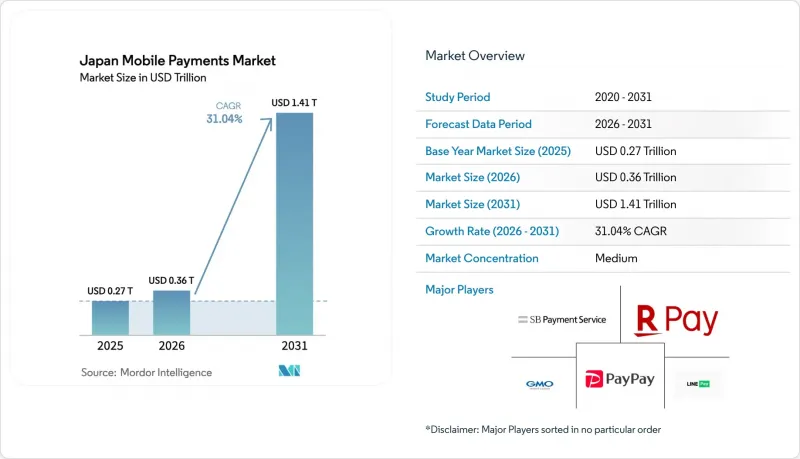
This report is Segmented by Payment Instrument (PromptPay/RTP Transfers, Mobile Wallets, and More), Transaction Channel (In-Store POS, E-Commerce, P2P Transfers, and More), Payment Type (Proximity Payments, and Remote Payments), and End-User Industry (Retail and FMCG, Transportation and Mobility, Hospitality and Tourism, and More). The Market Forecasts are Provided in Terms of Value (USD).
Japan Mobile Payments Market Trends and Insights
Government Cashless Vision 80% Target by 2030
The Ministry of Economy, Trade and Industry raised the national cashless ratio goal to 80% by 2030 after surpassing 40% two years ahead of schedule. Subsidies now offset up to two-thirds of terminal costs for small and medium enterprises, a decisive incentive for nearly 60% of merchants that remained cash-only through 2024. Credit cards still generate most digital turnover, yet QR payments have already reached double-digit share, reflecting a generational pivot toward smartphone-centric transactions. Urban cashless ratios above 50% highlight the momentum in Tokyo, Osaka, and Nagoya, whereas rural prefectures lag, creating expansion headroom for wallet providers. JPQR standardization seeks to unify codes across eight Asian networks in time for Expo 2025, removing a key interoperability hurdle.
E-commerce and M-commerce Boom Across Retail and Services
Japan's e-commerce sector touched USD 112.9 billion in 2024, with mobile commerce already exceeding half of all online turnover. Ecosystem leaders such as Rakuten seamlessly bridge shopping, payment, credit, and loyalty, producing higher repeat-purchase frequency and lower checkout friction. Peer-to-peer platforms like Mercari embed Merpay to keep payments native to the browsing flow, reinforcing conversion gains of 15%-20% over desktop. Mobile-first design has broad appeal in fashion, electronics, and food delivery, while inbound shoppers leverage UnionPay and Alipay Plus to blur domestic and international transaction boundaries.
Aging SME POS Hardware and High Acquirer Fees
Roughly 60% of small merchants still use outdated terminals or remain cash-only, wary of fees that erode already thin margins. Even with subsidies, residual hardware costs and maintenance deter operators in low-volume rural sites. Wallet providers respond with zero-capex QR decals and periodic fee holidays, yet such promotions need cross-subsidies from urban spend to stay viable. The resulting two-tier ecosystem slows nationwide ubiquity for the Japan mobile payments market.
Other drivers and restraints analyzed in the detailed report include:
- Nationwide QR-Code Acceptance Incentives for SMEs
- High Smartphone and 5G Penetration Enabling Wallet Adoption
- Fragmented Wallet Ecosystem Confusing Users and Merchants
For complete list of drivers and restraints, kindly check the Table Of Contents.
Segment Analysis
Wallets held 47.83% of payment instrument volume in 2025 within the Japan mobile payments market. PayPay alone processed 7.8 billion transactions worth JPY 12.5 trillion (USD 83.3 billion) in fiscal 2024, leveraging telecom backing and cashback incentives to reach 70 million users. Rakuten Pay turns ecosystem points into tender and ranks highest in satisfaction surveys three years running, while d-Barai and au PAY employ carrier billing to extend micro-credit. Despite this lead, real-time transfers are predicted to post a 31.76% CAGR, underpinned by Bank of Japan settlement upgrades and an impending digital yen decision. The Japan mobile payments market size tied to real-time rails therefore expands faster than any other instrument category. Interbank APIs and yen-backed stablecoin pilots by major banks illustrate a path toward programmable money that could bypass legacy card networks.
Card tokenization via Apple Pay and Google Pay keeps premium iOS and Android users within near-field communication ecosystems, yet these segments remain smaller than QR-driven wallets. Carrier billing supports niche digital-content purchases and prepaid top-ups but faces regulatory limits on credit exposure. Meanwhile, Payment Card Industry Data Security Standard requirements introduced in 2024 raise compliance costs, tilting smaller issuers toward gateway partnerships. These factors collectively maintain wallets as the anchor but set the stage for real-time and central bank digital currency solutions to gain incremental share inside the Japan mobile payments industry.
E-commerce represented 47.83% of all transaction volume in 2025, buoyed by one-click wallet integrations that cut cart abandonment by up to one-fifth. Mobile commerce's 58.2% share of online spend underscores consumer comfort with biometric checkouts on handheld devices. Yet the highest growth resides in cross-border and tourist channels at a 31.83% CAGR, a shift that will reshape the Japan mobile payments market. Visitor arrivals rebounded to 36.87 million in 2024 and are headed toward the 60 million goal, funneling additional spend through Alipay Plus and UnionPay networks.
Transport-integrated e-money, namely Suica and PASMO, expands in-store acceptance beyond rail gates, reinforcing hybrid digital-physical commerce. Peer-to-peer transfers also rise, driven by PayPay's zero-fee model, highlighting consumer appetite for instant, bank-free remittances. Together, these trends diversify revenue streams while increasing competitive pressure on static e-commerce channels within the Japan mobile payments market.
Complete Report Scope:
- By Payment Instrument
- PromptPay / RTP Transfers
- Mobile Wallets (e.g., PayPay, Rakuten Pay, d-Barai)
- Card-based Mobile Payments
- Carrier Billing / Others
- By Transaction Channel
- In-store POS
- E-commerce
- P2P Transfers
- Bill and Government Payments
- Cross-border / Tourist
- By Payment Type
- Proximity Payments
- Remote Payments
- By End-User Industry
- Retail and FMCG
- Transportation and Mobility
- Hospitality and Tourism
- Utilities and Telecom
- Healthcare and Education
- Other End-User Industries
List of Companies Covered in this Report:
- GMO Payment Gateway Inc.
- SB Payment Service Corp.
- NETSTARS Co., Ltd.
- Canal Payment Service Co., Ltd.
- Digital Garage, Inc.
- Visa Worldwide Japan Co., Ltd.
- Mastercard Asia/Pacific Pte. Ltd.
- JCB Co., Ltd.
- American Express International, Inc.
- UnionPay International Co., Ltd.
- PayPay Corporation
- Rakuten Payment, Inc.
- NTT DOCOMO, Inc. (d-Barai)
- LY Corporation (Line Pay)
- KDDI Corporation (au PAY)
- AEON Financial Service Co., Ltd. (WAON)
- Seven & i Holdings Co., Ltd. (Nanaco)
- Mercari, Inc. (Merpay)
- PayPal Japan K.K.
- Mitsubishi UFJ NICOS Co., Ltd. (MUFG Wallet)
Additional Benefits:
- The market estimate (ME) sheet in Excel format
- 3 months of analyst support
TABLE OF CONTENTS
1 INTRODUCTION
- 1.1 Study Assumptions and Market Definition
- 1.2 Scope of the Study
2 RESEARCH METHODOLOGY
3 EXECUTIVE SUMMARY
4 MARKET LANDSCAPE
- 4.1 Market Overview
- 4.2 Market Drivers
- 4.2.1 Government "Cashless Vision 80%" Target by 2030
- 4.2.2 E-commerce and M-commerce Boom Across Retail and Services
- 4.2.3 Nationwide QR-Code Acceptance Incentives for SMEs
- 4.2.4 High Smartphone and 5G Penetration Enabling Wallet Adoption
- 4.2.5 Digital-Yen Pilot Integration Pathways
- 4.2.6 Payroll Digitization after Labor Standards Act Revision
- 4.3 Market Restraints
- 4.3.1 Aging SME POS Hardware and High Acquirer Fees
- 4.3.2 Fragmented Wallet Ecosystem Confusing Users and Merchants
- 4.3.3 Cyber-fraud Surge and Card-not-Present Chargebacks
- 4.3.4 Slow QR Interoperability for Regional Cross-Border Links
- 4.4 Industry Value Chain Analysis
- 4.5 Regulatory Landscape
- 4.6 Technological Outlook
- 4.7 Impact of Macroeconomic Factors
- 4.8 Porter's Five Forces Analysis
- 4.8.1 Bargaining Power of Suppliers
- 4.8.2 Bargaining Power of Buyers / Consumers
- 4.8.3 Threat of New Entrants
- 4.8.4 Threat of Substitute Products
- 4.8.5 Intensity of Competitive Rivalry
- 4.9 Industry Stakeholder Analysis
- 4.10 Evolution of the Payments Landscape in Japan
- 4.11 Key Market Trends in Cashless Adoption
- 4.12 Impact of COVID-19 on Payments
- 4.13 Case Studies and Use-cases
5 MARKET SIZE AND GROWTH FORECASTS (VALUE)
- 5.1 By Payment Instrument
- 5.1.1 PromptPay / RTP Transfers
- 5.1.2 Mobile Wallets (e.g., PayPay, Rakuten Pay, d-Barai)
- 5.1.3 Card-based Mobile Payments
- 5.1.4 Carrier Billing / Others
- 5.2 By Transaction Channel
- 5.2.1 In-store POS
- 5.2.2 E-commerce
- 5.2.3 P2P Transfers
- 5.2.4 Bill and Government Payments
- 5.2.5 Cross-border / Tourist
- 5.3 By Payment Type
- 5.3.1 Proximity Payments
- 5.3.2 Remote Payments
- 5.4 By End-User Industry
- 5.4.1 Retail and FMCG
- 5.4.2 Transportation and Mobility
- 5.4.3 Hospitality and Tourism
- 5.4.4 Utilities and Telecom
- 5.4.5 Healthcare and Education
- 5.4.6 Other End-User Industries
6 COMPETITIVE LANDSCAPE
- 6.1 Market Concentration
- 6.2 Strategic Moves
- 6.3 Market Share Analysis
- 6.4 Company Profiles {(includes Global level Overview, Market level overview, Core Segments, Financials as available, Strategic Information, Market Rank/Share, Products and Services, Recent Developments)}
- 6.4.1 GMO Payment Gateway Inc.
- 6.4.2 SB Payment Service Corp.
- 6.4.3 NETSTARS Co., Ltd.
- 6.4.4 Canal Payment Service Co., Ltd.
- 6.4.5 Digital Garage, Inc.
- 6.4.6 Visa Worldwide Japan Co., Ltd.
- 6.4.7 Mastercard Asia/Pacific Pte. Ltd.
- 6.4.8 JCB Co., Ltd.
- 6.4.9 American Express International, Inc.
- 6.4.10 UnionPay International Co., Ltd.
- 6.4.11 PayPay Corporation
- 6.4.12 Rakuten Payment, Inc.
- 6.4.13 NTT DOCOMO, Inc. (d-Barai)
- 6.4.14 LY Corporation (Line Pay)
- 6.4.15 KDDI Corporation (au PAY)
- 6.4.16 AEON Financial Service Co., Ltd. (WAON)
- 6.4.17 Seven & i Holdings Co., Ltd. (Nanaco)
- 6.4.18 Mercari, Inc. (Merpay)
- 6.4.19 PayPal Japan K.K.
- 6.4.20 Mitsubishi UFJ NICOS Co., Ltd. (MUFG Wallet)
7 MARKET OPPORTUNITIES AND FUTURE OUTLOOK
- 7.1 White-space and Unmet-Need Assessment

