PUBLISHER: Mordor Intelligence | PRODUCT CODE: 2125459

PUBLISHER: Mordor Intelligence | PRODUCT CODE: 2125459
UK Cybersecurity - Market Share Analysis, Industry Trends & Statistics, Growth Forecasts (2026 - 2031)
According to Mordor Intelligence, the UK cybersecurity market reached USD 18.36 billion in 2026 and is projected to attain USD 30.19 billion by 2031, reflecting a 10.46% CAGR.
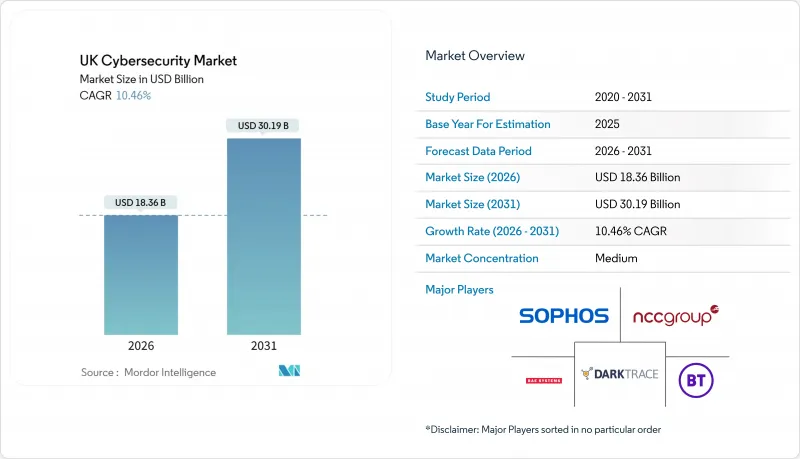
This report is Segmented by Offering (Solutions [Application Security, Cloud Security, Data Security, Network Security, Endpoint Security, and More], and Services), Deployment Mode (Cloud, and On-Premise), End-User Industry (BFSI, Government and Public Sector, and More), End-User Enterprise Size (Large Enterprises, and Small and Medium Enterprises). The Market Forecasts are Provided in Terms of Value in USD.
UK Cybersecurity Market Trends and Insights
Escalating Digitalization And Hybrid-Work Attack Surface
Hybrid work dismantled the traditional perimeter, so organizations now defend thousands of endpoints that sit on domestic broadband with inconsistent patch regimes. National guidance urges secure access service edge rollouts that blend firewall, secure web gateway, and zero-trust network access in a single cloud stack, enabling uniform policies regardless of user location. Regulated firms must also maintain continuous authentication and micro-segmentation, a requirement that effectively pushes cloud-native adoption across finance and technology hubs. Seventy-three percent of large employers intend to keep flexible work patterns, which cements identity-centric security as a long-term necessity. As a result, cloud deployments outpace on-premise alternatives, and vendors heavily promote policy engines that span both remote and campus networks.
Surge In Ransomware And Nation-State Threats
The National Cyber Security Centre recorded a 68% year-on-year jump in ransomware incidents during 2025, linking the spike to ransomware-as-a-service kits that allow entry-level affiliates to execute sophisticated attacks. Healthcare systems suffered prolonged outages, while energy utilities confronted supply-chain intrusions traced to Russian and Iranian groups. A government survey found that 32% of businesses endured breaches in 2025, with remediation costs averaging GBP 15,300 (USD 20534.97). Heightened threat pressure pushes enterprises toward managed detection and response contracts that guarantee 24 x 7 coverage and direct escalation to incident-response teams.
Acute Cyber-Skills Deficit
Government estimates indicate 14,100 cybersecurity vacancies nationwide in 2025, with senior cloud security engineers in London commanding median salaries of GBP 85,000 (USD 114083.18). Supply shortages inflate labor costs and prolong implementation schedules, prompting enterprises to outsource security operations to specialist providers. Apprenticeship schemes and university investment will ease shortages only in the medium term, so managed services remain the primary stopgap, reinforcing their double-digit growth trajectory.
Other drivers and restraints analyzed in the detailed report include:
- Growing UK Compliance Mandates Under Telecom Security Act And DORA
- Rapid Adoption Of AI-Driven Security Analytics
- High Total Cost Of Ownership For Advanced Platforms
For complete list of drivers and restraints, kindly check the Table Of Contents.
Segment Analysis
Services captured 62.73% of UK cybersecurity market share in 2025, and this slice is projected to widen at a 12.22% CAGR. Managed detection and response has become the fastest-growing line item because enterprises can activate cloud sensors within days and receive round-the-clock threat hunting for a recurring fee that is simpler to budget than staffing an internal security operations center. Professional services demand also rises as compliance mandates proliferate and boards commission gap analyses, penetration tests, and resilience rehearsals. In contrast, the solutions segment remains essential but lags in percentage growth, with buyers favoring cloud-native tools that bundle firewall, zero-trust network access, and secure web gateway features into a single subscription. Identity and access management ranks as the most consistently purchased solution because zero-trust designs rest on strong authentication and least-privilege authorizations. Application security tooling attracts software-as-a-service vendors that integrate static, dynamic, and software composition analysis into continuous-integration pipelines. Despite steady interest in endpoint, network, and data security products, spending tilts toward service engagements that wrap expert oversight around these technologies.
The UK cybersecurity market size for services is forecast to accelerate further as public entities mandate that critical suppliers hold round-the-clock security monitoring certifications. Meanwhile, vendors that operate multiple regional security operations centers hedge latency risks, meet data-residency clauses, and guarantee continuity in the event of localized outages. Multiyear outsourcing is therefore likely to reach a higher penetration rate among both highly regulated industries and mid-market firms that once relied on reactive outsourcing on an ad hoc basis.
Cloud captured 63.84% of UK cybersecurity market size in 2025, growing at a 12.32% CAGR, while on-premises deployments expand at mid-single-digit rates. Remote and hybrid workforces require identity-centric architectures, so organizations adopt security service edge platforms that enforce consistent policies across any location. Government and financial regulators endorse multi-cloud strategies paired with centralized identity federation, which further validates vendor roadmaps built around cloud-first controls. Enterprises note that activating cloud protection can take days, whereas procurement, racking, and maintenance cycles slow on-premises platforms. Even industries with strict data localization rules embrace hybrid designs that keep sensitive records onsite but shift analytics to elastic cloud nodes.
On-premises estates persist in segments that run legacy operational technology, such as manufacturing, energy, and utilities. Air-gapped programmable logic controllers cannot interface with external platforms, so asset owners deploy intermediary sensors and network taps to gain telemetry. Vendors blend these deployments with cloud-hosted management consoles, which illustrates the broader trend toward flexible consumption models. However, migration introduces misconfiguration risks, and cloud security posture management is now bundled into most enterprise contracts to check compliance against Center for Internet Security benchmarks automatically.
Complete Report Scope:
- By Offering
- Solutions
- Application Security
- Cloud Security
- Data Security
- Network Security
- Endpoint Security
- Infrastructure Protection
- Integrated Risk Management
- Identity and Access Management (IAM)
- Services
- Professional Services
- Managed Services
- Solutions
- By Deployment Mode
- Cloud
- On-Premise
- By End-user Industry
- BFSI
- Government and Public Sector
- Oil and Gas
- IT and Telecom
- Retail, E-commerce and Consumers
- Manufacturing and Industrial
- Energy and Utilities
- Healthcare
- Other End-user Industries (Transport, Logistics, Education, Hospitality)
- By End-user Enterprise Size
- Large Enterprises
- Small and Medium Enterprises (SMEs)
List of Companies Covered in this Report:
- Darktrace plc
- Sophos Group plc
- NCC Group plc
- BAE Systems Digital Intelligence
- BT Group plc (BT Security)
- Clearswift Ltd (Fortra LLC)
- Gen Digital UK Ltd (Avast)
- Becrypt Ltd
- LRQA Nettitude Ltd
- Reliance Cyber Science Ltd
- Quorum Cyber Ltd
- Adarma Ltd
- CybSafe Ltd
- Orpheus Cyber Ltd
- Titania Ltd
- Sophos Rapid Response Ltd
- Bridewell Consulting Ltd
- Integrity360 UK Ltd
- Trustwave SpiderLabs UK Ltd
- Thales UK Ltd (e-Security Division)
- XM Cyber UK Ltd
- Immersive Labs Ltd
- Censornet Ltd
- Bulletproof Cyber Security Services Ltd
- SureCloud Ltd
Additional Benefits:
- The market estimate (ME) sheet in Excel format
- 3 months of analyst support
TABLE OF CONTENTS
1 INTRODUCTION
- 1.1 Study Assumptions and Market Definition
- 1.2 Scope of the Study
2 RESEARCH METHODOLOGY
3 EXECUTIVE SUMMARY
4 MARKET LANDSCAPE
- 4.1 Market Overview
- 4.2 Market Drivers
- 4.2.1 Escalating Digitalisation and Hybrid-Work Attack Surface
- 4.2.2 Surge in Ransomware and Nation-State Threats
- 4.2.3 Growing UK Compliance Mandates (Telecom Security Act, DORA)
- 4.2.4 Rapid Adoption of AI-Driven Security Analytics
- 4.2.5 Government Zero-Trust Procurement Requirements
- 4.2.6 Cyber-Insurance Underwriting Pressures Shaping Controls
- 4.3 Market Restraints
- 4.3.1 Acute Cyber-Skills Deficit
- 4.3.2 High Total Cost of Ownership for Advanced Platforms
- 4.3.3 Legacy OT and Critical-Infrastructure Systems Hard to Secure
- 4.3.4 SME Under-Investment Given Unclear ROI
- 4.4 Industry Value Chain Analysis
- 4.5 Regulatory Landscape
- 4.6 Technological Outlook
- 4.7 Porter's Five Forces Analysis
- 4.7.1 Bargaining Power of Buyers
- 4.7.2 Bargaining Power of Suppliers
- 4.7.3 Threat of New Entrants
- 4.7.4 Threat of Substitutes
- 4.7.5 Intensity of Competitive Rivalry
- 4.8 Pricing Analysis
- 4.9 Impact of Macroeconomic Factors on the Market
- 4.10 Emerging Market Trends (AI, SASE, MDR)
5 MARKET SIZE AND GROWTH FORECASTS (VALUE)
- 5.1 By Offering
- 5.1.1 Solutions
- 5.1.1.1 Application Security
- 5.1.1.2 Cloud Security
- 5.1.1.3 Data Security
- 5.1.1.4 Network Security
- 5.1.1.5 Endpoint Security
- 5.1.1.6 Infrastructure Protection
- 5.1.1.7 Integrated Risk Management
- 5.1.1.8 Identity and Access Management (IAM)
- 5.1.2 Services
- 5.1.2.1 Professional Services
- 5.1.2.2 Managed Services
- 5.1.1 Solutions
- 5.2 By Deployment Mode
- 5.2.1 Cloud
- 5.2.2 On-Premise
- 5.3 By End-user Industry
- 5.3.1 BFSI
- 5.3.2 Government and Public Sector
- 5.3.3 Oil and Gas
- 5.3.4 IT and Telecom
- 5.3.5 Retail, E-commerce and Consumers
- 5.3.6 Manufacturing and Industrial
- 5.3.7 Energy and Utilities
- 5.3.8 Healthcare
- 5.3.9 Other End-user Industries (Transport, Logistics, Education, Hospitality)
- 5.4 By End-user Enterprise Size
- 5.4.1 Large Enterprises
- 5.4.2 Small and Medium Enterprises (SMEs)
6 COMPETITIVE LANDSCAPE
- 6.1 Market Concentration
- 6.2 Strategic Moves
- 6.3 Market Share Analysis
- 6.4 Company Profiles (includes Global level Overview, Market level overview, Core Segments, Financials as available, Strategic Information, Market Rank/Share for key companies, Products and Services, and Recent Developments)
- 6.4.1 Darktrace plc
- 6.4.2 Sophos Group plc
- 6.4.3 NCC Group plc
- 6.4.4 BAE Systems Digital Intelligence
- 6.4.5 BT Group plc (BT Security)
- 6.4.6 Clearswift Ltd (Fortra LLC)
- 6.4.7 Gen Digital UK Ltd (Avast)
- 6.4.8 Becrypt Ltd
- 6.4.9 LRQA Nettitude Ltd
- 6.4.10 Reliance Cyber Science Ltd
- 6.4.11 Quorum Cyber Ltd
- 6.4.12 Adarma Ltd
- 6.4.13 CybSafe Ltd
- 6.4.14 Orpheus Cyber Ltd
- 6.4.15 Titania Ltd
- 6.4.16 Sophos Rapid Response Ltd
- 6.4.17 Bridewell Consulting Ltd
- 6.4.18 Integrity360 UK Ltd
- 6.4.19 Trustwave SpiderLabs UK Ltd
- 6.4.20 Thales UK Ltd (e-Security Division)
- 6.4.21 XM Cyber UK Ltd
- 6.4.22 Immersive Labs Ltd
- 6.4.23 Censornet Ltd
- 6.4.24 Bulletproof Cyber Security Services Ltd
- 6.4.25 SureCloud Ltd
7 MARKET OPPORTUNITIES AND FUTURE OUTLOOK
- 7.1 White-Space and Unmet-Need Assessment

