PUBLISHER: Mordor Intelligence | PRODUCT CODE: 2154344

PUBLISHER: Mordor Intelligence | PRODUCT CODE: 2154344
Transformer Protection Equipment - Market Share Analysis, Industry Trends & Statistics, Growth Forecasts (2026 - 2031)
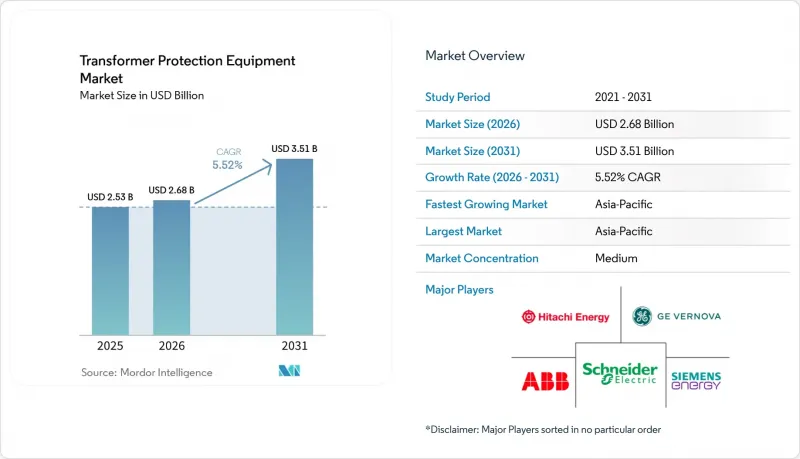
According to Mordor Intelligence, the transformer protection equipment market size is expected to increase from USD 2.53 billion in 2025 to USD 2.68 billion in 2026 and reach USD 3.51 billion by 2031, growing at a CAGR of 5.52% over 2026-2031.
Global Transformer Protection Equipment Market Trends and Insights
Grid Modernization and Digital-Substation Deployment
Utilities are moving from hardwired protection systems to digital substations built around IEC 61850 communication standards. This change makes compatible protection relays a more common requirement in new substation tenders. RTE is advancing its R#SPACE program to develop digital and multi-vendor substations across its network. Hitachi Energy and Turkiye's transmission system operator TEIAS began a pilot for the country's first digital substation in May 2026. The project shows how national grid operators are testing digital protection before applying it more widely. The transformer protection equipment market benefits because operators need devices that can exchange dependable data across the substation while supporting protection functions.
Renewable-Energy and Distributed-Generation Integration
Inverter-based resources can reduce fault-current levels and introduce bidirectional power flows into distribution and transmission networks. These conditions make static overcurrent settings less dependable and can lead to poor coordination or unnecessary trips. A 2026 scientific review identified hybrid, adaptive, and data-driven protection approaches as important responses to renewable-integrated network conditions. Hitachi Energy and Orsted developed an adaptive model-based line differential protection method for offshore wind export cables using the Relion RED670 device. The work addresses the operating issues that can occur on long submarine alternating-current cables. The transformer protection equipment market, therefore, favors numerical relays that can apply multiple setting groups and adapt to changing system conditions.
High Installation, Calibration, and Retrofit Costs
The move from electromechanical equipment to digital protection can require a significant investment beyond the relay itself. A full bay retrofit may require merging units, process-bus cabling, device configuration, testing, and changes to existing panels. In smaller substations, these activities can cost 2.5 to 3 times the equipment price. Operators may also need to modify civil works when new protection panels do not fit the original substation layout. Utilities in South America, Southeast Asia, and sub-Saharan Africa can defer upgrades when budgets are restricted. The transformer protection equipment market faces delayed procurement in these cases until reliability risks or equipment failures make action unavoidable.
Other drivers and restraints analyzed in the detailed report include:
- Aging Transformer Fleet Replacement and Retrofit Programs
- Data-Center and Critical-Infrastructure Reliability Requirements
- Legacy-System Interoperability and Protocol Fragmentation
For complete list of drivers and restraints, kindly check the Table Of Contents.
Segment Analysis
Protection relays held 47.3% of the transformer protection equipment market size in 2025 and are forecast to grow at a 6.3% CAGR through 2031. Their position reflects the standard use of numerical relays in new substations and the replacement of older electromechanical devices in existing sites. These relays can combine differential protection, overcurrent backup, thermal overload functions, and links to monitoring systems in one device. This combination reduces the number of separate devices that a utility needs to configure and maintain. The transformer protection equipment industry is increasingly using these platforms to support both local protection and digital-substation communication.
Mechanical and electrical protection devices remain important because oil-immersed transformers commonly require Buchholz relays, pressure-relief devices, oil-level indicators, and winding-temperature instruments. These devices provide direct alarms or trips when conditions inside a transformer indicate a developing fault. ABB introduced the REX600 compact protection and control device for digital substations in 2026, combining protection and control capabilities in a smaller design. Surge protection equipment is gaining relevance in renewable interconnections and data centers, where switching events and changing grid conditions can create transient voltage exposure. Other protection equipment also has a role in improving earth-fault sensitivity for networks that connect distributed solar and wind resources. The transformer protection equipment market continues to require a mix of numerical devices, mechanical safeguards, and specialized monitoring tools.
Complete Report Scope:
- By Equipment Type
- Protection Relays
- Mechanical and Electrical Transformer Protection Devices
- Surge Protection Equipment
- Other Protection Equipment
- By Application
- Power Generation
- Power Transmission and Distribution
- Industrial
- Commercial and Infrastructure
- Data Centers
- Other Applications
- By Geography
- North America
- United States
- Canada
- Mexico
- Europe
- Germany
- France
- Italy
- Spain
- United Kingdom
- Poland
- Russia
- Rest of Europe
- Asia-Pacific
- China
- India
- Japan
- South Korea
- Australia
- Indonesia
- Vietnam
- Thailand
- Rest of Asia-Pacific
- South America
- Brazil
- Argentina
- Chile
- Rest of South America
- Middle East and Africa
- Saudi Arabia
- United Arab Emirates
- Egypt
- South Africa
- Morocco
- Rest of Middle East and Africa
- North America
Geography Analysis
Asia-Pacific held 37.6% of the transformer protection equipment market size in 2025 and is forecast to grow at a 7.4% CAGR through 2031. China's National Energy Administration stated in July 2026 that grid fixed-asset investment under the Fifteenth Five-Year Plan would exceed CNY 5 trillion, which was cited as USD 689 billion, and that 15 new ultra-high-voltage direct-current channels were planned. The plan also indicated grid capital spending growth of more than 80% compared with the preceding planning period. State Grid placed its first active transformer fault-prevention system into commercial operation at the Tianjin South UHV substation in July 2026. Hitachi Energy announced a INR 2,000 crore investment, cited as USD 240 million, in June 2026 for a large power transformer factory in Karjan, Vadodara. Southeast Asian countries, including Vietnam, Indonesia, and Thailand, are adding grid capacity and beginning to adopt IEC 61850 under updated grid codes.
North America is the second-largest region in the transformer protection equipment market. Its demand is shaped by grid modernization, data-center construction, clean-energy interconnections, and limits in transformer availability. The U.S. Government Accountability Office reported that the Department of Energy has worked on common transformer configurations to support industry efforts on transformer supply. Common designs can encourage more standardized specifications for related protection equipment. NERC cybersecurity requirements also make hardened firmware and auditable security documentation more important in relay procurement. These factors favor suppliers that can support utilities through both equipment selection and compliance work.
Europe has substantial demand because energy-transition plans, grid codes, and equipment efficiency rules support new projects and retrofit work. Hitachi Energy signed an agreement with E.ON in July 2025 worth up to USD 700 million for transformer deliveries across Germany. The agreement reflects the scale of grid investment required to connect new generation and reinforce existing networks. In the Middle East and Africa, full-digital substation projects are creating an early demand channel for standards-compliant devices. South America is expanding more gradually, but Brazil commissioned its first fully digital substation at Itajai in 2025 with 600 MVA of capacity. The project provides a reference point for real-time monitoring, remote control, and predictive maintenance in the region.
- ABB Ltd.
- Arteche Group
- Camlin Energy
- CG Power and Industrial Solutions Limited
- Eaton Corporation plc
- GE Vernova Inc.
- Hitachi Energy Ltd.
- Hyundai Electric and Energy Systems Co., Ltd.
- Maschinenfabrik Reinhausen GmbH
- Mitsubishi Electric Corporation
- NR Electric Co., Ltd.
- Qualitrol Company LLC
- Schneider Electric SE
- Schweitzer Engineering Laboratories, Inc.
- Siemens Energy AG
- Toshiba Energy Systems and Solutions Corporation
- Vaisala Oyj
- WIKA Alexander Wiegand SE and Co. KG
Additional Benefits:
- The market estimate (ME) sheet in Excel format
- 3 months of analyst support
TABLE OF CONTENTS
1 INTRODUCTION
- 1.1 Study Assumptions and Market Definition
- 1.2 Scope of the Study
2 RESEARCH METHODOLOGY
3 EXECUTIVE SUMMARY
4 MARKET LANDSCAPE
- 4.1 Market Overview
- 4.2 Market Drivers
- 4.2.1 Grid Modernization and Digital-Substation Deployment
- 4.2.2 Renewable-Energy and Distributed-Generation Integration
- 4.2.3 Aging Transformer Fleet Replacement and Retrofit Programs
- 4.2.4 Rising Data-Center and Critical-Infrastructure Reliability Requirements
- 4.2.5 Adaptive Protection for Bidirectional Power Flows and Weak Grids
- 4.2.6 Transformer Shortage and National-Resilience Monitoring Requirements
- 4.3 Market Restraints
- 4.3.1 High Installation, Calibration, and Retrofit Costs
- 4.3.2 Legacy-System Interoperability and Protocol Fragmentation
- 4.3.3 Extended Lead Times for Specialized Semiconductors and Metal-Oxide Components
- 4.3.4 IEC 61850 Engineering and Cybersecurity Skills Gap
- 4.4 Supply-Chain Analysis
- 4.5 Porter's Five Forces Analysis
- 4.5.1 Bargaining Power of Suppliers
- 4.5.2 Bargaining Power of Buyers
- 4.5.3 Threat of New Entrants
- 4.5.4 Threat of Substitutes
- 4.5.5 Competitive Rivalry
- 4.6 Technology Outlook
- 4.7 Regulatory Landscape
- 4.8 Investment Analysis
5 MARKET SIZE AND GROWTH FORECASTS
- 5.1 By Equipment Type
- 5.1.1 Protection Relays
- 5.1.2 Mechanical and Electrical Transformer Protection Devices
- 5.1.3 Surge Protection Equipment
- 5.1.4 Other Protection Equipment
- 5.2 By Application
- 5.2.1 Power Generation
- 5.2.2 Power Transmission and Distribution
- 5.2.3 Industrial
- 5.2.4 Commercial and Infrastructure
- 5.2.5 Data Centers
- 5.2.6 Other Applications
- 5.3 By Geography
- 5.3.1 North America
- 5.3.1.1 United States
- 5.3.1.2 Canada
- 5.3.1.3 Mexico
- 5.3.2 Europe
- 5.3.2.1 Germany
- 5.3.2.2 France
- 5.3.2.3 Italy
- 5.3.2.4 Spain
- 5.3.2.5 United Kingdom
- 5.3.2.6 Poland
- 5.3.2.7 Russia
- 5.3.2.8 Rest of Europe
- 5.3.3 Asia-Pacific
- 5.3.3.1 China
- 5.3.3.2 India
- 5.3.3.3 Japan
- 5.3.3.4 South Korea
- 5.3.3.5 Australia
- 5.3.3.6 Indonesia
- 5.3.3.7 Vietnam
- 5.3.3.8 Thailand
- 5.3.3.9 Rest of Asia-Pacific
- 5.3.4 South America
- 5.3.4.1 Brazil
- 5.3.4.2 Argentina
- 5.3.4.3 Chile
- 5.3.4.4 Rest of South America
- 5.3.5 Middle East and Africa
- 5.3.5.1 Saudi Arabia
- 5.3.5.2 United Arab Emirates
- 5.3.5.3 Egypt
- 5.3.5.4 South Africa
- 5.3.5.5 Morocco
- 5.3.5.6 Rest of Middle East and Africa
- 5.3.1 North America
6 COMPETITIVE LANDSCAPE
- 6.1 Market Concentration
- 6.2 Strategic Moves
- 6.3 Market Share Analysis
- 6.4 Company Profiles (includes Global Level Overview, Market Level Overview, Core Segments, Financials as available, Strategic Information, Market Rank/Share, Products and Services, Recent Developments)
- 6.4.1 ABB Ltd.
- 6.4.2 Arteche Group
- 6.4.3 Camlin Energy
- 6.4.4 CG Power and Industrial Solutions Limited
- 6.4.5 Eaton Corporation plc
- 6.4.6 GE Vernova Inc.
- 6.4.7 Hitachi Energy Ltd.
- 6.4.8 Hyundai Electric and Energy Systems Co., Ltd.
- 6.4.9 Maschinenfabrik Reinhausen GmbH
- 6.4.10 Mitsubishi Electric Corporation
- 6.4.11 NR Electric Co., Ltd.
- 6.4.12 Qualitrol Company LLC
- 6.4.13 Schneider Electric SE
- 6.4.14 Schweitzer Engineering Laboratories, Inc.
- 6.4.15 Siemens Energy AG
- 6.4.16 Toshiba Energy Systems and Solutions Corporation
- 6.4.17 Vaisala Oyj
- 6.4.18 WIKA Alexander Wiegand SE and Co. KG
7 MARKET OPPORTUNITIES AND FUTURE OUTLOOK
- 7.1 White-Space and Unmet-Need Assessment

