PUBLISHER: Mordor Intelligence | PRODUCT CODE: 2154502

PUBLISHER: Mordor Intelligence | PRODUCT CODE: 2154502
Thailand Medical and Wellness Tourism - Market Share Analysis, Industry Trends & Statistics, Growth Forecasts (2026 - 2031)
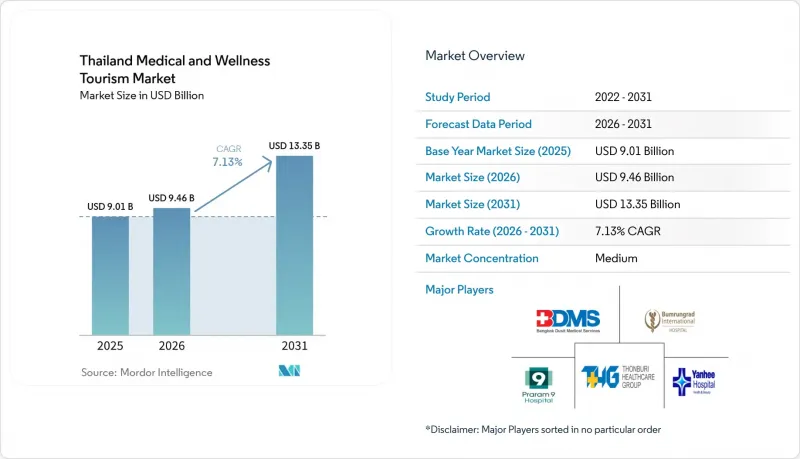
According to Mordor Intelligence, the Thailand medical and wellness tourism market size is expected to increase from USD 9.01 billion in 2025 to USD 9.46 billion in 2026 and reach USD 13.35 billion by 2031, growing at a CAGR of 7.13% over 2026-2031.
Thailand Medical and Wellness Tourism Market Trends and Insights
Affordable High-Quality Medical Care Versus Western Destinations
The Thailand medical and wellness tourism market continues to attract planned-care travelers because treatment costs remain well below many Western alternatives across surgery, dental work, and recovery care. Major procedures can be 50% to 70% less expensive than in Western markets, while dental scaling typically costs THB 900 to THB 1,200 (USD 25.7 to USD 34.3) in Thailand, compared with around THB 8,000 (USD 228.6) in Australia. This cost advantage supports demand from cost-sensitive travelers while also expanding the addressable market to upper-middle-income patients seeking recognized clinicians at more accessible price points. Thailand's Board of Investment supports the health and wellness value chain through incentives for specialty medical centers and contract research organizations, helping maintain competitiveness as labor and operating costs increase. Although price competition remains strong across Southeast Asia, Thailand offers greater depth in complex elective procedures than lower-cost regional alternatives.
Strong Global Reputation for Elective and Specialty Procedures
The Thailand medical and wellness market benefits from a long-established reputation in elective and specialty treatments that require both skilled clinicians and destination appeal. Medical tourism accounted for 58.43% of revenue in 2025, with cosmetic surgery, orthopedics, and fertility treatments attracting patients from the Middle East, South Asia, Europe, and China. Cosmetic & Aesthetic Procedures led treatment demand with a 22.61% share in 2025, underscoring the role of a reputation for visible, outcome-based services in shaping international patient choice. Bumrungrad recorded more than 520,000 international patient visits annually, reinforcing Thailand's cross-border referral strength and brand recognition among foreign patients. This reputation matters because patients booking elective care usually compare surgeons' credentials, hospital brands, and peer referrals before committing to overseas treatment.
Specialized Doctor and Nurse Shortages
Thailand's medical and wellness tourism market faces a shortage of specialized healthcare professionals, which could constrain capacity expansion. By 2026 end, the country is projected to meet only 72% of its physician staffing target, while 661 vacancies remain across 208 community hospitals. Shortages are particularly acute across 36 provinces classified as "red zones," where staffing gaps exceed 40%. The imbalance is also evident between urban and rural areas, with Bangkok having approximately one doctor per 462 residents compared with one per 5,000 residents in rural provinces. This disparity limits the ability to extend international-grade medical services beyond the capital. For private operators, competition for specialists is intensified by the higher earning potential offered by medical tourism facilities, further concentrating skilled professionals in premium healthcare centers. As demand continues to grow, workforce availability is likely to remain a key constraint on the market's future expansion.
Other drivers and restraints analyzed in the detailed report include:
- JCI-Accredited Hospital Infrastructure and International Care Standards
- Supportive Visa Policies and Simplified Patient Travel
- Uneven Post-Treatment Follow-Up for International Patients
For complete list of drivers and restraints, kindly check the Table Of Contents.
Segment Analysis
Medical tourism accounted for 58.43% of Thailand's medical and wellness tourism market share in 2025. That lead reflects long-standing investment in specialist care, tertiary hospitals, and referral systems that support cosmetic surgery, orthopedics, fertility treatments, and other planned procedures. The segment also benefits from Thailand's ability to combine recognized hospital brands with destination appeal, which makes it easier for patients to justify travel for elective care. Bangkok and Phuket remain central to this segment because they offer the strongest mix of specialist depth, international patient handling, and premium accommodation. Medical tourism, therefore, remains the revenue anchor for Thailand's medical and wellness tourism market, even as growth patterns are broadening.
Wellness tourism is the fastest-growing tourism segment and is projected to grow at a 8.97% CAGR through 2031. This pace shows that the Thailand medical and wellness tourism industry is moving beyond passive recuperation and toward structured prevention, longevity, and recovery-based travel. Operators are increasingly blending diagnostics, nutrition, and traditional healing with resort stays, which raises spend per visitor and supports longer itineraries. The overlap with hospital-led wellness clinics is also increasing, which creates cross-selling opportunities between medical and non-medical services. Over time, that convergence is likely to make the tourism type split less rigid, even if medical tourism remains larger in value terms.
Complete Report Scope:
- By Tourism Type
- Medical Tourism
- Wellness Tourism
- By Treatment / Service Type
- Medical Tourism
- Cosmetic & Aesthetic Procedures
- Dental Treatments
- Orthopedic Treatments
- Fertility & Reproductive Treatments
- Cardiology & Specialized Treatments
- Other Medical Treatments
- Wellness Tourism
- Spa & Wellness Retreats
- Traditional Thai Healing & Alternative Therapies
- Detox & Weight Management Programs
- Others (Preventive Health & Wellness Check-Ups,Yoga & Meditation Retreats)
- Medical Tourism
- By Travel Type
- Domestic
- International
- By Geography
- Bangkok
- Southern Thailand
- Northern Thailand
- Rest of Thailand
List of Companies Covered in this Report:
- Bumrungrad International Hospital
- Bangkok Dusit Medical Services Public Company Limited
- Thonburi Healthcare Group (THG)
- Praram 9 Hospital
- Yanhee International Hospital
- Aek Udon International Hospital
- Principal Capital (PRINC)
- Amanpuri Resort Phuket
- The Slate Phuket
- Baan Laimai Beach Resort
- Banyan Tree Hotels and Resorts
- Chiva-Som International Health Resort
- COMO Hotels and Resorts
- Four Seasons Hotels Limited
- Hilton Worldwide Holdings Inc.
- IHG Hotels and Resorts
- Kamalaya Koh Samui
- Keemala
- RAKxa Integrated Wellness
- Rosewood Hotel Group
Additional Benefits:
- The market estimate (ME) sheet in Excel format
- 3 months of analyst support
TABLE OF CONTENTS
1 Introduction
- 1.1 Study Assumptions and Market Definition
- 1.2 Scope of the Study
2 Research Methodology
3 Executive Summary
4 Market Landscape
- 4.1 Market Overview
- 4.2 Market Drivers
- 4.2.1 Affordable High-Quality Medical Care Versus Western Destinations
- 4.2.2 Strong Global Reputation For Elective and Specialty Procedures
- 4.2.3 JCI-Accredited Hospital Infrastructure and International Care Standards
- 4.2.4 Supportive Visa Policies and Simplified Patient Travel
- 4.2.5 Rising Global Demand For Preventive and Wellness-Oriented Travel
- 4.2.6 Integration of Medical Tourism With Luxury Hospitality and Recovery Services
- 4.3 Market Restraints
- 4.3.1 Specialized Doctor and Nurse Shortages
- 4.3.2 Uneven Post-Treatment Follow-Up for International Patients
- 4.3.3 High Cost of Premium Wellness Programs
- 4.3.4 Reimbursement and Coverage Limitations For Cross-Border Care
- 4.4 Value and Supply Chain Analysis
- 4.5 Regulatory Landscape
- 4.6 Technological Outlook
- 4.7 Porter's Five Forces Analysis
- 4.7.1 Threat of New Entrants
- 4.7.2 Bargaining Power of Buyers
- 4.7.3 Bargaining Power of Suppliers
- 4.7.4 Threat of Substitutes
- 4.7.5 Competitive Rivalry
5 Market Size and Growth Forecasts
- 5.1 By Tourism Type
- 5.1.1 Medical Tourism
- 5.1.2 Wellness Tourism
- 5.2 By Treatment / Service Type
- 5.2.1 Medical Tourism
- 5.2.1.1 Cosmetic & Aesthetic Procedures
- 5.2.1.2 Dental Treatments
- 5.2.1.3 Orthopedic Treatments
- 5.2.1.4 Fertility & Reproductive Treatments
- 5.2.1.5 Cardiology & Specialized Treatments
- 5.2.1.6 Other Medical Treatments
- 5.2.2 Wellness Tourism
- 5.2.2.1 Spa & Wellness Retreats
- 5.2.2.2 Traditional Thai Healing & Alternative Therapies
- 5.2.2.3 Detox & Weight Management Programs
- 5.2.2.4 Others (Preventive Health & Wellness Check-Ups,Yoga & Meditation Retreats)
- 5.2.1 Medical Tourism
- 5.3 By Travel Type
- 5.3.1 Domestic
- 5.3.2 International
- 5.4 By Geography
- 5.4.1 Bangkok
- 5.4.2 Southern Thailand
- 5.4.3 Northern Thailand
- 5.4.4 Rest of Thailand
6 Competitive Landscape
- 6.1 Market Concentration
- 6.2 Strategic Moves
- 6.3 Market Share Analysis
- 6.4 Company Profiles (includes Global Level Overview, Market Level Overview, Core Segments, Financials as available, Strategic Information, Market Rank/Share, Products and Services, Recent Developments)
- 6.4.1 Bumrungrad International Hospital
- 6.4.2 Bangkok Dusit Medical Services Public Company Limited
- 6.4.3 Thonburi Healthcare Group (THG)
- 6.4.4 Praram 9 Hospital
- 6.4.5 Yanhee International Hospital
- 6.4.6 Aek Udon International Hospital
- 6.4.7 Principal Capital (PRINC)
- 6.4.8 Amanpuri Resort Phuket
- 6.4.9 The Slate Phuket
- 6.4.10 Baan Laimai Beach Resort
- 6.4.11 Banyan Tree Hotels and Resorts
- 6.4.12 Chiva-Som International Health Resort
- 6.4.13 COMO Hotels and Resorts
- 6.4.14 Four Seasons Hotels Limited
- 6.4.15 Hilton Worldwide Holdings Inc.
- 6.4.16 IHG Hotels and Resorts
- 6.4.17 Kamalaya Koh Samui
- 6.4.18 Keemala
- 6.4.19 RAKxa Integrated Wellness
- 6.4.20 Rosewood Hotel Group
7 Market Opportunities and Future Outlook
- 7.1 Market Opportunities
- 7.1.1 Middle East Patient Referral Expansion
- 7.1.2 Premium Integrated Medical-Wellness Recovery Bundles
- 7.2 White-Space and Unmet-Need Assessment

