PUBLISHER: Mordor Intelligence | PRODUCT CODE: 2155282

PUBLISHER: Mordor Intelligence | PRODUCT CODE: 2155282
South America Neobanking - Market Share Analysis, Industry Trends & Statistics, Growth Forecasts (2026 - 2031)
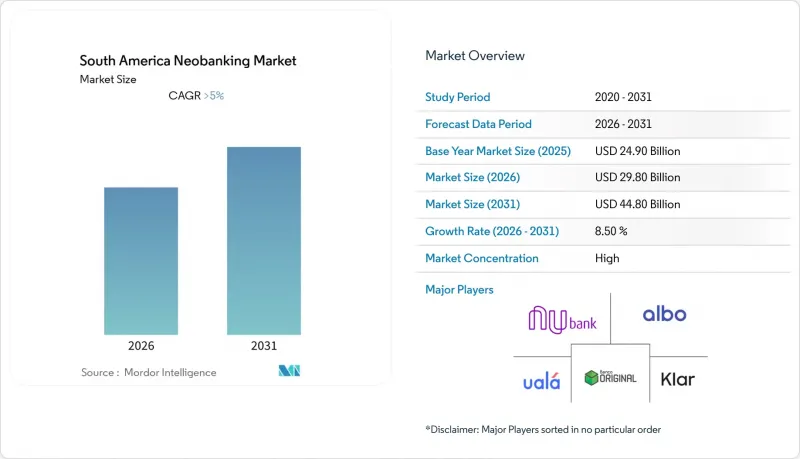
According to Mordor Intelligence, the South America neobanking market size is expected to grow from USD 24.90 billion in 2025 to USD 29.80 billion in 2026 and is forecast to reach USD 44.80 billion by 2031 at 8.5% CAGR over 2026-2031.
South America Neobanking Market Trends and Insights
Rising Smartphone And Internet-Based Banking Adoption
Mobile banking volumes in Brazil increased by 169% over the 5 years through 2025, reaching 187.5 billion operations, which shows that daily financial activity is increasingly centered on digital interfaces. Customers who receive payments through a mobile account can use the same interface for savings, credit, or insurance, which reduces the practical advantage once provided by a physical branch network. Nubank reported that it had banked 31.5 million previously unbanked Brazilians by July 2026 and had a stronger presence in regions where many municipalities lack a physical bank branch. Brazilian banking technology investment is expected to reach BRL 50.1 billion (USD 9.84 billion) in 2026, compared with BRL 46.8 billion (USD 9.19 billion) in 2025, supporting secure and high-volume mobile services. The South American neobanking market benefits as established institutions and digital specialists continue to expand the underlying technology base. Accessible onboarding can serve remote customers without replicating branch infrastructure and support wider product use after a primary account is established.
Financial Inclusion Demand Among Underbanked Consumers
Financial inclusion remains a major source of demand in the South America neobanking market, because digital products can reach customers with limited access to conventional banking. Nubank reported that its credit operations in Brazil's Northeast equaled 6.8% of regional GDP in 2025, showing that digital credit has relevance beyond a conventional consumer product. Payment data can help platforms assess customers with limited traditional credit histories and bring first-time borrowers into the formal financial system. Yape has banked 6.6 million people since 2020 and surpassed 19 million users in Peru, demonstrating how a digital platform can reach customers with limited traditional access. A record of payments can support later savings, credit, and protection products, making customer activity as important as account opening. The South America neobanking industry can extend formal participation when product design reflects thin-file customers, while providers manage affordability and repayment risk.
Regulatory Fragmentation And Licensing Complexity Across South American Markets
South American countries use separate supervisory structures for digital financial providers, with different requirements for capital, product permissions, deposit treatment, and data obligations. Nubank's 2025 annual filing describes its regulated operations and the importance of approvals across operating markets. Providers may need distinct licenses as they expand from payments into lending, deposits, or investment distribution, increasing cost and entry preparation. A payment license can support account acquisition, while lending and deposit products require broader permissions and more capital. Multi-license structures can reduce product gaps, though smaller providers may have fewer resources for applications and ongoing compliance. The South America neobanking market is regionally connected through customer needs, but cross-border expansion must account for local rules.
Other drivers and restraints analyzed in the detailed report include:
- Expansion Of Instant Payments And Digital Payment Ecosystems
- Growing Demand For Low-Cost Digital Financial Services Among SMEs And Consumers
- Cybersecurity, Digital Fraud, And Customer Trust Risks
For complete list of drivers and restraints, kindly check the Table Of Contents.
Segment Analysis
Lending and credit accounted for a 58.52% of the South America neobanking market size in 2025. Its position reflects platforms' ability to use real-time payment behavior when assessing customers with limited formal credit records. Nubank reported a USD 32.7 billion total credit portfolio at the end of 2025, 40% above the prior year. The portfolio reached USD 37.2 billion in the first quarter of 2026, also 40% higher than the prior-year period. Unsecured lending represented 25% of that portfolio at the end of 2025.
Insurance Distribution is forecast to grow at a 13.21% CAGR through 2031. Providers can offer insurance inside applications that customers already use for payments and account management. This arrangement can widen access and reduce reliance on a separate distribution channel. Transactional accounts, deposits, savings, payments, transfers, and cards remain important entry and engagement products. Investments, securities distribution, and other services have smaller contributions but can broaden customer relationships. The South America neobanking market share is shifting toward a more diversified service mix, creating opportunities to expand lending and adjacent financial products while maintaining responsible product suitability.
Retail Individuals held a 78.12% of the South America neobanking market share in 2025. Free accounts, no annual-fee cards, and zero-commission transfers suit consumers with frequent basic financial needs. Retail activity also provides payment data and establishes trust in the provider's interface. Nubank reported primary-institution incidence above 30% of the adult population in 17 Brazilian states during the fourth quarter of 2025. The company reported stronger penetration in lower-income states with lower branch density.
SMEs are forecast to grow at a 12.43% CAGR through 2031. Many small firms have limited access to collateral-based bank credit and need services aligned with their operating patterns. Payment acceptance tools can give providers visibility into receivables and business activity. DaviPlata's first-quarter 2026 results illustrate demand for small-ticket merchant finance. Micro-businesses and sole proprietors can use payment tools that build records for later credit decisions, while large enterprises remain more dependent on established corporate banks. The growth of the South America neobanking market size is supported by providers combining payments, collections, and working-capital services while maintaining careful affordability assessment.
Complete Report Scope:
- By Service
- Transactional Accounts, Deposits and Savings
- Payments and Transfers
- Cards
- Lending and Credit
- Investments and Securities Distribution
- Insurance Distribution
- Other Value-Added
- By End User
- Retail Individuals
- Micro-Businesses and Sole-Proprietor Firms
- SMEs (Small & Medium Enterprises)
- Large Enterprises
- By Revenue Stream
- Interest Income
- Card Interchange and Card Fees
- Account, Payment and Transaction Fees (Non-Card)
- Foreign Exchange and Cross-Border
- Subscription and Membership Fees
- Distribution Commissions and Other
- By License Type
- Full Bank License
- Payment-Account / Wallet License
- Specialized Credit / Finance-Company License
- Multi-License Group
- By Geography
- Brazil
- Argentina
- Colombia
- Chile
- Peru
- Rest of South America (Uruguay, Paraguay, Bolivia, Venezuela, and Ecuador)
List of Companies Covered in this Report:
- Nubank (Nu Holdings)
- Mercado Pago (MercadoLibre)
- PicPay
- Banco Inter (Inter & Co.)
- PagBank (PagSeguro)
- C6 Bank
- Neon
- Uala
- Nequi
- DaviPlata
- Brubank
- Cora
- Tenpo
- Naranja X
- Yape
- MACH
- Banco Original
- RecargaPay
- Prex
- Agibank
Additional Benefits:
- The market estimate (ME) sheet in Excel format
- 3 months of analyst support
TABLE OF CONTENTS
1 INTRODUCTION
- 1.1 Study Assumptions and Market Definition
- 1.2 Scope of the Study
2 RESEARCH METHODOLOGY
3 EXECUTIVE SUMMARY
4 MARKET LANDSCAPE
- 4.1 Market Overview
- 4.2 Market Drivers
- 4.2.1 Rising Smartphone and Internet-Based Banking Adoption
- 4.2.2 Financial Inclusion Demand Among Underbanked Consumers
- 4.2.3 Expansion of Instant Payments and Digital Payment Ecosystems
- 4.2.4 Growing Demand for Low-Cost Digital Financial Services Among SMEs and Consumers
- 4.2.5 Alternative Data and Digital Transactions Expanding Access to Credit
- 4.2.6 Expansion of Digital Banking Partnerships and Embedded Finance Ecosystems
- 4.3 Market Restraints
- 4.3.1 Regulatory Fragmentation and Licensing Complexity Across South American Markets
- 4.3.2 Cybersecurity, Digital Fraud and Customer Trust Risks
- 4.3.3 High Customer Acquisition Costs and Intensifying Competition
- 4.3.4 Macroeconomic Volatility and Elevated Credit Risk
- 4.4 Value Chain Analysis
- 4.4.1 Banking Infrastructure and Technology Providers
- 4.4.2 Payments, Card Issuing and Financial Transaction Infrastructure
- 4.4.3 Customer Acquisition, Data, Risk and Compliance Ecosystem
- 4.5 Regulatory Landscape
- 4.5.1 Digital Banking and Financial Institution Licensing Frameworks
- 4.5.2 Open Finance, Payments and Data-Sharing Regulations
- 4.5.3 Consumer Protection, Data Privacy and Cybersecurity Requirements
- 4.6 Technological Outlook
- 4.6.1 Mobile-First and Cloud-Native Banking Platforms
- 4.6.2 Artificial Intelligence and Advanced Data Analytics
- 4.6.3 Digital Identity, Open APIs and Real-Time Fraud Prevention
- 4.7 Porter's Five Forces Analysis
- 4.7.1 Threat of New Entrants
- 4.7.2 Bargaining Power of Suppliers
- 4.7.3 Bargaining Power of Buyers
- 4.7.4 Threat of Substitutes
- 4.7.5 Competitive Rivalry
5 MARKET SIZE AND GROWTH FORECASTS
- 5.1 By Service
- 5.1.1 Transactional Accounts, Deposits and Savings
- 5.1.2 Payments and Transfers
- 5.1.3 Cards
- 5.1.4 Lending and Credit
- 5.1.5 Investments and Securities Distribution
- 5.1.6 Insurance Distribution
- 5.1.7 Other Value-Added
- 5.2 By End User
- 5.2.1 Retail Individuals
- 5.2.2 Micro-Businesses and Sole-Proprietor Firms
- 5.2.3 SMEs (Small & Medium Enterprises)
- 5.2.4 Large Enterprises
- 5.3 By Revenue Stream
- 5.3.1 Interest Income
- 5.3.2 Card Interchange and Card Fees
- 5.3.3 Account, Payment and Transaction Fees (Non-Card)
- 5.3.4 Foreign Exchange and Cross-Border
- 5.3.5 Subscription and Membership Fees
- 5.3.6 Distribution Commissions and Other
- 5.4 By License Type
- 5.4.1 Full Bank License
- 5.4.2 Payment-Account / Wallet License
- 5.4.3 Specialized Credit / Finance-Company License
- 5.4.4 Multi-License Group
- 5.5 By Geography
- 5.5.1 Brazil
- 5.5.2 Argentina
- 5.5.3 Colombia
- 5.5.4 Chile
- 5.5.5 Peru
- 5.5.6 Rest of South America (Uruguay, Paraguay, Bolivia, Venezuela, and Ecuador)
6 COMPETITIVE LANDSCAPE
- 6.1 Market Concentration
- 6.2 Strategic Moves
- 6.3 Market Share Analysis (Top 5-6 players)
- 6.4 Company Profiles (includes Global Level Overview, Market Level Overview, Core Segments, Financials as available, Strategic Information, Market Rank/Share, Products and Services, Recent Developments)
- 6.4.1 Nubank (Nu Holdings)
- 6.4.2 Mercado Pago (MercadoLibre)
- 6.4.3 PicPay
- 6.4.4 Banco Inter (Inter & Co.)
- 6.4.5 PagBank (PagSeguro)
- 6.4.6 C6 Bank
- 6.4.7 Neon
- 6.4.8 Uala
- 6.4.9 Nequi
- 6.4.10 DaviPlata
- 6.4.11 Brubank
- 6.4.12 Cora
- 6.4.13 Tenpo
- 6.4.14 Naranja X
- 6.4.15 Yape
- 6.4.16 MACH
- 6.4.17 Banco Original
- 6.4.18 RecargaPay
- 6.4.19 Prex
- 6.4.20 Agibank
7 MARKET OPPORTUNITIES AND FUTURE OUTLOOK
- 7.1 White-Space and Unmet-Need Assessment
- 7.1.1 Underserved Micro, Small Businesses and Self-Employed Consumers
- 7.1.2 Financial Inclusion for Informal, Underbanked and Rural Populations
- 7.1.3 Cross-Border Financial Services and Portable Digital Financial Access
- 7.2 Future Outlook
- 7.2.1 Evolution from Payments-Led Platforms Toward Full-Service Digital Banking
- 7.2.2 Increasing Focus on Sustainable Profitability, Credit Risk and Industry Consolidation
- 7.2.3 Expansion of Open Finance and Cross-Border Digital Financial Ecosystems

