PUBLISHER: Mordor Intelligence | PRODUCT CODE: 2157069

PUBLISHER: Mordor Intelligence | PRODUCT CODE: 2157069
Indonesia Third-Party Logistics (3PL) - Market Share Analysis, Industry Trends & Statistics, Growth Forecasts (2026 - 2031)
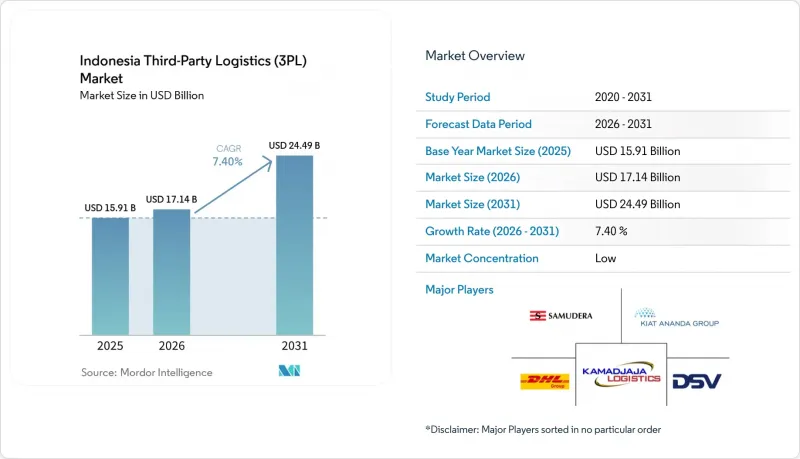
According to Mordor Intelligence, the Indonesia third-party logistics (3PL) market size was valued at USD 15.91 billion in 2025, and is estimated to grow from USD 17.14 billion in 2026 to reach USD 24.49 billion by 2031, at a CAGR of 7.40% during the forecast period (2026-2031).
Indonesia Third-Party Logistics (3PL) Market Trends and Insights
E-Commerce Fulfillment and Omnichannel Outsourcing Driving 3PL Demand
Platform delivery networks have expanded their own last-mile coverage, while upstream work has increasingly moved to specialist providers in the Indonesia third-party logistics (3PL) market. Shopee Express served 487 cities, and Lazada eLogistics operated 73 automated hubs that processed 850,000 packages daily in 2025. This arrangement concentrates delivery activity inside platforms but leaves inventory positioning, kitting, multichannel fulfillment, and returns handling open to third-party providers. Video commerce transactions reached 2.6 billion in 2025 after growing 90% year-over-year, which increased the volume of small, frequent orders. In September 2026, FAS expanded its portfolio to include a planned cold-chain offering alongside warehousing, delivery, and customer-care services. Brands can therefore seek broader support from one provider rather than coordinating multiple specialized vendors.
Manufacturing Expansion Increasing Industrial Logistics Outsourcing Requirements
At least 7 electric vehicle manufacturers committed to Indonesian production facilities since 2024, with Batam and West Java identified as manufacturing hubs. Their facilities require battery module storage, hazardous-material handling, aftermarket distribution, and just-in-time replenishment. Chinese and Hong Kong foreign direct investment rose 6.5% to USD 8.2 billion in the first half of 2025, while West Java industrial land rents rose 15% to 25% as manufacturers entered the country. The manufacturing base increases demand for bonded storage, customs support, and documented supply-chain controls. Indonesia's downstream processing requirements for nickel and bauxite add further compliance needs for logistics partners. These needs favor providers that can combine physical handling with contract-based services across production and export flows.
Archipelagic Transshipment Increasing Logistics Costs and Complexity
Indonesia's 17,500-island geography requires much inter-island freight to move through sea transshipment. Similar inbound consumer-goods volumes do not match commodity exports from Sumatra, Kalimantan, and eastern Indonesia. The imbalance creates empty-container repositioning costs that affect freight rates across the archipelago. The Tol Laut program allocated IDR 623.4 billion (USD 35.28 million) across 756 voyages serving 104 ports in 2025. The program reduced the Java-to-Papua price gap from 47% in 2019 to 31% in 2025, although last-mile bottlenecks continued to limit the effect on retail prices. Smaller operators face a particular challenge because they lack enough network density to optimize loads in both directions.
Other drivers and restraints analyzed in the detailed report include:
- Infrastructure Investment Improving Inter-Island 3PL Network Connectivity
- Digitalization and Automation Improving 3PL Operating Efficiency
- Zero-ODOL Compliance Pressuring Payload Economics and Costs
For complete list of drivers and restraints, kindly check the Table Of Contents.
Segment Analysis
Domestic transportation management accounted for 45.32% of Indonesia third-party logistics (3PL) market share in 2025, reflecting its role in the country's road-based freight system. Value-added warehousing and distribution is forecast to register a 10.54% CAGR through 2031, driven by demand for specialized logistics services. Road freight remained the main logistics backbone, with trucks handling around 90% of domestic cargo movements across major consumption and industrial corridors. Water and air transport remain important for connecting Kalimantan, Papua, and Sulawesi, while rail serves industrial corridors in Java and North Sumatra. International transportation management is also gaining importance as Batam develops as a customs gateway for electronics manufacturing and cross-border cargo.
Value-added warehousing and distribution is supported by kitting, labeling, cold-chain management, and reverse logistics. E-commerce, healthcare, and FMCG companies increasingly require standardized handling across multiple locations, creating opportunities for specialized 3PL providers. Halal certification and pharmaceutical Good Distribution Practice standards further raise compliance requirements. Logistics hubs in Greater Jakarta and Surabaya are also adopting warehouse-management systems and automated storage technologies to improve inventory and fulfillment efficiency.
Complete Report Scope:
- By Service
- Domestic Transportation Management (DTM)
- Roadways
- Railways
- Airways
- Waterways
- International Transportation Management (ITM)
- Roadways
- Railways
- Airways
- Waterways
- Value-Added Warehousing and Distribution (VAWD)
- Domestic Transportation Management (DTM)
- By End-Use Application
- Automotive
- Energy and Utilities
- Manufacturing
- Life Sciences and Healthcare
- Technology and Electronics
- Retail and E-commerce
- Consumer Goods and FMCG
- Food and Beverages
- Others
- By Logistics Model
- Asset-Light
- Asset-Heavy
- Hybrid
- By Region
- Java (Jakarta and BOD)
- Sumatra
- Kalimantan
- Sulawesi
- Bali and Nusa Tenggara
- Papua Region and Maluku Islands
List of Companies Covered in this Report:
- DHL Group
- DSV A/S
- Kuehne+Nagel International AG
- CEVA Logistics (CMA CGM Group)
- A.P. Moller - Maersk
- GEODIS
- Nippon Express Holdings, Inc.
- Yusen Logistics Co., Ltd.
- Linfox
- CJ Logistics Corporation
- LOGISTEED, Ltd
- Rhenus Group
- YCH Group
- PT Samudera Indonesia Tbk
- Kiat Ananda Group
- PT Kamadjaja Logistics
- PT Puninar Logistics
- PT Cipta Krida Bahari
- Waresix
- PT BGR Logistik Indonesia
- PT Dunia Express Transindo
- MGM Bosco Logistics
Additional Benefits:
- The market estimate (ME) sheet in Excel format
- 3 months of analyst support
TABLE OF CONTENTS
1 INTRODUCTION
- 1.1 Study Assumptions and Market Definition
- 1.2 Scope of the Study
2 RESEARCH METHODOLOGY
3 EXECUTIVE SUMMARY
- 3.1 Market Size, Growth, and Forecast Outlook
- 3.2 Key Demand Drivers and 3PL Market Trends
- 3.3 Major Logistics Corridors and Demand Concentration
- 3.4 Competitive Landscape and Leading 3PL Providers
4 MARKET LANDSCAPE
- 4.1 Market Overview and Importance of Third-Party Logistics
- 4.2 Market Drivers
- 4.2.1 E-Commerce Fulfillment and Omnichannel Outsourcing Driving 3PL Demand
- 4.2.2 Manufacturing Expansion Increasing Industrial Logistics Outsourcing Requirements
- 4.2.3 Infrastructure Investment Improving Inter-Island 3PL Network Connectivity
- 4.2.4 Contract Logistics Outsourcing Expanding Integrated 3PL Service Demand
- 4.2.5 Digitalization and Automation Improving 3PL Operating Efficiency
- 4.2.6 Tier-Two City Expansion Broadening 3PL Service Coverage
- 4.3 Market Restraints
- 4.3.1 Archipelagic Transshipment Increasing Logistics Costs and Complexity
- 4.3.2 Fragmented Trucking Capacity Increasing Empty-Return Operating Exposure
- 4.3.3 Zero-ODOL Compliance Pressuring Payload Economics and Costs
- 4.3.4 Power Reliability Constraints Limiting Automated Cold Facilities
- 4.4 Value Chain Structure and 3PL Service Flow Analysis
- 4.5 Regulatory Framework and Logistics Compliance Requirements Analysis
- 4.6 Technology Adoption and Logistics Digitalization Trend Analysis
- 4.7 Warehousing Capacity and Distribution Network Development Analysis
- 4.8 Regional Logistics Infrastructure and Connectivity Development Analysis
- 4.9 Freight Rate Trends and Transportation Cost Analysis
- 4.10 Porter's Five Forces Analysis
- 4.10.1 Threat of New Entrants
- 4.10.2 Bargaining Power of Buyers
- 4.10.3 Bargaining Power of Suppliers
- 4.10.4 Threat of Substitute Services
- 4.10.5 Intensity of Competitive Rivalry
- 4.11 Impact of Geo-Political Events on Supply Chain Shifts
5 MARKET SIZE AND GROWTH FORECASTS
- 5.1 By Service
- 5.1.1 Domestic Transportation Management (DTM)
- 5.1.1.1 Roadways
- 5.1.1.2 Railways
- 5.1.1.3 Airways
- 5.1.1.4 Waterways
- 5.1.2 International Transportation Management (ITM)
- 5.1.2.1 Roadways
- 5.1.2.2 Railways
- 5.1.2.3 Airways
- 5.1.2.4 Waterways
- 5.1.3 Value-Added Warehousing and Distribution (VAWD)
- 5.1.1 Domestic Transportation Management (DTM)
- 5.2 By End-Use Application
- 5.2.1 Automotive
- 5.2.2 Energy and Utilities
- 5.2.3 Manufacturing
- 5.2.4 Life Sciences and Healthcare
- 5.2.5 Technology and Electronics
- 5.2.6 Retail and E-commerce
- 5.2.7 Consumer Goods and FMCG
- 5.2.8 Food and Beverages
- 5.2.9 Others
- 5.3 By Logistics Model
- 5.3.1 Asset-Light
- 5.3.2 Asset-Heavy
- 5.3.3 Hybrid
- 5.4 By Region
- 5.4.1 Java (Jakarta and BOD)
- 5.4.2 Sumatra
- 5.4.3 Kalimantan
- 5.4.4 Sulawesi
- 5.4.5 Bali and Nusa Tenggara
- 5.4.6 Papua Region and Maluku Islands
6 COMPETITIVE LANDSCAPE
- 6.1 Market Concentration
- 6.2 Strategic Moves
- 6.3 Market Share Analysis
- 6.4 Company Profiles (includes Global Level Overview, Market Level Overview, Core Segments, Financials as available, Strategic Information, Geographic Coverage, Products and Services, Recent Developments)
- 6.4.1 DHL Group
- 6.4.2 DSV A/S
- 6.4.3 Kuehne+Nagel International AG
- 6.4.4 CEVA Logistics (CMA CGM Group)
- 6.4.5 A.P. Moller - Maersk
- 6.4.6 GEODIS
- 6.4.7 Nippon Express Holdings, Inc.
- 6.4.8 Yusen Logistics Co., Ltd.
- 6.4.9 Linfox
- 6.4.10 CJ Logistics Corporation
- 6.4.11 LOGISTEED, Ltd
- 6.4.12 Rhenus Group
- 6.4.13 YCH Group
- 6.4.14 PT Samudera Indonesia Tbk
- 6.4.15 Kiat Ananda Group
- 6.4.16 PT Kamadjaja Logistics
- 6.4.17 PT Puninar Logistics
- 6.4.18 PT Cipta Krida Bahari
- 6.4.19 Waresix
- 6.4.20 PT BGR Logistik Indonesia
- 6.4.21 PT Dunia Express Transindo
- 6.4.22 MGM Bosco Logistics
7 MARKET OPPORTUNITIES AND FUTURE OUTLOOK
- 7.1 White-Space Opportunities and Unmet 3PL Service Needs
- 7.2 High-Potential End-User Segments and Growth Opportunities
- 7.3 Strategic Growth Priorities Across 3PL Ecosystem
- 7.4 Future Market Outlook and Emerging Demand Pockets
8 APPENDIX

