PUBLISHER: Mordor Intelligence | PRODUCT CODE: 2163424

PUBLISHER: Mordor Intelligence | PRODUCT CODE: 2163424
Data Center Facility Management - Market Share Analysis, Industry Trends & Statistics, Growth Forecasts (2026 - 2031)
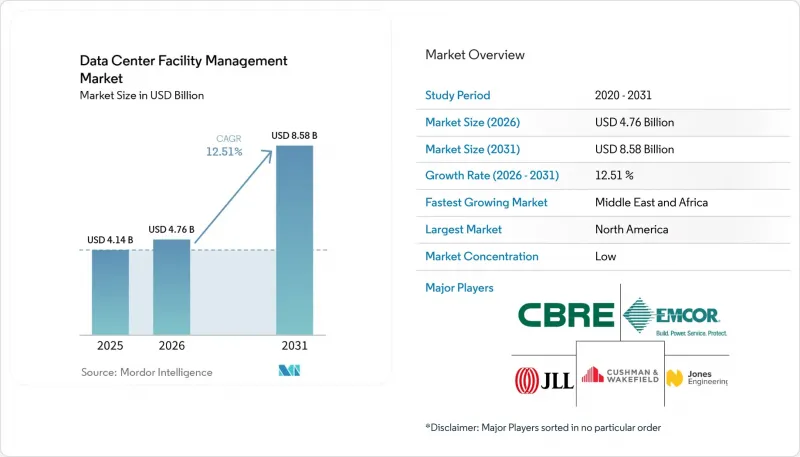
According to Mordor Intelligence, the data center facility management market size is projected to expand from USD 4.14 billion in 2025 to USD 4.76 billion in 2026, and to USD 8.58 billion by 2031, registering a CAGR of 12.51% between 2026 and 2031.
Global Data Center Facility Management Market Trends and Insights
Rising AI Workload Density Increases On-Site Operational Complexity
The Data Center Facility Management Market faces distinct operating requirements as AI systems increase rack densities and cooling demands. Standard facilities had racks near 15 kW, while AI-heavy zones ranged from 300 kW to 600 kW in 2026, making scheduled maintenance less dependable than continuous condition monitoring. New facilities are expected to use more liquid cooling, which adds work related to coolant condition, leak detection, and heat exchanger servicing. Providers without liquid-cooling capability may be excluded from new-build assignments despite their experience with air-cooled sites. Maintenance windows must also be planned around AI training workloads, where an interruption can affect client operations. This places greater value on providers that can combine engineering judgment with real-time equipment data.
Stricter Uptime Expectations Across Hyperscale and Colocation Campuses
The Data Center Facility Management Market benefits when uptime commitments require more rigorous operational support. The Uptime Institute reported in 2026 that 1 in 10 outages remained serious or severe, even as overall outage frequency improved. Colocation agreements commonly guarantee 99.99% monthly power availability, which increases the need for dependable engineering coverage. Hyperscale customers are also moving beyond credit-based remedies toward shared accountability for operations. Providers with independently audited uptime records and evidence of mean time to repair can strengthen their position at renewal. Longstanding on-site engineering relationships can therefore matter as much as price when operators assess risk.
High Switching Costs and Complex Mobilization Delay Outsourcing Decisions
The Data Center Facility Management Market can face delays when a live facility changes providers. A transition may require staff mobilization, CMMS migration, access approvals, and periods of parallel operation. On a large campus, this work can take 6 to 18 months and raise concerns about cost and service continuity. Embedded personnel and proprietary systems can make the replacement process harder for the client to manage. This often benefits an incumbent at renewal, even when another provider offers a stronger commercial proposal. It can also postpone first-time outsourcing by operators that currently manage facilities internally.
Other drivers and restraints analyzed in the detailed report include:
- Multi-Site Standardization Pushes Outsourced FM Adoption
- Talent Scarcity for Mission-Critical Engineers Supports Managed Services
- Stringent Client Security and Access Controls Limit Vendor Scope Expansion
For complete list of drivers and restraints, kindly check the Table Of Contents.
Segment Analysis
Critical Infrastructure Maintenance Services accounted for 38.12% of revenue in 2025, making it the largest segment of the Data Center Facility Management Market. The service includes planned and reactive work on UPS systems, generators, cooling equipment, high-voltage switchgear, and electrical distribution. These assets require physical intervention and cannot be virtualized. Higher AI density increases the number of assets requiring inspection and narrows maintenance windows. EN 50600-3-1:2026 identifies maintenance, incident management, and change management as core operating processes.
Digital Monitoring and Optimization Services is projected to expand at a 17.94% CAGR through 2031 in the Data Center Facility Management Industry. The service shifts work from calendar-based tasks to condition-based maintenance. Vertiv launched Next Predict in January 2026 with anomaly detection across power, cooling, and IT systems. Schneider Electric stated that users achieved reductions of up to 75% in unplanned downtime and 20% in operating expenditure. Operators reported greater trust in sensor analytics and predictive maintenance than in autonomous AI applications.
Complete Report Scope:
- By Service Type
- Critical Facility Operations Services (includes Includes energy management, sustainability, compliance, and risk management)
- Critical Infrastructure Maintenance Services
- Commissioning and Operational Readiness Services
- Digital Monitoring and Optimization Services
- By End User
- Hyperscale Operators (includes cloud services providers)
- Colocation Providers
- Enterprise Operators
- Telecom Operators
- Government and Defense
- By Geography
- North America
- United States
- Canada
- Mexico
- South America
- Brazil
- Argentina
- Rest of South America
- Europe
- Germany
- United Kingdom
- France
- Russia
- Rest of Europe
- Asia-Pacific
- China
- Japan
- India
- Australia
- Rest of Asia-Pacific
- Middle East and Africa
- Middle East
- Saudi Arabia
- United Arab Emirates
- Israel
- Turkey
- Rest of Middle East
- Africa
- South Africa
- Nigeria
- Kenya
- Rest of Africa
- Middle East
- North America
Geography Analysis
North America held 47.1% of global revenue in 2025 and remained the largest regional contributor to the Data Center Facility Management Market size. Its mature hyperscale and colocation campus base supports sustained volume in facilities contracts. The United States accounted for most activity, while Canada and Mexico provided secondary opportunities. South America, led by Brazil and Argentina, remained at an earlier stage, while hyperscale and colocation investments built asset scale for specialized outsourcing.
Europe has a regulatory-led demand profile within the Data Center Facility Management Market. Energy monitoring and reporting requirements are extending service work into auditing, PUE optimization, and waste-heat activities. The Uptime Institute reported an industry-wide average PUE of 1.52 in 2026. This creates demand for energy-management services. Asia-Pacific expansion is led by India and Australia, with secondary cities creating new requirements beyond established tier-1 locations.
The Middle East and Africa are projected to expand at an 18.03% CAGR through 2031, the highest regional rate in the Data Center Facility Management Market. Saudi Arabia's installed capacity reached 467 MW in Q1 2026, compared with 68 MW in 2021. National digital infrastructure commitments totaled SR 56.2 billion, or USD 14.87 billion. JLL received the integrated facilities appointment for Pure DC's 45 MW Yas Island campus in Abu Dhabi in March 2025. Saudi sovereign-backed operators are building internal teams, while UAE and African multi-tenant operators more often use external sourcing.
- CBRE Group, Inc.
- Jones Lang LaSalle Incorporated
- Jones Engineering
- BGIS
- RED Engineering
- Cushman and Wakefield plc
- ISS A/S
- Sodexo S.A.
- ENGIE SA
- Dalkia
- Mitie Group plc
- OCS Group
- EMCOR Group, Inc.
Additional Benefits:
- The market estimate (ME) sheet in Excel format
- 3 months of analyst support
TABLE OF CONTENTS
1 INTRODUCTION
- 1.1 Study Assumptions and Market Definition
- 1.2 Scope of the Study
2 RESEARCH METHODOLOGY
3 EXECUTIVE SUMMARY
4 MARKET LANDSCAPE
- 4.1 Market Overview
- 4.2 Market Drivers
- 4.2.1 Rising AI Workload Density Increases On-Site Operational Complexity
- 4.2.2 Stricter Uptime Expectations Across Hyperscale And Colocation Campuses
- 4.2.3 Multi-Site Standardization Pushes Outsourced FM Adoption
- 4.2.4 Talent Scarcity For Mission-Critical Engineers Supports Managed Services
- 4.2.5 Carbon Reporting And Energy Intensity Targets Elevate Specialist FM Demand
- 4.2.6 Remote Monitoring And Predictive Operations Improve Portfolio Visibility
- 4.3 Market Restraints
- 4.3.1 High Switching Costs And Complex Mobilization Delay Outsourcing Decisions
- 4.3.2 Stringent Client Security And Access Controls Limit Vendor Scope Expansion
- 4.3.3 In-House Operator Preference In Hyperscale Facilities Caps Outsourced Share
- 4.3.4 Shortage Of Qualified Technicians Constrains Service Quality And Expansion
- 4.4 Impact of Macroeconomic Factors on the Market
- 4.5 Industry Supply-Chain Analysis
- 4.6 Technology Outlook
- 4.7 Regulatory Landscape
- 4.8 Porter's Five Forces Analysis
- 4.8.1 Threat of New Entrants
- 4.8.2 Bargaining Power of Suppliers
- 4.8.3 Bargaining Power of Buyers
- 4.8.4 Threat of Substitutes
- 4.8.5 Intensity of Competitive Rivalry
5 MARKET SIZE AND GROWTH FORECASTS (Value)
- 5.1 By Service Type
- 5.1.1 Critical Facility Operations Services (includes Includes energy management, sustainability, compliance, and risk management)
- 5.1.2 Critical Infrastructure Maintenance Services
- 5.1.3 Commissioning and Operational Readiness Services
- 5.1.4 Digital Monitoring and Optimization Services
- 5.2 By End User
- 5.2.1 Hyperscale Operators (includes cloud services providers)
- 5.2.2 Colocation Providers
- 5.2.3 Enterprise Operators
- 5.2.4 Telecom Operators
- 5.2.5 Government and Defense
- 5.3 By Geography
- 5.3.1 North America
- 5.3.1.1 United States
- 5.3.1.2 Canada
- 5.3.1.3 Mexico
- 5.3.2 South America
- 5.3.2.1 Brazil
- 5.3.2.2 Argentina
- 5.3.2.3 Rest of South America
- 5.3.3 Europe
- 5.3.3.1 Germany
- 5.3.3.2 United Kingdom
- 5.3.3.3 France
- 5.3.3.4 Russia
- 5.3.3.5 Rest of Europe
- 5.3.4 Asia-Pacific
- 5.3.4.1 China
- 5.3.4.2 Japan
- 5.3.4.3 India
- 5.3.4.4 Australia
- 5.3.4.5 Rest of Asia-Pacific
- 5.3.5 Middle East and Africa
- 5.3.5.1 Middle East
- 5.3.5.1.1 Saudi Arabia
- 5.3.5.1.2 United Arab Emirates
- 5.3.5.1.3 Israel
- 5.3.5.1.4 Turkey
- 5.3.5.1.5 Rest of Middle East
- 5.3.5.2 Africa
- 5.3.5.2.1 South Africa
- 5.3.5.2.2 Nigeria
- 5.3.5.2.3 Kenya
- 5.3.5.2.4 Rest of Africa
- 5.3.5.1 Middle East
- 5.3.1 North America
6 COMPETITIVE LANDSCAPE
- 6.1 Market Concentration
- 6.2 Strategic Moves
- 6.3 Market Share Analysis
- 6.4 Company Profiles (includes Global Level Overview, Market Level Overview, Core Segments, Financials as available, Strategic Information, Market Rank/Share, Products and Services, Recent Developments)
- 6.4.1 CBRE Group, Inc.
- 6.4.2 Jones Lang LaSalle Incorporated
- 6.4.3 Jones Engineering
- 6.4.4 BGIS
- 6.4.5 RED Engineering
- 6.4.6 Cushman and Wakefield plc
- 6.4.7 ISS A/S
- 6.4.8 Sodexo S.A.
- 6.4.9 ENGIE SA
- 6.4.10 Dalkia
- 6.4.11 Mitie Group plc
- 6.4.12 OCS Group
- 6.4.13 EMCOR Group, Inc.
7 MARKET OPPORTUNITIES AND FUTURE OUTLOOK
- 7.1 White-Space and Unmet-Need Assessment

