PUBLISHER: Mordor Intelligence | PRODUCT CODE: 2163611

PUBLISHER: Mordor Intelligence | PRODUCT CODE: 2163611
North America Building Inspection Services - Market Share Analysis, Industry Trends & Statistics, Growth Forecasts (2026 - 2031)
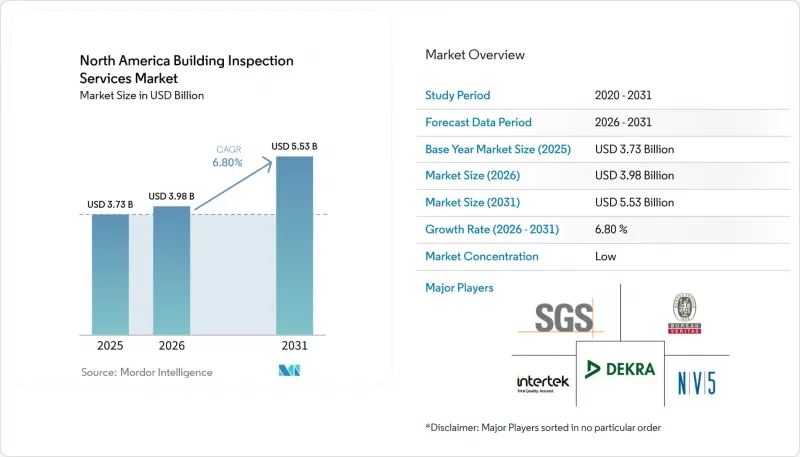
According to Mordor Intelligence, the North America building inspection services market size was valued at USD 3.73 billion in 2025 and is estimated to grow from USD 3.98 billion in 2026 to reach USD 5.53 billion by 2031, at a CAGR of 6.80% during the forecast period (2026-2031).
North America Building Inspection Services Market Trends and Insights
Real-Estate Transaction Due Diligence
Pre-purchase inspections remain part of the normal residential transaction process in the United States and Canada. The National Association of Realtors reported that the typical agent completed 9 transaction sides during 2025, which supports a regular referral base for inspection providers. Buyers face greater financial exposure when property prices are high. That exposure increases scrutiny of repair needs, building systems, and concealed defects. Inspection reports can therefore remain relevant even when affordability reduces transaction volumes. Commercial lenders also use property condition assessments before financing, which supports demand outside the housing resale cycle.
The North America building inspection services market is supported by the role of inspection reports in negotiations and underwriting. Buyers use findings to evaluate repair obligations before closing. Lenders and insurers use reports to assess property condition and risk. These uses create demand that is tied to the quality of a transaction, not only its number. Agent referrals also reduce customer-acquisition costs for established residential providers. This relationship makes service quality, report speed, and local reputation important competitive factors.
Stricter State and Municipal Building Codes
New building and energy code editions increase plan-review requirements and create new inspection steps. New York City began enforcing its 2025 Energy Conservation Code for relevant building applications filed from March 30, 2026. The change expands the documentation needed for affected projects. Building owners must demonstrate compliance during planning and construction. Inspectors can support this process through reviews, site visits, and records. The North America building inspection services market gains steadier work when compliance deadlines replace one-time project decisions.
Building performance requirements can also create repeat work over several years. Owners must track building energy performance, corrective actions, and verification needs. This changes inspection from an event linked only to a sale or permit. It becomes part of a compliance schedule for some large properties. Firms with code knowledge and digital evidence systems are better placed to handle repeat assignments. The resulting work is less dependent on short-term real estate sentiment.
Shortage of Qualified Inspectors
The supply of qualified inspectors remains a central limit on service capacity. The Bureau of Labor Statistics projects 14,800 annual openings for construction and building inspectors from 2024 to 2034, as cited by Wisconsin's apprenticeship announcement. Retirements increase the need for trained replacements. Many jurisdictions need staff who understand both code requirements and local approval processes. Delays can slow permits, inspections, and housing delivery. Providers with deeper inspector pools can gain assignments when municipal departments cannot meet demand.
Wisconsin introduced its first Commercial Building Inspector Registered Apprenticeship in the fall of 2026. The program combines 288 hours of instruction with more than 2,000 hours of work experience. Such programs can expand the workforce over time. They do not remove immediate shortages in high-demand locations. Training requirements and licensing pathways can deter workers from entering from other construction roles. The North America building inspection services market remains constrained when demand rises faster than qualified staff.
Other drivers and restraints analyzed in the detailed report include:
- Aging Residential and Commercial Building Stock
- Renovation, Retrofit, and Climate-Resiliency Projects
- State-by-State Licensing and Code Complexity
For complete list of drivers and restraints, kindly check the Table Of Contents.
Segment Analysis
Home Inspection Services held 45.6% of the North America building inspection services market size in 2025. The segment is linked to residential purchases, lender expectations, and agent referrals. Buyers use home inspections to identify visible defects and maintenance needs. Reports can influence repair negotiations before a sale closes. This makes speed, clarity, and local knowledge important service attributes. Standard home inspections remain a high-volume entry point for many providers. Specific Element Inspection Services add work related to radon, mold, pests, structures, and other hidden risks. Commercial Building Inspection Services support acquisitions, lender reviews, and facility management. Together, these services broaden provider exposure beyond a single property type.
Other Specialized Services is forecast to grow at an 8.9% CAGR through 2031. This area includes energy audits, thermal imaging, and drone-based reviews of roofs and exterior walls. EagleView launched its Horizon property intelligence platform in April 2026. The company said the platform uses a library of more than 3.5 billion aerial images. It also stated that coverage reaches 96% of the U.S. population. These tools can shift some work from single projects toward portfolio monitoring. Asset managers and insurers may value more consistent property data across large portfolios. This supports specialized service demand within the North America building inspection services market. Providers still need experienced inspectors to interpret complex findings and address site-specific conditions.
In-House Services held 57.8% of the North America building inspection services market size in 2025. Large municipalities and institutional owners use internal teams to control work quality and scheduling. National companies may also retain in-house professionals for complex facilities. Internal teams have direct familiarity with their assets and operating standards. They can coordinate closely with capital planning and maintenance functions. This model is most practical for organizations with a large, stable inspection workload. It can become difficult when hiring needs rise quickly. Inspector shortages increase the cost of maintaining full internal coverage. The North America building inspection services market continues to include this model because many large asset owners value direct control.
Outsourced Services is forecast to grow at an 8.4% CAGR through 2031. Municipalities use third-party providers when they cannot recruit or retain enough inspectors. SAFEbuilt operates across 41 states and the District of Columbia, demonstrating the reach of a pooled municipal services model. External providers can also supply specialists in structures, energy audits, and drone operations. This access can be difficult for each municipality to build separately. Accreditation and formal quality procedures can strengthen confidence in outsourced work. The sourcing shift is therefore more than a staffing response. It gives clients access to specialized capabilities and common reporting systems. Credentialed firms can use these strengths to compete for larger contracts.
Complete Report Scope:
- By Service
- Home Inspection Services
- Specific Element Inspection Services
- Commercial Building Inspection Services
- Other Specialised Services
- By Sourcing Type
- In-House Services
- Outsourced Services
- By Application
- Residential
- Commercial
- Other Applications
- By End User
- Real-Estate Agencies and Brokers
- Property Owners and Investors
- Government and Municipalities
- Insurance and Financial Institutions
- Facility-Management Firms
- By Countries
- United States
- Canada
- Mexico
List of Companies Covered in this Report:
- SGS Group
- Bureau Veritas
- Intertek Group plc
- DEKRA SE
- NV5 Global
- AmeriSpec Inspection Services
- HouseMaster
- National Property Inspections
- Pillar To Post
- WIN Home Inspection
- SAFEbuilt
- Quality Built
- Criterium Engineers
- Houspect
- Resicert
- HomeTeam Inspection Service
- InterNACHI
- DEKRA Drone Inspection Services
- AeroSpect NY
- Drone Fly Inspect
Additional Benefits:
- The market estimate (ME) sheet in Excel format
- 3 months of analyst support
TABLE OF CONTENTS
1 Introduction
- 1.1 Study Assumptions and Market Definition
- 1.2 Scope of the Study
2 Research Methodology
3 Executive Summary
4 Market Landscape
- 4.1 Market Overview
- 4.2 Market Drivers
- 4.2.1 Real-Estate Transaction Due Diligence
- 4.2.2 Stricter State and Municipal Building Codes
- 4.2.3 Aging Residential and Commercial Building Stock
- 4.2.4 Renovation, Retrofit, and Climate-Resiliency Projects
- 4.2.5 Portfolio-Level Property Intelligence Subscriptions
- 4.2.6 Digitally Auditable Inspection Evidence
- 4.3 Market Restraints
- 4.3.1 Shortage of Qualified Inspectors
- 4.3.2 State-by-State Licensing and Code Complexity
- 4.3.3 Professional-Liability Exposure From Digital and AI-Assisted Findings
- 4.3.4 Price Competition From Local and Franchise Operators
- 4.4 Value and Supply-Chain Analysis
- 4.5 Regulatory Landscape and Government Initiatives
- 4.6 Technological Outlook
- 4.7 Economic and Market Scenario
- 4.8 Key Industry Trends
- 4.9 Porter's Five Forces Analysis
- 4.9.1 Threat of New Entrants
- 4.9.2 Bargaining Power of Suppliers
- 4.9.3 Bargaining Power of Buyers
- 4.9.4 Threat of Substitutes
- 4.9.5 Competitive Rivalry
5 Market Size and Growth Forecasts
- 5.1 By Service
- 5.1.1 Home Inspection Services
- 5.1.2 Specific Element Inspection Services
- 5.1.3 Commercial Building Inspection Services
- 5.1.4 Other Specialised Services
- 5.2 By Sourcing Type
- 5.2.1 In-House Services
- 5.2.2 Outsourced Services
- 5.3 By Application
- 5.3.1 Residential
- 5.3.2 Commercial
- 5.3.3 Other Applications
- 5.4 By End User
- 5.4.1 Real-Estate Agencies and Brokers
- 5.4.2 Property Owners and Investors
- 5.4.3 Government and Municipalities
- 5.4.4 Insurance and Financial Institutions
- 5.4.5 Facility-Management Firms
- 5.5 By Countries
- 5.5.1 United States
- 5.5.2 Canada
- 5.5.3 Mexico
6 Competitive Landscape
- 6.1 Market Concentration
- 6.2 Strategic Moves
- 6.3 Company Profiles (includes Global Level Overview, Market Level Overview, Core Segments, Financials as available, Strategic Information, Market Rank/Share, Products and Services, Recent Developments)
- 6.3.1 SGS Group
- 6.3.2 Bureau Veritas
- 6.3.3 Intertek Group plc
- 6.3.4 DEKRA SE
- 6.3.5 NV5 Global
- 6.3.6 AmeriSpec Inspection Services
- 6.3.7 HouseMaster
- 6.3.8 National Property Inspections
- 6.3.9 Pillar To Post
- 6.3.10 WIN Home Inspection
- 6.3.11 SAFEbuilt
- 6.3.12 Quality Built
- 6.3.13 Criterium Engineers
- 6.3.14 Houspect
- 6.3.15 Resicert
- 6.3.16 HomeTeam Inspection Service
- 6.3.17 InterNACHI
- 6.3.18 DEKRA Drone Inspection Services
- 6.3.19 AeroSpect NY
- 6.3.20 Drone Fly Inspect
7 Market Opportunities and Future Outlook
- 7.1 White-Space and Unmet-Need Assessment

