PUBLISHER: Mordor Intelligence | PRODUCT CODE: 2163613

PUBLISHER: Mordor Intelligence | PRODUCT CODE: 2163613
South America Building Inspection Services - Market Share Analysis, Industry Trends & Statistics, Growth Forecasts (2026 - 2031)
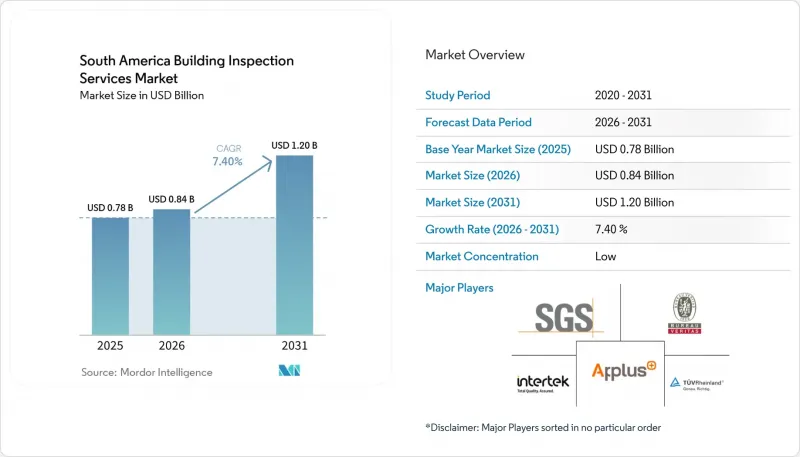
According to Mordor Intelligence, the South America building inspection services market size is expected to increase from USD 0.78 billion in 2025 to USD 0.84 billion in 2026 and reach USD 1.20 billion by 2031, growing at a CAGR of 7.40% over 2026-2031.
South America Building Inspection Services Market Trends and Insights
Stronger Construction and Safety Enforcement Reshapes Inspection as Mandatory Infrastructure
Regulatory requirements are moving building inspection from a discretionary activity toward a formal compliance obligation in the South America building inspection services market. Brazil's Senate regional development committee approved PL 159/2026 in April 2026, advancing a proposed periodic inspection system and the Laudo de Inspecao Tecnica de Edificacao, or LITE, credential. The proposal uses the Brazilian Association of Technical Standards NBR 16747 inspection standard and requires professional responsibility records from qualified engineers. Chile's NCh433:2026 standard now requires deeper soil assessment and revised seismic zoning, which expands the technical work needed before construction and occupancy. Colombia's Law 1796 requires independent technical supervision for certain multi-unit residential projects, creating a repeat inspection need after delivery. Peru's 2026 proposal on urban reviewer accreditation similarly aims to strengthen qualifications for structural safety assessments.
Independent Property Due Diligence Creates Recurring Inspection Demand
Independent assessments are becoming more important in property financing and investment decisions across the South America building inspection services market. In Brazil, certified engineering assessments support mortgage collateral valuations under Central Bank Resolution No. 4.676, linking inspection work to the housing finance process. The Minha Casa, Minha Vida housing program has contracted 2 million homes since 2023, supporting a broad base of financed residential transactions. Institutional buyers in Sao Paulo and Rio de Janeiro increasingly require technical reviews of structural, plumbing, electrical, and facade systems before approving acquisitions. This requirement makes the inspection a standard control within the transaction process rather than a step taken only after an agreement. Chile's housing-finance reforms and Colombia's development financing practices also support more formal appraisal and technical documentation requirements.
Shortage of Accredited Technical Inspectors Limits Delivery Capacity
The availability of qualified inspectors may limit the speed at which the South America building inspection services market can meet new compliance demands. Brazil faces pressure from high infrastructure activity and lower engineering school enrollment, which limits the supply of experienced professionals. The Lima chapter of the Peruvian College of Engineers accredited 144 municipal technical inspectors for 2026-2027, including 51 first-time certifications. Professional groups in Peru have also sought the return of mandatory civil-engineer participation in building safety inspections. Chile's rules on public officials acting as technical works inspectors create different registration requirements from those applied to private specialists. Uneven enforcement across municipalities and the use of lower-cost informal alternatives can also reduce demand for accredited providers and create inspection backlogs.
Other drivers and restraints analyzed in the detailed report include:
- Housing, Transport, and Urban Infrastructure Development Sustain Inspection Volumes
- Rehabilitation of Aging and Informally Modified Buildings Broadens the Service Pipeline
- Currency Volatility and Imported Equipment Costs Restrict Technology Deployment
For complete list of drivers and restraints, kindly check the Table Of Contents.
Segment Analysis
Commercial building inspection services held 40.1% of the South America building inspection services market in 2025, making them the largest service category. Large offices, retail properties, logistics facilities, and multi-story assets need combined checks of structural, mechanical, electrical, plumbing, and fire-suppression systems. These assignments often involve more than 1 discipline and can support longer service engagements. Home inspection and specific-element inspection services remain important for residential properties and targeted building repairs. The Reforma Casa Brazil program supports this work because funded rehabilitation projects require assessments before work begins and after it is completed. The service mix is therefore extending beyond one-time visual inspections toward documented, recurring building-condition reviews.
Other specialized services are forecast to grow at a 9.6% CAGR through 2031, the fastest rate among service types. This category includes drone-based facade checks, thermal imaging, and non-destructive structural testing. ViaMobilidade integrated drone patrols on Sao Paulo metro Lines 8 and 9 in April 2026, showing how an aerial inspection can cover areas that would take much longer to review from the ground. Brazil's electricity regulator requires periodic drone inspections of transmission lines, which supports the use of this format for infrastructure assets. Technical standards are also expanding attention to air-conditioning, fire prevention, and other critical building systems. These changes give service providers a reason to offer specialized work alongside conventional commercial inspections.
Outsourced services held 54.7% of the regional share in 2025. Property owners use external providers to access accredited specialists without maintaining internal teams across several jurisdictions. This approach is particularly relevant where a professional must sign inspection records and assume formal responsibility for the assessment. Brazil's proposed LITE system, Chile's seismic requirements, and Colombia's independent technical supervision rules all reinforce the value of third-party expertise. Large agencies and property management organizations still retain in-house teams where they can support the cost of permanent technical staff. In-house delivery remains most common where inspection is part of a public authority's ongoing building oversight role.
Outsourced services are also forecast to expand at an 8.8% CAGR through 2031, the fastest sourcing format. The technical requirements for drones, thermography, and digital building documentation increase the investment needed to maintain a competitive in-house service. Intertek acquired TESIS, a Sao Paulo building-products testing company, in May 2025 to extend its building and construction testing, assurance, inspection, and certification services in Brazil. The acquisition demonstrates how larger providers are assembling broader external service platforms. Formal third-party sign-off also creates demand that cannot simply be reassigned to an internal facilities team. This supports continuing use of outsourced services as regulatory scope becomes more complex.
Complete Report Scope:
- By Service
- Home Inspection Services
- Specific Element Inspection Services
- Commercial Building Inspection Services
- Other Specialised Services
- By Sourcing Type
- In-House Services
- Outsourced Services
- By Application
- Residential
- Commercial
- Other Applications
- By End User
- Real-Estate Agencies and Brokers
- Property Owners and Investors
- Government and Municipalities
- Insurance and Financial Institutions
- Facility-Management Firms
- By Countries
- Brazil
- Argentina
- Chile
- Colombia
- Peru
- Rest of South America
List of Companies Covered in this Report:
- SGS Group
- Bureau Veritas
- Intertek Group plc
- Applus+
- TUV Rheinland AG
- DEKRA SE
- DNV Group AS
- UL Solutions Inc.
- Eurofins Scientific SE
- Pillar To Post Home Inspectors
- NV5 Global
- Quality Built
- Criterium Engineers
- Houspect
- Resicert
- HomeTeam Inspection Service
- InterNACHI
- Bureau Veritas SIA
- DEKRA Drone Inspection Services
- AeroSpect NY
Additional Benefits:
- The market estimate (ME) sheet in Excel format
- 3 months of analyst support
TABLE OF CONTENTS
1 Introduction
- 1.1 Study Assumptions and Market Definition
- 1.2 Scope of the Study
2 Research Methodology
3 Executive Summary
4 Market Landscape
- 4.1 Market Overview
- 4.2 Market Drivers
- 4.2.1 Independent Property Due Diligence
- 4.2.2 Stronger Construction and Safety Enforcement
- 4.2.3 Housing, Transport, and Urban Infrastructure Development
- 4.2.4 Rehabilitation of Aging and Informally Modified Buildings
- 4.2.5 Formal Digital Records for Banks and Insurers
- 4.2.6 Drone Inspection for Remote and Difficult-to-Access Assets
- 4.3 Market Restraints
- 4.3.1 Shortage of Accredited Technical Inspectors
- 4.3.2 Uneven Application of Building Codes Across Municipalities
- 4.3.3 Currency Volatility and Imported Technology Costs
- 4.3.4 Informal Construction and Low-Cost Inspection Substitution
- 4.4 Value and Supply-Chain Analysis
- 4.5 Regulatory Landscape and Government Initiatives
- 4.6 Technological Outlook
- 4.7 Economic and Market Scenario
- 4.8 Key Industry Trends
- 4.9 Porter's Five Forces Analysis
- 4.9.1 Threat of New Entrants
- 4.9.2 Bargaining Power of Suppliers
- 4.9.3 Bargaining Power of Buyers
- 4.9.4 Threat of Substitutes
- 4.9.5 Competitive Rivalry
5 Market Size and Growth Forecasts
- 5.1 By Service
- 5.1.1 Home Inspection Services
- 5.1.2 Specific Element Inspection Services
- 5.1.3 Commercial Building Inspection Services
- 5.1.4 Other Specialised Services
- 5.2 By Sourcing Type
- 5.2.1 In-House Services
- 5.2.2 Outsourced Services
- 5.3 By Application
- 5.3.1 Residential
- 5.3.2 Commercial
- 5.3.3 Other Applications
- 5.4 By End User
- 5.4.1 Real-Estate Agencies and Brokers
- 5.4.2 Property Owners and Investors
- 5.4.3 Government and Municipalities
- 5.4.4 Insurance and Financial Institutions
- 5.4.5 Facility-Management Firms
- 5.5 By Countries
- 5.5.1 Brazil
- 5.5.2 Argentina
- 5.5.3 Chile
- 5.5.4 Colombia
- 5.5.5 Peru
- 5.5.6 Rest of South America
6 Competitive Landscape
- 6.1 Market Concentration
- 6.2 Strategic Moves
- 6.3 Company Profiles (includes Global Level Overview, Market Level Overview, Core Segments, Financials as available, Strategic Information, Market Rank/Share, Products and Services, Recent Developments)
- 6.3.1 SGS Group
- 6.3.2 Bureau Veritas
- 6.3.3 Intertek Group plc
- 6.3.4 Applus+
- 6.3.5 TUV Rheinland AG
- 6.3.6 DEKRA SE
- 6.3.7 DNV Group AS
- 6.3.8 UL Solutions Inc.
- 6.3.9 Eurofins Scientific SE
- 6.3.10 Pillar To Post Home Inspectors
- 6.3.11 NV5 Global
- 6.3.12 Quality Built
- 6.3.13 Criterium Engineers
- 6.3.14 Houspect
- 6.3.15 Resicert
- 6.3.16 HomeTeam Inspection Service
- 6.3.17 InterNACHI
- 6.3.18 Bureau Veritas SIA
- 6.3.19 DEKRA Drone Inspection Services
- 6.3.20 AeroSpect NY
7 Market Opportunities and Future Outlook
- 7.1 White-Space and Unmet-Need Assessment

