PUBLISHER: Mordor Intelligence | PRODUCT CODE: 2163612

PUBLISHER: Mordor Intelligence | PRODUCT CODE: 2163612
Europe Building Inspection Services - Market Share Analysis, Industry Trends & Statistics, Growth Forecasts (2026 - 2031)
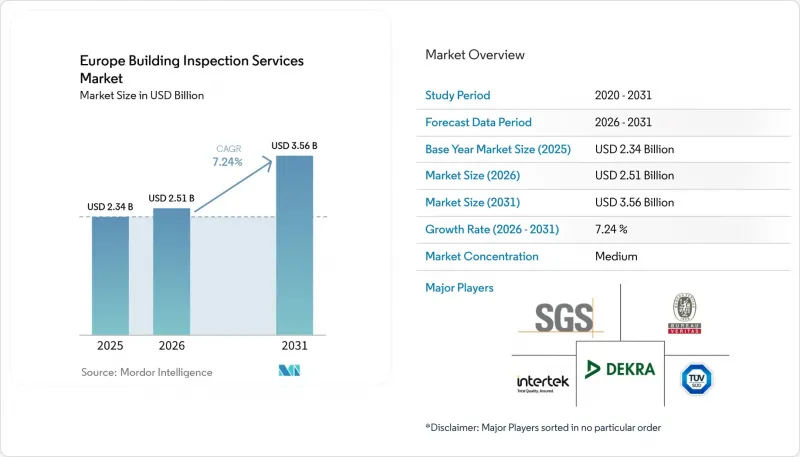
According to Mordor Intelligence, the Europe building inspection services market size is projected to expand from USD 2.34 billion in 2025 and USD 2.51 billion in 2026 to USD 3.56 billion by 2031, registering a CAGR of 7.24% between 2026 and 2031.
Europe Building Inspection Services Market Trends and Insights
Energy Performance and Building Renovation Obligations
The Europe building inspection services market gains demand from minimum energy performance standards for non-residential buildings. The recast directive requires the worst-performing 16% of non-residential stock to be renovated by 2030. It also sets a 2033 target for the worst-performing 26% of that stock. Member states must submit national building renovation plans by December 2026, creating a need for baseline assessments and documented building data. A major renovation generally requires a renewed energy performance certificate, which can create repeat work for assessors. Italy updated its energy-performance calculation methods in October 2025, adding rigor to inspections of heating, ventilation, and air-conditioning systems.
Fire and Building Safety Oversight
Fire and safety rules create inspection needs that are separate from energy upgrades. In the United Kingdom, local authorities have faced shortages of inspectors certified by the Building Safety Regulator. German technical experts inspected 70,447 safety-relevant building systems in 2024. They identified major defects in 27% of inspected systems and minor defects in 44%. France introduced cable classification requirements for new or renovated buildings with planning applications submitted after May 2025. These requirements add inspection and certification work before installation. The revised Construction Products Regulation broadens attention to product-level information and environmental documentation within building projects.
Shortage of Qualified Inspectors and Energy Specialists
The supply of qualified personnel is a direct constraint on the Europe building inspection services market. The EU LIFE program updated skills roadmaps in 15 member states after consultations with more than 6,000 organizations. Scotland reported a 52-post staffing gap in building standards services during 2025. Its workforce report projected a gap of 120 staff by 2028 and 144 staff by 2035. Nearly 46.5% of its current workforce was aged over 50, raising the risk of retirement-related losses. Providers may face longer scheduling periods and higher retention costs when certified expertise is scarce. Training programs can reduce this pressure, but they require time before new specialists can conduct regulated work.
Other drivers and restraints analyzed in the detailed report include:
- Aging Building Stock
- Green Building and Carbon Reporting Requirements
- Divergent National Standards and Approval Procedures
For complete list of drivers and restraints, kindly check the Table Of Contents.
Segment Analysis
Specific element inspection services captured 41.8% of revenue in 2025, making them the largest service category in the Europe building inspection services market. The category covers detailed assessments of structural components, heating, ventilation, and air-conditioning systems, electrical installations, and facades. Its scale reflects the need for evidence at the level of individual systems and building elements. These examinations support certificates, maintenance decisions, renovation design, and corrective action. The Europe building inspection services industry depends on personnel who can interpret building conditions and regulatory requirements together.
Other specialized services are forecast to grow at a 9.3% CAGR through 2031. This category includes drone-based facade diagnostics, indoor air-quality testing, acoustic surveys, and digital condition monitoring. Kiwa's Building Scan service uses drones, three-dimensional models, and automated analysis to identify cracks, erosion, and concrete deterioration. France's collective energy performance certificate requirements also support continued work in residential assessments. The Europe building inspection services market benefits when these tools complement professional judgment rather than replace it.
In-house services held 54.9% of revenue in 2025, retaining the largest position within the Europe building inspection services market. Government bodies, utilities, and public real estate operators often keep inspection capability internally to manage liability and sensitive asset information. Internal teams can maintain familiarity with building portfolios and local operating procedures. They can coordinate routine inspections with wider facilities management duties. This model does not remove the need for external specialists when projects require advanced technical capabilities.
Outsourced services are forecast to advance at an 8.6% CAGR through 2031. Thermal imaging, drone surveys, carbon assessments, and complex heating, ventilation, and air-conditioning audits can exceed the capacity of general internal teams. SOCOTEC secured a 6-year contract in September 2025 to conduct more than 100,000 inspections in Groningen and Drenthe from 2026. Many large owners are likely to keep an internal coordination role while purchasing specialized work externally. This approach can increase the inspections completed for each asset instead of merely moving work between providers.
Complete Report Scope:
- By Service
- Home Inspection Services
- Specific Element Inspection Services
- Commercial Building Inspection Services
- Other Specialised Services
- By Sourcing Type
- In-House Services
- Outsourced Services
- By Application
- Residential
- Commercial
- Other Applications
- By End User
- Real-Estate Agencies and Brokers
- Property Owners and Investors
- Government and Municipalities
- Insurance and Financial Institutions
- Facility-Management Firms
- By Countries
- United Kingdom
- Germany
- France
- Italy
- Spain
- Netherlands
- Russia
- Rest of Europe
List of Companies Covered in this Report:
- SGS Group
- Bureau Veritas
- Intertek Group plc
- DEKRA SE
- TUV SUD AG
- TUV Rheinland AG
- DNV Group AS
- Applus+
- Eurofins Scientific SE
- UL Solutions Inc.
- NV5 Global
- Kiwa Group
- SOCOTEC
- RINA S.p.A.
- Criterium Engineers
- Houspect
- Resicert
- InterNACHI
- DEKRA Drone Inspection Services
- Bureau Veritas SIA
Additional Benefits:
- The market estimate (ME) sheet in Excel format
- 3 months of analyst support
TABLE OF CONTENTS
1 Introduction
- 1.1 Study Assumptions and Market Definition
- 1.2 Scope of the Study
2 Research Methodology
3 Executive Summary
4 Market Landscape
- 4.1 Market Overview
- 4.2 Market Drivers
- 4.2.1 Energy-Performance and Building-Renovation Obligations
- 4.2.2 Fire and Building-Safety Oversight
- 4.2.3 Aging Building Stock
- 4.2.4 Green-Building and Carbon-Reporting Requirements
- 4.2.5 Digital Building Logbooks and Renovation Passports
- 4.2.6 Cross-Border Asset Management by Institutional Owners
- 4.3 Market Restraints
- 4.3.1 Shortage of Qualified Inspectors and Energy Specialists
- 4.3.2 Divergent National Standards and Approval Procedures
- 4.3.3 General Data-Protection and Building-Data Governance Risk
- 4.3.4 High Cost of Advanced Inspection Equipment and Software
- 4.4 Value and Supply-Chain Analysis
- 4.5 Regulatory Landscape and Government Initiatives
- 4.6 Technological Outlook
- 4.7 Economic and Market Scenario
- 4.8 Key Industry Trends
- 4.9 Porter's Five Forces Analysis
- 4.9.1 Threat of New Entrants
- 4.9.2 Bargaining Power of Suppliers
- 4.9.3 Bargaining Power of Buyers
- 4.9.4 Threat of Substitutes
- 4.9.5 Competitive Rivalry
5 Europe Building Inspection Services Market, Market Size & Growth Forecasts (Value In USD)
- 5.1 By Service
- 5.1.1 Home Inspection Services
- 5.1.2 Specific Element Inspection Services
- 5.1.3 Commercial Building Inspection Services
- 5.1.4 Other Specialised Services
- 5.2 By Sourcing Type
- 5.2.1 In-House Services
- 5.2.2 Outsourced Services
- 5.3 By Application
- 5.3.1 Residential
- 5.3.2 Commercial
- 5.3.3 Other Applications
- 5.4 By End User
- 5.4.1 Real-Estate Agencies and Brokers
- 5.4.2 Property Owners and Investors
- 5.4.3 Government and Municipalities
- 5.4.4 Insurance and Financial Institutions
- 5.4.5 Facility-Management Firms
- 5.5 By Countries
- 5.5.1 United Kingdom
- 5.5.2 Germany
- 5.5.3 France
- 5.5.4 Italy
- 5.5.5 Spain
- 5.5.6 Netherlands
- 5.5.7 Russia
- 5.5.8 Rest of Europe
6 Competitive Landscape
- 6.1 Market Concentration
- 6.2 Strategic Moves
- 6.3 Company Profiles (includes Global Level Overview, Market Level Overview, Core Segments, Financials as available, Strategic Information, Market Rank/Share, Products and Services, Recent Developments)
- 6.3.1 SGS Group
- 6.3.2 Bureau Veritas
- 6.3.3 Intertek Group plc
- 6.3.4 DEKRA SE
- 6.3.5 TUV SUD AG
- 6.3.6 TUV Rheinland AG
- 6.3.7 DNV Group AS
- 6.3.8 Applus+
- 6.3.9 Eurofins Scientific SE
- 6.3.10 UL Solutions Inc.
- 6.3.11 NV5 Global
- 6.3.12 Kiwa Group
- 6.3.13 SOCOTEC
- 6.3.14 RINA S.p.A.
- 6.3.15 Criterium Engineers
- 6.3.16 Houspect
- 6.3.17 Resicert
- 6.3.18 InterNACHI
- 6.3.19 DEKRA Drone Inspection Services
- 6.3.20 Bureau Veritas SIA
7 Market Opportunities and Future Outlook
- 7.1 White-Space and Unmet-Need Assessment

