PUBLISHER: Mordor Intelligence | PRODUCT CODE: 2163615

PUBLISHER: Mordor Intelligence | PRODUCT CODE: 2163615
Middle East and Africa Building Inspection Services - Market Share Analysis, Industry Trends & Statistics, Growth Forecasts (2026 - 2031)
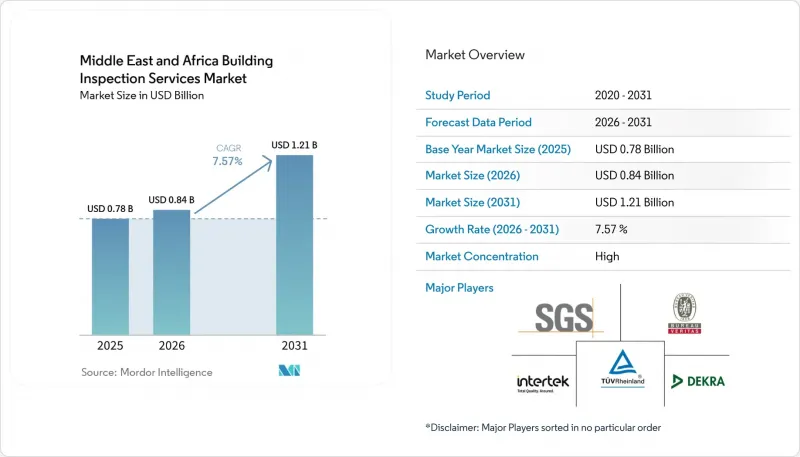
According to Mordor Intelligence, the Middle East and Africa building inspection services market size was valued at USD 0.78 billion in 2025 and is estimated to grow from USD 0.84 billion in 2026 to reach USD 1.21 billion by 2031, at a CAGR of 7.57% during the forecast period (2026-2031).
Middle East and Africa Building Inspection Services Market Trends and Insights
Urban, Tourism, and Infrastructure Megaprojects
Saudi Arabia's committed construction pipeline provides a broad base for building inspection work across power, housing, and hospitality projects. Government-aligned initiatives represented 86% of the Kingdom's committed project spending value in 2025, tying a large share of project activity to public delivery programs. The Middle East and Africa building inspection services market benefits where project owners need documented checks during construction and at handover. Long-term public delivery arrangements place independent inspection within municipal permit and excavation processes. Morocco's 2026 public investment program and preparations for the 2030 World Cup extend demand for structured inspection work into North Africa. These active construction programs make inspection demand less dependent on a single project's schedule.
Fire, Life-Safety, and Occupancy Requirements
Fire and life-safety rules are increasing the frequency of inspections for occupied buildings in the United Arab Emirates. Dubai Civil Defense requirements cover alarm testing, sprinkler flow, fire-pump operation, emergency lighting, and exit-route clearance. The United Arab Emirates Fire and Life Safety Code was updated through Circular No. 3 of 2026, including revised fire-barrier specifications and requirements for buildings between 150 and 500 square meters. The Abu Dhabi Civil Defense Authority required certification for Class G contractors working with firestop and through-penetration systems in June 2025. The Middle East and Africa building inspection services market gains recurring work as owners and facility managers must maintain compliance after occupancy. This turns inspection from a permit-stage activity into an operating requirement for many assets.
Limited Availability of Locally Qualified Inspectors
The limited supply of locally qualified inspectors constrains service capacity, particularly outside established Gulf markets. The Project Management Institute projected that the Middle East and North Africa could require up to 330,794 construction project management professionals by 2035 under its high-growth scenario. It also identified a possible shortfall of 111,737 professionals that could delay infrastructure delivery. Building inspection employers need engineering knowledge alongside drone operation, digital inspection, and data-handling skills. The Middle East and Africa building inspection services market may face longer wait times and higher costs where firms rely on internationally recruited staff. The constraint is particularly material in secondary African cities where accredited inspectors remain scarce.
Other drivers and restraints analyzed in the detailed report include:
- High-Rise, Mixed-Use, and Hospitality Development
- Green-Building and Energy-Efficiency Programs
- Variation in Regulatory Enforcement Across Markets
For complete list of drivers and restraints, kindly check the Table Of Contents.
Segment Analysis
Commercial building inspection services accounted for 46.1% of service revenue in 2025. Their position reflects the concentration of office, retail, hospitality, and mixed-use assets in Dubai, Abu Dhabi, Riyadh, and Johannesburg. These properties require repeat checks for fire safety, building services, structural condition, and post-occupancy compliance. The Middle East and Africa building inspection services market has a stable commercial base because many of these obligations recur during asset operation. Home inspection services remain relevant where property sales are active, and buyers seek pre-purchase reviews. Saudi Arabia's ROSHN-led affordable housing program also supports demand for residential property inspection.
Other specialized services are forecast to grow at a 10.1% CAGR between 2026 and 2031. This category includes drone-based facade review, thermal imaging, digital snagging, and digital-twin delivery. Bureau Veritas provides General Civil Aviation Authority-approved drone services in the United Arab Emirates, producing geo-referenced 3-dimensional models and annotated defect maps that can connect with Building Information Modelling outputs. Specific element inspection services for fire suppression systems, lifts, and facade cladding also give property owners focused options when a full-building review is not needed. Digital snagging and 360-degree reality-capture tools can improve the continuity of records during refurbishment work. These methods make inspection records more useful for facility-management teams and reduce reliance on paper reports.
Outsourced services captured 61.3% of the Middle East and Africa building inspection services market size in 2025. They are also the fastest-growing sourcing type, with a forecast 9.2% CAGR through 2031. Asset owners are using independent providers within project governance and integrated facility-management contracts rather than buying inspections only when a problem arises. This approach can combine inspection, maintenance, and compliance responsibilities within a single service arrangement. The Middle East and Africa building inspection services market benefits when these contracts set ongoing review schedules. Outsourcing also gives clients access to accredited teams and specialist equipment without building every capability internally.
In-house services remain important for government-controlled assets and large industrial operators that maintain their own quality teams. Saudi Arabia's municipal model supports the use of private providers for building permits and excavation inspection. The Saudi Building Code requires inspection activities to be conducted by accredited conformity-assessment entities listed by the Saudi Standards, Metrology, and Quality Organization. That requirement raises the technical standard for internal teams as well as external firms. The sourcing choice depends on an owner's ability to maintain accredited staff and the required infrastructure. The continued move toward contracted delivery indicates that independent inspection is becoming a core part of the built-asset operating model.
Complete Report Scope:
- By Service
- Home Inspection Services
- Specific Element Inspection Services
- Commercial Building Inspection Services
- Other Specialised Services
- By Sourcing Type
- In-House Services
- Outsourced Services
- By Application
- Residential
- Commercial
- Other Applications
- By End User
- Real-Estate Agencies and Brokers
- Property Owners and Investors
- Government and Municipalities
- Insurance and Financial Institutions
- Facility-Management Firms
- By Countries
- Saudi Arabia
- United Arab Emirates
- Nigeria
- Egypt
- South Africa
- Rest of Middle East and Africa
List of Companies Covered in this Report:
- SGS Group
- Bureau Veritas
- Intertek Group plc
- TUV Rheinland AG
- DEKRA SE
- DNV Group AS
- Applus+
- UL Solutions Inc.
- Eurofins Scientific SE
- NV5 Global
- Kiwa Group
- SOCOTEC
- RINA S.p.A.
- Cornerstone Premier Building Inspection Services LLC
- Atom Inspections
- AmeriSpec Inspection Services
- HouseMaster
- Pillar To Post
- InterNACHI
- DEKRA Drone Inspection Services
Additional Benefits:
- The market estimate (ME) sheet in Excel format
- 3 months of analyst support
TABLE OF CONTENTS
1 Introduction
- 1.1 Study Assumptions and Market Definition
- 1.2 Scope of the Study
2 Research Methodology
3 Executive Summary
4 Market Landscape
- 4.1 Market Overview
- 4.2 Market Drivers
- 4.2.1 Urban, Tourism, and Infrastructure Megaprojects
- 4.2.2 Fire, Life-Safety, and Occupancy Requirements
- 4.2.3 High-Rise, Mixed-Use, and Hospitality Development
- 4.2.4 Green-Building and Energy-Efficiency Programmes
- 4.2.5 Digital Snagging and Handover for Developer Portfolios
- 4.2.6 Remote Inspection of Industrial and Desert Assets
- 4.3 Market Restraints
- 4.3.1 Limited Availability of Locally Qualified Inspectors
- 4.3.2 Variation in Regulatory Enforcement Across Markets
- 4.3.3 Unclear Ownership of Digital Inspection Data
- 4.3.4 Project-Cycle Dependence and Uneven Procurement
- 4.4 Value and Supply-Chain Analysis
- 4.5 Regulatory Landscape and Government Initiatives
- 4.6 Technological Outlook
- 4.7 Economic and Market Scenario
- 4.8 Key Industry Trends
- 4.9 Porter's Five Forces Analysis
- 4.9.1 Threat of New Entrants
- 4.9.2 Bargaining Power of Suppliers
- 4.9.3 Bargaining Power of Buyers
- 4.9.4 Threat of Substitutes
- 4.9.5 Competitive Rivalry
5 Middle East and Africa Building Inspection Services Market, Market Size & Growth Forecasts (Value In USD)
- 5.1 By Service
- 5.1.1 Home Inspection Services
- 5.1.2 Specific Element Inspection Services
- 5.1.3 Commercial Building Inspection Services
- 5.1.4 Other Specialised Services
- 5.2 By Sourcing Type
- 5.2.1 In-House Services
- 5.2.2 Outsourced Services
- 5.3 By Application
- 5.3.1 Residential
- 5.3.2 Commercial
- 5.3.3 Other Applications
- 5.4 By End User
- 5.4.1 Real-Estate Agencies and Brokers
- 5.4.2 Property Owners and Investors
- 5.4.3 Government and Municipalities
- 5.4.4 Insurance and Financial Institutions
- 5.4.5 Facility-Management Firms
- 5.5 By Countries
- 5.5.1 Saudi Arabia
- 5.5.2 United Arab Emirates
- 5.5.3 Nigeria
- 5.5.4 Egypt
- 5.5.5 South Africa
- 5.5.6 Rest of Middle East and Africa
6 Competitive Landscape
- 6.1 Market Concentration
- 6.2 Strategic Moves
- 6.3 Company Profiles (includes Global Level Overview, Market Level Overview, Core Segments, Financials as available, Strategic Information, Market Rank/Share, Products and Services, Recent Developments)
- 6.3.1 SGS Group
- 6.3.2 Bureau Veritas
- 6.3.3 Intertek Group plc
- 6.3.4 TUV Rheinland AG
- 6.3.5 DEKRA SE
- 6.3.6 DNV Group AS
- 6.3.7 Applus+
- 6.3.8 UL Solutions Inc.
- 6.3.9 Eurofins Scientific SE
- 6.3.10 NV5 Global
- 6.3.11 Kiwa Group
- 6.3.12 SOCOTEC
- 6.3.13 RINA S.p.A.
- 6.3.14 Cornerstone Premier Building Inspection Services LLC
- 6.3.15 Atom Inspections
- 6.3.16 AmeriSpec Inspection Services
- 6.3.17 HouseMaster
- 6.3.18 Pillar To Post
- 6.3.19 InterNACHI
- 6.3.20 DEKRA Drone Inspection Services
7 Market Opportunities and Future Outlook
- 7.1 White-Space and Unmet-Need Assessment

