PUBLISHER: Mordor Intelligence | PRODUCT CODE: 2163614

PUBLISHER: Mordor Intelligence | PRODUCT CODE: 2163614
Asia Pacific Building Inspection Services - Market Share Analysis, Industry Trends & Statistics, Growth Forecasts (2026 - 2031)
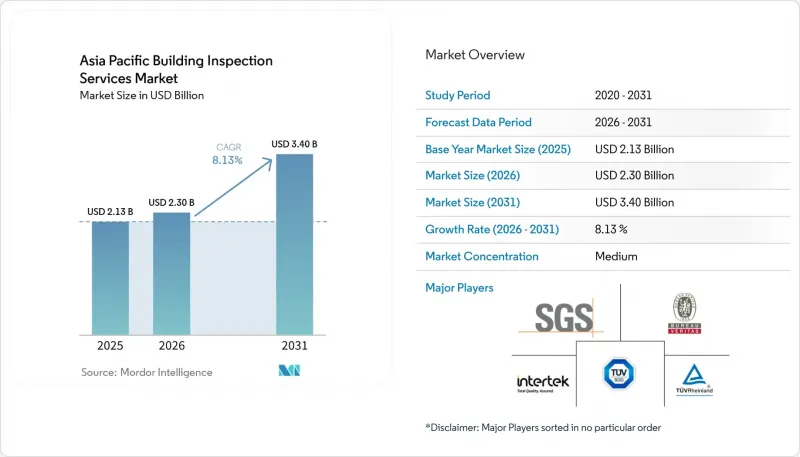
According to Mordor Intelligence, the Asia Pacific building inspection services market size is projected to be USD 2.13 billion in 2025, USD 2.30 billion in 2026, and reach USD 3.40 billion by 2031, growing at a CAGR of 8.13% from 2026 to 2031.
Asia Pacific Building Inspection Services Market Trends and Insights
Urbanization and New-Build Construction
New construction and urban renewal are increasing the number of assets that need assessment before handover, during defect-liability periods, and after occupancy. The Asia Pacific building inspection services market, therefore, benefits from a larger installed base of residential, commercial, and public buildings. The United Nations Economic and Social Commission for Asia and the Pacific projects that the region's urban population, already above 2.2 billion, will increase by 50% by 2050. Greater building density in secondary cities can tighten the availability of qualified inspectors relative to the number of assets. Remote inspection tools can help providers reach difficult terrain and lower-tier cities, although physical verification remains important for many regulated tasks. This setting supports outsourced specialists who can mobilize certified teams across multiple locations.
Smart-City and Green-Building Programs
Green certification and smart-city investment are expanding the inspection work needed to verify building performance and compliance. The World Green Building Council reported that green buildings in the Asia Pacific can command rental premiums of up to 11% and can deliver energy savings of 20% to 60%. These economic benefits give owners a reason to maintain certification through periodic checks rather than treat it as a one-time exercise. Singapore's Green Mark, Australia's Green Star Buildings v1.1, and India's GRIHA framework create a need for documented assessment against stated criteria. The United Nations Development Program noted that the Asia Pacific was expected to receive 40% of global smart-city investment by 2025, increasing the need for protocols suited to connected building systems. Digital defect records for high-rise and large projects can improve accountability where several contractors and public agencies are involved.
Uneven Availability of Skilled Inspectors
A limited supply of qualified inspectors can restrict service capacity even where demand is rising. Jobs and Skills Australia listed Building Inspector as a shortage occupation across every Australian state and territory in its 2025 list. The New South Wales Government committed AUD 9.2 million in 2025 to accelerate building certification and trades licensing approvals. Shortages are especially difficult in residential and small-commercial work, where fee levels may not attract highly credentialed personnel. Providers may respond through training, geographic partnerships, and drone-supported surveys, but technology cannot replace every on-site judgment. The result can be uneven service quality between large cities and less-developed locations.
Other drivers and restraints analyzed in the detailed report include:
- Stronger Handover and Defect-Liability Requirements
- Infrastructure Modernization and Climate Resilience
- Inconsistent Code Enforcement Across Countries and Cities
For complete list of drivers and restraints, kindly check the Table Of Contents.
Segment Analysis
Commercial Building Inspection Services held 43.2% of the Asia Pacific building inspection services market share in 2025, supported by complex compliance and liability requirements for offices, logistics facilities, retail properties, industrial sites, and mixed-use assets. Commercial clients often need documented fire safety, energy performance, facade condition, and mechanical-system checks, while Home Inspection Services and Specific Element Inspection Services continue to serve stable demand pools. Green certification and disclosure expectations reinforce the need for more frequent and detailed assessments in major markets. Commercial work also has high value per engagement because the assets are often large and operationally important.
Other Specialized Services are forecast to grow at a 10.4% CAGR from 2026 to 2031 and include energy audits, indoor air-quality testing, facade-specific inspections, asbestos surveys, acoustic assessment, and green-certification verification. Clients are increasingly awarding these assignments to providers with narrow certifications or technical capabilities rather than buying a single general service. Japan's ERI Inspection Center was formed in July 2025 through the integration of ERISolution and Taito Building and Equipment Inspection Center, offering drone-based exterior-wall surveys, asbestos surveys, and 3D laser scanning under Japan's building standards framework. This shift creates opportunities for specialists and reduces the certainty of broad generalist contracts. At the same time, data-center and semiconductor facilities also require structural, mechanical, electrical, plumbing, commissioning, and thermal-imaging checks.
Outsourced Services accounted for 58.1% of the Asia Pacific building inspection services market size in 2025. The segment's lead reflects the challenge of maintaining certified staff, specialized equipment, and current local-code expertise within a property owner's organization. More detailed requirements for green certification, seismic compliance, defect records, and digital documentation favor external providers that can spread scarce skills across a larger client base. Large state-owned enterprises and public agencies still retain internal teams where they have established technical workforces.
Outsourced Services is also the fastest-growing sourcing channel, with a forecast of 9.3% CAGR through 2031. This combination shows that internal capability building is not keeping pace with the changing scope of inspection work. China's quality-insurance initiatives link third-party inspection to property cover, while the Suzhou Industrial Park pilot indicates that inspection records may have value beyond compliance through tradable carbon assets. In-house teams remain relevant in China and South Korea. Still, rising accreditation and technology-investment needs give the Asia Pacific building inspection services industry a strong incentive to build locally compliant outsourced capacity.
Complete Report Scope:
- By Service
- Home Inspection Services
- Specific Element Inspection Services
- Commercial Building Inspection Services
- Other Specialised Services
- By Sourcing Type
- In-House Services
- Outsourced Services
- By Application
- Residential
- Commercial
- Other Applications
- By End User
- Real-Estate Agencies and Brokers
- Property Owners and Investors
- Government and Municipalities
- Insurance and Financial Institutions
- Facility-Management Firms
- By Countries
- China
- India
- Japan
- South Korea
- Australia
- Indonesia
- Rest of Asia-Pacific
List of Companies Covered in this Report:
- SGS Group
- Bureau Veritas
- Intertek Group plc
- TUV SUD AG
- TUV Rheinland AG
- DEKRA SE
- DNV Group AS
- UL Solutions Inc.
- Applus+
- Eurofins Scientific SE
- NV5 Global
- Kiwa Group
- Quality Built
- Criterium Engineers
- Houspect
- Resicert
- HomeTeam Inspection Service
- InterNACHI
- Pro Inspect Solution (M) Sdn Bhd
- Cornerstone Premier Building Inspection Services LLC
Additional Benefits:
- The market estimate (ME) sheet in Excel format
- 3 months of analyst support
TABLE OF CONTENTS
1 Introduction
- 1.1 Study Assumptions and Market Definition
- 1.2 Scope of the Study
2 Research Methodology
3 Executive Summary
4 Market Landscape
- 4.1 Market Overview
- 4.2 Market Drivers
- 4.2.1 Urbanisation and New-Build Construction
- 4.2.2 Smart-City and Green-Building Programmes
- 4.2.3 Stronger Handover and Defect-Liability Requirements
- 4.2.4 Infrastructure Modernisation and Climate Resilience
- 4.2.5 Remote Inspection for Secondary Cities and Difficult Terrain
- 4.2.6 Digital Defect Records for High-Rise and Megaproject Governance
- 4.3 Market Restraints
- 4.3.1 Uneven Availability of Skilled Inspectors
- 4.3.2 Inconsistent Code Enforcement Across Countries and Cities
- 4.3.3 Limited Interoperability of Digital Inspection Systems
- 4.3.4 Technology-Adoption Gaps Among Smaller Contractors
- 4.4 Value and Supply-Chain Analysis
- 4.5 Regulatory Landscape and Government Initiatives
- 4.6 Technological Outlook
- 4.7 Economic and Market Scenario
- 4.8 Key Industry Trends
- 4.9 Porter's Five Forces Analysis
- 4.9.1 Threat of New Entrants
- 4.9.2 Bargaining Power of Suppliers
- 4.9.3 Bargaining Power of Buyers
- 4.9.4 Threat of Substitutes
- 4.9.5 Competitive Rivalry
5 Asia Pacific Building Inspection Services Market, Market Size & Growth Forecasts (Value In USD)
- 5.1 By Service
- 5.1.1 Home Inspection Services
- 5.1.2 Specific Element Inspection Services
- 5.1.3 Commercial Building Inspection Services
- 5.1.4 Other Specialised Services
- 5.2 By Sourcing Type
- 5.2.1 In-House Services
- 5.2.2 Outsourced Services
- 5.3 By Application
- 5.3.1 Residential
- 5.3.2 Commercial
- 5.3.3 Other Applications
- 5.4 By End User
- 5.4.1 Real-Estate Agencies and Brokers
- 5.4.2 Property Owners and Investors
- 5.4.3 Government and Municipalities
- 5.4.4 Insurance and Financial Institutions
- 5.4.5 Facility-Management Firms
- 5.5 By Countries
- 5.5.1 China
- 5.5.2 India
- 5.5.3 Japan
- 5.5.4 South Korea
- 5.5.5 Australia
- 5.5.6 Indonesia
- 5.5.7 Rest of Asia-Pacific
6 Competitive Landscape
- 6.1 Market Concentration
- 6.2 Strategic Moves
- 6.3 Company Profiles (includes Global Level Overview, Market Level Overview, Core Segments, Financials as available, Strategic Information, Market Rank/Share, Products and Services, Recent Developments)
- 6.3.1 SGS Group
- 6.3.2 Bureau Veritas
- 6.3.3 Intertek Group plc
- 6.3.4 TUV SUD AG
- 6.3.5 TUV Rheinland AG
- 6.3.6 DEKRA SE
- 6.3.7 DNV Group AS
- 6.3.8 UL Solutions Inc.
- 6.3.9 Applus+
- 6.3.10 Eurofins Scientific SE
- 6.3.11 NV5 Global
- 6.3.12 Kiwa Group
- 6.3.13 Quality Built
- 6.3.14 Criterium Engineers
- 6.3.15 Houspect
- 6.3.16 Resicert
- 6.3.17 HomeTeam Inspection Service
- 6.3.18 InterNACHI
- 6.3.19 Pro Inspect Solution (M) Sdn Bhd
- 6.3.20 Cornerstone Premier Building Inspection Services LLC
7 Market Opportunities and Future Outlook
- 7.1 White-Space and Unmet-Need Assessment

