PUBLISHER: Mordor Intelligence | PRODUCT CODE: 2185246

PUBLISHER: Mordor Intelligence | PRODUCT CODE: 2185246
Vietnam Third-party Logistics - Market Share Analysis, Industry Trends & Statistics, Growth Forecasts (2027 - 2032)
According to Mordor Intelligence, the Vietnam third-party logistics market was valued at USD 4.74 billion in 2026 and is estimated to reach USD 5.11 billion in 2027 and USD 7.37 billion by 2032, registering a CAGR of 7.59% during 2027-2032.
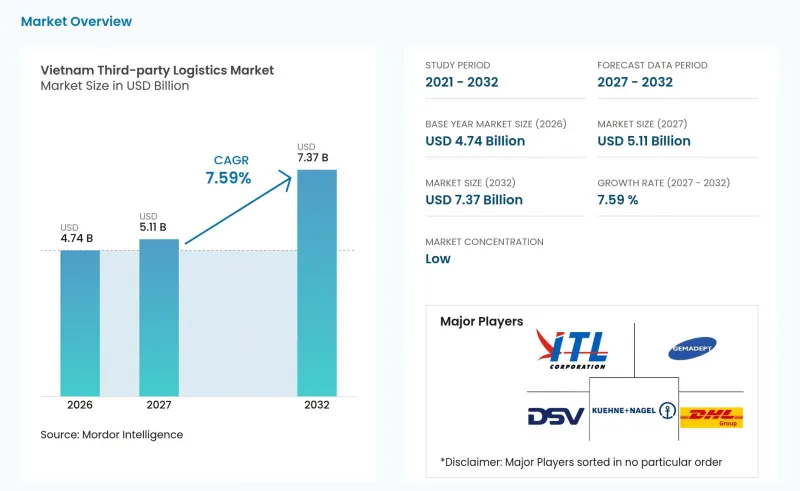
Manufacturing investment, international trade, and the expansion of e-commerce are supporting demand for outsourced transportation, warehousing, freight forwarding, and distribution services. This report is Segmented by Service (Domestic, International Transportation, and More), by End-Use Application (Automotive, Energy and Utilities, Manufacturing, Life Sciences and Healthcare, Technology and Electronics, and More), by Logistics Model (Asset-Light, Asset-Heavy, Hybrid), and by Region (Northern, Central, Southern Vietnam). The Market Forecasts are Provided in Terms of Value (USD).
Vietnam Third-party Logistics Market Trends and Insights
Export Manufacturing Growth Increasing Integrated Logistics Demand
Manufacturing investment is supporting demand for outsourced logistics across Vietnam. The National Statistics Office reported that realized foreign direct investment (FDI) reached USD 27.62 billion in 2025, with manufacturing and processing accounting for 82.8% of disbursed FDI. These investments generate demand for inbound raw-material transportation, factory-side logistics, inventory management, and export distribution. Electronics, machinery, automotive components, and other manufactured goods may require coordinated transport, specialized handling, and reliable connections to airports and seaports. The market therefore benefits from providers that can combine domestic transportation with warehousing, customs coordination, and international freight services.
E-commerce Expansion Accelerating Fulfillment and Delivery Outsourcing
Vietnam's expanding e-commerce sector is creating demand for order fulfillment, inventory management, parcel distribution, and returns handling. Vietnam's online retail market continues to expand rapidly, reflecting stronger consumer adoption of digital shopping channels and rising demand for faster, more reliable fulfilment. This growth is increasing the need for scalable warehousing, last-mile delivery, and technology-enabled logistics networks across the country. As online transactions expand, retailers and marketplace sellers need logistics networks capable of processing smaller orders, handling changing demand, and delivering to customers across urban and regional markets. These requirements support the use of outsourced fulfillment centers, transport networks, and distribution services.
Fragmented Transport Networks Reducing Service Consistency and Scale
Vietnam's logistics network combines road, inland waterway, rail, air, and maritime transportation, but the availability and efficiency of connections differ by location. Gaps in supporting infrastructure, congestion around industrial areas, and uneven access to inland logistics facilities can increase travel times and complicate shipment planning. These conditions make it more difficult for 3PL providers to maintain consistent service levels across routes, particularly when shipments involve several transport modes or locations outside the main industrial corridors. The country's logistics costs were estimated at approximately 16-17% of GDP in the Vietnam Logistics Report 2025, highlighting the continuing importance of improving transport and supply-chain efficiency.
Other drivers and restraints analyzed in the detailed report include:
- Digital Customs Improving Cross-Border Logistics Integration Efficiency
- Enterprise Outsourcing Expanding Warehousing and Transport Demand
- Skilled Labor Shortages Constraining Logistics Technology Adoption
For complete list of drivers and restraints, kindly check the Table Of Contents.
Segment Analysis
Domestic transportation management accounted for 62.45% of the Vietnam third-party logistics market share in 2026. Its leading position reflects the importance of moving goods between manufacturing facilities, suppliers, warehouses, distribution centers, and ports. This pattern highlights the expanding role of Vietnam freight and logistics services in supporting domestic and cross-border supply chains. Road transportation remains important for domestic freight movements, while international freight forwarding and customs coordination support cross-border supply chains. Businesses increasingly seek providers that can coordinate transport with inventory handling and distribution, particularly when goods pass through several facilities before reaching customers.
The value-added warehousing and distribution segment is projected to register at a CAGR of 9.26% during 2027-2032. Manufacturers and retailers require more than storage alone, creating opportunities for order picking, packing, labeling, inventory management, and distribution coordination. In September 2025, Kuehne+Nagel and the LEGO Group opened a regional distribution center in Dong Nai to support distribution across Asia-Pacific. The facility provides an example of how warehousing can be integrated with customs clearance, sea freight, and regional distribution services.
Complete Report Scope:
- By Service
- Domestic Transportation Management (DTM)
- Roadways
- Railways
- Airways
- Waterways
- International Transportation Management (ITM)
- Roadways
- Railways
- Airways
- Waterways
- Value-Added Warehousing and Distribution (VAWD)
- Domestic Transportation Management (DTM)
- By End-Use Application
- Automotive
- Energy and Utilities
- Manufacturing
- Life Sciences and Healthcare
- Technology and Electronics
- Retail and E-commerce
- Consumer Goods and FMCG
- Food and Beverages
- Others
- By Logistics Model
- Asset-Light
- Asset-Heavy
- Hybrid
- By Region
- Northern Vietnam
- Central Vietnam
- Southern Vietnam
List of Companies Covered in this Report:
- DHL Supply Chain
- Gemadept Corporation
- Indo Trans Logistics Corporation (ITL)
- Transimex Corporation
- DSV
- Kuehne+Nagel
- CEVA Logistics
- Nippon Express Holdings
- Maersk
- Kerry Logistics
- CJ Logistics
- Viettel Post
- Vietnam Post Logistics
- Vinafco Corporation
- Bee Logistics Corporation
- Saigon Newport Corporation
- Yusen Logistics
- FedEx
- UPS
- Expeditors International
- FM Logistic Vietnam
- Rhenus Logistics Vietnam
Additional Benefits:
- The market estimate (ME) sheet in Excel format
- 3 months of analyst support
TABLE OF CONTENTS
1 INTRODUCTION
- 1.1 Study Assumptions and Market Definition
- 1.2 Scope of the Study
2 RESEARCH METHODOLOGY
3 EXECUTIVE SUMMARY
- 3.1 Market Size, Growth, and Forecast Outlook
- 3.2 Key Demand Drivers and 3PL Market Trends
- 3.3 Major Logistics Corridors and Demand Concentration
- 3.4 Competitive Landscape and Leading 3PL Providers
4 MARKET LANDSCAPE
- 4.1 Market Overview and Importance of Third-Party Logistics
- 4.2 Market Drivers
- 4.2.1 Export Manufacturing Growth Increasing Integrated Logistics Demand
- 4.2.2 E-Commerce Expansion Accelerating Fulfillment and Delivery Outsourcing
- 4.2.3 Digital Customs Improving Cross-Border Logistics Integration Efficiency
- 4.2.4 Enterprise Outsourcing Expanding Warehousing and Transport Demand
- 4.2.5 Cold-Chain Requirements Increasing Specialized Logistics Service Adoption
- 4.2.6 Energy Projects Driving Complex Project Logistics Requirements
- 4.3 Market Restraints
- 4.3.1 Fragmented Transport Networks Reducing Service Consistency and Scale
- 4.3.2 Skilled Labor Shortages Constraining Logistics Technology Adoption
- 4.3.3 Inland Bottlenecks Disrupting Multimodal Logistics Network Efficiency
- 4.3.4 Compliance Costs Pressuring Smaller Logistics Service Providers
- 4.4 Value Chain Structure and 3PL Service Flow Analysis
- 4.5 Regulatory Framework and Logistics Compliance Requirements Analysis
- 4.6 Technology Adoption and Logistics Digitalization Trend Analysis
- 4.7 Warehousing Capacity and Distribution Network Development Analysis
- 4.8 Regional Logistics Infrastructure and Connectivity Development Analysis
- 4.9 Freight Rate Trends and Transportation Cost Analysis
- 4.10 Porter's Five Forces Analysis
- 4.10.1 Threat of New Entrants
- 4.10.2 Bargaining Power of Buyers
- 4.10.3 Bargaining Power of Suppliers
- 4.10.4 Threat of Substitute Services
- 4.10.5 Intensity of Competitive Rivalry
- 4.11 Impact of Geo-Political Events on Supply Chain Shifts
5 MARKET SIZE AND GROWTH FORECASTS
- 5.1 By Service
- 5.1.1 Domestic Transportation Management (DTM)
- 5.1.1.1 Roadways
- 5.1.1.2 Railways
- 5.1.1.3 Airways
- 5.1.1.4 Waterways
- 5.1.2 International Transportation Management (ITM)
- 5.1.2.1 Roadways
- 5.1.2.2 Railways
- 5.1.2.3 Airways
- 5.1.2.4 Waterways
- 5.1.3 Value-Added Warehousing and Distribution (VAWD)
- 5.1.1 Domestic Transportation Management (DTM)
- 5.2 By End-Use Application
- 5.2.1 Automotive
- 5.2.2 Energy and Utilities
- 5.2.3 Manufacturing
- 5.2.4 Life Sciences and Healthcare
- 5.2.5 Technology and Electronics
- 5.2.6 Retail and E-commerce
- 5.2.7 Consumer Goods and FMCG
- 5.2.8 Food and Beverages
- 5.2.9 Others
- 5.3 By Logistics Model
- 5.3.1 Asset-Light
- 5.3.2 Asset-Heavy
- 5.3.3 Hybrid
- 5.4 By Region
- 5.4.1 Northern Vietnam
- 5.4.2 Central Vietnam
- 5.4.3 Southern Vietnam
6 COMPETITIVE LANDSCAPE
- 6.1 Market Concentration
- 6.2 Strategic Moves
- 6.3 Market Share Analysis
- 6.4 Company Profiles (includes Global Level Overview, Market Level Overview, Core Segments, Financials as available, Strategic Information, Geographic Coverage, Products and Services, Recent Developments)
- 6.4.1 DHL Supply Chain
- 6.4.2 Gemadept Corporation
- 6.4.3 Indo Trans Logistics Corporation (ITL)
- 6.4.4 Transimex Corporation
- 6.4.5 DSV
- 6.4.6 Kuehne+Nagel
- 6.4.7 CEVA Logistics
- 6.4.8 Nippon Express Holdings
- 6.4.9 Maersk
- 6.4.10 Kerry Logistics
- 6.4.11 CJ Logistics
- 6.4.12 Viettel Post
- 6.4.13 Vietnam Post Logistics
- 6.4.14 Vinafco Corporation
- 6.4.15 Bee Logistics Corporation
- 6.4.16 Saigon Newport Corporation
- 6.4.17 Yusen Logistics
- 6.4.18 FedEx
- 6.4.19 UPS
- 6.4.20 Expeditors International
- 6.4.21 FM Logistic Vietnam
- 6.4.22 Rhenus Logistics Vietnam
7 MARKET OPPORTUNITIES AND FUTURE OUTLOOK
- 7.1 White-Space Opportunities and Unmet 3PL Service Needs
- 7.2 High-Potential End-User Segments and Growth Opportunities
- 7.3 Strategic Growth Priorities Across 3PL Ecosystem
- 7.4 Future Market Outlook and Emerging Demand Pockets
8 APPENDIX

