PUBLISHER: Mordor Intelligence | PRODUCT CODE: 2187217

PUBLISHER: Mordor Intelligence | PRODUCT CODE: 2187217
Philippines Solar Energy - Market Share Analysis, Industry Trends & Statistics, Growth Forecasts (2027 - 2032)
According to Mordor Intelligence, the Philippines solar energy market size is projected to expand from 5.43 gigawatt in 2026 and 6.94 gigawatt in 2027 to 23.35 gigawatt by 2032, registering a CAGR of 27.46% between 2027 and 2032.
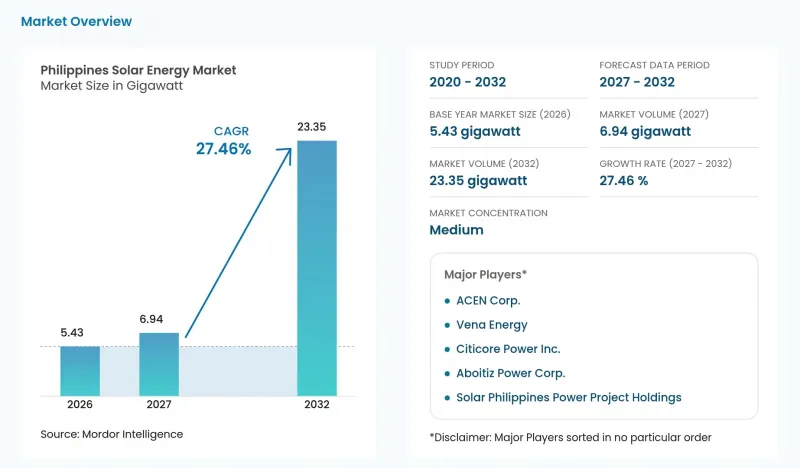
This report is segmented by Technology (Solar Photovoltaic and Concentrated Solar Power), Grid Type (On-Grid and Off-Grid), End-User (Utility-Scale, Commercial and Industrial, and more), and Component (Solar Modules/Panels, Inverters, and more). The market forecasts are provided in terms of volume (gigawatt), based on availability.
Philippines Solar Energy Market Trends and Insights
Rapid decline in PV module & BOS costs
The affordability effect of cheaper solar hardware depends on the cost of turning it into an installed system. The IEA Photovoltaic Power Systems Programme reported that very low module costs supported further global PV market growth in 2025. Ember estimated that Philippine solar installation costs fell roughly 10% from May 2025 to May 2026. For rooftop buyers, that local reduction strengthens the investment case for a complete installation, while global module prices provide an input-cost backdrop. The potential demand benefit extends to installers and associated electrical and mounting work as more households can consider a rooftop system.
Green energy auctions (GEAP) unlocking >=1 GW solar pipeline from 2025
Auction selection gives solar developers a defined route from a project proposal into a named national development pipeline. DOE's 2025 GEA-4 winning-bidder list recorded offered capacities of 630 MW for SMC Global Light and Power Corp.'s Cauayan ground-mounted solar project, Phase 2, and 540 MW for its Angat floating-solar project, Phase 1. Together, the offers total 1,170 MW, exceeding 1 GW, with delivery commencement listed for January 2028 for both projects. Their common developer concentrates execution exposure, so these offers represent a dated procurement opportunity conditional on project progress. Advancing them would create demand for modules, mounting structures, floating systems, and EPC services across 2 solar formats.
Weak grid capacity in Visayas-Mindanao corridor
Transmission constraints complicate how solar developers turn a completed generating asset into electricity that buyers can use. On September 7, 2026, DOE said it was assessing transmission constraints across the Visayas, including the Leyte-Samar corridor, for possible infrastructure improvements. For a developer, a constrained network can separate the readiness of a solar plant from the deliverability of its output. A completed Visayas plant unable to deliver output would earn no revenue from that output while financing costs continued, reducing project returns.
Other drivers and restraints analyzed in the detailed report include:
- Corporate PPAs by hyperscalers & BPOs demanding 24/7 clean power
- DOE net-metering reform lifting 100 kW cap to 1 MW (2024)
- High financing costs vs. Vietnam & Malaysia (>=9 % WACC)
For complete list of drivers and restraints, kindly check the Table Of Contents.
Segment Analysis
Solar photovoltaic (PV) accounted for a 100% share of the Philippines solar energy market size in 2026 and is the fastest-growing segment, with a projected CAGR of 27.46% between 2027 and 2032. IRENA recorded 3,892 MW of Philippine PV capacity at year-end 2025, up from 2,993 MW at year-end 2024. With no concentrated solar power (CSP) in the technology split, all forecast capacity growth comes from PV additions.
PV adoption also extends through arrangements that separate industrial electricity consumption from upfront equipment expenditure. TotalEnergies ENEOS Renewables Distributed Generation Asia commissioned a 1.9 MWp rooftop PV system at SteelAsia's Meycauayan plant in Bulacan on March 4, 2025. Under the 10-year agreement, TotalEnergies ENEOS funded and installed the system and undertook to operate it, while SteelAsia purchases the electricity without additional upfront costs. That structure broadens the PV proposition from equipment acquisition to a contracted electricity service, making the provider's long-term operating obligation central to the customer's offer.
On-grid installations represented a 97.07% Philippines solar energy market share in 2026, making them the largest segment. DOE reported 3,544 MW of installed solar capacity on the national grid in 2025. For grid-connected developers, the key commercial task is to align generating assets with their route to delivery, since installed megawatts describe plant capability rather than electricity sold.
Off-grid installations are the fastest-growing segment, with a projected CAGR of 30.85% between 2027 and 2032. On April 26, 2026, the National Power Corporation transported 243 solar home systems to remote Sitangkai, Tawi-Tawi, with the local government and the 2nd Marine Brigade. That household channel makes transport to dispersed beneficiaries a distinct task alongside supplying the system. The value of delivery ultimately depends on turning transported equipment into usable electricity access for the intended households. The NPC delivery places transport with a public agency and local partners, giving equipment suppliers an identifiable institutional counterpart.
Complete Report Scope:
- By Technology
- Solar Photovoltaic (PV)
- Concentrated Solar Power (CSP)
- By Grid Type
- On-Grid
- Off-Grid
- By End-User
- Utility-Scale
- Commercial and Industrial (C&I)
- Residential
- By Component (Qualitative Analysis)
- Solar Modules/Panels
- Inverters (String, Central, Micro)
- Mounting and Tracking Systems
- Balance-of-System and Electricals
- Energy Storage and Hybrid Integration
List of Companies Covered in this Report:
- Solar Philippines Power Project Holdings
- ACEN Corp.
- Vena Energy
- Citicore Power Inc.
- Aboitiz Power Corp.
- Solenergy Systems Inc.
- SunAsia Energy
- Helios Solar Energy Corp.
- Cleantech Global Renewables
- Trina Solar Ltd.
- Canadian Solar
- JinkoSolar
- First Gen Corp.
- Meralco PowerGen (MGen)
- Shell Pilipinas - Solar
- TotalEnergies - Solar
- NextGen Power
- Enfinity Global
- Rizal Wind-Solar Energy Corp.
- Greenergy Holdings
Additional Benefits:
- The market estimate (ME) sheet in Excel format
- 3 months of analyst support
TABLE OF CONTENTS
1 INTRODUCTION
- 1.1 Study Assumptions and Market Definition
- 1.2 Scope of the Study
2 RESEARCH METHODOLOGY
3 EXECUTIVE SUMMARY
4 MARKET LANDSCAPE
- 4.1 Market Overview
- 4.2 Market Drivers
- 4.2.1 Rapid decline in PV module & BOS costs
- 4.2.2 Green energy auctions (GEAP) unlocking >=1 GW solar pipeline from 2025
- 4.2.3 Corporate PPAs by hyperscalers & BPOs demanding 24/7 clean power
- 4.2.4 DOE net-metering reform lifting 100 kW cap to 1 MW (2024)
- 4.2.5 Floating-solar deployment on irrigation reservoirs (National Irrigation Administration-DOE MoA)
- 4.2.6 ASEAN-wide carbon border adjustment pressure on export manufacturers
- 4.3 Market Restraints
- 4.3.1 Weak grid capacity in Visayas-Mindanao corridor
- 4.3.2 High financing costs vs. Vietnam & Malaysia (>=9 % WACC)
- 4.3.3 Land-acquisition disputes under CARP agrarian rules
- 4.3.4 Typhoon-related O&M disruptions raising LCOE
- 4.4 Industry Value Chain Analysis
- 4.5 Regulatory Landscape
- 4.6 Technological Outlook
- 4.7 Porter's Five Forces Analysis
- 4.7.1 Threat of New Entrants
- 4.7.2 Bargaining Power of Suppliers
- 4.7.3 Bargaining Power of Buyers
- 4.7.4 Threat of Substitutes
- 4.7.5 Competitive Rivalry
- 4.8 PESTLE Analysis
5 MARKET SIZE AND GROWTH FORECASTS (VOLUME)
- 5.1 By Technology
- 5.1.1 Solar Photovoltaic (PV)
- 5.1.2 Concentrated Solar Power (CSP)
- 5.2 By Grid Type
- 5.2.1 On-Grid
- 5.2.2 Off-Grid
- 5.3 By End-User
- 5.3.1 Utility-Scale
- 5.3.2 Commercial and Industrial (C&I)
- 5.3.3 Residential
- 5.4 By Component (Qualitative Analysis)
- 5.4.1 Solar Modules/Panels
- 5.4.2 Inverters (String, Central, Micro)
- 5.4.3 Mounting and Tracking Systems
- 5.4.4 Balance-of-System and Electricals
- 5.4.5 Energy Storage and Hybrid Integration
6 COMPETITIVE LANDSCAPE
- 6.1 Market Concentration
- 6.2 Strategic Moves
- 6.3 Market Share Analysis
- 6.4 Company Profiles (includes Global level Overview, Market level overview, Core Segments, Financials as available, Strategic Information, Market Rank/Share for key companies, Products and Services, and Recent Developments)
- 6.4.1 Solar Philippines Power Project Holdings
- 6.4.2 ACEN Corp.
- 6.4.3 Vena Energy
- 6.4.4 Citicore Power Inc.
- 6.4.5 Aboitiz Power Corp.
- 6.4.6 Solenergy Systems Inc.
- 6.4.7 SunAsia Energy
- 6.4.8 Helios Solar Energy Corp.
- 6.4.9 Cleantech Global Renewables
- 6.4.10 Trina Solar Ltd.
- 6.4.11 Canadian Solar
- 6.4.12 JinkoSolar
- 6.4.13 First Gen Corp.
- 6.4.14 Meralco PowerGen (MGen)
- 6.4.15 Shell Pilipinas - Solar
- 6.4.16 TotalEnergies - Solar
- 6.4.17 NextGen Power
- 6.4.18 Enfinity Global
- 6.4.19 Rizal Wind-Solar Energy Corp.
- 6.4.20 Greenergy Holdings
7 MARKET OPPORTUNITIES AND FUTURE OUTLOOK
- 7.1 White-Space and Unmet-Need Assessment

