PUBLISHER: Mordor Intelligence | PRODUCT CODE: 2187407

PUBLISHER: Mordor Intelligence | PRODUCT CODE: 2187407
United States Commercial Construction - Market Share Analysis, Industry Trends & Statistics, Growth Forecasts (2027 - 2032)
According to Mordor Intelligence, the United States commercial construction market size was valued at USD 567.1 billion in 2026 and estimated to grow from USD 591 billion in 2027 to reach USD 713.9 billion by 2032, at a CAGR of 3.85% during the forecast period (2027-2032).
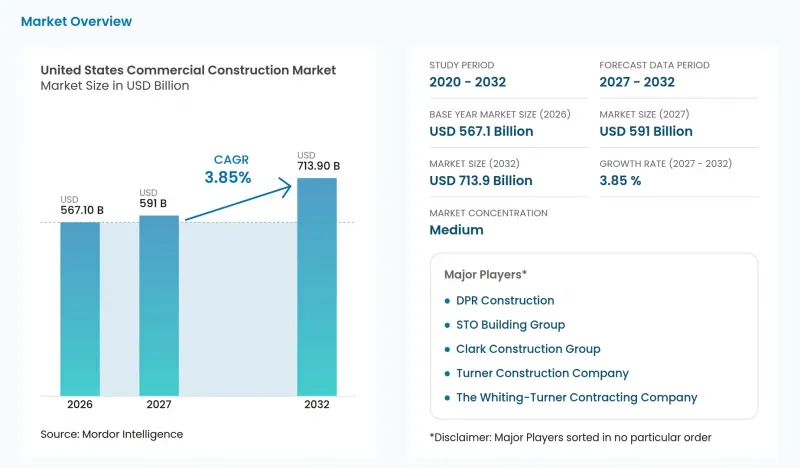
This report is segmented by Commercial Sector Type (Office, Industrial & Logistics, Others, and Retail), Construction Type (New Construction and Renovation), Investment Source (Private and Public), and Geography (Rest of US, Texas, California, Florida, New York, and Illinois). The market forecasts are provided in terms of value (USD), based on availability.
United States Commercial Construction Market Trends and Insights
E-commerce expansion is fueling build-outs of warehouses, distribution centers, and fulfillment hubs.
Online order growth can create construction demand where delivery coverage requires additional operating locations. Census estimated seasonally adjusted US retail e-commerce sales grew 12.2% (+-0.9%) from Q2 2025 to Q2 2026, without adjusting for price changes. Total retail sales increased 6.7% (+-0.5%) over the same period. Amazon reported USD 4 billion invested in its rural US delivery network and a goal of exceeding 200 delivery stations by the end of 2026. Average monthly rural customers receiving its same-day delivery had doubled year over year in 2025. For commercial builders, this combination ties demand to delivery-station placement, so proximity to underserved customers explains potential new projects better than online sales growth alone.
Office retrofit and redevelopment is rising as employers seek more modern, hybrid-ready workplaces.
Tenant selectivity can support office upgrading even when substantial space is available in the surrounding property market. JLL reported office vacancy of 25% in Northern and Central New Jersey in Q2 2026. Tenant demand concentrated in Premier Class A offices, defined as buildings built or extensively renovated within the past decade. The coexistence of vacancy and demand for that tier suggests owners can face a quality gap even where the wider area has spare floor space. Extensive renovation therefore serves a different purpose from adding office space, because it lets an existing building qualify for the preferred tier.
Skilled labor shortages and wage pressure are slowing project delivery and increasing costs.
Labor availability can restrict how much data-center work contractors can accept without increasing delivery risk. In the July-August 2026 AGC-NCCER survey, 37% of respondents whose firms performed data-center construction in the prior 12 months identified worker or subcontractor availability as their biggest challenge in pursuing or delivering those projects. Among that same subgroup, 49% reported that those projects increased wage pressure. For contractors, expanding capacity therefore involves exposure to labor costs alongside the challenge of securing crews. In summer 2025, HITT Contracting hosted 140 interns from more than 60 universities as part of its construction workforce pipeline. Such a pipeline offers a longer-term response, while near-term bids must accommodate the cost of scarce delivery capacity.
Other drivers and restraints analyzed in the detailed report include:
- Data center growth is accelerating with new AI, cloud, and edge computing infrastructure.
- Hospitality and mixed-use projects are recovering, driven by strong travel and retail demand.
- High material and freight inflation is compressing margins and delaying budgets.
For complete list of drivers and restraints, kindly check the Table Of Contents.
Segment Analysis
Office accounted for a 34.99% share of the United States commercial construction market size in 2026, making it the largest segment. US private office construction spending, a Census category that includes data-center buildings, ran at a seasonally adjusted annual rate of USD 150.7 billion in August 2026. Initial construction activity at 2 World Trade Center began in March 2026, with completion anticipated in 2031. American Express identifies itself as owner and occupant of the planned tower, with nearly 2 million square feet of building area, 55 floors, and capacity for up to 10,000 colleagues. Data-center activity lifts that statistical category, while a headquarters such as 2 World Trade Center adds a long-dated, occupier-led workload.
Industrial & logistics is the fastest-growing segment, with a forecast CAGR of 5.1% during 2027-2032. The US Census Bureau recorded USD 64.8 billion in private nonresidential warehouse construction put in place in 2025. Private manufacturing-site construction put in place totaled USD 114.6 billion from January through August 2026, down 22.2% from the same 2025 period. Warehouse construction of that scale gives logistics a sizable base of delivery work, while the decline in manufacturing-site construction places current weakness in factory building. The Others segment includes private lodging construction, which totaled USD 22.9 billion in 2025, down 3.3% from 2024.
Complete Report Scope:
- By Commercial Sector Type
- Office
- Retail
- Industrial & Logistics
- Others
- By Construction Type
- New Construction
- Renovation
- By Investment Source
- Public
- Private
- By Geography
- Texas
- California
- Florida
- New York
- Illinois
- Rest of US
List of Companies Covered in this Report:
- Turner Construction Company
- The Whiting-Turner Contracting Company
- STO Building Group
- DPR Construction
- Clark Construction Group
- Gilbane Building Company
- PCL Construction
- Hensel Phelps
- JE Dunn Construction
- McCarthy Building Companies
- Mortenson
- Lendlease (US)
- Balfour Beatty US
- HITT Contracting
- Webcor
- Layton Construction
- Pepper Construction
- Brasfield & Gorrie
- Ryan Companies US
- Swinerton
- The Walsh Group
- Holder Construction
Additional Benefits:
- The market estimate (ME) sheet in Excel format
- 3 months of analyst support
TABLE OF CONTENTS
1 INTRODUCTION
- 1.1 Study Assumptions and Market Definition
- 1.2 Scope of the Study
2 RESEARCH METHODOLOGY
3 EXECUTIVE SUMMARY
4 MARKET LANDSCAPE
- 4.1 Market Overview
- 4.2 Market Drivers
- 4.2.1 E-commerce expansion is fueling build-outs of warehouses, distribution centers, and fulfillment hubs.
- 4.2.2 Office retrofit and redevelopment is rising as employers seek more modern, hybrid-ready workplaces.
- 4.2.3 Data center growth is accelerating with new AI, cloud, and edge computing infrastructure.
- 4.2.4 Hospitality and mixed-use projects are recovering, driven by strong travel and retail demand.
- 4.2.5 Public investment in transit and civic facilities is sparking construction in infrastructure-adjacent zones.
- 4.2.6 Green-building and ESG focus is driving new commercial developments toward certified designs.
- 4.3 Market Restraints
- 4.3.1 Skilled labor shortages and wage pressure are slowing project delivery and increasing costs.
- 4.3.2 High material and freight inflation is compressing margins and delaying budgets.
- 4.3.3 Tight lending conditions and rising interest rates are hindering financing of speculative projects.
- 4.3.4 Permitting delays and zoning restrictions are prolonging pre-construction phases.
- 4.4 Industry Value Chain Analysis
- 4.5 Regulatory Landscape
- 4.6 Technological Outlook
- 4.7 Porter's Five Forces Analysis
- 4.7.1 Threat of New Entrants
- 4.7.2 Bargaining Power of Suppliers
- 4.7.3 Bargaining Power of Buyers
- 4.7.4 Threat of Substitutes
- 4.7.5 Competitive Rivalry
- 4.8 Government Initiatives and Vision
- 4.9 Pricing (Construction Materials) and Construction Cost (Materials, Labour, Equipment) Analysis
- 4.10 Comparison of Key Industry Metrics of United States with Other Countries
- 4.11 Key Upcoming/Ongoing Projects (with a focus on Mega Projects)
5 MARKET SIZE AND GROWTH FORECASTS (VALUE)
- 5.1 By Commercial Sector Type
- 5.1.1 Office
- 5.1.2 Retail
- 5.1.3 Industrial & Logistics
- 5.1.4 Others
- 5.2 By Construction Type
- 5.2.1 New Construction
- 5.2.2 Renovation
- 5.3 By Investment Source
- 5.3.1 Public
- 5.3.2 Private
- 5.4 By Geography
- 5.4.1 Texas
- 5.4.2 California
- 5.4.3 Florida
- 5.4.4 New York
- 5.4.5 Illinois
- 5.4.6 Rest of US
6 COMPETITIVE LANDSCAPE
- 6.1 Market Concentration
- 6.2 Strategic Moves
- 6.3 Market Share Analysis
- 6.4 Company Profiles (includes Global level Overview, Market level overview, Core Segments, Financials as available, Strategic Information, Market Rank/Share for key companies, Products and Services, and Recent Developments)
- 6.4.1 Turner Construction Company
- 6.4.2 The Whiting-Turner Contracting Company
- 6.4.3 STO Building Group
- 6.4.4 DPR Construction
- 6.4.5 Clark Construction Group
- 6.4.6 Gilbane Building Company
- 6.4.7 PCL Construction
- 6.4.8 Hensel Phelps
- 6.4.9 JE Dunn Construction
- 6.4.10 McCarthy Building Companies
- 6.4.11 Mortenson
- 6.4.12 Lendlease (US)
- 6.4.13 Balfour Beatty US
- 6.4.14 HITT Contracting
- 6.4.15 Webcor
- 6.4.16 Layton Construction
- 6.4.17 Pepper Construction
- 6.4.18 Brasfield & Gorrie
- 6.4.19 Ryan Companies US
- 6.4.20 Swinerton
- 6.4.21 The Walsh Group
- 6.4.22 Holder Construction
7 MARKET OPPORTUNITIES AND FUTURE OUTLOOK
- 7.1 White-Space and Unmet-Need Assessment

