PUBLISHER: Mordor Intelligence | PRODUCT CODE: 2187645

PUBLISHER: Mordor Intelligence | PRODUCT CODE: 2187645
Philippines E-commerce - Market Share Analysis, Industry Trends & Statistics, Growth Forecasts (2027 - 2032)
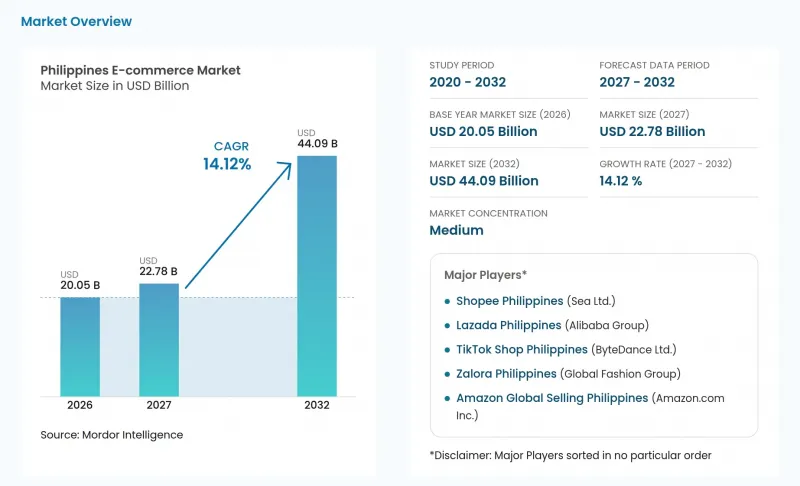
According to Mordor Intelligence, the Philippines e-commerce market size is projected to expand from USD 20.05 billion in 2026 and USD 22.78 billion in 2027 to USD 44.09 billion by 2032, registering a CAGR of 14.12% between 2027 and 2032.
Philippines E-commerce Market Trends and Insights
Soaring mobile-wallet penetration (GCash, Maya)
An established e-money account base provides a pool of potential digital payers for online merchants. E-money account ownership among Filipino adults was 36% in 2025, steady from 2021, according to the Bangko Sentral ng Pilipinas (BSP) Consumer Finance and Inclusion Survey. The GSM Association (GSMA) described in December 2025 an online payment route in which users select GCash at a merchant checkout gateway and validate the payment by SMS. That connection lets an existing wallet account become a means of paying for an online order, giving merchants a way to serve holders who choose it. Wallet-led demand can develop through wider acceptance and more purchases per account even when the adult ownership share holds steady.
Logistics mini-hubs in provincial cities
Provincial fulfillment locations can change which orders are commercially practical for logistics operators to serve. In 2025, J&T Express launched a Cagayan de Oro forward warehouse for physical warehousing and forward fulfillment. The launch added a provincial location to the operator's logistics network. Positioning goods at such a node can shorten the portion of an order's route that must be handled after the order is placed. A forward-fulfillment model can shift part of the distribution task ahead of the final customer order, potentially making a wider service area feasible. Merchants serving buyers far from their main stock point stand to benefit most, because pre-positioning can remove a long dispatch leg from each subsequent order.
High last-mile costs outside NCR
Provincial delivery charges can absorb a disproportionate part of the economics of a small online order. In its June 27, 2026 rate card, GoGo Xpress priced a 24 by 36 centimeter pouch weighing up to 3 kilograms at PHP 200 (USD 3.27) from Greater Metro Manila to Mindanao. The comparable within-Greater Metro Manila price was PHP 71.43 (USD 1.17), with both tariffs subject to VAT. Greater Metro Manila includes Metro Manila and specified surrounding cities, making this a comparison of the courier's defined delivery zones. For merchants serving these destinations, the higher charge raises the minimum order value needed to spread delivery expense economically. Absorbing that difference reduces the seller's proceeds, while passing it through raises the buyer's delivered price.
Other drivers and restraints analyzed in the detailed report include:
- Rapid cross-border social-commerce adoption
- Digital-payment mandates for government fees
- Fragmented VAT compliance among merchants
For complete list of drivers and restraints, kindly check the Table Of Contents.
Segment Analysis
B2C accounted for a 91.64% share of the Philippines e-commerce market size in 2026. Philippine video-commerce transaction volume rose 35% year over year in 2025. Within video-led B2C selling, that increase adds transactions for platforms and sellers to process. Over the same year, the number of Philippine video-commerce sellers and stores rose 90%, so transaction growth accompanied a much larger seller base.
B2B is forecast to be the fastest-growing segment, with a CAGR of 15.2% between 2027 and 2032. In March 2025, Shoppable Business reported more than 1,000 buyer companies and 2,500+ suppliers in its Philippine supply-chain network. The company operates a managed B2B marketplace, bringing business buyers and suppliers into a shared commercial environment. Supplier breadth can make that network relevant to more business requirements, while a broader company-buyer base increases the potential pool of counterparties. For company buyers, a managed network offers a way to compare suppliers within one marketplace rather than build each sourcing relationship separately.
Mobile wallets were the largest segment, accounting for 64.65% of market value in 2026. Mynt's GCash reports more than 6 million partner merchants and social sellers on its app. In July 2025, Mynt, GCash's parent company, and logistics provider Flash Express introduced the Webpay payment option in the Philippines. At launch, Webpay enabled users to pay through the Flash Express app using GCash. GCash thereby gains a payment point inside a delivery app, extending its usefulness beyond an individual merchant's checkout.
Other payment modes for B2C e-commerce are forecast to be the fastest-growing segment, with a 15.85% CAGR between 2027 and 2032. In September 2026, Billease and Swiftpay made buy-now-pay-later available at Swiftpay online checkouts in the Philippines. Merchants already accepting payments through Swiftpay could enable Billease from their existing setup. Access through an established checkout can lower the implementation task associated with adding an installment option. Billease reaches Swiftpay merchants that choose to enable it, so wider installment availability depends on individual merchant activation rather than checkout integration alone.
Complete Report Scope:
- By Business Model
- B2B
- B2C
- By Payment Mode for B2C E-commerce
- Credit/Debit Cards
- Mobile Wallets
- Other Payment Modes for B2C E-commerce
- By Product Category
- Beauty and Personal Care
- Consumer Electronics
- Fashion and Apparel
- Food and Beverages
- Furniture and Home
- Toys, DIY and Media
- Other Product Categories for B2C E-commerce
- By Device Type for B2C E-commerce
- Smartphone
- Desktop/Laptop
- Other Device Types for B2C E-commerce
List of Companies Covered in this Report:
- Shopee Philippines (Sea Ltd.)
- Lazada Philippines (Alibaba Group)
- TikTok Shop Philippines (ByteDance Ltd.)
- Zalora Philippines (Global Fashion Group)
- Amazon Global Selling Philippines (Amazon.com Inc.)
- Alibaba.com Philippines (Alibaba Group)
- Globe Fintech Innovations Inc. (GCash)
- Maya Philippines Inc.
- SM Retail Inc.
- Robinsons Retail Holdings Inc.
- UnionBank of the Philippines
- GrabExpress Philippines
- Ninja Van Philippines
- J&T Express Philippines
- Entrego Fulfillment Solutions Inc.
- LBC Express Holdings Inc.
- PayMongo Philippines
- Dragonpay Corporation
- Xendit Philippines
- Meta Platforms Inc. (Facebook Marketplace PH)
- Kumu, Inc.
Additional Benefits:
- The market estimate (ME) sheet in Excel format
- 3 months of analyst support
TABLE OF CONTENTS
1 INTRODUCTION
- 1.1 Study Assumptions and Market Definition
- 1.2 Scope of the Study
2 RESEARCH METHODOLOGY
3 EXECUTIVE SUMMARY
4 MARKET LANDSCAPE
- 4.1 Market Overview
- 4.2 Market Drivers
- 4.2.1 Soaring mobile-wallet penetration (GCash, Maya)
- 4.2.2 Logistics mini-hubs in provincial cities
- 4.2.3 Rapid cross-border social-commerce adoption
- 4.2.4 Digital-payment mandates for government fees
- 4.2.5 MSME onboarding incentives
- 4.2.6 AI-powered live-commerce engagement
- 4.3 Market Restraints
- 4.3.1 High last-mile costs outside NCR
- 4.3.2 Fragmented VAT compliance among merchants
- 4.3.3 Data-privacy skills gap in SMEs
- 4.3.4 Port congestion and customs delays
- 4.4 Industry Value Chain Analysis
- 4.5 Regulatory Landscape
- 4.6 Technological Outlook
- 4.7 Porter's Five Forces Analysis
- 4.7.1 Threat of New Entrants
- 4.7.2 Bargaining Power of Suppliers
- 4.7.3 Bargaining Power of Buyers
- 4.7.4 Threat of Substitutes
- 4.7.5 Competitive Rivalry
5 MARKET SIZE AND GROWTH FORECASTS (VALUE)
- 5.1 By Business Model
- 5.1.1 B2B
- 5.1.2 B2C
- 5.2 By Payment Mode for B2C E-commerce
- 5.2.1 Credit/Debit Cards
- 5.2.2 Mobile Wallets
- 5.2.3 Other Payment Modes for B2C E-commerce
- 5.3 By Product Category
- 5.3.1 Beauty and Personal Care
- 5.3.2 Consumer Electronics
- 5.3.3 Fashion and Apparel
- 5.3.4 Food and Beverages
- 5.3.5 Furniture and Home
- 5.3.6 Toys, DIY and Media
- 5.3.7 Other Product Categories for B2C E-commerce
- 5.4 By Device Type for B2C E-commerce
- 5.4.1 Smartphone
- 5.4.2 Desktop/Laptop
- 5.4.3 Other Device Types for B2C E-commerce
6 COMPETITIVE LANDSCAPE
- 6.1 Market Concentration
- 6.2 Strategic Moves
- 6.3 Market Share Analysis
- 6.4 Company Profiles (includes Global level Overview, Market level overview, Core Segments, Financials as available, Strategic Information, Market Rank/Share for key companies, Products and Services, and Recent Developments)
- 6.4.1 Shopee Philippines (Sea Ltd.)
- 6.4.2 Lazada Philippines (Alibaba Group)
- 6.4.3 TikTok Shop Philippines (ByteDance Ltd.)
- 6.4.4 Zalora Philippines (Global Fashion Group)
- 6.4.5 Amazon Global Selling Philippines (Amazon.com Inc.)
- 6.4.6 Alibaba.com Philippines (Alibaba Group)
- 6.4.7 Globe Fintech Innovations Inc. (GCash)
- 6.4.8 Maya Philippines Inc.
- 6.4.9 SM Retail Inc.
- 6.4.10 Robinsons Retail Holdings Inc.
- 6.4.11 UnionBank of the Philippines
- 6.4.12 GrabExpress Philippines
- 6.4.13 Ninja Van Philippines
- 6.4.14 J&T Express Philippines
- 6.4.15 Entrego Fulfillment Solutions Inc.
- 6.4.16 LBC Express Holdings Inc.
- 6.4.17 PayMongo Philippines
- 6.4.18 Dragonpay Corporation
- 6.4.19 Xendit Philippines
- 6.4.20 Meta Platforms Inc. (Facebook Marketplace PH)
- 6.4.21 Kumu, Inc.
7 MARKET OPPORTUNITIES AND FUTURE OUTLOOK
- 7.1 White-Space and Unmet-Need Assessment

