PUBLISHER: Mordor Intelligence | PRODUCT CODE: 2187646

PUBLISHER: Mordor Intelligence | PRODUCT CODE: 2187646
Indonesia E-commerce - Market Share Analysis, Industry Trends & Statistics, Growth Forecasts (2027 - 2032)
According to Mordor Intelligence, the Indonesia e-commerce market size is expected to increase from USD 104.2 billion in 2026 to USD 120.2 billion in 2027 and reach USD 239.4 billion by 2032, growing at a CAGR of 14.78% over 2027-2032.
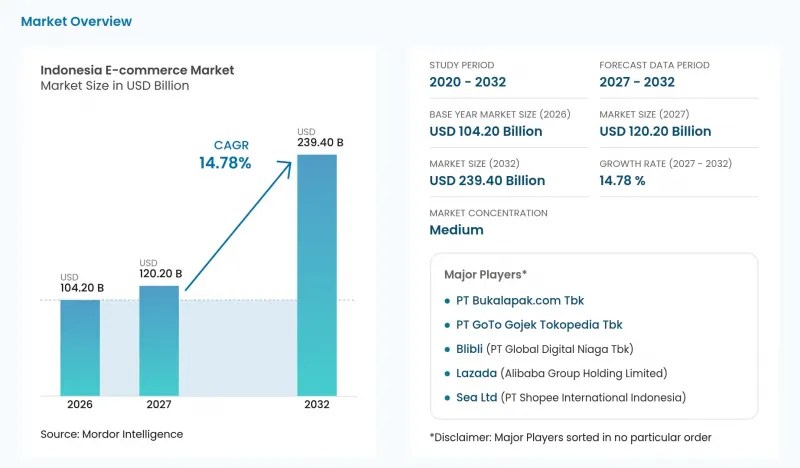
This report is segmented by Business Model (B2C and B2B), Device Type (Smartphone / Mobile, Desktop and Laptop, and more), Payment Method (Digital Wallets, Credit / Debit Cards, and more), and B2C Product Category (Consumer Electronics, Fashion and Apparel, and more). The market forecasts are provided in terms of value (USD), based on availability.
Indonesia E-commerce Market Trends and Insights
Surge in Live-stream Shopping Adoption on Mobile Apps
Live shopping gives sellers a channel with demonstrated use and a role in customer purchase decisions. In Jakpat's November to December 2025 survey, 76% of 776 Indonesian respondents who had shopped through live shopping said they had used Shopee Live. For a seller, that audience provides a route to consumers already familiar with purchasing through the format. A 2025 purposive study of 105 Barenbliss customers using Shopee live streaming reported a significant relationship between live-stream commerce and purchase decisions. Beauty brands can therefore organize live presentations around the product choices they want to support, connecting audience access with a specific merchandising task.
Rapid Digitization of Tier-2/3 Cities via Logistics Micro-Hubs
Regional fulfillment capacity gives online sellers a practical route to serve buyers beyond their existing dispatch base. PowerCommerce.Asia opened a multi-fulfillment hub in Palembang in October 2025 to cover South Sumatra and nearby areas, according to its founder and group CEO. The commercial significance lies in adding a regional point around which merchants can organize fulfillment, rather than extending only the storefront's digital reach. For sellers targeting that service area, a local fulfillment option can make distribution arrangements more closely match the geography of their intended customers. This can support demand by making a wider online offer operationally feasible, although its economics depend on the orders allocated to the node. The hub opened during the October 2025 10.10 shopping event, putting the new fulfillment option in place for that selling occasion.
Fulfillment Cost Inflation from Jakarta Traffic Restrictions
Restricted road access makes vehicle eligibility a cost variable for Jakarta distribution operations. The odd-even rule covers designated roads on weekdays from 6:00 to 10:00 a.m. and 4:00 to 9:00 p.m., excluding national holidays. Motorcycles, electric vehicles, and other specified categories are exempt, which concentrates the burden on affected vehicles and routes. A study published in 2022 by researchers at Institut Pertanian Bogor (IPB) linked higher expedition-company distribution costs to longer customer routes when vehicle plates did not match the permitted parity. For e-commerce fulfillment, that mechanism can increase the resources needed to feed delivery networks even when exempt vehicles handle the final customer leg. Operators using affected distribution vehicles therefore face a narrower choice between longer routes and restricted dispatch windows, limiting economical service flexibility.
Other drivers and restraints analyzed in the detailed report include:
- Fintech-Led Checkout ('PayLater') Boosting Average Order Value
- Government's 'Making Indonesia 4.0' SME On-Boarding Programs
- Persistent Cash-on-Delivery Risk Elevating Return Rates
For complete list of drivers and restraints, kindly check the Table Of Contents.
Segment Analysis
B2C accounted for an 86.51% share of the Indonesia e-commerce market size in 2026. Blibli reported 47% year-over-year growth in the value of paid and delivered purchases for its online first-party B2C retail segment in the second quarter of 2026. The segment spans first-party products and services across categories, placing the retailer's own offer at the center of those completed transactions. Because that measure counts paid and delivered purchases, the growth concerns fulfilled orders, tying the first-party retailer's sales opportunity to completing delivery of its own offer.
B2B is forecast to be the fastest-growing segment, with a CAGR of 18.2% over 2027-2032. PT MONOTARO INDONESIA reported 16.9% year-over-year sales growth in local currency in 2025. Sales nevertheless missed plan, which the company attributed to declining high-value orders and more government-encouraged holidays around Ramadan. For B2B platforms, a year in which sales grew yet missed plan after fewer high-value orders and more holidays shows that results depend on the timing of large purchases and on working days.
Smartphone/mobile commerce held 71.17% of total e-commerce value in 2026 and is forecast to grow at a CAGR of 17.85% over 2027-2032, making mobile the largest and fastest-growing segment. A checkout fault on phones would put access to the channel carrying most industry transaction value at risk, even if a seller could accept orders through other devices. For a merchant facing that fault, restoring mobile order completion takes priority over expanding device coverage because the existing spending pool is already concentrated on phones.
A merchant choosing between its own app and a marketplace flow decides who controls the mobile purchase journey. PT Fast Food Indonesia Tbk reported that sales through aggregators and KFCku Apps together grew 25% in 2025. Transactions through those combined channels increased 27% in 2025. An owned app puts navigation and checkout design within the seller's service offer, while an aggregator requires integration with its platform's flow.
Complete Report Scope:
- By Business Model
- B2C
- B2B
- By Device Type
- Smartphone / Mobile
- Desktop and Laptop
- Other Device Types
- By Payment Method
- Credit / Debit Cards
- Digital Wallets
- BNPL
- Other Payment Method
- By B2C Product Category
- Beauty and Personal Care
- Consumer Electronics
- Fashion and Apparel
- Food and Beverages
- Furniture and Home
- Toys, DIY and Media
- Other Product Categories
List of Companies Covered in this Report:
- Sea Ltd (PT Shopee International Indonesia)
- PT GoTo Gojek Tokopedia Tbk
- Lazada (Alibaba Group Holding Limited)
- PT Bukalapak.com Tbk
- Blibli (PT Global Digital Niaga Tbk)
- PT Bhinneka Mentaridimensi
- PT Silicon Media Indonesia
- PT Raksasa Laju Lintang
- PT Metrotech Jaya Komunika
- Global Fashion Group
- TikTok Pte Ltd
- PT Warung Pintar Sekali
- Amazon.com Services LLC
- PT Lion Parcel
- PT Matahari Putra Prima Tbk
Additional Benefits:
- The market estimate (ME) sheet in Excel format
- 3 months of analyst support
TABLE OF CONTENTS
1 INTRODUCTION
- 1.1 Study Assumptions and Market Definition
- 1.2 Scope of the Study
2 RESEARCH METHODOLOGY
3 EXECUTIVE SUMMARY
4 MARKET LANDSCAPE
- 4.1 Market Overview
- 4.2 Market Drivers
- 4.2.1 Surge in Live-stream Shopping Adoption on Mobile Apps
- 4.2.2 Rapid Digitization of Tier-2/3 Cities via Logistics Micro-Hubs
- 4.2.3 Fintech-Led Checkout ('PayLater') Boosting Average Order Value
- 4.2.4 Government's 'Making Indonesia 4.0' SME On-Boarding Programs
- 4.2.5 Rising Cross-border Seller Participation via Singapore and China Gateways
- 4.2.6 Social-Commerce Integration with WhatsApp and Instagram APIs
- 4.3 Market Restraints
- 4.3.1 Fulfillment Cost Inflation from Jakarta Traffic Restrictions
- 4.3.2 Persistent Cash-on-Delivery Risk Elevating Return Rates
- 4.3.3 Data-Localization Rules Raising Cloud-Hosting Expense
- 4.3.4 Talent Shortage in Last-Mile Cold-Chain Logistics
- 4.4 Industry Value Chain Analysis
- 4.5 Regulatory Landscape
- 4.6 Technological Outlook
- 4.7 Porter's Five Forces Analysis
- 4.7.1 Threat of New Entrants
- 4.7.2 Bargaining Power of Suppliers
- 4.7.3 Bargaining Power of Buyers
- 4.7.4 Threat of Substitutes
- 4.7.5 Competitive Rivalry
- 4.8 Key Market Trends and Share of E-commerce in Total Retail
- 4.9 Assessment of Macro Economic Trends on the Market
- 4.10 Demographic Analysis (Population, Internet, Age, Income)
- 4.11 Cross-Border E-commerce Size and Trends
- 4.12 Current Positioning of Indonesia in the E-commerce Industry in Asia Pacific
5 MARKET SIZE AND GROWTH FORECASTS (VALUE)
- 5.1 By Business Model
- 5.1.1 B2C
- 5.1.2 B2B
- 5.2 By Device Type
- 5.2.1 Smartphone / Mobile
- 5.2.2 Desktop and Laptop
- 5.2.3 Other Device Types
- 5.3 By Payment Method
- 5.3.1 Credit / Debit Cards
- 5.3.2 Digital Wallets
- 5.3.3 BNPL
- 5.3.4 Other Payment Method
- 5.4 By B2C Product Category
- 5.4.1 Beauty and Personal Care
- 5.4.2 Consumer Electronics
- 5.4.3 Fashion and Apparel
- 5.4.4 Food and Beverages
- 5.4.5 Furniture and Home
- 5.4.6 Toys, DIY and Media
- 5.4.7 Other Product Categories
6 COMPETITIVE LANDSCAPE
- 6.1 Market Concentration
- 6.2 Strategic Moves
- 6.3 Market Share Analysis
- 6.4 Company Profiles (includes Global level Overview, Market level overview, Core Segments, Financials as available, Strategic Information, Market Rank/Share for key companies, Products and Services, and Recent Developments)
- 6.4.1 Sea Ltd (PT Shopee International Indonesia)
- 6.4.2 PT GoTo Gojek Tokopedia Tbk
- 6.4.3 Lazada (Alibaba Group Holding Limited)
- 6.4.4 PT Bukalapak.com Tbk
- 6.4.5 Blibli (PT Global Digital Niaga Tbk)
- 6.4.6 PT Bhinneka Mentaridimensi
- 6.4.7 PT Silicon Media Indonesia
- 6.4.8 PT Raksasa Laju Lintang
- 6.4.9 PT Metrotech Jaya Komunika
- 6.4.10 Global Fashion Group
- 6.4.11 TikTok Pte Ltd
- 6.4.12 PT Warung Pintar Sekali
- 6.4.13 Amazon.com Services LLC
- 6.4.14 PT Lion Parcel
- 6.4.15 PT Matahari Putra Prima Tbk
7 MARKET OPPORTUNITIES AND FUTURE OUTLOOK
- 7.1 White-Space and Unmet-Need Assessment

