PUBLISHER: Mordor Intelligence | PRODUCT CODE: 2187656

PUBLISHER: Mordor Intelligence | PRODUCT CODE: 2187656
Payments - Market Share Analysis, Industry Trends & Statistics, Growth Forecasts (2027 - 2032)
According to Mordor Intelligence, the payments market size is projected to expand from USD 46.85 trillion in 2026 and USD 49.28 trillion in 2027 to USD 64.01 trillion by 2032, registering a CAGR of 5.37% between 2027 and 2032.
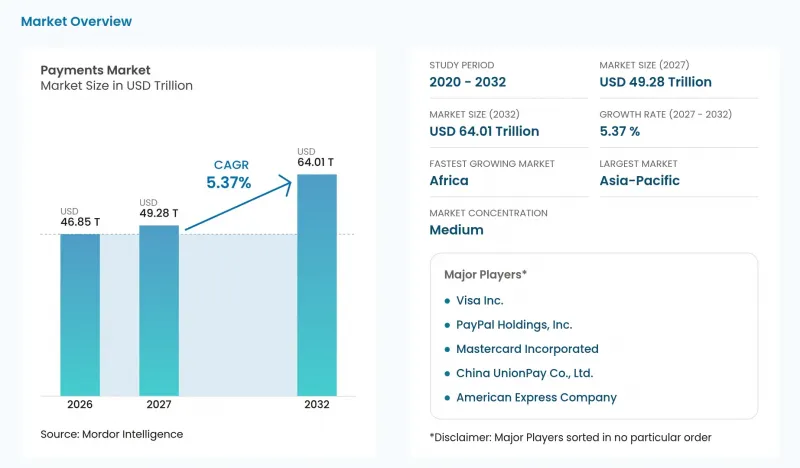
This report is segmented by Mode of Payment (Online and Point-of-Sale), Interaction Channel (Point-of-Sale and E-commerce/M-commerce), Transaction Type (Consumer-to-Business, Person-to-Person, and more), End-user Industry (Retail, Other End-user Industries, and more), and Geography (Asia-Pacific, North America, and more). The market forecasts are provided in terms of value (USD), based on availability.
Global Payments Market Trends and Insights
E-commerce Expansion Driven by Mobile-First Emerging Asia
Mobile-first commerce gives payment providers a route to expanding purchase activity through an already widely used access channel. China's online retail sales grew 8.6% year over year in 2025 on comparable platform coverage. By December 2025, 99.6% of China's internet users accessed the internet by mobile phone. These conditions support mobile checkout as a commercial priority for providers serving Chinese online merchants. The commercial opportunity is additional domestic checkout activity within that already connected Chinese audience, rather than relying on converting the small remaining share of internet users to mobile access.
Government Instant-Payment Rails (e.g., FedNow, Pix) Accelerating A2A Adoption in North & Latin America
Government instant-payment rails create demand for account-to-account services when connected institutions turn network availability into settled transactions. In Brazil, Banco Central do Brasil's Instant Payments System (SPI) settled 7.1 billion interbank Pix transactions in December 2025, approximately 24.32% more than in December 2024. In the United States, FedNow settled 6,376,467 customer credit transfers in the third quarter of 2026, up 27.6% from the second quarter. These settlement figures show actual use of public rails, giving providers an operating base for services beyond simply connecting an institution to a network. The much larger monthly SPI count supports a volume-led processing proposition in Brazil, while FedNow's smaller quarterly base makes expanding usage the more immediate US opportunity.
Cyber-fraud Sophistication Outpacing AI/ML Defenses in Cross-border Flows
Cross-border fraud makes route selection a commercial constraint because payment activity and fraud exposure can be distributed very differently. In Italian retail payments in the second half of 2025, destinations outside the European Economic Area represented about 2% of card and e-money payments. Those destinations accounted for about one-quarter of associated card fraud and about one-third of e-money fraud. For providers serving these routes, adding a small share of payment traffic can therefore materially change the concentration of fraud exposure. International expansion requires room for the cost of controlling that exposure, which can limit the attractiveness of additional corridor volume even when customer demand exists.
Other drivers and restraints analyzed in the detailed report include:
- Surging Cross-border B2C Remittances Fueling Digital Wallet Uptake in MENA & APAC Corridors
- Contactless Transit & Toll Schemes Catalyzing Tap-to-Pay Card Volumes in Europe & Nordics
- Interchange & MDR Caps Compressing Issuer Margins in EU & India
For complete list of drivers and restraints, kindly check the Table Of Contents.
Segment Analysis
Online accounted for a 59.21% share of the payments market size in 2026 and is the largest and fastest-growing segment, with a forecast CAGR of 6.5% from 2027 to 2032. Worldpay estimated that digital wallets accounted for 56% of e-commerce transaction value across the 42 markets in its 2025 coverage. That payment-method mix makes wallet access a material distribution consideration for providers seeking participation in online merchant spending. A checkout offering physical-card entry alone would therefore omit wallets, the method carrying a majority of the covered e-commerce value.
Within Visa's network, card-on-file commerce and wallet-button checkout accounted for 84% of e-commerce transactions in the fiscal year ended September 30, 2025. Card-on-file commerce uses credentials stored by merchants for recurring payments, while wallet buttons connect checkout with wallets from technology platforms and financial institutions. This places part of the provider's commercial opportunity in the continuing merchant-customer relationship, where credentials support successive purchases. Competition for these online payments can therefore continue after the first purchase through the servicing of recurring merchant relationships.
Point-of-sale was the largest interaction-channel segment, accounting for 71.69% of payment transaction value in 2026. More than three-quarters of US consumers' purchases were made at the in-person point of sale in 2025. Worldpay estimated that payment apps represented 37% of point-of-sale transaction value across the 42 markets in its 2025 coverage. For merchant acquirers, this combination makes physical acceptance a route into both established purchase activity and app-based payment demand. Acquirers serving only physical-card and cash transactions would leave the app-based portion of in-person spending outside their offer.
E-commerce/m-commerce is the fastest-growing segment, with a forecast CAGR of 7.3% from 2027 to 2032. Ireland recorded 305 million domestic online card payments in the first half of 2026, up 12.9% from the same period in 2025. For providers serving Irish merchants, the additional card transactions create demand within the domestic checkout base.
Complete Report Scope:
- By Mode of Payment
- Point-of-Sale
- Card (Debit, Credit, Pre-paid)
- Digital Wallets (Apple Pay, Google Pay, Interac Flash)
- Cash
- Other POS (Gift-cards, QR, Wearables)
- Online
- Card (Card-Not-Present)
- Digital Wallet & Account-to-Account (Interac e-Transfer, PayPal)
- Other Online (COD, BNPL, Bank Transfer)
- Point-of-Sale
- By Interaction Channel
- Point-of-Sale
- E-commerce/M-commerce
- By Transaction Type
- Person-to-Person (P2P)
- Consumer-to-Business (C2B)
- Business-to-Business (B2B)
- Remittances & Cross-border
- By End-user Industry
- Retail
- Entertainment & Digital Content
- Healthcare
- Hospitality & Travel
- Government & Utilities
- Other End-user Industries
- By Geography
- North America
- United States
- Canada
- Europe
- Germany
- United Kingdom
- France
- Mexico
- Rest of Europe
- Asia-Pacific
- China
- India
- Japan
- Rest of Asia-Pacific
- South America
- Brazil
- Argentina
- Rest of South America
- Middle East
- United Arab Emirates
- Saudi Arabia
- Rest of Middle East
- Africa
- South Africa
- Nigeria
- Rest of Africa
- North America
Geography Analysis
Asia-Pacific accounted for a 37.76% share of the payments market size in 2026, making it the largest geography. Chinese banks processed 60.82 billion mobile-payment transactions in the second quarter of 2026, initiated through mobile devices using bank settlement accounts. Providers serving these transactions can build around connectivity with bank payment operations, which offers access to an established processing base for mobile transfers through customer bank settlement accounts.
Africa is the fastest-growing geography, with a forecast CAGR of 9.45% from 2027 to 2032. Mobile-money transaction value in the region reached USD 1.4 trillion in 2025, up 27% from 2024. Africa also had 347 million active 30-day mobile-money accounts in 2025, up 19% from 2024. Integration of Government Electronic Payment Gateway use cases into Tanzania Instant Payment System was completed in 2025, enabling government bill payments across participating institutions. Providers can consequently address active-account services and institutional bill-payment flows as separate commercial openings, combining account use with a broader range of payment applications.
North America shows local differences, with US rural residents averaging 9 cash payments monthly in 2025 versus 6 among urban and suburban residents, supporting cash-capable merchant services. In Europe, provisional euro-area figures subject to revision put payments using cards issued by resident payment service providers at 57.3% of non-cash transactions in the second half of 2025, making card acceptance central to transaction coverage. South America's Chile recorded 382 payments per person in 2025 using bank and non-bank cards and transfers, according to ABIF figures reported by Diario Financiero. In the Middle East, digital payments represented 85% of Saudi Arabia's retail transactions in 2025, making digital acceptance central to retail coverage. The rural US cash gap makes location within a country an acceptance requirement, while the euro-area, Chilean, and Saudi figures point to instrument coverage across established transaction flows.
- Visa Inc.
- Mastercard Incorporated
- China UnionPay Co., Ltd.
- Ant Group Co., Ltd. (Alipay)
- PayPal Holdings, Inc.
- Juspay Technologies Private Limited
- Google LLC (Google Pay)
- Amazon.com, Inc. (Amazon Pay)
- American Express Company
- Adyen N.V.
- Stripe, Inc.
- Block, Inc. (Square & Afterpay)
- Worldline SA
- Fidelity National Information Services, Inc. (FIS)
- Fiserv, Inc.
- Global Payments Inc.
- Klarna Bank AB
- Razorpay Payments Pvt. Ltd.
- PayU Payments Pvt. Ltd.
- Revolut Ltd.
- Apple Inc. (Apple Pay)
Additional Benefits:
- The market estimate (ME) sheet in Excel format
- 3 months of analyst support
TABLE OF CONTENTS
1 INTRODUCTION
- 1.1 Study Assumptions and Market Definition
- 1.2 Scope of the Study
2 RESEARCH METHODOLOGY
3 EXECUTIVE SUMMARY
4 MARKET LANDSCAPE
- 4.1 Market Overview
- 4.2 Market Drivers
- 4.2.1 E-commerce Expansion Driven by Mobile-First Emerging Asia
- 4.2.2 Government Instant-Payment Rails (e.g., FedNow, Pix) Accelerating A2A Adoption in North & Latin America
- 4.2.3 Surging Cross-border B2C Remittances Fueling Digital Wallet Uptake in MENA & APAC Corridors
- 4.2.4 Contactless Transit & Toll Schemes Catalyzing Tap-to-Pay Card Volumes in Europe & Nordics
- 4.2.5 BNPL Integration by Tier-1 Retailers Boosting Ticket-Size & Frequency in Oceania
- 4.2.6 ISO 20022 Migration Enabling Rich-Data Corporate Payments in Developed Markets
- 4.3 Market Restraints
- 4.3.1 Cyber-fraud Sophistication Outpacing AI/ML Defenses in Cross-border Flows
- 4.3.2 Interchange & MDR Caps Compressing Issuer Margins in EU & India
- 4.3.3 Legacy Core-Banking Inflexibility Delaying Real-time Settlement in Africa
- 4.3.4 High Cash Reliance in Rural Caribbean Economies
- 4.4 Industry Value Chain Analysis
- 4.5 Regulatory Landscape
- 4.6 Technological Outlook
- 4.7 Porter's Five Forces Analysis
- 4.7.1 Threat of New Entrants
- 4.7.2 Bargaining Power of Suppliers
- 4.7.3 Bargaining Power of Buyers
- 4.7.4 Threat of Substitutes
- 4.7.5 Competitive Rivalry
- 4.8 Sustainability & Green-Payments Initiatives
- 4.9 Analysis of key demographic trends and patterns related to Global payments industry (Coverage to include Population, Internet Penetration, Banking Penetration/Unbanking Population, Age & Income etc.)
- 4.10 Analysis of major case studies and use-cases
- 4.11 Assessment of Macro Economic Trends on the Market
5 MARKET SIZE AND GROWTH FORECASTS (VALUE)
- 5.1 By Mode of Payment
- 5.1.1 Point-of-Sale
- 5.1.1.1 Card (Debit, Credit, Pre-paid)
- 5.1.1.2 Digital Wallets (Apple Pay, Google Pay, Interac Flash)
- 5.1.1.3 Cash
- 5.1.1.4 Other POS (Gift-cards, QR, Wearables)
- 5.1.2 Online
- 5.1.2.1 Card (Card-Not-Present)
- 5.1.2.2 Digital Wallet & Account-to-Account (Interac e-Transfer, PayPal)
- 5.1.2.3 Other Online (COD, BNPL, Bank Transfer)
- 5.1.1 Point-of-Sale
- 5.2 By Interaction Channel
- 5.2.1 Point-of-Sale
- 5.2.2 E-commerce/M-commerce
- 5.3 By Transaction Type
- 5.3.1 Person-to-Person (P2P)
- 5.3.2 Consumer-to-Business (C2B)
- 5.3.3 Business-to-Business (B2B)
- 5.3.4 Remittances & Cross-border
- 5.4 By End-user Industry
- 5.4.1 Retail
- 5.4.2 Entertainment & Digital Content
- 5.4.3 Healthcare
- 5.4.4 Hospitality & Travel
- 5.4.5 Government & Utilities
- 5.4.6 Other End-user Industries
- 5.5 By Geography
- 5.5.1 North America
- 5.5.1.1 United States
- 5.5.1.2 Canada
- 5.5.2 Europe
- 5.5.2.1 Germany
- 5.5.2.2 United Kingdom
- 5.5.2.3 France
- 5.5.2.4 Mexico
- 5.5.2.5 Rest of Europe
- 5.5.3 Asia-Pacific
- 5.5.3.1 China
- 5.5.3.2 India
- 5.5.3.3 Japan
- 5.5.3.4 Rest of Asia-Pacific
- 5.5.4 South America
- 5.5.4.1 Brazil
- 5.5.4.2 Argentina
- 5.5.4.3 Rest of South America
- 5.5.5 Middle East
- 5.5.5.1 United Arab Emirates
- 5.5.5.2 Saudi Arabia
- 5.5.5.3 Rest of Middle East
- 5.5.6 Africa
- 5.5.6.1 South Africa
- 5.5.6.2 Nigeria
- 5.5.6.3 Rest of Africa
- 5.5.1 North America
6 COMPETITIVE LANDSCAPE
- 6.1 Market Concentration
- 6.2 Strategic Moves
- 6.3 Market Share Analysis
- 6.4 Company Profiles (includes Global level Overview, Market level overview, Core Segments, Financials as available, Strategic Information, Market Rank/Share for key companies, Products and Services, and Recent Developments)
- 6.4.1 Visa Inc.
- 6.4.2 Mastercard Incorporated
- 6.4.3 China UnionPay Co., Ltd.
- 6.4.4 Ant Group Co., Ltd. (Alipay)
- 6.4.5 PayPal Holdings, Inc.
- 6.4.6 Juspay Technologies Private Limited
- 6.4.7 Google LLC (Google Pay)
- 6.4.8 Amazon.com, Inc. (Amazon Pay)
- 6.4.9 American Express Company
- 6.4.10 Adyen N.V.
- 6.4.11 Stripe, Inc.
- 6.4.12 Block, Inc. (Square & Afterpay)
- 6.4.13 Worldline SA
- 6.4.14 Fidelity National Information Services, Inc. (FIS)
- 6.4.15 Fiserv, Inc.
- 6.4.16 Global Payments Inc.
- 6.4.17 Klarna Bank AB
- 6.4.18 Razorpay Payments Pvt. Ltd.
- 6.4.19 PayU Payments Pvt. Ltd.
- 6.4.20 Revolut Ltd.
- 6.4.21 Apple Inc. (Apple Pay)
7 MARKET OPPORTUNITIES AND FUTURE OUTLOOK
- 7.1 White-Space and Unmet-Need Assessment

