PUBLISHER: Mordor Intelligence | PRODUCT CODE: 2124952

PUBLISHER: Mordor Intelligence | PRODUCT CODE: 2124952
North America Payments - Market Share Analysis, Industry Trends & Statistics, Growth Forecasts (2026 - 2031)
According to Mordor Intelligence, the North America payments market size was valued at USD 426.73 billion in 2025 and estimated to grow from USD 471.03 billion in 2026 to reach USD 772.11 billion by 2031, at a CAGR of 10.38% during the forecast period (2026-2031).
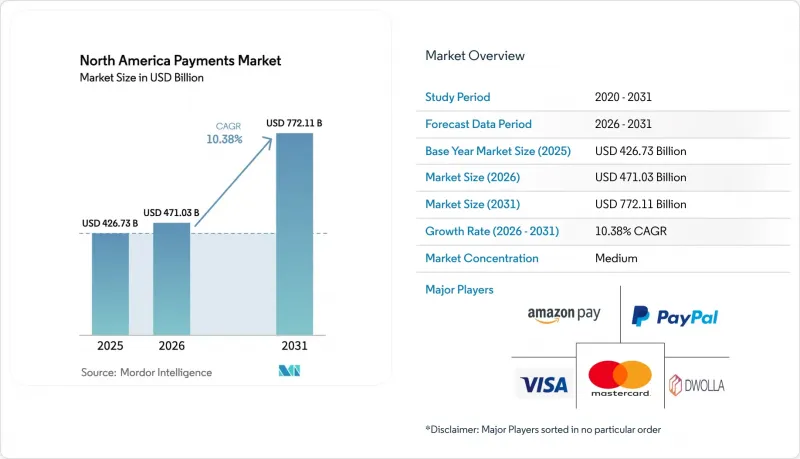
This report is Segmented by Mode of Payment (Point of Sale, Online), Interaction Channel (Point-Of-Sale, E-commerce/M-commerce), Transaction Type (P2P, C2B, B2B, Remittances and Cross-Border), End-User Industry (Retail, Entertainment and Digital Content, Healthcare, Hospitality & Travel, and More), and Country. The Market Forecasts are Provided in Terms of Value (USD).
North America Payments Market Trends and Insights
Real-time rail roll-out accelerating instant payments adoption
FedNow expanded from 35 launch banks to more than 900 institutions by August 2024, with community banks representing 78% of participants. Businesses and consumers alike increased faster-payment use in 2023, setting the foundation for a regional shift away from legacy ACH in favor of irrevocable, immediate settlement. Early adopters such as MSU Federal Credit Union logged a 643% rise in volume year-over-year, underscoring strong demand among gig-economy workers. The resulting ubiquity of instant rails positions the market to compete internationally with systems such as PIX and UPI, improving liquidity management and supporting new treasury products.
BNPL penetration driving high-ticket online transactions
About 21% of Americans used BNPL by end-2022, and the product is projected to reach 12% of United States e-commerce sales by 2025. Regulation Z now imposes credit card-style statements and dispute rights, raising compliance costs. Providers with adequate scale can internalize these costs, consolidating market share while smaller players likely seek partnerships. Mexico's 32% projected BNPL CAGR through 2028 points to cross-border expansion potential, but capital-light entrants face heightened scrutiny on consumer debt transparency.
Increasing interchange-fee litigation risk
A federal judge rejected Visa and Mastercard's proposed USD 30 billion interchange settlement in June 2024, prolonging two decades of merchant litigation. The separate USD 5.54 billion class action covering 2004-2019 fees remains open to claims until February 2025. Annual interchange exceeded USD 100.8 billion in 2023, amplifying calls for fee caps and routing choice under the Credit Card Competition Act. Prolonged legal exposure diverts capital from innovation and could incentivize merchants to steer volume toward lower-cost real-time rails.
Other drivers and restraints analyzed in the detailed report include:
- Cross-border e-commerce growth into Canada via US platforms
- Network tokenization reducing CNP fraud
- Real-time fraud and authorized push-payment scams
For complete list of drivers and restraints, kindly check the Table Of Contents.
Segment Analysis
Point-of-sale card payments accounted for 40.72% of the North America payments market share in 2025. Overall Point-of-Sale led with 57.35% revenue share. Online digital wallets and account-to-account alternatives are expanding at 15.36% CAGR through 2031 as merchants pursue faster funding cycles and lower fees. Federal Reserve data shows a 31% rise in business digital-wallet use during 2023. Contactless capability reached 69% of issued debit cards in 2024 and will reach near universality by 2027.
The convergence of wallet tokens with network security reduces the acceptance gap between cards and A2A rails. Cash volumes in Canada rose 15% in 2023 despite digital gains, illustrating consumer preference for optionality. Tokenization allows recurring subscription providers to store credentials securely, blending card utility with wallet convenience.
Point-of-sale transactions still generate 54.62% of revenue yet e-commerce and m-commerce are projected to grow at 13.01% CAGR to 2031. Canada's USD 71.6 billion online spend in 2023 underlines cross-border scale as United States merchants deploy localized checkout flows. Contactless adoption (53% of Canadian transactions) reflects user comfort with proximity tech, smoothing the offline-online divide.
Consumers show clear appetite for omnichannel journeys. Seventy-four percent favor faster payments from their primary bank, yet large shares remain open to fintech alternatives. Tap-to-pay on mobile reduces hardware costs for small merchants and extends acceptance in rural geographies, bringing new users into the North America payments market.
Complete Report Scope:
- Segmentation by Mode of Payment
- Point-of-Sale
- Card (Debit, Credit, Pre-paid)
- Digital Wallets (Apple Pay, Google Pay, Interac Flash)
- Cash
- Other POS (Gift-cards, QR, Wearables)
- Online
- Card (Card-Not-Present)
- Digital Wallet and Account-to-Account (Interac e-Transfer, PayPal)
- Other Online (COD, BNPL, Bank Transfer)
- Point-of-Sale
- Segmentation by Interaction Channel
- Point-of-Sale
- E-commerce/M-commerce
- Segmentation by Transaction Type
- Person-to-Person (P2P)
- Consumer-to-Business (C2B)
- Business-to-Business (B2B)
- Remittances and Cross-border
- Segmentation by End-user Industry
- Retail
- Entertainment and Digital Content
- Healthcare
- Hospitality and Travel
- Government and Utilities
- Other End-user Industries
- By Country
- United States
- Canada
- Mexico
List of Companies Covered in this Report:
- Visa Inc.
- Mastercard Incorporated
- PayPal Holdings Inc.
- Fiserv Inc.
- Block, Inc.
- Stripe, Inc.
- Apple Inc.
- Google LLC
- Amazon.com, Inc.
- Interac Corp.
- Dwolla, Inc.
- Adyen N.V.
- Global Payments Inc.
- PaySafe Limited
- JPMorgan Chase and Co. (Chase Payment Solutions)
- Ant Group Co., Ltd. (Alipay North America)
- Toast, Inc.
- Shopify Inc. (Shopify Payments)
- Clover Network, Inc.
- Beacon Payments LLC
- Wells Fargo and Co. (Wells Fargo Gateway)
- Worldline SA
- Payoneer Global Inc.
Additional Benefits:
- The market estimate (ME) sheet in Excel format
- 3 months of analyst support
TABLE OF CONTENTS
1 INTRODUCTION
- 1.1 Study Assumptions and Market Definition
- 1.2 Scope of the Study
2 RESEARCH METHODOLOGY
3 EXECUTIVE SUMMARY
4 MARKET LANDSCAPE
- 4.1 Market Overview
- 4.2 Market Drivers
- 4.2.1 Real-Time Rail Roll-out (FedNow, RTR) Accelerating Instant Payments Adoption
- 4.2.2 BNPL Penetration Driving High-Ticket Online Transactions
- 4.2.3 Cross-Border Ecommerce Growth into Canada via US Platforms
- 4.2.4 Network Tokenization Reducing CNP Fraud and Boosting Card-on-File Volumes
- 4.2.5 Tap-to-Pay on Mobile Unlocking SME Acceptance in U.S. and Canada
- 4.2.6 Corporate AP Automation Shifting B2B Spend to Virtual Cards
- 4.3 Market Restraints
- 4.3.1 Increasing Interchange-Fee Litigation Risk
- 4.3.2 Real-Time Fraud and Authorized Push-Payment (APP) Scams
- 4.3.3 Processor and Core Modernization Cost Overruns for Mid-Tier Banks
- 4.4 Value Chain Analysis
- 4.5 Regulatory Outlook
- 4.6 Porter's Five Forces Analysis
- 4.6.1 Bargaining Power of Suppliers
- 4.6.2 Bargaining Power of Buyers
- 4.6.3 Threat of New Entrants
- 4.6.4 Threat of Substitute Products
- 4.6.5 Intensity of Competitive Rivalry
- 4.7 Evolution of the Payments Landscape in North America
- 4.8 Key Market Trends Driving Cashless Transactions
- 4.9 Assessment of Macro Economic Trends on the Market
- 4.10 Industry Stakeholder Analysis
- 4.11 Analysis of Major Case Studies and Use-Cases
- 4.12 Demographic Trends Analysis
- 4.13 Customer Experience Convergence Analysis
- 4.14 Cash Displacement and Rise of Contactless Payments
- 4.15 Investment Analysis
5 MARKET SIZE AND GROWTH FORECASTS (VALUES)
- 5.1 Segmentation by Mode of Payment
- 5.1.1 Point-of-Sale
- 5.1.1.1 Card (Debit, Credit, Pre-paid)
- 5.1.1.2 Digital Wallets (Apple Pay, Google Pay, Interac Flash)
- 5.1.1.3 Cash
- 5.1.1.4 Other POS (Gift-cards, QR, Wearables)
- 5.1.2 Online
- 5.1.2.1 Card (Card-Not-Present)
- 5.1.2.2 Digital Wallet and Account-to-Account (Interac e-Transfer, PayPal)
- 5.1.2.3 Other Online (COD, BNPL, Bank Transfer)
- 5.1.1 Point-of-Sale
- 5.2 Segmentation by Interaction Channel
- 5.2.1 Point-of-Sale
- 5.2.2 E-commerce/M-commerce
- 5.3 Segmentation by Transaction Type
- 5.3.1 Person-to-Person (P2P)
- 5.3.2 Consumer-to-Business (C2B)
- 5.3.3 Business-to-Business (B2B)
- 5.3.4 Remittances and Cross-border
- 5.4 Segmentation by End-user Industry
- 5.4.1 Retail
- 5.4.2 Entertainment and Digital Content
- 5.4.3 Healthcare
- 5.4.4 Hospitality and Travel
- 5.4.5 Government and Utilities
- 5.4.6 Other End-user Industries
- 5.5 By Country
- 5.5.1 United States
- 5.5.2 Canada
- 5.5.3 Mexico
6 COMPETITIVE LANDSCAPE
- 6.1 Market Concentration
- 6.2 Strategic Developments
- 6.3 Market Share Analysis
- 6.4 Company Profiles (includes Global level Overview, Market level overview, Core Segments, Financials as available, Strategic Information, Market Rank/Share for key companies, Products and Services, and Recent Developments)
- 6.4.1 Visa Inc.
- 6.4.2 Mastercard Incorporated
- 6.4.3 PayPal Holdings Inc.
- 6.4.4 Fiserv Inc.
- 6.4.5 Block, Inc.
- 6.4.6 Stripe, Inc.
- 6.4.7 Apple Inc.
- 6.4.8 Google LLC
- 6.4.9 Amazon.com, Inc.
- 6.4.10 Interac Corp.
- 6.4.11 Dwolla, Inc.
- 6.4.12 Adyen N.V.
- 6.4.13 Global Payments Inc.
- 6.4.14 PaySafe Limited
- 6.4.15 JPMorgan Chase and Co. (Chase Payment Solutions)
- 6.4.16 Ant Group Co., Ltd. (Alipay North America)
- 6.4.17 Toast, Inc.
- 6.4.18 Shopify Inc. (Shopify Payments)
- 6.4.19 Clover Network, Inc.
- 6.4.20 Beacon Payments LLC
- 6.4.21 Wells Fargo and Co. (Wells Fargo Gateway)
- 6.4.22 Worldline SA
- 6.4.23 Payoneer Global Inc.
7 MARKET OPPORTUNITIES AND FUTURE OUTLOOK
- 7.1 White-space and Unmet-Need Assessment

