PUBLISHER: Mordor Intelligence | PRODUCT CODE: 2124928

PUBLISHER: Mordor Intelligence | PRODUCT CODE: 2124928
France Payments - Market Share Analysis, Industry Trends & Statistics, Growth Forecasts (2026 - 2031)
According to Mordor Intelligence, the France payments market size is expected to increase from USD 1.28 trillion in 2025 to USD 1.31 trillion in 2026 and reach USD 1.45 trillion by 2031, growing at a CAGR of 2.05% over 2026-2031.
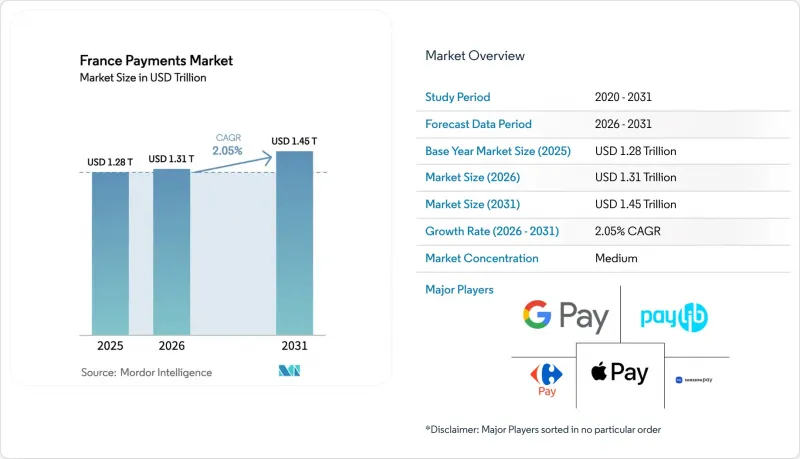
This report is Segmented by Mode of Payment (Point of Sale [Card Payments (Debit Cards, Credit Cards, and Bank Financing Prepaid Cards), Digital Wallets, and More], and Online Sale [Card Payments (Debit Cards, Credit Cards, and More), Digital Wallets, and More]), and End-User Industry (Retail, Entertainment and Digital Content, Healthcare, and More). The Market Forecasts are Provided in Terms of Value (USD).
France Payments Market Trends and Insights
PSD2-Enabled Open-Banking Fuels Instant Account-to-Account Payments
Revised open-banking rules required French banks to expose application-programming interfaces, yet customer uptake remained limited until the SEPA Instant mandate took hold in 2025. The regulation now obliges every payment service provider to both receive and send real-time euro transfers, collapsing settlement windows from days to seconds. E-commerce platforms promptly embedded "Pay by Bank" buttons that authorize funds directly from current accounts, bypassing interchange altogether. Interoperability is assured because over 80% of French banks support the STET API framework. Merchants enjoy lower costs and faster confirmation, while consumers gain a familiar, friction-free checkout that mirrors card tap-to-pay convenience.
E-Commerce and M-Commerce Boom Among Gen-Z Spurs Digital Wallet Uptake
French online spending reached EUR 150 billion (USD 160 billion) in 2024, with mobile devices capturing 43% of transactions. A 2025 survey found 62% of shoppers aged 18-25 store at least one credential in Apple Pay, Google Pay, Lydia, or Paylib. These wallets bundle loyalty IDs, transport passes, and tickets alongside payment instruments, trimming checkout to a single biometric confirmation. Lydia's user base climbed to 8 million by late 2025, aided by QR acceptance and installment finance options. As Gen-Z purchasing power expands, merchants that optimize for mobile wallets record higher conversion and larger average order values.
Escalating Card Interchange and Scheme Fees Pressure SME Margins
Although EU law caps interchange at 0.2% on debit and 0.3% on credit, unregulated scheme fees continue to rise and can lift the effective charge well above 1%. For a neighborhood bakery turning over EUR 200,000 (USD 237,440) annually, that difference erodes thin operating margins and discourages card acceptance. Many SMEs are experimenting with Wero or Carte Bancaires A2A options that levy flat-fee or subscription pricing, but cross-border reach remains limited, complicating e-commerce ambitions.
Other drivers and restraints analyzed in the detailed report include:
- Regulatory Increase of Contactless-Spend Limit Accelerates Tap-and-Go Transactions
- Merchant Adoption of SoftPOS Turns Smartphones into Acceptance Terminals
- Ageing and Rural Population's Persistent Cash Preference
For complete list of drivers and restraints, kindly check the Table Of Contents.
Segment Analysis
Online transactions represented 42.11% of total value in 2025 and are forecast to post a 3.07% CAGR through 2031, outpacing headline France payments market growth. Point-of-sale still leads, yet the share of tap-to-pay wallets inside physical stores climbed steadily as EMV acceptance reached 98% of terminals. Instant SEPA transfers embedded in checkout flows remove the need to enter 16-digit card numbers, trimming abandonment rates and lowering merchant costs.
Digital wallets aggregate debit cards, credit cards, and A2A mandates within a single interface, encouraging users to toggle between instruments without leaving the merchant page. Klarna's installment pay option gained 22% more French merchants in 2025, illustrating consumer appetite for deferred settlement. As tokenization under EMVCo standards becomes ubiquitous, the France payments market size for online channels will continue to rise on the back of lower fraud and higher approval rates.
Complete Report Scope:
- By Mode of Payment
- By Point of Sale
- Card Payments
- Debit Cards
- Credit Cards
- Bank Financing Prepaid Cards
- Digital Wallets (includes Mobile Wallet)
- Other Point of Sale
- Card Payments
- By Online Sale
- Card Payments
- Debit Cards
- Credit Cards
- Bank Financing Prepaid Cards
- Digital Wallets
- Other Online Sales (includes Cash on Delivery, Bank Transfer, and Buy Now Pay Later)
- Card Payments
- Digital Wallets
- Other Online Sales (includes Cash on Delivery, Bank Transfer, and Buy Now Pay Later)
- By Point of Sale
- By End-user Industry
- Retail
- Entertainment and Digital Content
- Healthcare
- Hospitality and Travel
- Government and Utilities
- Other End-user Industries
List of Companies Covered in this Report:
- Apple Inc. (Apple Pay)
- Visa Inc.
- Mastercard Inc.
- Google LLC (Google Pay)
- Samsung Electronics Co., Ltd. (Samsung Pay)
- Paylib SAS
- Carrefour S.A. (Carrefour Pay)
- Lydia Solutions SAS
- Lyf Pay
- Pumpkin SAS
- PayPal Holdings Inc.
- Worldline S.A.
- Ingenico Group S.A. (Worldline)
- BNP Paribas S.A.
- Societe Generale S.A.
- Stripe Inc.
- Adyen N.V.
- Ant International (Alipay+)
- Klarna Bank AB
- Amazon.com, Inc. (Amazon Pay)
- European Payments Initiative GmbH (wero)
Additional Benefits:
- The market estimate (ME) sheet in Excel format
- 3 months of analyst support
TABLE OF CONTENTS
1 INTRODUCTION
- 1.1 Study Assumptions and Market Definition
- 1.2 Scope of the Study
2 RESEARCH METHODOLOGY
3 EXECUTIVE SUMMARY
4 MARKET LANDSCAPE
- 4.1 Market Overview
- 4.2 Market Drivers
- 4.2.1 PSD2-enabled Open-Banking Fuels Instant Account-to-Account Payments
- 4.2.2 E-commerce and M-commerce Boom Among Gen-Z Spurs Digital Wallet Uptake
- 4.2.3 Regulatory Increase of Contactless-Spend Limit Accelerates Tap-and-Go Transactions
- 4.2.4 Merchant Adoption of SoftPOS Turns Smartphones into Acceptance Terminals
- 4.2.5 Wero Wallet Launch Catalyses A2A Real-Time Retail Payments Adoption
- 4.2.6 AI-Driven Risk Decisioning Lifts Authorisation Rates While Reducing Chargebacks
- 4.3 Market Restraints
- 4.3.1 Escalating Card Interchange and Scheme Fees Pressure SME Margins
- 4.3.2 Ageing and Rural Population's Persistent Cash Preference
- 4.3.3 Dependency on Non-European Card Processors Heightens Sovereignty and Cost Risks
- 4.3.4 Real-Time Authorised Push-Payment Fraud Undermines Consumer Trust in Instant Rails
- 4.4 Industry Value Chain Analysis
- 4.5 Regulatory Outlook (PSD2, PSD3 Draft, SEPA Instant, AML 6th Directive)
- 4.6 Technological Outlook (Tokenisation, NFC, SoftPOS, AI Fraud Detection, Digital Euro Readiness)
- 4.7 Impact of Macroeconomic Factors on the Market
- 4.8 Porter's Five Forces Analysis
- 4.8.1 Bargaining Power of Suppliers
- 4.8.2 Bargaining Power of Buyers
- 4.8.3 Threat of New Entrants
- 4.8.4 Threat of Substitute Products
- 4.8.5 Intensity of Competitive Rivalry
- 4.9 Pricing Analysis
- 4.10 Evolution of the Payments Landscape in France
- 4.11 Key Trends in Cashless Transaction Growth
- 4.12 Demographic and Socio-economic Analysis
- 4.13 Cash Displacement and Rise of Contactless Modes
- 4.14 Customer Experience and Satisfaction Convergence with Global Standards
- 4.15 Case Studies and Use-Cases
- 4.16 Investment Analysis
5 MARKET SIZE AND GROWTH FORECASTS (VALUE)
- 5.1 By Mode of Payment
- 5.1.1 By Point of Sale
- 5.1.1.1 Card Payments
- 5.1.1.1.1 Debit Cards
- 5.1.1.1.2 Credit Cards
- 5.1.1.1.3 Bank Financing Prepaid Cards
- 5.1.1.2 Digital Wallets (includes Mobile Wallet)
- 5.1.1.3 Other Point of Sale
- 5.1.1.1 Card Payments
- 5.1.2 By Online Sale
- 5.1.2.1 Card Payments
- 5.1.2.1.1 Debit Cards
- 5.1.2.1.2 Credit Cards
- 5.1.2.1.3 Bank Financing Prepaid Cards
- 5.1.2.2 Digital Wallets
- 5.1.2.3 Other Online Sales (includes Cash on Delivery, Bank Transfer, and Buy Now Pay Later)
- 5.1.2.1 Card Payments
- 5.1.3 Digital Wallets
- 5.1.4 Other Online Sales (includes Cash on Delivery, Bank Transfer, and Buy Now Pay Later)
- 5.1.1 By Point of Sale
- 5.2 By End-user Industry
- 5.2.1 Retail
- 5.2.2 Entertainment and Digital Content
- 5.2.3 Healthcare
- 5.2.4 Hospitality and Travel
- 5.2.5 Government and Utilities
- 5.2.6 Other End-user Industries
6 COMPETITIVE LANDSCAPE
- 6.1 Market Concentration
- 6.2 Strategic Moves
- 6.3 Market Share Analysis
- 6.4 Company Profiles (includes Global Level Overview, Market Level Overview, Core Segments, Financials as available, Strategic Information, Market Rank/Share, Products and Services, Recent Developments)
- 6.4.1 Apple Inc. (Apple Pay)
- 6.4.2 Visa Inc.
- 6.4.3 Mastercard Inc.
- 6.4.4 Google LLC (Google Pay)
- 6.4.5 Samsung Electronics Co., Ltd. (Samsung Pay)
- 6.4.6 Paylib SAS
- 6.4.7 Carrefour S.A. (Carrefour Pay)
- 6.4.8 Lydia Solutions SAS
- 6.4.9 Lyf Pay
- 6.4.10 Pumpkin SAS
- 6.4.11 PayPal Holdings Inc.
- 6.4.12 Worldline S.A.
- 6.4.13 Ingenico Group S.A. (Worldline)
- 6.4.14 BNP Paribas S.A.
- 6.4.15 Societe Generale S.A.
- 6.4.16 Stripe Inc.
- 6.4.17 Adyen N.V.
- 6.4.18 Ant International (Alipay+)
- 6.4.19 Klarna Bank AB
- 6.4.20 Amazon.com, Inc. (Amazon Pay)
- 6.4.21 European Payments Initiative GmbH (wero)
7 MARKET OPPORTUNITIES AND FUTURE OUTLOOK
- 7.1 White-space and Unmet-Need Assessment

