PUBLISHER: Mordor Intelligence | PRODUCT CODE: 2124914

PUBLISHER: Mordor Intelligence | PRODUCT CODE: 2124914
Germany Payments - Market Share Analysis, Industry Trends & Statistics, Growth Forecasts (2026 - 2031)
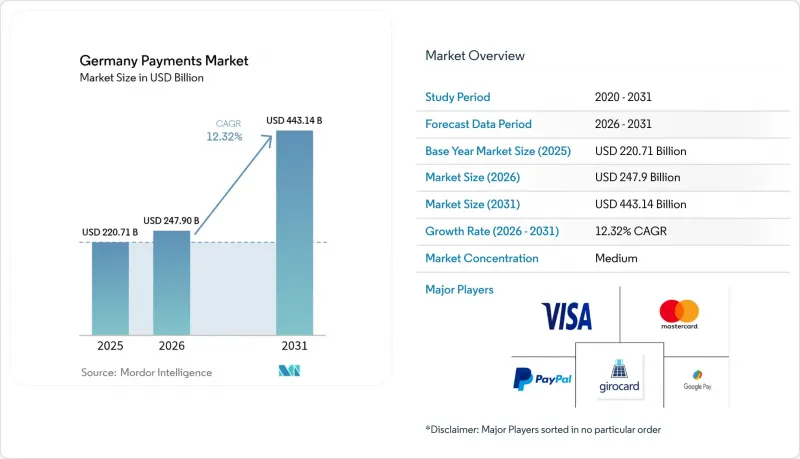
According to Mordor Intelligence, Germany payments market size in 2026 is estimated at USD 247.9 billion, growing from 2025 value of USD 220.71 billion with 2031 projections showing USD 443.14 billion, growing at 12.32% CAGR over 2026-2031.
This report is Segmented by Mode of Payment (Point of Sale, Online), Interaction Channel (Point-Of-Sale, E-commerce/M-commerce), Transaction Type (P2P, C2B, B2B, Remittances and Cross-Border), End-User Industry (Retail, Entertainment and Digital Content, Healthcare, Hospitality & Travel, and More). The Market Forecasts are Provided in Terms of Value (USD).
Germany Payments Market Trends and Insights
Explosion of Mobile-Wallet Acceptance at German POS Terminals
PayPal's contactless debut in 2025-enabled by Digital Markets Act access to Apple's NFC chipset-removed a long-standing technical barrier and let non-bank wallets compete directly with Apple Pay and Google Pay at 286,000 VR Payment terminals. Merchant queues shortened, checkout data improved, and mobile usage jumped as cash lost relevance. Banks responded by integrating girocard tokens into Android and iOS wallets to retain top-of-mind status at the point of tap. The network effect is self-reinforcing: each accepting merchant encourages more consumers, who in turn press other merchants to upgrade. Over the medium term the uplift adds 2.8 percentage points to the Germany payments market CAGR, particularly in high-traffic urban micro-segments.
E-commerce Boom Fueling Card-Not-Present Volumes
Online shopping reached 82% household penetration by 2023 and remains on a steep trajectory. Lidl and Kaufland's Click to Pay roll-out trimmed authentication friction, lifting conversion while allowing Mastercard to march toward its 100% tokenization target. Higher basket values and purchase frequency in digital channels give payment providers revenue leverage even when physical retail stabilizes. Digital identity projects and one-click checkout standards converge to suppress fraud rates, further nudging late adopters into the channel. The result is a 3.2 percentage-point boost to overall growth in the Germany payments market, with CNP volumes eclipsing face-to-face growth by more than 2:1.
Interchange-Fee Caps Compressing Issuer Economics
Proposed fee ceilings could shift USD 502 million of annual economics from issuers to merchants. German banks therefore accelerate account-to-account propositions and seek subscription-style revenues from digital identity or loyalty add-ons. Card schemes respond by unbundling value-added services-fraud scoring, token vaults, instalment APIs-to preserve relevance. Smaller issuers, lacking scale, may retreat from consumer cards altogether, trimming innovation budgets and shaving 1.8 percentage points off the otherwise robust CAGR in the Germany payments market.
Other drivers and restraints analyzed in the detailed report include:
- Government-Backed Instant-Payment Infrastructure Drives the Market
- Surging Buy-Now-Pay-Later Adoption Among Millennials
- Legacy Core-Banking Systems Slowing API Roll-outs
For complete list of drivers and restraints, kindly check the Table Of Contents.
Segment Analysis
POS card payments held 37.62% Germany payments market share in 2025, underscoring consumers' familiarity with girocard and dual-network debit credentials. Overall, Point-of-Sale Payment is largest share with 63.25%. Credit and prepaid cards together stayed below 15% because many Germans prefer immediate settlement over revolving credit. Yet digital wallets, helped by open-NFC policy and SEPA Instant reach, are expanding at 15.74% CAGR. Their share of Germany payments market size for online checkouts is forecast to eclipse cards by 2028. Unlike cards, wallets can weave loyalty, buy-now-pay-later, and identity verification into one interface, making them magnets for merchant upselling. Cash use is slipping into single-digit range for transactions above EUR 50 (USD 54) as public transport and event venues pivot to tap-only acceptance. Meanwhile, QR code and wearable payments ride contactless rails but remain niche, capturing less than 2% of 2025 volume. Over the forecast period, regulators will watch wallet concentration to ensure competitive balance, yet the consumer tide is clearly in favor of tap-to-phone and in-app credentials.
The brick-and-mortar environment delivered 69.85% of 2025 transaction value, reflecting Germany's dense grocery and discount-retail footprint. Yet e-commerce posted a 14.25% CAGR, adding incremental spend faster than physical outlets. Mobile commerce-fueled by same-day delivery and 5G coverage-accounts for more than half of online checkouts in urban corridors. PayPal's contactless launch blurs channel boundaries by letting shoppers re-use the same credential online and in stores. That convergence encourages merchants to invest in unified token vaults and customer-data platforms. Within the Germany payments market, omnichannel experiences will reduce stand-alone online fraud rates and harmonize loyalty programs, supporting profitable growth across both channels.
Complete Report Scope:
- By Mode of Payment
- Point-of-Sale
- Card (Debit, Credit, Pre-paid)
- Digital Wallets (Apple Pay, Google Pay, Interac Flash)
- Cash
- Other POS (Gift-cards, QR, Wearables)
- Online
- Card (Card-Not-Present)
- Digital Wallet and Account-to-Account (Interac e-Transfer, PayPal)
- Other Online (COD, BNPL, Bank Transfer)
- Point-of-Sale
- By Interaction Channel
- Point-of-Sale
- E-commerce/M-commerce
- By Transaction Type
- Person-to-Person (P2P)
- Consumer-to-Business (C2B)
- Business-to-Business (B2B)
- Remittances and Cross-border
- By End-user Industry
- Retail
- Entertainment and Digital Content
- Healthcare
- Hospitality and Travel
- Government and Utilities
- Other End-user Industries
List of Companies Covered in this Report:
- Mastercard Inc.
- Visa Inc.
- Girocard (Deutsche Kreditwirtschaft)
- PayPal Holdings Inc.
- Google Pay (Alphabet Inc.)
- Apple Pay (Apple Inc.)
- Amazon Pay (Amazon.com Inc.)
- American Express Co.
- Payback Pay
- Paydirekt GmbH
- Klarna Bank AB
- Adyen N.V.
- Stripe Inc.
- PAYONE GmbH
- Worldline Sa
- Sofort GmbH (Klarna Group)
- Ratepay GmbH
- Bluecode Mobile Payment GmbH
- Checkout.com
- Paysafe Ltd.
Additional Benefits:
- The market estimate (ME) sheet in Excel format
- 3 months of analyst support
TABLE OF CONTENTS
1 INTRODUCTION
- 1.1 Study Assumptions and Market Definition
- 1.2 Scope of the Study
2 RESEARCH METHODOLOGY
3 EXECUTIVE SUMMARY
4 MARKET LANDSCAPE
- 4.1 Market Overview
- 4.2 Market Drivers
- 4.2.1 Explosion of Mobile-Wallet Acceptance at German POS Terminals
- 4.2.2 E-commerce Boom Fueling Card-Not-Present Volumes
- 4.2.3 Government-backed Instant-Payment Infrastructure Drives the Market
- 4.2.4 Surging Buy-Now-Pay-Later (BNPL) Adoption Among Millennials
- 4.2.5 Merchant Demand for Omnichannel Checkout Experiences
- 4.2.6 Fin-Tech Partnerships Enabling Embedded-Payment Use-Cases
- 4.3 Market Restraints
- 4.3.1 Interchange-Fee Caps Compressing Issuer Economics
- 4.3.2 Legacy Core-Banking Systems Slowing API Roll-outs
- 4.3.3 Consumer Privacy Concerns over PSD2 Data-Sharing
- 4.3.4 Fragmented KYC/AML Requirements for Cross-border Payments
- 4.4 Value Chain Analysis
- 4.5 Regulatory and Standards Outlook (BaFin, PSD3, Digital-Euro Pilots)
- 4.6 Technological Outlook (Tokenisation, Contactless NFC, Open-Banking APIs)
- 4.7 Porter's Five Forces Analysis
- 4.7.1 Bargaining Power of Suppliers
- 4.7.1.1 Bargaining Power of Buyers / Consumers
- 4.7.1.2 Threat of New Entrants
- 4.7.1.3 Threat of Substitutes
- 4.7.1.4 Intensity of Competitive Rivalry
- 4.7.1 Bargaining Power of Suppliers
- 4.8 Evolution of the Payments Landscape in Germany
- 4.9 Assessment of Macro Economic Trends on the Market
- 4.10 Key Trends Accelerating the Shift to Cashless Transactions
- 4.11 Analysis of Cash Displacement and Contactless Uptake
- 4.12 Demographic Patterns (Population, Internet, Banking, Age, Income)
- 4.13 Major Case Studies and Use-Cases (Aldi, Deutsche Bahn, Deutsche Post)
5 MARKET SIZE AND GROWTH FORECASTS (VALUES)
- 5.1 By Mode of Payment
- 5.1.1 Point-of-Sale
- 5.1.1.1 Card (Debit, Credit, Pre-paid)
- 5.1.1.2 Digital Wallets (Apple Pay, Google Pay, Interac Flash)
- 5.1.1.3 Cash
- 5.1.1.4 Other POS (Gift-cards, QR, Wearables)
- 5.1.2 Online
- 5.1.2.1 Card (Card-Not-Present)
- 5.1.2.2 Digital Wallet and Account-to-Account (Interac e-Transfer, PayPal)
- 5.1.2.3 Other Online (COD, BNPL, Bank Transfer)
- 5.1.1 Point-of-Sale
- 5.2 By Interaction Channel
- 5.2.1 Point-of-Sale
- 5.2.2 E-commerce/M-commerce
- 5.3 By Transaction Type
- 5.3.1 Person-to-Person (P2P)
- 5.3.2 Consumer-to-Business (C2B)
- 5.3.3 Business-to-Business (B2B)
- 5.3.4 Remittances and Cross-border
- 5.4 By End-user Industry
- 5.4.1 Retail
- 5.4.2 Entertainment and Digital Content
- 5.4.3 Healthcare
- 5.4.4 Hospitality and Travel
- 5.4.5 Government and Utilities
- 5.4.6 Other End-user Industries
6 COMPETITIVE LANDSCAPE
- 6.1 Market Concentration
- 6.2 Strategic Moves (MandA, Partnerships, Product Launches)
- 6.3 Market Share Analysis
- 6.4 Company Profiles {(includes Global level Overview, Market level overview, Core Segments, Financials as available, Strategic Information, Market Rank/Share for key companies, Products and Services, and Recent Developments)}
- 6.4.1 Mastercard Inc.
- 6.4.2 Visa Inc.
- 6.4.3 Girocard (Deutsche Kreditwirtschaft)
- 6.4.4 PayPal Holdings Inc.
- 6.4.5 Google Pay (Alphabet Inc.)
- 6.4.6 Apple Pay (Apple Inc.)
- 6.4.7 Amazon Pay (Amazon.com Inc.)
- 6.4.8 American Express Co.
- 6.4.9 Payback Pay
- 6.4.10 Paydirekt GmbH
- 6.4.11 Klarna Bank AB
- 6.4.12 Adyen N.V.
- 6.4.13 Stripe Inc.
- 6.4.14 PAYONE GmbH
- 6.4.15 Worldline Sa
- 6.4.16 Sofort GmbH (Klarna Group)
- 6.4.17 Ratepay GmbH
- 6.4.18 Bluecode Mobile Payment GmbH
- 6.4.19 Checkout.com
- 6.4.20 Paysafe Ltd.
7 MARKET OPPORTUNITIES AND FUTURE OUTLOOK
- 7.1 White-space and Unmet-Need Assessment

