PUBLISHER: Mordor Intelligence | PRODUCT CODE: 2125274

PUBLISHER: Mordor Intelligence | PRODUCT CODE: 2125274
Asia Pacific Payments - Market Share Analysis, Industry Trends & Statistics, Growth Forecasts (2026 - 2031)
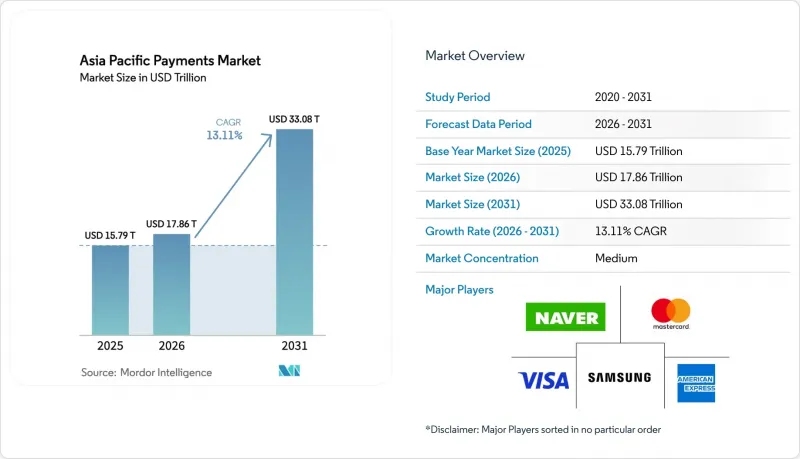
According to Mordor Intelligence, the Asia-Pacific payments market size was valued at USD 15.79 trillion in 2025 and estimated to grow from USD 17.86 trillion in 2026 to reach USD 33.08 trillion by 2031, at a CAGR of 13.11% during the forecast period (2026-2031).
This report is Segmented by Mode of Payment (Point of Sale [Debit Card, Credit Card, A2A, Digital Wallet, Cash, and More], Online Sale [Debit Card, Credit Card, A2A, Digital Wallet, Cash-On-Delivery, and More]), End-User Industry (Retail, Entertainment and Media, Hospitality and Travel, Healthcare, and More), and Country. The Market Forecasts are Provided in Terms of Value (USD).
Asia Pacific Payments Market Trends and Insights
Rapid E-commerce and M-commerce Expansion
Asia-Pacific online retail sales surged during 2024, and mobile transactions already account for more than 70% of total digital commerce in China and India. Escalating cross-border shopping forces merchants to support multi-currency checkout, real-time FX, and orchestrated routing that bypasses costly correspondent banking corridors. Payment-orchestration platforms roll out unified APIs, letting retailers dynamically switch acquirers or payment methods to maximize authorization rates and minimize fees. Social commerce features embedded in super-apps commoditize checkout and place renewed emphasis on loyalty programs, cashback, and personalized offers that keep users inside closed ecosystems. Regulatory sandboxes attempt to balance consumer protection with innovation velocity, yet uneven implementation across markets creates temporary arbitrage opportunities for agile fintechs.
Government Real-time Rails and Digitization Programs
Public-sector infrastructure shapes the Asia-Pacific payments market by standardizing instant settlement, reducing transaction fees, and asserting data sovereignty. India's UPI processed 131 billion transactions in 2024, while Thailand's PromptPay crossed 15 billion, proving that government rails can scale in a fraction of the time historically required by private networks. Programmable-money pilots such as Singapore's Project Orchid explore automated tax collection, escrow, and compliance triggers that fire within the payment itself, shrinking reconciliation cycles from days to seconds. Central-bank oversight of core rails lowers systemic-risk concerns and increases competitive pressure on incumbents who must now differentiate through value-added services rather than proprietary switching. The expanded visibility into domestic flows also sharpens monetary-policy tools, enabling regulators to identify stress pockets early and intervene with targeted liquidity measures.
Fragmented Cross-border Regulations
Payment providers navigating the Asia-Pacific payments market face multiple licensing regimes that seldom recognize each other's approvals. Anti-money-laundering thresholds, foreign-exchange caps, and data-localization demands differ by jurisdiction, raising compliance costs and delaying new-product rollouts. Smaller fintechs often restrict initial expansion to two or three markets, ceding broader regional opportunities to incumbents with existing compliance frameworks. The ASEAN Payment Connectivity roadmap aims to harmonize rules by 2027, yet stakeholders indicate extended timelines as individual governments prioritize domestic financial-stability concerns. Until policy alignment materializes, scale advantages accrue to platforms large enough to maintain redundant regulatory reporting across a dozen jurisdictions.
Other drivers and restraints analyzed in the detailed report include:
- Rising Smartphone and Internet Penetration
- Accelerating Buy-Now-Pay-Later Uptake
- Escalating Payment-fraud Sophistication
For complete list of drivers and restraints, kindly check the Table Of Contents.
Segment Analysis
Digital wallets captured 65.12% of the Asia-Pacific payments market in 2025, reflecting consumer appetite for a unified interface that merges loyalty, lending, and lifestyle services into a single tap. The segment's dominance is underpinned by QR-code ubiquity, near-field communication upgrades, and OEM wallets pre-installed on low-cost smartphones that penetrate rural markets. Card networks respond by pushing tokenization, and Visa's Token Service alone generated USD 2 billion in incremental volume across the region in 2024. This security layer lets cards remain relevant within wallets even as physical plastic recedes, illustrating how infrastructure adaptation, rather than direct competition, can preserve legacy revenue streams. BNPL sits inside this ecosystem, with one-click installments surfacing contextually at checkout, creating a seamless blend of payments and credit that users perceive as a single service rather than two separate verticals. Contactless point-of-sale solutions stay important for transit and quick-service restaurants, where speed trumps richer in-app experiences. Account-to-account real-time payments, meanwhile, grow fastest where cost-sensitive merchants prefer zero-interchange models, notably in Singapore and Australia.
Regulatory mandates for multifactor authentication sharpen the competitive field, because only platforms with deep engineering resources can maintain frictionless user experience while meeting token-life-cycle management rules. The Asia-Pacific payments market size for digital-wallet transactions is projected to reach USD 21.15 trillion by 2031, underlining the continued primacy of wallet rails in both peer-to-peer and retail settings. Smaller e-money apps often white-label token services from global schemes, but they retain frontend branding and customer relationships, ensuring data harvesting stays local. Cash still circulates in rural economies, though its share of overall consumer spending falls each year, suggesting a dual-track evolution that calls for hybrid acceptance hardware capable of processing both QR and contactless card taps in a single device.
Complete Report Scope:
- Mode of Payment
- Point of Sale
- Debit Card Payments
- Credit Card Payments
- A2A Payments
- Digital Wallet
- Cash
- Other Point-of-Sale Payment Mode
- Online Sale
- Debit Card Payments
- Credit Card Payments
- A2A Payments
- Digital Wallet
- Cash-on-Delivery
- Other Online-Sale Payment Mode
- Point of Sale
- End-User Industry
- Retail
- Entertainment
- Hospitality
- Healthcare
- Transportation and Logistics
- Other End-User Industries
- By Country
- China
- India
- South Korea
- Taiwan
- Singapore
- Philippines
- Malaysia
- Indonesia
- Vietnam
- Australia
- Japan
- Other Countries
List of Companies Covered in this Report:
- Payment Processors / Gateways
- Card Networks
- Mobile Wallet Providers
Additional Benefits:
- The market estimate (ME) sheet in Excel format
- 3 months of analyst support
TABLE OF CONTENTS
1 INTRODUCTION
- 1.1 Study Assumptions and Market Definition
- 1.2 Scope of the Study
2 RESEARCH METHODOLOGY
3 EXECUTIVE SUMMARY
4 MARKET LANDSCAPE
- 4.1 Market Overview
- 4.2 Market Drivers
- 4.2.1 Rapid e-commerce and m-commerce expansion
- 4.2.2 Government real-time rails and digitization programs
- 4.2.3 Rising smartphone and internet penetration
- 4.2.4 Accelerating Buy-Now-Pay-Later (BNPL) uptake
- 4.2.5 Cross-border QR and real-time linkages
- 4.2.6 Tokenization boosts card-in-wallet security
- 4.3 Market Restraints
- 4.3.1 Fragmented cross-border regulations
- 4.3.2 Escalating payment-fraud sophistication
- 4.3.3 Merchant-fee and interchange compression
- 4.3.4 Zero-fee instant rails eroding bank revenues
- 4.4 Impact of Macroeconomic Factors
- 4.5 Industry Value Chain Analysis
- 4.6 Regulatory Landscape and Key Standards
- 4.7 Technological Outlook
- 4.8 Porter's Five Forces Analysis
- 4.8.1 Bargaining Power of Suppliers
- 4.8.2 Bargaining Power of Buyers
- 4.8.3 Threat of New Entrants
- 4.8.4 Threat of Substitute Products
- 4.8.5 Intensity of Competitive Rivalry
- 4.9 Evolution of the Payments Landscape in Asia-Pacific
- 4.10 Analysis of Growing Payment Fraud
- 4.11 Analysis of Major Case Studies and Use-Cases
- 4.12 Demographic Trends and Patterns
- 4.13 Customer-Satisfaction Convergence
- 4.14 Cash Displacement and Rise of Contactless
5 MARKET SIZE AND GROWTH FORECASTS (VALUE)
- 5.1 Mode of Payment
- 5.1.1 Point of Sale
- 5.1.1.1 Debit Card Payments
- 5.1.1.2 Credit Card Payments
- 5.1.1.3 A2A Payments
- 5.1.1.4 Digital Wallet
- 5.1.1.5 Cash
- 5.1.1.6 Other Point-of-Sale Payment Mode
- 5.1.2 Online Sale
- 5.1.2.1 Debit Card Payments
- 5.1.2.2 Credit Card Payments
- 5.1.2.3 A2A Payments
- 5.1.2.4 Digital Wallet
- 5.1.2.5 Cash-on-Delivery
- 5.1.2.6 Other Online-Sale Payment Mode
- 5.1.1 Point of Sale
- 5.2 End-User Industry
- 5.2.1 Retail
- 5.2.2 Entertainment
- 5.2.3 Hospitality
- 5.2.4 Healthcare
- 5.2.5 Transportation and Logistics
- 5.2.6 Other End-User Industries
- 5.3 By Country
- 5.3.1 China
- 5.3.2 India
- 5.3.3 South Korea
- 5.3.4 Taiwan
- 5.3.5 Singapore
- 5.3.6 Philippines
- 5.3.7 Malaysia
- 5.3.8 Indonesia
- 5.3.9 Vietnam
- 5.3.10 Australia
- 5.3.11 Japan
- 5.3.12 Other Countries
6 COMPETITIVE LANDSCAPE
- 6.1 Market Concentration
- 6.2 Strategic Moves
- 6.3 Market Share Analysis
- 6.4 Company Profiles (includes Global-level Overview, Market-level Overview, Core Segments, Financials, Strategic Information, Market Rank/Share, Products and Services, Recent Developments)
- 6.4.1 Payment Processors / Gateways
- 6.4.1.1 Worldpay, LLC
- 6.4.1.2 PayPal Holdings, Inc.
- 6.4.1.3 Adyen N.V.
- 6.4.1.4 Stripe, Inc.
- 6.4.1.5 Block, Inc. (Square)
- 6.4.1.6 AsiaPay Limited
- 6.4.1.7 Razorpay Software Pvt Ltd
- 6.4.1.8 PayU Payments Pvt Ltd
- 6.4.1.9 Airwallex (Hong Kong) Ltd
- 6.4.1.10 Ipay88 (M) Sdn. Bhd.
- 6.4.2 Card Networks
- 6.4.2.1 Visa Inc.
- 6.4.2.2 Mastercard Incorporated
- 6.4.2.3 American Express Company
- 6.4.2.4 JCB Co., Ltd.
- 6.4.2.5 UnionPay International Co., Ltd.
- 6.4.3 Mobile Wallet Providers
- 6.4.3.1 Ant Group Co., Ltd. (Alipay)
- 6.4.3.2 Tencent Holdings Ltd. (WeChat Pay)
- 6.4.3.3 Paytm Payments Bank Ltd. (Paytm Wallet)
- 6.4.3.4 PhonePe Pvt Ltd.
- 6.4.3.5 Grab Holdings Ltd. (GrabPay)
- 6.4.3.6 Kakao Pay Corp.
- 6.4.3.7 Naver Corporation (Naver Pay)
- 6.4.3.8 Samsung Electronics Co., Ltd. (Samsung Pay)
- 6.4.3.9 Viva Republica Co., Ltd. (Toss)
- 6.4.3.10 Globe Fintech Innovations, Inc. (GCash)
- 6.4.1 Payment Processors / Gateways
7 MARKET OPPORTUNITIES AND FUTURE OUTLOOK
- 7.1 White-space and Unmet-need Assessment

