PUBLISHER: Mordor Intelligence | PRODUCT CODE: 2187741

PUBLISHER: Mordor Intelligence | PRODUCT CODE: 2187741
India Organic Fertilizer - Market Share Analysis, Industry Trends & Statistics, Growth Forecasts (2026 - 2031)
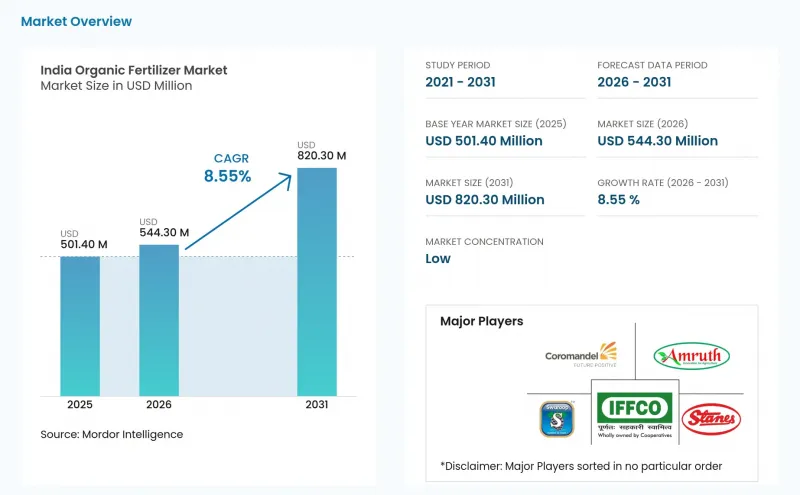
According to Mordor Intelligence, the India organic fertilizer market size was valued at USD 501.40 million in 2025 and is projected to grow from USD 544.30 million in 2026 to USD 820.30 million by 2031, with a forecast CAGR of 8.55% from 2026 to 2031.
India Organic Fertilizer Market Trends and Insights
Government Incentives and Organic-Input Subsidies
Government incentives and organic-input subsidies are supporting the adoption of organic fertilizers by reducing the cost burden on farmers and improving access to certified organic inputs. Under the Paramparagat Krishi Vikas Yojana (PKVY), farmers receive INR 31,500 (USD 331.25) per hectare over three years, including INR 15,000 (USD 157.38) per hectare through direct benefit transfer for organic inputs, according to the Press Information Bureau (PIB). These financial incentives encourage farmers to adopt organic fertilizers as part of structured organic farming programs and support demand through cluster-based procurement. Similar assistance under programs such as the Mission Organic Value Chain Development for North Eastern Region (MOVCDNER) extends government-supported organic-input adoption to additional regions. The availability of multi-year financial assistance, certification support, and organized organic farming programs improves market access for suppliers offering compliant organic fertilizer products and can encourage repeat procurement within supported farming clusters.
Rising Demand for Certified and Export-Oriented Organic Produce
Growing demand for certified organic produce in export markets is supporting the use of compliant organic inputs across India's certified farming supply chains. India exported USD 665.97 million of organic products in 2024-25, according to the Agricultural and Processed Food Products Export Development Authority (APEDA). Export-oriented organic production requires adherence to certification and traceability requirements under the National Programme for Organic Production (NPOP), increasing the importance of documented and compliant input use. The launch of the 8th edition of NPOP and TraceNet 2.0 in January 2025 further strengthened digital traceability, certification, and compliance across organic supply chains. These requirements favor organic fertilizer suppliers that can provide standardized formulations, certification-related documentation, and traceability records suitable for NPOP-registered farms, supporting demand from farmers targeting premium domestic and export markets.
Higher Delivered Cost Compared With Subsidized Synthetic Fertilizers
Higher delivered costs compared with subsidized synthetic fertilizers remain a restraint for the India organic fertilizer market, particularly in regions where transportation, handling, and storage costs are higher. Urea is sold at a government-notified MRP of INR 242 (USD 2.54) per 45-kilogram bag, with the government covering the difference between its delivered cost and the amount realized from farmers through the Urea Subsidy Scheme, according to the Press Information Bureau. Organic fertilizers generally have a different cost structure because their bulkier nature can increase transportation, storage, handling, and application expenses relative to concentrated synthetic fertilizers. Government initiatives encouraging reduced chemical fertilizer use can support the adoption of alternative nutrient sources, but they do not eliminate the established price advantage of subsidized synthetic fertilizers. This cost differential can make organic fertilizers more difficult to adopt among price-sensitive farmers, particularly where organic products do not command a premium or receive direct input support.
Other drivers and restraints analyzed in the detailed report include:
- Expansion of Certified Organic Farmland and Cluster Farming
- GOBARdhan and Compressed Biogas Feedstock Commercialization
- Inconsistent Nutrient Content and Quality Across Decentralized Suppliers
For complete list of drivers and restraints, kindly check the Table Of Contents.
Segment Analysis
Meal-based fertilizers accounted for 67.3% of the India organic fertilizer market size in 2025, making them the largest form segment. Their leading position is supported by their established use in nutrient management across cotton, turmeric, chili, and other higher-value crops, as well as the availability of granular and easy-to-apply formulations compatible with existing fertilizer-spreading equipment. Quality requirements under the Fertilizer Control Order (FCO) can favor processors with established testing and quality-control systems. Manure and other organic fertilizers, including city compost, press mud-based manure, and enriched formulations, complement meal-based products by serving broader soil-conditioning and nutrient-management applications.
Manure is the fastest-growing segment, forecast to expand at a 9.2% CAGR between 2026 and 2031. Its growth is supported by increasing availability of organic manure from compressed biogas (CBG) facilities, which generate fermented organic manure (FOM) and liquid fermented organic manure (LFOM) as co-products. The expansion of CBG infrastructure is creating additional sources of standardized manure products while strengthening the link between waste management and agricultural input supply. Press mud-based manure and other enriched manure products also benefit from government support and increasing commercialization of organic nutrient sources. This expanding supply base can improve product availability and distribution, although suppliers need to maintain consistent nutrient content, quality, and regulatory compliance as manure-based products gain a larger role in the India organic fertilizer market.
Complete Report Scope:
- By Form
- Manure
- Meal-Based Fertilizers
- Oilcakes
- Other Organic Fertilizers
- By Crop Type
- Cash Crops
- Horticultural Crops
- Row Crops
List of Companies Covered in this Report:
- Coromandel International Limited
- Indian Farmers Fertiliser Cooperative Limited
- T. Stanes and Company Limited
- Swaroop Agri Sciences Private Limited
- Amruth Organic Fertilizers
- Multiplex Fertilizers Private Limited (Multiplex Group)
- Growtech Agri Science and Research Private Limited
- Prabhaat Global Industries Limited
- Aries Agro Limited
- Rallis India Limited (Tata Chemicals Limited)
- Southern Petrochemical Industries Corporation Limited (AM International Group)
- Madras Fertilizers Limited (Government of India)
- Krishak Bharati Cooperative Limited
Additional Benefits:
- The market estimate (ME) sheet in Excel format
- 3 months of analyst support
TABLE OF CONTENTS
1 INTRODUCTION
- 1.1 Study Assumptions and Market Definition
- 1.2 Scope of the Study
- 1.3 Research Methodology
2 REPORT OFFERS
3 EXECUTIVE SUMMARY AND KEY FINDINGS
4 KEY INDUSTRY TRENDS
- 4.1 Area Under Organic Cultivation
- 4.2 Per Capita Spending on Organic Products
- 4.3 Regulatory Framework
- 4.4 Value Chain and Distribution Channel Analysis
- 4.5 Market Drivers
- 4.5.1 Government Incentives and Organic-Input Subsidies
- 4.5.2 Rising Demand for Certified and Export-Oriented Organic Produce
- 4.5.3 Expansion of Certified Organic Farmland and Cluster Farming
- 4.5.4 Environmental Pressure to Reduce Chemical Fertilizer Overuse
- 4.5.5 GOBARdhan and Compressed Biogas Feedstock Commercialization
- 4.5.6 Crop-Specific Organic Formulations Enabled by Soil Testing and Digital Advisory
- 4.6 Market Restraints
- 4.6.1 Higher Delivered Cost Compared With Subsidized Synthetic Fertilizers
- 4.6.2 Inconsistent Nutrient Content and Quality Across Decentralized Suppliers
- 4.6.3 High Moisture, Low Nutrient Density, and Fragmented Logistics Raise Delivered Costs
- 4.6.4 Limited Monetization of Farm-Made Organic Inputs and Weak Traceability
5 MARKET SIZE AND GROWTH FORECASTS (VALUE AND VOLUME)
- 5.1 By Form
- 5.1.1 Manure
- 5.1.2 Meal-Based Fertilizers
- 5.1.3 Oilcakes
- 5.1.4 Other Organic Fertilizers
- 5.2 By Crop Type
- 5.2.1 Cash Crops
- 5.2.2 Horticultural Crops
- 5.2.3 Row Crops
6 COMPETITIVE LANDSCAPE
- 6.1 Market Concentration
- 6.2 Strategic Moves
- 6.3 Market Share Analysis
- 6.4 Company Profiles (Includes Global Level Overview, Market Level Overview, Core Segments, Financials as Available, Strategic Information, Market Rank/Share, Products and Services, Recent Developments)
- 6.4.1 Coromandel International Limited
- 6.4.2 Indian Farmers Fertiliser Cooperative Limited
- 6.4.3 T. Stanes and Company Limited
- 6.4.4 Swaroop Agri Sciences Private Limited
- 6.4.5 Amruth Organic Fertilizers
- 6.4.6 Multiplex Fertilizers Private Limited (Multiplex Group)
- 6.4.7 Growtech Agri Science and Research Private Limited
- 6.4.8 Prabhaat Global Industries Limited
- 6.4.9 Aries Agro Limited
- 6.4.10 Rallis India Limited (Tata Chemicals Limited)
- 6.4.11 Southern Petrochemical Industries Corporation Limited (AM International Group)
- 6.4.12 Madras Fertilizers Limited (Government of India)
- 6.4.13 Krishak Bharati Cooperative Limited
7 KEY STRATEGIC QUESTIONS FOR ORGANIC FERTILIZER CEOS

