
PUBLISHER: Global Market Insights Inc. | PRODUCT CODE: 2045661

PUBLISHER: Global Market Insights Inc. | PRODUCT CODE: 2045661
North America Gaming Handheld Market Opportunity, Growth Drivers, Industry Trend Analysis, and Forecast 2026 - 2035
North America Gaming Handheld Market was valued at USD 4.4 billion in 2025 and is estimated to grow at a CAGR of 2.6% to reach USD 5.3 billion by 2035.
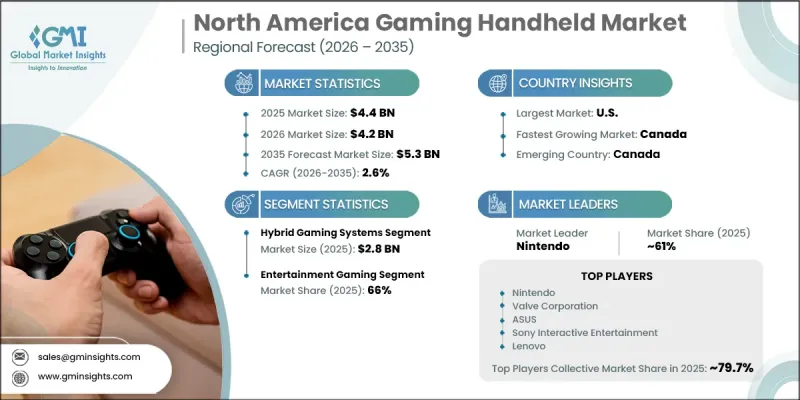
Strong gaming engagement across the United States and Canada, combined with high consumer spending on digital entertainment products, continues to support market expansion throughout the region. Gaming has become a mainstream recreational activity among multiple age groups, driving demand for portable gaming solutions that offer convenience and flexibility. Handheld gaming devices are increasingly preferred by consumers seeking immersive gaming experiences both at home and while traveling. The growth of digital game distribution platforms and subscription-based gaming ecosystems is also strengthening product adoption across North America. In addition, rising consumer interest in high-performance handheld gaming systems capable of delivering console-quality experiences is accelerating market growth. Advanced processors, enhanced graphics capabilities, high-refresh-rate displays, and cloud gaming compatibility are significantly improving user experience. Continuous innovation in portable gaming hardware and system integration continues to create favorable growth opportunities for the North America gaming handheld industry.
| Market Scope | |
|---|---|
| Start Year | 2025 |
| Forecast Year | 2026-2035 |
| Start Value | $4.4 Billion |
| Forecast Value | $5.3 Billion |
| CAGR | 2.6% |
The hybrid gaming systems segment generated USD 2.8 billion in 2025 and is expected to grow at a CAGR of 1.1% from 2026 to 2035. Hybrid gaming systems continue to dominate the North America gaming handheld market due to their ability to function as both portable gaming devices and home gaming consoles. This dual-function capability allows users to transition seamlessly between handheld gameplay and larger display experiences, improving overall flexibility and convenience. Hybrid systems appeal to a wide consumer audience by combining portability with advanced gaming performance. The growing demand for multifunctional entertainment devices and the increasing popularity of connected gaming ecosystems are further contributing to segment growth throughout the region.
The entertainment gaming segment accounted for 66% share in 2025 and is projected to grow at a CAGR of 1.1% through 2035. The segment continues to lead the market due to strong consumer demand for portable gaming devices designed for leisure, immersive gameplay, and recreational entertainment. Consumers increasingly prefer handheld systems that allow gaming access across various environments without sacrificing performance quality. The segment includes a broad range of gaming experiences catering to different player preferences and age groups. Rising popularity of competitive gaming, cloud-based gaming services, and evolving mobile gaming culture is significantly contributing to sustained demand for entertainment-focused handheld gaming systems across North America.
U.S. Gaming Handheld Market generated USD 3.9 billion in 2025 and is anticipated to grow at a CAGR of 2.4% from 2026 to 2035. The United States remains the dominant market within North America due to strong purchasing power, advanced gaming infrastructure, and a highly developed digital entertainment ecosystem. Demand is being driven by consumers seeking portable gaming devices capable of delivering high-quality graphics, fast processing performance, and seamless connectivity with cloud gaming platforms. Hybrid gaming systems compatible with televisions and PC gaming environments are gaining widespread popularity due to their versatility and convenience. The market also benefits from strong growth in esports participation, subscription-based gaming services, and frequent hardware upgrade cycles introduced by major gaming brands. Distribution channels continue to expand through electronics retailers, specialty gaming stores, and online sales platforms across the country.
Major companies operating in the North America Gaming Handheld Market include global manufacturers such as Nintendo, Valve Corporation, Sony Interactive Entertainment, ASUS, Lenovo, MSI, and AYN. Companies operating in the North America gaming handheld market are implementing several strategic initiatives to strengthen their market position and improve competitive advantage. Leading manufacturers are investing heavily in advanced hardware technologies, including high-performance processors, improved graphics systems, and enhanced battery efficiency to deliver superior gaming experiences. Product innovation focused on lightweight designs, ergonomic functionality, and cloud gaming compatibility remains a major growth strategy across the industry. Companies are also expanding strategic partnerships with game developers, digital distribution platforms, and subscription gaming service providers to strengthen ecosystem integration and content accessibility. In addition, market participants are increasingly investing in research and development activities to improve device portability, display quality, and overall system performance. Expansion of online distribution channels and targeted marketing strategies aimed at gaming communities are further helping companies strengthen brand visibility and expand their foothold in the North America gaming handheld market.
Table of Contents
Chapter 1 Methodology & Scope
- 1.1 Market scope and definition
- 1.2 Research design
- 1.2.1 Research approach
- 1.2.2 Data collection methods
- 1.3 Data mining sources
- 1.3.1 Global
- 1.3.2 Regional/Country
- 1.4 Base estimates and calculations
- 1.4.1 Base year calculation
- 1.4.2 Key trends for market estimation
- 1.5 Primary research and validation
- 1.5.1 Primary sources
- 1.6 Forecast model
- 1.7 Research assumptions and limitations
Chapter 2 Executive Summary
- 2.1 Industry 360° synopsis
- 2.2 Key market trends
- 2.2.1 Regional
- 2.2.2 Product Type
- 2.2.3 Form
- 2.2.4 Technology
- 2.2.5 Age Group
- 2.2.6 Display Size
- 2.2.7 Price Range
- 2.2.8 Application
- 2.2.9 Distribution channel
Chapter 3 Industry Insights
- 3.1 Industry ecosystem analysis
- 3.1.1 Supplier landscape
- 3.1.2 Profit margin
- 3.1.3 Value addition at each stage
- 3.1.4 Factor affecting the value chain
- 3.2 Industry impact forces
- 3.2.1 Growth drivers
- 3.2.1.1 Strong gaming culture and high consumer spending
- 3.2.1.2 Rapid adoption of high-performance handheld gaming PCs
- 3.2.1.3 Advanced digital infrastructure and cloud gaming ecosystem
- 3.2.2 Pitfalls & Challenges
- 3.2.2.1 High competition from smartphones and tablets as gaming alternatives
- 3.2.2.2 High product pricing for premium handheld gaming devices
- 3.2.3 Opportunities
- 3.2.3.1 Growth of subscription-based cloud gaming platforms
- 3.2.3.2 Rising demand for hybrid and modular gaming devices
- 3.2.1 Growth drivers
- 3.3 Growth potential analysis
- 3.4 Future market trends
- 3.5 Technology and innovation landscape
- 3.5.1 Current technological trends
- 3.5.2 Emerging technologies
- 3.6 Regulatory landscape
- 3.6.1 Standards and compliance requirements
- 3.6.2 Regional regulatory frameworks
- 3.6.3 Certification standards
- 3.7 Porter’s analysis
- 3.8 PESTEL analysis
- 3.8.1 Pricing analysis (driven by primary research)
- 3.8.1.1 Historical price trend analysis (2019-2024) (driven by primary research)
- 3.8.1.2 Pricing strategy by player type (premium / value / cost-plus) (driven by primary research)
- 3.8.1.3 Regional price variations and purchasing power parity
- 3.8.1.4 Component cost dynamics and BOM analysis
- 3.8.1.5 Price elasticity of demand by segment
- 3.8.2 Trade data analysis (HS code- 9504.50) (driven by paid database)
- 3.8.2.1 Import/export volume and value trends (2019-2024) (driven by paid database)
- 3.8.2.2 Key trade corridors and tariff impact (driven by paid database)
- 3.8.2.3 HS code classification and trade flow mapping
- 3.8.3 Impact of AI and generative AI on the market
- 3.8.3.1 AI-driven disruption of existing business models
- 3.8.3.2 GenAI use cases and adoption roadmap by segment
- 3.8.3.3 AI-powered game development and optimization
- 3.8.3.4 Personalized gaming experiences via AI
- 3.8.3.5 AI-enhanced performance management
- 3.8.3.6 Natural language processing for voice control
- 3.8.3.7 Computer vision for eye tracking and biometric controls
- 3.8.3.8 Risks, limitations and regulatory considerations
- 3.8.3.9 AI hardware integration trends (NPUs, edge AI chips)
- 3.8.4 Distribution infrastructure and channel penetration landscape (driven by primary research)
- 3.8.4.1 Channel coverage by region and format (modern vs. traditional trade) (driven by primary research)
- 3.8.4.2 Last-mile infrastructure gaps and emerging channel shifts (driven by primary research)
- 3.8.4.3 E-commerce platform penetration by geography
- 3.8.4.4 Retailer consolidation and shelf space dynamics
- 3.8.1 Pricing analysis (driven by primary research)
Chapter 4 Competitive Landscape, 2025
- 4.1 Introduction
- 4.2 Company market share analysis
- 4.2.1 By Region
- 4.2.1.1 North America
- 4.2.1.2 Europe
- 4.2.1.3 Asia Pacific
- 4.2.1.4 Latin America
- 4.2.1.5 Middle East & Africa
- 4.2.1 By Region
- 4.3 Company matrix analysis
- 4.4 Competitive analysis of major market players
- 4.5 Competitive positioning matrix
- 4.6 Key developments
- 4.6.1 Mergers & acquisitions
- 4.6.2 Partnerships & collaborations
- 4.6.3 New product launches
- 4.6.4 Expansion plans
Chapter 5 Market Estimates & Forecast, By Product Type, 2022 - 2035, (USD Billion) (Thousand Units)
- 5.1 Key trends
- 5.2 Dedicated handheld gaming consoles
- 5.3 Hybrid gaming systems
- 5.4 Handheld gaming pcs
- 5.5 Android gaming handhelds
Chapter 6 Market Estimates & Forecast, By Form, 2022 - 2035, (USD Billion) (Thousand Units)
- 6.1 Key trends
- 6.2 Traditional handheld
- 6.3 Clamshell
- 6.4 Slider
- 6.5 Modular
- 6.6 Foldable
Chapter 7 Market Estimates & Forecast, By Technology, 2022 - 2035, (USD Billion) (Thousand Units)
- 7.1 Key trends
- 7.2 Touch only
- 7.3 Physical controls
- 7.4 Hybrid touch & physical
- 7.5 Motion control
- 7.6 Voice control
- 7.7 Eye tracking & biometric
Chapter 8 Market Estimates & Forecast, By Age Group, 2022 - 2035, (USD Billion) (Thousand Units)
- 8.1 Key trends
- 8.2 Children
- 8.3 Teenagers
- 8.4 Adults
Chapter 9 Market Estimates & Forecast, By Display Size, 2022 - 2035, (USD Billion) (Thousand Units)
- 9.1 Key trends
- 9.2 Small screen devices (3-5 inches)
- 9.3 Medium screen devices (5-7 inches)
- 9.4 Large screen devices (7-9 inches)
- 9.5 Extra-large screen devices (9+ inches)
Chapter 10 Market Estimates & Forecast, By Price Range, 2022 - 2035, (USD Billion) (Thousand Units)
- 10.1 Key trends
- 10.2 Low
- 10.3 Medium
- 10.4 High
Chapter 11 Market Estimates & Forecast, By Application, 2022 - 2035, (USD Billion) (Thousand Units)
- 11.1 Key trends
- 11.2 Entertainment gaming
- 11.3 Professional & competitive gaming
- 11.4 Educational gaming applications
- 11.5 Cloud & streaming gaming
Chapter 12 Market Estimates & Forecast, By Distribution Channel, 2022 - 2035, (USD Billion) (Thousand Units)
- 12.1 Key trends
- 12.2 Offline
- 12.3 Online
Chapter 13 Market Estimates & Forecast, By Country, 2022 - 2035, (USD Billion) (Thousand Units)
- 13.1 Key trends
- 13.2 U.S.
- 13.3 Canada
Chapter 14 Company Profiles
- 14.1 Top Global Players
- 14.1.1 Nintendo
- 14.1.2 Valve Corporation
- 14.1.3 Sony Interactive Entertainment
- 14.1.4 ASUS
- 14.1.5 Lenovo
- 14.1.6 MSI
- 14.1.7 AYN
- 14.2 Regional Champions
- 14.2.1 Anbernic
- 14.2.2 GPD Technology
- 14.2.3 OneXPlayer
- 14.2.4 AYANEO
- 14.2.5 Retroid
- 14.2.6 Powkiddy
- 14.2.7 Atari
- 14.3 Emerging & Specialized Players
- 14.3.1 Razer
- 14.3.2 Logitech
- 14.3.3 Panic
- 14.3.4 Hyperkin
- 14.3.5 Miyoo
- 14.3.6 ZOTAC
- 14.3.7 Trimui

