
PUBLISHER: Global Market Insights Inc. | PRODUCT CODE: 2101536

PUBLISHER: Global Market Insights Inc. | PRODUCT CODE: 2101536
Europe Used EV Market Opportunity, Growth Drivers, Industry Trend Analysis, and Forecast 2026 - 2035
Europe Used EV Market was valued at USD 63 billion in 2025 and is estimated to grow at a CAGR of 10% to reach USD 161.4 billion by 2035.
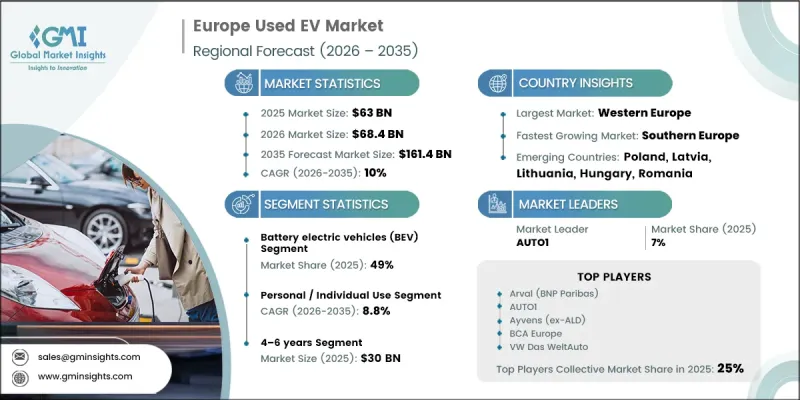
Market development is increasingly shifting from early-stage resale activity toward a structured and scalable secondary ecosystem supported by lease returns, standardized inspection processes, and improving transparency in battery condition assessment. A key structural change shaping demand is the reduction of uncertainty around battery health, vehicle residual value estimation, and historical usage tracking across borders. Used electric vehicles are typically priced 30% to 50% lower than comparable new models, significantly improving accessibility for cost-sensitive buyers and small fleet operators. Additional demand support comes from lower running costs, reduced maintenance requirements, and policy-linked advantages such as urban emission restrictions and tax-related benefits in selected European cities. However, battery degradation risk remains a central concern, though increasing reliance on standardized state-of-health metrics is improving confidence among lenders, insurers, and buyers. Independent certification tools and manufacturer diagnostic systems are strengthening pricing transparency and reshaping valuation models across the used EV ecosystem.
| Market Scope | |
|---|---|
| Start Year | 2025 |
| Forecast Year | 2026-2035 |
| Start Value | $63 Billion |
| Forecast Value | $161.4 Billion |
| CAGR | 10% |
The battery electric vehicle (BEV) segment accounted for 49% share in 2025 and is projected to grow at a CAGR of 9.7% through 2035. BEVs continue to represent the leading propulsion category in the secondary EV market due to their fully electric drivetrain architecture and zero tailpipe emissions during operation. Growing environmental awareness and increased adoption of low-emission transport solutions are supporting sustained demand for BEVs across resale channels, reinforcing their dominant position within the used EV landscape.
The personal/individual ownership segment held 56% share in 2025 and is expected to grow at a CAGR of 8.8% through 2035. Demand in this segment is primarily driven by household buyers seeking cost-effective alternatives to new electric vehicles and internal combustion engine models. Urban mobility restrictions, combined with lower operating costs, are encouraging adoption in major European economies. Affordability remains a key purchasing factor, with used EV pricing typically 30% to 50% lower than new vehicles, enabling wider access to electric mobility among individual consumers. However, adoption patterns vary significantly depending on public charging infrastructure availability and local policy support.
Germany Used EV Market reached USD 16.4 billion in 2025, supported by its strong automotive ecosystem and well-developed vehicle resale infrastructure. The country benefits from highly organized auction networks and established certified pre-owned channels, which enhance transaction efficiency and pricing transparency. A strong presence of OEM-backed resale programs and extensive dealer networks further supports market maturity and competitive intensity across the used EV sector.
Major companies operating in the Europe Used EV Market include AUTO1, Arval (BNP Paribas), AutoScout24, Ayvens (formerly ALD), BCA Europe, BMW Premium Selection, OPENLANE Europe, Renault Occasions, Volkswagen Das WeltAuto, and VW Das WeltAuto. Companies operating in the Europe used EV market are strengthening their competitive position through expansion of certified pre-owned programs, enhanced digital vehicle marketplaces, and integration of advanced battery diagnostic technologies. Market participants are increasingly focusing on improving transparency in vehicle history and battery health to build buyer confidence and support pricing accuracy. Strategic partnerships with OEMs, leasing companies, and fleet operators are helping expand access to high-quality used EV inventories.
Table of Contents
Chapter 1 Methodology & Scope
- 1.1 Research approach
- 1.2 Quality Commitments
- 1.2.1 GMI AI policy & data integrity commitment
- 1.2.1.1 Source consistency protocol
- 1.2.1 GMI AI policy & data integrity commitment
- 1.3 Research Trail & Confidence Scoring
- 1.3.1 Research Trail Components
- 1.3.2 Scoring Components
- 1.4 Data Collection
- 1.4.1 Partial list of primary sources
- 1.5 Data mining sources
- 1.5.1 Paid sources
- 1.5.1.1 Sources, by region
- 1.5.1 Paid sources
- 1.6 Base estimates and calculations
- 1.6.1 Base year calculation
- 1.7 Forecast model
- 1.7.1 Quantified market impact analysis
- 1.7.1.1 Mathematical impact of growth parameters on forecast
- 1.7.1 Quantified market impact analysis
- 1.8 Research transparency addendum
- 1.8.1 Source attribution framework
- 1.8.2 Quality assurance metrics
- 1.8.3 Our commitment to trust
Chapter 2 Executive Summary
- 2.1 Industry 360° synopsis
- 2.2 Key market trends
- 2.2.1 Region
- 2.2.2 Propulsion
- 2.2.3 Vehicle Age
- 2.2.4 Range
- 2.2.5 Vehicle
- 2.2.6 End Use
- 2.2.7 Sales Channel
- 2.3 TAM Analysis, 2026-2035
- 2.4 CXO perspectives: Strategic imperatives
Chapter 3 Industry Insights
- 3.1 Industry ecosystem analysis
- 3.1.1 Supplier landscape
- 3.1.1.1 Vehicle suppliers
- 3.1.1.2 Technology & platform providers
- 3.1.1.3 Inspection and certification providers
- 3.1.1.4 End user
- 3.1.2 Cost structure
- 3.1.3 Profit margin
- 3.1.4 Value addition at each stage
- 3.1.5 Vertical integration trends
- 3.1.6 Disruptors
- 3.1.1 Supplier landscape
- 3.2 Impact forces
- 3.2.1 Growth drivers
- 3.2.1.1 Increasing supply of off-lease EVs
- 3.2.1.2 Affordability advantage over new EVs
- 3.2.1.3 Expansion of certified pre-owned EV programs
- 3.2.1.4 Government incentives supporting EV ownership
- 3.2.2 Industry pitfalls & challenges
- 3.2.2.1 Battery degradation and replacement concerns
- 3.2.2.2 Rapid depreciation of certain EV models
- 3.2.3 Market opportunities
- 3.2.3.1 Battery health certification becoming standard
- 3.2.3.2 Growth of digital used EV marketplaces
- 3.2.3.3 Cross-border used EV trade expansion
- 3.2.3.4 Advanced EV valuation and data analytics adoption
- 3.2.1 Growth drivers
- 3.3 Growth potential analysis
- 3.4 Pricing Analysis (Driven by Primary Research)
- 3.4.1 Historical Price Trend Analysis
- 3.4.2 Pricing Strategy by Player Type (Premium / Value / Cost-plus)
- 3.5 Regulatory landscape
- 3.5.1 Western Europe
- 3.5.1.1 German Vehicle Tax Exemption
- 3.5.1.2 Batteries Implementation Act (BattDG)
- 3.5.1.3 Climate and Resilience Law (Loi Climat et Resilience)
- 3.5.1.4 Crit'Air Vehicle Classification Scheme
- 3.5.2 Eastern Europe
- 3.5.2.1 Electromobility and Alternative Fuels Act
- 3.5.2.2 Clean Transport Zones (Strefa Czystego Transportu)
- 3.5.2.3 Road Vehicles Act (Act No. 56/2001 Coll.)
- 3.5.2.4 End-of-Life Vehicles Act
- 3.5.3 Northern Europe
- 3.5.3.1 Zero Emission Vehicle (ZEV) Mandate
- 3.5.3.2 Vehicle Excise Duty (VED) for Electric Vehicles
- 3.5.3.3 Registration Tax Act (Registreringsafgiftsloven)
- 3.5.4 Southern Europe
- 3.5.4.1 Ecobonus Auto
- 3.5.4.2 Climate Change and Energy Transition Law (Law 7/2021)
- 3.5.1 Western Europe
- 3.6 Technology and Innovation Landscape
- 3.6.1 Current technologies
- 3.6.2 Emerging technologies
- 3.7 Porter's analysis
- 3.8 PESTEL analysis
- 3.9 Patent analysis (Driven by Primary Research)
- 3.10 Use cases
- 3.11 Impact of AI & generative AI on the market
- 3.11.1 AI-Driven Disruption of Existing Business Models
- 3.11.2 Automated design optimization
- 3.11.3 Supply chain AI for demand forecasting
- 3.11.4 GenAI use cases & adoption roadmap by segment
- 3.11.5 Risks, Limitations & Regulatory Considerations
- 3.12 Forecast assumptions & scenario analysis (Driven by Primary Research)
- 3.12.1 Base Case - key macro & industry variables driving CAGR
- 3.12.2 Optimistic Scenarios - Favorable Macro and Industry Tailwinds
- 3.12.3 Pessimistic Scenario - Macroeconomic slowdown or industry headwinds
- 3.13 Sustainability and environmental aspects
- 3.13.1 Sustainable practices
- 3.13.2 Waste reduction strategies
- 3.13.3 Energy efficiency in production
- 3.13.4 Eco-friendly Initiatives
- 3.13.5 Carbon footprint considerations
Chapter 4 Competitive Landscape, 2025
- 4.1 Introduction
- 4.2 Company market share analysis
- 4.2.1 Western Europe
- 4.2.2 Eastern Europe
- 4.2.3 Northern Europe
- 4.2.4 Southern Europe
- 4.3 Competitive positioning matrix
- 4.4 Strategic outlook matrix
- 4.5 Key developments
- 4.5.1 Mergers & acquisitions
- 4.5.2 Partnerships & collaborations
- 4.5.3 New product launches
- 4.5.4 Expansion plans and funding
- 4.6 Company Tier Benchmarking
- 4.6.1 Tier Classification Criteria & Qualifying Thresholds
- 4.6.2 Tier Positioning Matrix by Revenue, Geography & Innovation
Chapter 5 Market Estimates & Forecast, By Propulsion, 2022 - 2035 ($Bn, Unit)
- 5.1 Key trends
- 5.2 Battery electric vehicles (BEV)
- 5.3 Hybrid electric vehicles (HEV)
- 5.4 Plug-in hybrid electric vehicles (PEV)
- 5.5 Fuel cell electric vehicles (FCEV)
Chapter 6 Market Estimates & Forecast, By Vehicle Age, 2022 - 2035 ($Bn, Unit)
- 6.1 Key trends
- 6.2 1-3 Years
- 6.3 4-6 Years
- 6.4 Above 7 Years
Chapter 7 Market Estimates & Forecast, By Range, 2022 - 2035 ($Bn, Unit)
- 7.1 Key trends
- 7.2 Less than 100 Miles
- 7.3 100-200 Miles
- 7.4 200-300 Miles
- 7.5 Over 300 Miles
Chapter 8 Market Estimates & Forecast, By Vehicle, 2022 - 2035 ($Bn, Unit)
- 8.1 Key trends
- 8.2 Passenger car
- 8.2.1 Hatchback
- 8.2.2 Sedan
- 8.2.3 SUV
- 8.3 Commercial Vehicle
- 8.3.1 Light duty
- 8.3.2 Medium duty
- 8.3.3 Heavy duty
- 8.4 Two-wheeler
- 8.4.1 Scooters
- 8.4.2 Motorcycles
- 8.5 Three-wheeler
Chapter 9 Market Estimates & Forecast, By End use, 2022 - 2035 ($Bn, Unit)
- 9.1 Key trends
- 9.2 Personal / Individual Use
- 9.3 Commercial Fleet
- 9.4 Government & Public Sector
- 9.5 Rental & Shared Mobility
Chapter 10 Market Estimates & Forecast, By Sales Channel, 2022 - 2035 ($Bn, Unit)
- 10.1 Key trends
- 10.2 Certified Pre-Owned (CPO) Dealerships
- 10.3 Independent Dealerships
- 10.4 Online Platforms
- 10.5 Auctions & Wholesale
Chapter 11 Market Estimates & Forecast, By Region, 2022 - 2035 ($Mn, Units)
- 11.1 Key Trends
- 11.2 Western Europe
- 11.2.1 Germany
- 11.2.2 France
- 11.2.3 Netherlands
- 11.2.4 Belgium
- 11.2.5 Switzerland
- 11.2.6 Austria
- 11.2.7 Ireland
- 11.2.8 Luxembourg
- 11.3 Eastern Europe
- 11.3.1 Poland
- 11.3.2 Czech Republic
- 11.3.3 Portugal
- 11.3.4 Serbia
- 11.3.5 Albania
- 11.3.6 Slovakia
- 11.3.7 Romania
- 11.4 Northern Europe
- 11.4.1 UK
- 11.4.2 Denmark
- 11.4.3 Sweden
- 11.4.4 Norway
- 11.4.5 Iceland
- 11.4.6 Faroe Islands
- 11.5 Southern Europe
- 11.5.1 Italy
- 11.5.2 Spain
- 11.5.3 Vatican City
- 11.5.4 San Marino
Chapter 12 Company Profiles
- 12.1 Global players
- 12.1.1 Ayvens
- 12.1.2 Arval
- 12.1.3 BCA Europe
- 12.1.4 Manheim Europe
- 12.1.5 OPENLANE Europe
- 12.1.6 AUTO1
- 12.1.7 AutoScout24
- 12.2 Regional players
- 12.2.1 Volkswagen Das WeltAuto
- 12.2.2 Renault Occasions
- 12.2.3 BMW Premium Selection
- 12.2.4 Tesla Certified Pre-Owned
- 12.2.5 Emil Frey Group
- 12.2.6 Arnold Clark Automobiles
- 12.2.7 Autorola
- 12.2.8 AVILOO
- 12.2.9 EV-Remarketing
- 12.3 Emerging players
- 12.3.1 Cardino
- 12.3.2 Eccasion
- 12.3.3 Aampere
- 12.3.4 Renault Refactory

