
PUBLISHER: Global Market Insights Inc. | PRODUCT CODE: 2101573

PUBLISHER: Global Market Insights Inc. | PRODUCT CODE: 2101573
Asia Pacific Used EV Market Opportunity, Growth Drivers, Industry Trend Analysis, and Forecast 2026 - 2035
Asia Pacific Used EV Market was valued at USD 105.9 billion in 2025 and is estimated to grow at a CAGR of 11% to reach USD 332.4 billion by 2035.
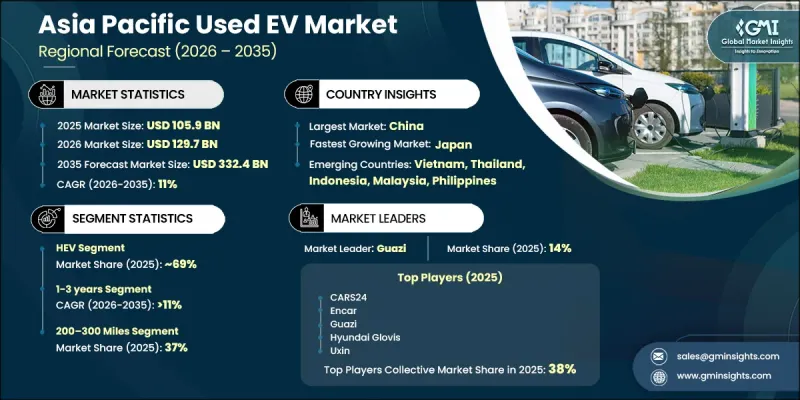
Asia Pacific used EV market is undergoing a significant transformation as it moves away from informal resale channels toward a more structured and technology-enabled marketplace. Digital platforms, automotive service providers, and market intermediaries are increasingly adopting advanced solutions such as battery condition assessment tools, artificial intelligence-based valuation models, and integrated financing services to improve transparency and strengthen buyer confidence. The rising number of electric vehicles entering secondary markets, growing manufacturer-backed certified pre-owned programs, and supportive electrification policies are accelerating the development of the used EV ecosystem across the region. The increasing availability of affordable pre-owned electric vehicles is encouraging wider consumer participation, particularly among buyers seeking economical alternatives to new EV purchases. As battery technology improves and electric mobility adoption expands, the used EV market is becoming an important contributor to sustainable transportation growth across Asia Pacific.
| Market Scope | |
|---|---|
| Start Year | 2025 |
| Forecast Year | 2026-2035 |
| Start Value | $105.9 Billion |
| Forecast Value | $332.4 Billion |
| CAGR | 11% |
The increasing deployment of new electric vehicles across major Asia Pacific automotive markets is creating a strong supply base for future used EV transactions. As more EV models complete their initial ownership cycles, the availability of pre-owned vehicles is expanding, supporting the development of a larger secondary market. The price gap between new and used electric vehicles is attracting consumers who want access to electric mobility at lower costs. Rising prices of newly launched EV models, driven by advanced battery systems and extended driving range features, are encouraging more buyers to consider used EVs as a practical option.
The HEV segment accounted for 69% share in 2025 and is projected to grow at a CAGR of 9% from 2026 to 2035. Used hybrid electric vehicles continue to experience strong demand across Asia Pacific due to their combination of fuel efficiency, affordability, and reduced dependence on charging infrastructure. HEVs provide an attractive ownership option for consumers looking for improved mileage without requiring extensive access to charging networks. This advantage is supporting adoption among urban and long-distance drivers while helping more consumers transition toward electrified transportation. Limited charging infrastructure development in several Asia Pacific markets is also contributing to continued demand for used hybrid vehicles within the resale segment.
The 1-3 years vehicle age category held a 47% share in 2025 and is anticipated to grow at a CAGR of 11% from 2026 to 2035. The increasing number of EVs sold in recent years is creating a larger supply of relatively new used electric vehicles in the secondary market. Vehicles within this age group attract buyers due to their modern technology, lower usage levels, and remaining manufacturer warranty coverage. These benefits make 1-3-year-old used EVs an appealing choice for consumers seeking advanced features and reliable performance at a more accessible price point across the Asia Pacific region.
China Used EV Market held 41% share, generating USD 43.8 billion in 2025. The country's used EV sector continues to benefit from ongoing government efforts supporting electric mobility and sustainable transportation development. Expanding charging networks, improved digital vehicle management systems, and policies encouraging EV ownership are creating favorable conditions for secondary EV sales. These initiatives are improving consumer confidence, simplifying ownership processes, and supporting stronger growth of the used EV ecosystem in China.
Major players operating in the Asia Pacific used EV industry include BYD, CARS24, Uxin, Hyundai Glovis, Carro, Encar, Carsome, Nissan, Guazi, and Droom. Companies operating in the Asia Pacific used EV market are focusing on digital transformation, platform expansion, battery evaluation technologies, and customer-focused services to strengthen their market presence. Leading players are investing in online marketplaces, AI-based vehicle assessment systems, and transparent pricing solutions to improve buyer trust and simplify transactions. Companies are also developing partnerships with manufacturers, financing providers, and service networks to offer comprehensive ownership solutions. Expansion into emerging markets, enhancement of inspection capabilities, and integration of battery health monitoring tools are becoming key competitive strategies. Additionally, businesses are prioritizing certified pre-owned programs and improved after-sales support to increase customer confidence. These approaches are helping companies build stronger market positions and capture opportunities created by the rapid growth of used electric vehicle adoption across Asia Pacific.
Table of Contents
Chapter 1 Methodology
- 1.1 Research approach
- 1.2 Quality Commitments
- 1.2.1 GMI AI policy & data integrity commitment
- 1.2.1.1 Source consistency protocol
- 1.2.1 GMI AI policy & data integrity commitment
- 1.3 Research Trail & Confidence Scoring
- 1.3.1 Research Trail Components
- 1.3.2 Scoring Components
- 1.4 Data Collection
- 1.4.1 Partial list of primary sources
- 1.5 Data mining sources
- 1.5.1 Paid sources
- 1.5.2 Sources, by region
- 1.6 Base estimates and calculations
- 1.6.1 Base year calculation
- 1.7 Forecast model
- 1.7.1 Quantified market impact analysis
- 1.7.1.1 Mathematical impact of growth parameters on forecast
- 1.7.1 Quantified market impact analysis
- 1.8 Research transparency addendum
- 1.8.1 Source attribution framework
- 1.8.2 Quality assurance metrics
- 1.8.3 Our commitment to trust
Chapter 2 Executive Summary
- 2.1 Industry 360° synopsis, 2022 – 2035
- 2.2 Key market trends
- 2.2.1 Regional
- 2.2.2 Propulsion
- 2.2.3 Vehicle Age
- 2.2.4 Range
- 2.2.5 Vehicle
- 2.2.6 End Use
- 2.2.7 Sales Channel
- 2.3 TAM Analysis, 2026-2035
- 2.4 CXO perspectives: Strategic imperatives
Chapter 3 Industry Insights
- 3.1 Industry ecosystem analysis
- 3.1.1 Supplier landscape
- 3.1.2 Profit margin analysis
- 3.1.3 Cost structure
- 3.1.4 Value addition at each stage
- 3.1.5 Factor affecting the value chain
- 3.1.6 Disruptions
- 3.2 Industry impact forces
- 3.2.1 Growth drivers
- 3.2.1.1 Growing new EV penetration creating first-generation used EV supply wave
- 3.2.1.2 Rising consumer demand for affordable EV access amid high new EV prices
- 3.2.1.3 Expansion of digital used EV platforms improving price transparency and liquidity
- 3.2.1.4 Government policies extending EV incentives to used vehicle transactions
- 3.2.2 Industry pitfalls and challenges
- 3.2.2.1 Absence of standardized battery health certification frameworks across APAC
- 3.2.2.2 High battery replacement costs creating consumer hesitancy in used EV purchases
- 3.2.2.3 Fragmented import and export regulations limiting cross-border used EV trade
- 3.2.3 Market opportunities
- 3.2.3.1 Emergence of OEM certified pre-owned programs building consumer trust
- 3.2.3.2 Growing fleet operator demand for cost-effective used EV alternatives
- 3.2.3.3 Second-life battery economy creating new revenue streams for used EV dealers
- 3.2.3.4 Rising adoption of buy-now-pay-later and EV-specific financing for used vehicles
- 3.2.1 Growth drivers
- 3.3 Growth potential analysis
- 3.4 Technology and innovation landscape
- 3.4.1 Current technological trends
- 3.4.2 Emerging technologies
- 3.5 Price analysis (Driven by Primary Research)
- 3.5.1 Historical Price Trend Analysis
- 3.5.2 Pricing Strategy by Player Type (Premium / Value / Cost-plus)
- 3.6 Regulatory landscape
- 3.6.1 China New Energy Vehicle (NEV) Regulations
- 3.6.2 China Compulsory Certification (CCC)
- 3.6.3 Measures for the Administration of Used Car Circulation
- 3.6.4 Indian Central Motor Vehicle Rules (CMVR)
- 3.6.5 Vehicle Scrapping Policy (India)
- 3.6.6 Battery Waste Management Rules
- 3.6.7 Japanese Road Transport Vehicle Act
- 3.6.8 Japanese Automobile Recycling Law
- 3.6.9 Korean Motor Vehicle Management Act
- 3.6.10 Encar Vehicle History & Registration Framework
- 3.6.11 Australian Design Rules (ADR)
- 3.6.12 Road Vehicle Standards Act (Australia)
- 3.6.13 ASEAN Harmonized Technical Requirements for Motor Vehicles
- 3.6.14 Singapore Land Transport Authority (LTA) Vehicle Registration & Transfer Regulations
- 3.6.15 Thailand Excise Department EV Tax and Vehicle Registration Regulations
- 3.7 Trade data analysis (Driven by Paid Research)
- 3.7.1 Import/export volume & value trends
- 3.7.2 Key trade corridors & tariff impact
- 3.8 Impact of AI & generative AI on the market
- 3.8.1 AI-driven disruption of existing business models
- 3.8.2 GenAI use cases & adoption roadmap by segment
- 3.8.3 Risks, limitations & regulatory considerations
- 3.9 Capacity & production landscape (Driven by Primary Research)
- 3.9.1 Installed capacity by region & key producer
- 3.9.2 Capacity utilization rates & expansion pipelines
- 3.10 Cost breakdown analysis
- 3.11 Patent analysis (Driven by Primary Research)
- 3.12 Porter’s analysis
- 3.13 PESTEL analysis
- 3.14 Sustainability and environmental aspects
- 3.14.1 Sustainable practices
- 3.14.2 Waste reduction strategies
- 3.14.3 Energy efficiency in production
- 3.14.4 Eco-friendly Initiatives
- 3.14.5 Carbon footprint considerations
- 3.15 Forecast assumptions & scenario analysis (Driven by Primary Research)
- 3.15.1 Base Case — key macro & industry variables driving CAGR
- 3.15.2 Optimistic Scenarios — Favorable macro and industry tailwinds
- 3.15.3 Pessimistic Scenario — Macroeconomic slowdown or industry headwinds
Chapter 4 Competitive Landscape, 2025
- 4.1 Introduction
- 4.2 Company market share analysis
- 4.2.1 North America
- 4.2.2 Europe
- 4.2.3 Asia Pacific
- 4.2.4 LATAM
- 4.2.5 MEA
- 4.3 Competitive analysis of major market players
- 4.4 Competitive positioning matrix
- 4.5 Key developments
- 4.5.1 Mergers & acquisitions
- 4.5.2 Partnerships & collaborations
- 4.5.3 New Product Launches
- 4.5.4 Expansion Plans and funding
- 4.6 Company tier benchmarking
- 4.6.1 Tier classification criteria & qualifying thresholds
- 4.6.2 Tier positioning matrix by revenue, geography & innovation
Chapter 5 Market Estimates & Forecast, By Propulsion, 2022 - 2035 ($Mn, Units)
- 5.1 Key trends
- 5.2 BEV
- 5.3 HEV
- 5.4 PHEV
- 5.5 FCEV
Chapter 6 Market Estimates & Forecast, By Vehicle Age, 2022 - 2035 ($Mn, Units)
- 6.1 Key trends
- 6.2 1–3 Years
- 6.3 4–6 Years
- 6.4 Above 7 Years
Chapter 7 Market Estimates & Forecast, By Range, 2022 - 2035 ($Mn, Units)
- 7.1 Key trends
- 7.2 Less than 100 Miles
- 7.3 100–200 Miles
- 7.4 200–300 Miles
- 7.5 Over 300 Miles
Chapter 8 Market Estimates & Forecast, By Vehicle, 2022 - 2035 ($Mn, Units)
- 8.1 Key trends
- 8.2 Passenger car
- 8.2.1 Hatchback
- 8.2.2 Sedan
- 8.2.3 SUV
- 8.3 Commercial Vehicle
- 8.3.1 Light duty
- 8.3.2 Medium duty
- 8.3.3 Heavy duty
- 8.4 Two-wheeler
- 8.4.1 Scooters
- 8.4.2 Motorcycles
- 8.5 Three-wheeler
Chapter 9 Market Estimates & Forecast, By End Use, 2022 - 2035 ($Mn, Units)
- 9.1 Key trends
- 9.2 Personal / Individual Use
- 9.3 Commercial Fleet
- 9.4 Government & Public Sector
- 9.5 Rental & Shared Mobility
Chapter 10 Market Estimates & Forecast, By Sales Channel, 2022 - 2035 ($Mn, Units)
- 10.1 Key trends
- 10.2 Certified Pre-Owned (CPO) Dealerships
- 10.3 Independent Dealerships
- 10.4 Online Platforms
- 10.5 Auctions & Wholesale
Chapter 11 Market Estimates & Forecast, By Region, 2022 - 2035 ($Mn, Units)
- 11.1 Key trends
- 11.2 China
- 11.3 India
- 11.4 Japan
- 11.5 South Korea
- 11.6 Australia
- 11.7 New Zealand
- 11.8 Taiwan
- 11.9 Indonesia
- 11.10 Thailand
- 11.11 Singapore
- 11.12 Philippines
- 11.13 Vietnam
- 11.14 Malaysia
- 11.15 Myanmar
Chapter 12 Company Profiles
- 12.1 Global Players
- 12.1.1 BYD
- 12.1.2 Hyundai/Genesis
- 12.1.3 Nissan
- 12.2 Regional Players
- 12.2.1 CARS24
- 12.2.2 Carsome
- 12.2.3 Carro
- 12.2.4 Droom
- 12.2.5 Encar
- 12.2.6 Guazi
- 12.2.7 Hyundai Glovis
- 12.2.8 Mahindra First Choice
- 12.2.9 One2Car
- 12.2.10 Spinny
- 12.2.11 Tata Motors
- 12.2.12 Uxin
- 12.3 Emerging Players
- 12.3.1 AmazingEV
- 12.3.2 Autovert
- 12.3.3 Carma
- 12.3.4 Charancha
- 12.3.5 EVCarMarket

