
PUBLISHER: Global Market Insights Inc. | PRODUCT CODE: 2101570

PUBLISHER: Global Market Insights Inc. | PRODUCT CODE: 2101570
North America Used EV Market Opportunity, Growth Drivers, Industry Trend Analysis, and Forecast 2026 - 2035
North America Used EV Market was valued at USD 54.2 billion in 2025 and is estimated to grow at a CAGR of 8.4% to reach USD 138.7 billion by 2035.
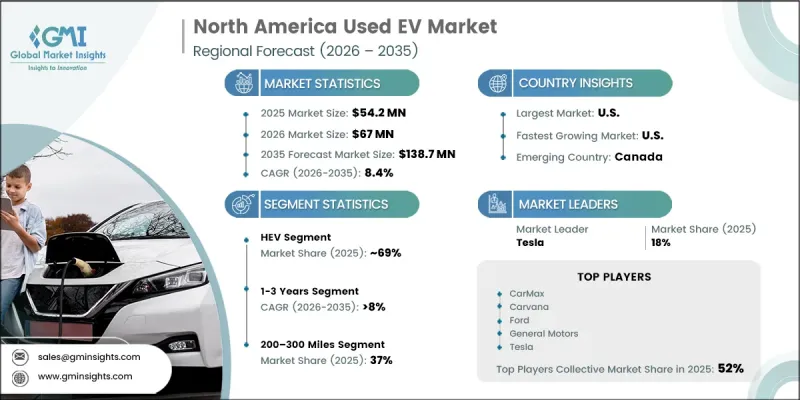
Market expansion is driven by the growing number of electric vehicles reaching the secondary market as vehicle ownership cycles continue to mature across the region. A larger supply of pre-owned electric vehicles is improving model availability, expanding options across different price ranges, and making electric mobility more accessible to a broader consumer base. Supportive federal and state incentive programs continue to strengthen the overall value proposition of purchasing used electric vehicles, encouraging wider adoption throughout North America. The increasing availability of certified pre-owned vehicles is also enhancing buyer confidence by improving transparency surrounding battery condition, vehicle quality, and long-term reliability. Automotive manufacturers continue to strengthen certified pre-owned programs through comprehensive vehicle inspections, standardized battery health evaluations, enhanced quality assurance procedures, and customer-focused ownership benefits. These initiatives are reducing consumer concerns associated with battery degradation while improving confidence in the performance of pre-owned electric vehicles. As awareness continues to grow, certified pre-owned electric vehicles are becoming an increasingly important and higher-value segment within the broader North America used EV market.
| Market Scope | |
|---|---|
| Start Year | 2025 |
| Forecast Year | 2026-2035 |
| Start Value | $54.2 Billion |
| Forecast Value | $138.7 Billion |
| CAGR | 8.4% |
The HEV segment accounted for 69% share in 2025 and is projected to grow at a CAGR of 7% between 2026 and 2035. Demand for affordable electrified transportation continues to support growth across this segment, particularly among consumers seeking lower ownership costs and improved fuel efficiency. Used hybrid electric vehicles provide an attractive balance between conventional and fully electric transportation, making them a preferred option for buyers looking to reduce operating expenses while avoiding charging-related considerations. Growing consumer awareness of long-term cost savings and fuel economy continues to strengthen demand for used HEVs across both urban and suburban markets.
The 1-3 years vehicle age segment represented 47% share in 2025 and is expected to record a CAGR of 8% through 2035. An increasing volume of vehicles entering the resale market is creating a steady supply of relatively new electric vehicles that appeal to a wide range of buyers. These vehicles generally offer low mileage, documented maintenance records, and modern vehicle technologies, making them an attractive alternative to purchasing a new model. Consumers increasingly favor vehicles within this age category because they deliver updated safety features, advanced driver assistance technologies, and improved battery performance while remaining significantly more affordable than newly manufactured electric vehicles.
U.S. Used EV Market held 90% share and generated USD 48.7 billion in 2025. The country continues to lead regional market growth due to its large population of electric vehicles entering the secondary market through normal ownership transitions and replacement cycles. A diverse inventory across multiple vehicle categories is improving consumer choice, increasing market competition, and supporting the continued expansion of the used electric vehicle industry throughout the United States. Government-supported financial incentives available for qualified pre-owned electric vehicles, together with additional regional support programs, continue to improve affordability and encourage greater consumer adoption across the country.
Major companies operating in North America used EV market include AutoTrader, BMW, CarMax, Cars.com, Carvana, Ford, General Motors, Hyundai, Mercedes-Benz, and Tesla. Companies operating in the North America used EV market are strengthening their competitive position by expanding certified pre-owned vehicle programs, improving vehicle inspection standards, and enhancing battery health assessment processes. Market participants continue to invest in digital retail platforms, transparent vehicle history reporting, and streamlined purchasing experiences to improve customer confidence and accelerate sales. Businesses are also expanding inventory availability across multiple vehicle categories to serve a broader customer base while improving nationwide distribution capabilities. Strategic investments in after-sales services, warranty offerings, financing solutions, and customer support are helping companies strengthen long-term relationships with buyers.
Table of Contents
Chapter 1 Methodology
- 1.1 Research approach
- 1.2 Quality Commitments
- 1.2.1 GMI AI policy & data integrity commitment
- 1.2.1.1 Source consistency protocol
- 1.2.1 GMI AI policy & data integrity commitment
- 1.3 Research Trail & Confidence Scoring
- 1.3.1 Research Trail Components
- 1.3.2 Scoring Components
- 1.4 Data Collection
- 1.4.1 Partial list of primary sources
- 1.5 Data mining sources
- 1.5.1 Paid sources
- 1.5.2 Sources, by region
- 1.6 Base estimates and calculations
- 1.6.1 Base year calculation
- 1.7 Forecast model
- 1.7.1 Quantified market impact analysis
- 1.7.1.1 Mathematical impact of growth parameters on forecast
- 1.7.1 Quantified market impact analysis
- 1.8 Research transparency addendum
- 1.8.1 Source attribution framework
- 1.8.2 Quality assurance metrics
- 1.8.3 Our commitment to trust
Chapter 2 Executive Summary
- 2.1 Industry 360° synopsis, 2022 – 2035
- 2.2 Key market trends
- 2.2.1 Regional
- 2.2.2 Propulsion
- 2.2.3 Vehicle Age
- 2.2.4 Range
- 2.2.5 Vehicle
- 2.2.6 End use
- 2.2.7 Sales Channel
- 2.3 TAM Analysis, 2026-2035
- 2.4 CXO perspectives: Strategic imperatives
Chapter 3 Industry Insights
- 3.1 Industry ecosystem analysis
- 3.1.1 Supplier landscape
- 3.1.2 Profit margin analysis
- 3.1.3 Cost structure
- 3.1.4 Value addition at each stage
- 3.1.5 Factor affecting the value chain
- 3.1.6 Disruptions
- 3.2 Industry impact forces
- 3.2.1 Growth drivers
- 3.2.1.1 Rising off-lease EV inventory increasing the supply of used electric vehicles
- 3.2.1.2 Government incentives and tax credits encouraging used EV purchases
- 3.2.1.3 Higher new EV prices driving consumers toward the used EV market
- 3.2.1.4 Advancements in battery technology reducing concerns over battery degradation and driving range
- 3.2.2 Industry pitfalls and challenges
- 3.2.2.1 Uncertainty regarding battery health and expensive battery replacement costs
- 3.2.2.2 Lack of standardized battery health assessment and disclosure practices
- 3.2.2.3 Rapid technological advancements reducing the resale value of older EV models
- 3.2.2.4 Limited financing options available for used EV buyers
- 3.2.3 Market opportunities
- 3.2.3.1 Expansion of OEM-certified pre-owned programs enhancing consumer trust and resale value
- 3.2.3.2 Growing adoption of battery health certification services
- 3.2.3.3 Increasing cross-border trade creating new opportunities for used EV sales
- 3.2.3.4 Growth of online and digital marketplaces streamlining used EV transactions
- 3.2.1 Growth drivers
- 3.3 Growth potential analysis
- 3.4 Technology and innovation landscape
- 3.4.1 Current technological trends
- 3.4.2 Emerging technologies
- 3.5 Price analysis (Driven by Primary Research)
- 3.5.1 Historical Price Trend Analysis
- 3.5.2 Pricing Strategy by Player Type (Premium / Value / Cost-plus)
- 3.6 Regulatory landscape
- 3.6.1 U.S.
- 3.6.1.1 Environmental Protection Agency (EPA)
- 3.6.1.2 National Highway Traffic Safety Administration (NHTSA)
- 3.6.1.3 U.S. Department of Transportation (DOT)
- 3.6.1.4 Federal Trade Commission (FTC) Used Car Rule
- 3.6.1.5 Internal Revenue Service (IRS) – Previously Owned Clean Vehicle Tax Credit
- 3.6.2 Canada
- 3.6.2.1 Canadian Motor Vehicle Safety Standards (CMVSS)
- 3.6.2.2 Motor Vehicle Safety Act (MVSA)
- 3.6.2.3 Transport Canada Vehicle Importation Regulations
- 3.6.2.4 Canadian Environmental Protection Act (CEPA)
- 3.6.2.5 Competition Act (Canada) – Vehicle Sales and Consumer Protection
- 3.6.1 U.S.
- 3.7 Cost breakdown analysis
- 3.8 Patent analysis (Driven by Primary Research)
- 3.9 Porter’s analysis
- 3.10 PESTEL analysis
- 3.11 Trade data analysis (Driven by Paid Research)
- 3.11.1 Import/export volume & value trends
- 3.11.2 Key trade corridors & tariff impact
- 3.12 Impact of AI & generative AI on the market
- 3.12.1 AI-driven disruption of existing business models
- 3.12.2 GenAI use cases & adoption roadmap by segment
- 3.12.3 Risks, limitations & regulatory considerations
- 3.13 Capacity & production landscape (Driven by Primary Research)
- 3.13.1 Installed capacity by region & key producer
- 3.13.2 Capacity utilization rates & expansion pipelines
- 3.14 Sustainability and environmental aspects
- 3.14.1 Sustainable practices
- 3.14.2 Waste reduction strategies
- 3.14.3 Energy efficiency in production
- 3.14.4 Eco-friendly Initiatives
- 3.14.5 Carbon footprint considerations
- 3.15 Forecast assumptions & scenario analysis (Driven by Primary Research)
- 3.15.1 Base Case — key macro & industry variables driving CAGR
- 3.15.2 Optimistic Scenarios — Favorable macro and industry tailwinds
- 3.15.3 Pessimistic Scenario — Macroeconomic slowdown or industry headwinds
Chapter 4 Competitive Landscape, 2025
- 4.1 Introduction
- 4.2 Company market share analysis
- 4.2.1 U.S.
- 4.2.2 Canada
- 4.3 Competitive analysis of major market players
- 4.4 Competitive positioning matrix
- 4.5 Key developments
- 4.5.1 Mergers & acquisitions
- 4.5.2 Partnerships & collaborations
- 4.5.3 New Product Launches
- 4.5.4 Expansion Plans and funding
- 4.6 Company tier benchmarking
- 4.6.1 Tier classification criteria & qualifying thresholds
- 4.6.2 Tier positioning matrix by revenue, geography & innovation
Chapter 5 Market Estimates & Forecast, By Propulsion, 2022 - 2035 ($Mn, Units)
- 5.1 Key trends
- 5.2 BEV
- 5.3 HEV
- 5.4 PHEV
- 5.5 FCEV
Chapter 6 Market Estimates & Forecast, By Vehicle Age, 2022 - 2035 ($Mn, Units)
- 6.1 Key trends
- 6.2 1–3 Years
- 6.3 4–6 Years
- 6.4 Above 7 Years
Chapter 7 Market Estimates & Forecast, By Range, 2022 - 2035 ($Mn, Units)
- 7.1 Key trends
- 7.2 Less than 100 Miles
- 7.3 100–200 Miles
- 7.4 200–300 Miles
- 7.5 Over 300 Miles
Chapter 8 Market Estimates & Forecast, By Vehicle, 2022 - 2035 ($Mn, Units)
- 8.1 Key trends
- 8.2 Passenger car
- 8.2.1 Hatchback
- 8.2.2 Sedan
- 8.2.3 SUV
- 8.3 Commercial Vehicle
- 8.3.1 Light duty
- 8.3.2 Medium duty
- 8.3.3 Heavy duty
- 8.4 Two-wheeler
- 8.4.1 Scooters
- 8.4.2 Motorcycles
- 8.5 Three-wheeler
Chapter 9 Market Estimates & Forecast, By End use, 2022 - 2035 ($Mn, Units)
- 9.1 Key trends
- 9.2 Personal / Individual Use
- 9.3 Commercial Fleet
- 9.4 Government & Public Sector
- 9.5 Rental & Shared Mobility
Chapter 10 Market Estimates & Forecast, By Sales Channel, 2022 - 2035 ($Mn, Units)
- 10.1 Key trends
- 10.2 Certified Pre-Owned (CPO) Dealerships
- 10.3 Independent Dealerships
- 10.4 Online Platforms
- 10.5 Auctions & Wholesale
Chapter 11 Market Estimates & Forecast, By Region, 2022 - 2035 ($Mn, Units)
- 11.1 Key trends
- 11.2 U.S.
- 11.2.1 Northeast
- 11.2.1.1 Maine
- 11.2.1.2 New Hampshire
- 11.2.1.3 Vermont
- 11.2.1.4 Massachusetts
- 11.2.1.5 Rhode Island
- 11.2.1.6 Connecticut
- 11.2.1.7 New Jersey
- 11.2.1.8 New York
- 11.2.1.9 Pennsylvania
- 11.2.2 Midwest
- 11.2.2.1 Ohio
- 11.2.2.2 Michigan
- 11.2.2.3 Indiana
- 11.2.2.4 Illinois
- 11.2.2.5 Wisconsin
- 11.2.2.6 Minnesota
- 11.2.2.7 Iowa
- 11.2.2.8 Missouri
- 11.2.2.9 North Dakota
- 11.2.2.10 South Dakota
- 11.2.2.11 Nebraska
- 11.2.2.12 Kansas
- 11.2.3 South
- 11.2.3.1 Delaware
- 11.2.3.2 Maryland
- 11.2.3.3 Virginia
- 11.2.3.4 West Virginia
- 11.2.3.5 North Carolina
- 11.2.3.6 South Carolina
- 11.2.3.7 Georgia
- 11.2.3.8 Florida
- 11.2.3.9 Alabama
- 11.2.3.10 Kentucky
- 11.2.3.11 Mississippi
- 11.2.3.12 Tennessee
- 11.2.3.13 Arkansas
- 11.2.3.14 Louisiana
- 11.2.3.15 Oklahoma
- 11.2.3.16 Texas
- 11.2.4 West
- 11.2.4.1 Montana
- 11.2.4.2 Idaho
- 11.2.4.3 Wyoming
- 11.2.4.4 Colorado
- 11.2.4.5 New Mexico
- 11.2.4.6 Arizona
- 11.2.4.7 Utah
- 11.2.4.8 Nevada
- 11.2.4.9 Washington
- 11.2.4.10 Oregon
- 11.2.4.11 California
- 11.2.4.12 Alaska
- 11.2.4.13 Hawaii
- 11.2.1 Northeast
- 11.3 Canada
- 11.3.1 British Columbia
- 11.3.2 Alberta
- 11.3.3 Saskatchewan
- 11.3.4 Manitoba
- 11.3.5 Ontario
- 11.3.6 Quebec
- 11.3.7 New Brunswick
- 11.3.8 Nova Scotia
- 11.3.9 Prince Edward Island
- 11.3.10 Newfoundland and Labrador
Chapter 12 Company Profiles
- 12.1 Global Players
- 12.1.1 BMW
- 12.1.2 Ford
- 12.1.3 General Motors
- 12.1.4 Hyundai
- 12.1.5 Kia
- 12.1.6 Mercedes-Benz
- 12.1.7 Polestar
- 12.1.8 Tesla
- 12.1.9 Volkswagen
- 12.2 Regional Players
- 12.2.1 AutoTrader
- 12.2.2 CarMax
- 12.2.3 Carvana
- 12.2.4 Cars.com
- 12.2.5 Kijiji Autos
- 12.2.6 Lucid
- 12.2.7 Rivian
- 12.2.8 TrueCar
- 12.3 Emerging Players
- 12.3.1 EV.com
- 12.3.2 Find My Electric
- 12.3.3 Plug Motors
- 12.3.4 Recurrent Auto

