PUBLISHER: Global Market Insights Inc. | PRODUCT CODE: 2101991

PUBLISHER: Global Market Insights Inc. | PRODUCT CODE: 2101991
Mammography Systems Market Opportunity, Growth Drivers, Industry Trend Analysis, and Forecast 2026 - 2035
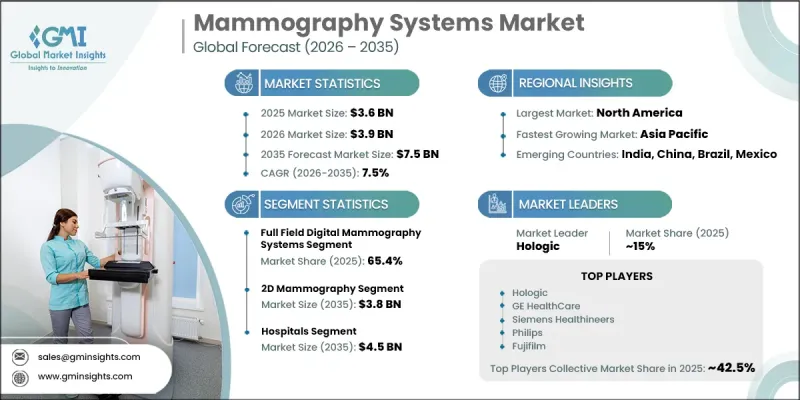
The Global Mammography Systems Market was valued at USD 3.6 billion in 2025 and is estimated to grow at a CAGR of 7.5% to reach USD 7.5 billion by 2035.
The global mammography systems market continues to expand as the incidence of breast cancer increases worldwide and awareness regarding the importance of early detection continues to improve. Mammography systems are advanced medical imaging solutions designed to generate high-quality breast X-ray images that support the detection, diagnosis, and ongoing evaluation of breast abnormalities. These systems play a critical role in routine screening by enabling healthcare professionals to identify potential concerns at an early stage, improving opportunities for timely clinical intervention. Continuous technological advancements have further strengthened diagnostic capabilities by enhancing image quality, workflow efficiency, and clinical accuracy. Growing investments in breast cancer screening initiatives, together with expanding public awareness programs and increasing institutional support for preventive healthcare, continue to encourage greater participation in routine screening. As healthcare providers increasingly prioritize early diagnosis and improved patient outcomes, demand for advanced mammography technologies is expected to remain strong, creating favorable long-term growth opportunities across the mammography systems market.
| Market Scope | |
|---|---|
| Start Year | 2025 |
| Forecast Year | 2026-2035 |
| Start Value | $3.6 Billion |
| Forecast Value | $7.5 Billion |
| CAGR | 7.5% |
The full-field digital mammography systems segment accounted for 65.4% share in 2025, making it the leading product category. Its strong market position is supported by superior image quality, enhanced diagnostic performance, and improved workflow efficiency compared with earlier imaging technologies. Growing replacement of legacy imaging equipment with full-field digital mammography systems continues to drive segment expansion as healthcare providers increasingly adopt digital platforms that offer better image management, streamlined clinical operations, and improved diagnostic support.
The hospitals segment is projected to grow at a CAGR of 7.5%, reaching USD 4.5 billion by 2035. Hospitals continue to represent the largest end-use segment within the mammography systems market because they provide comprehensive screening, diagnostic imaging, and follow-up care within a single healthcare environment. Their ability to deliver coordinated patient management while improving access to specialized medical expertise supports greater operational efficiency and contributes to improved quality of care. The availability of integrated clinical services also reinforces the preference for hospital-based mammography across both established and developing healthcare systems.
North America Mammography Systems Market accounted for 34.8% share in 2025. The region continues to lead the market due to the increasing prevalence of breast cancer and the strong emphasis placed on routine screening and early diagnosis. Ongoing support for preventive healthcare initiatives, combined with broad awareness of breast cancer screening, continues to encourage widespread adoption of advanced mammography technologies across the regional healthcare system.
Major companies operating in the global mammography systems market include Analogic, Canon Medical, Carestream Health, Delphinus Medical Technologies, Fujifilm, GE HealthCare, Hologic, IMS Giotto, Konica Minolta, Neusoft Medical Systems, NP JSC Amico, Philips, Planmed, Siemens Healthineers, and United Imaging Healthcare. Companies operating in the mammography systems market are strengthening their competitive position through continuous investment in research and development to improve imaging quality, workflow efficiency, and diagnostic performance. Manufacturers are expanding their product portfolios with advanced digital technologies while enhancing system integration with modern healthcare infrastructure. Strategic collaborations with healthcare providers, distributors, and technology partners are helping companies increase market reach and improve customer access. Businesses are also focusing on obtaining regulatory approvals, expanding their global footprint, and improving service capabilities to support long-term customer relationships.
Table of Contents
Chapter 1 Research Methodology
- 1.1 Research approach
- 1.2 Quality commitments
- 1.2.1 GMI AI policy & data integrity commitment
- 1.2.1.1 Source consistency protocol
- 1.2.1 GMI AI policy & data integrity commitment
- 1.3 Research trail & confidence scoring
- 1.3.1 Research trail components
- 1.3.2 Scoring components
- 1.4 Data collection
- 1.4.1 Partial list of primary sources
- 1.5 Data mining sources
- 1.5.1 Paid sources
- 1.5.1.1 Sources, by region
- 1.5.1 Paid sources
- 1.6 Base estimates and calculations
- 1.6.1 Base year calculation
- 1.7 Forecast model
- 1.7.1 Quantified market impact analysis
- 1.7.1.1 Mathematical impact of growth parameters on forecast
- 1.7.1 Quantified market impact analysis
- 1.8 Research transparency addendum
- 1.8.1 Source attribution framework
- 1.8.2 Quality assurance metrics
- 1.8.3 Our commitment to trust
Chapter 2 Executive Summary
- 2.1 Industry 360° synopsis
- 2.2 Key market trends
- 2.2.1 Regional trends
- 2.2.2 Product trends
- 2.2.3 Technology trends
- 2.2.4 End use trends
- 2.3 CXO perspectives: Strategic imperatives
Chapter 3 Industry Insights
- 3.1 Industry ecosystem analysis
- 3.2 Industry impact forces
- 3.2.1 Growth drivers
- 3.2.1.1 Increasing incidence of breast cancer across the globe
- 3.2.1.2 Growing awareness about breast cancer screening and early detection
- 3.2.1.3 Rising government funding for breast cancer screening tests in developed countries
- 3.2.1.4 Technological advancements
- 3.2.2 Industry pitfalls and challenges
- 3.2.2.1 High capital investment
- 3.2.2.2 False-negative result
- 3.2.3 Opportunities
- 3.2.3.1 Growing adoption of AI-powered breast imaging and decision-support tools
- 3.2.1 Growth drivers
- 3.3 Growth potential analysis
- 3.4 Regulatory landscape
- 3.5 Pricing trend analysis
- 3.6 Technology and innovation landscape (Driven by Primary Research)
- 3.6.1 Current technological trends
- 3.6.2 Emerging technologies
- 3.7 Future market trends (Driven by Primary Research)
- 3.8 Impact of AI & Generative AI on the Market (Driven by Primary Research)
- 3.9 Porter's analysis
- 3.10 PESTEL analysis
Chapter 4 Competitive Landscape, 2025
- 4.1 Introduction
- 4.2 Company matrix analysis
- 4.3 Company market share analysis (Driven by Primary Research)
- 4.3.1 Global
- 4.3.2 North America
- 4.3.3 Europe
- 4.3.4 Asia Pacific
- 4.3.5 LAMEA
- 4.4 Competitive analysis of major market players
- 4.5 Competitive positioning matrix
- 4.6 Key developments
- 4.6.1 Mergers & acquisitions
- 4.6.2 Partnerships & collaborations
- 4.6.3 New product launches
- 4.6.4 Expansion plans
Chapter 5 Market Estimates and Forecast, By Product, 2022 - 2035 ($ Mn)
- 5.1 Key trends
- 5.2 Analog Systems
- 5.3 Full field digital mammography systems
- 5.4 Breast tomosynthesis systems
Chapter 6 Market Estimates and Forecast, By Technology, 2022 - 2035 ($ Mn)
- 6.1 Key trends
- 6.2 Screen film
- 6.3 2D Mammography
- 6.4 3D Mammography
- 6.5 Contrast-enhanced mammography
- 6.6 Other technologies
Chapter 7 Market Estimates and Forecast, By End Use, 2022 - 2035 ($ Mn)
- 7.1 Key trends
- 7.2 Hospitals
- 7.3 Ambulatory surgical centres
- 7.4 Others
Chapter 8 Market Estimates and Forecast, By Region, 2022 - 2035 ($ Mn)
- 8.1 Key trends
- 8.2 North America
- 8.2.1 U.S.
- 8.2.2 Canada
- 8.3 Europe
- 8.3.1 Germany
- 8.3.2 UK
- 8.3.3 France
- 8.3.4 Spain
- 8.3.5 Italy
- 8.3.6 Netherlands
- 8.4 Asia Pacific
- 8.4.1 China
- 8.4.2 Japan
- 8.4.3 India
- 8.4.4 Australia
- 8.4.5 South Korea
- 8.5 Latin America
- 8.5.1 Brazil
- 8.5.2 Mexico
- 8.5.3 Argentina
- 8.6 MEA
- 8.6.1 South Africa
- 8.6.2 Saudi Arabia
- 8.6.3 UAE
Chapter 9 Company Profiles
- 9.1 Analogic
- 9.2 Canon Medical
- 9.3 Carestream Health
- 9.4 Delphinus Medical Technologies
- 9.5 Fujifilm
- 9.6 GE HealthCare
- 9.7 Hologic
- 9.8 IMS Giotto
- 9.9 Konica Minolta
- 9.10 Neusoft Medical Systems
- 9.11 NP JSC Amico
- 9.12 Philips
- 9.13 Planmed
- 9.14 Siemens Healthineers
- 9.15 United Imaging Healthcare

