
PUBLISHER: Mordor Intelligence | PRODUCT CODE: 1906117

PUBLISHER: Mordor Intelligence | PRODUCT CODE: 1906117
Germany Hospitality - Market Share Analysis, Industry Trends & Statistics, Growth Forecasts (2026 - 2031)
The Germany Hospitality Market was valued at USD 49.91 billion in 2025 and estimated to grow from USD 51.87 billion in 2026 to reach USD 62.87 billion by 2031, at a CAGR of 3.92% during the forecast period (2026-2031).
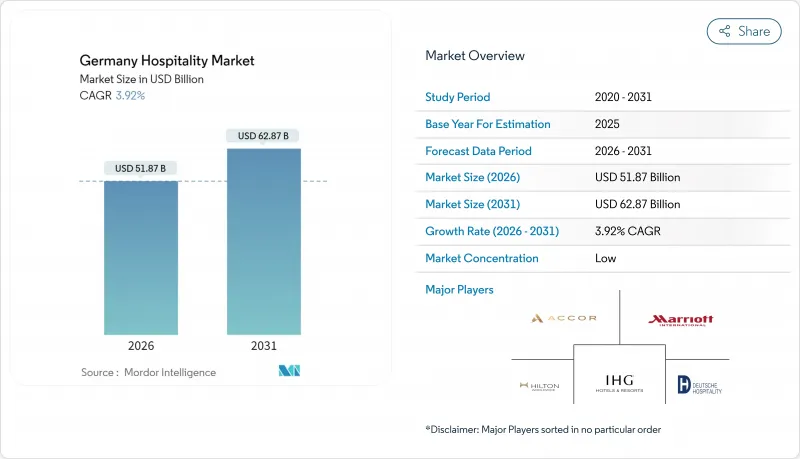
Record-high 496.1 million overnight stays in 2024, an 11.9% May 2025 RevPAR surge, and resilient domestic leisure demand confirm that the German hospitality market has regained, and slightly exceeded, its 2019 performance benchmarks. As global chains scale through franchising agreements, independent hotels continue to anchor supply, creating a dual-speed growth dynamic that intensifies competition for talent, sites, and distribution reach. Accelerated digital adoption, fuelled by the Digital Markets Act's ban on price-parity clauses, shifts bookings toward direct online channels, boosting margins for properties that master CRM and loyalty economics. Structural constraints, shortages of skilled labor, fluctuating utility costs, and a decline in building permits are creating increasingly challenging operating conditions for the industry. However, these factors are simultaneously reinforcing rate integrity within an undersupplied market. This environment is expected to benefit from a forecasted 1.1% recovery in domestic GDP in 2025, presenting potential opportunities for growth despite current limitations
Germany Hospitality Market Trends and Insights
Rebound of Inbound & Domestic Leisure Demand
Germany posted an all-time high of 496.1 million overnight stays in 2024, 0.1% above the 2019 peak, with domestic guests contributing 410.8 million and international arrivals rebounding 5.4% to 85.3 million. Mega-events, such as UEFA Euro 2024, contributed EUR 7.442 billion (USD 7.751 billion) to local economies, while hotels in host cities capitalized on the event by achieving higher average daily rates during match periods. The World Travel & Tourism Council projects a EUR 499 billion (USD 519.73 billion) sector GDP contribution and 6.5 million jobs in 2025, underscoring the German hospitality market's macro importance. Vacation rentals, campsites, and regional wellness resorts surpassed pre-pandemic levels, reflecting travellers' preference for domestic safety and value. Sustained leisure momentum provides a stable demand floor and encourages long-term asset investment across urban and rural locales.
Accelerated Shift Toward Direct-Digital Bookings
The classification of hotels as "gatekeepers" under the Digital Markets Act grants them the ability to promote competitive pricing directly on their branded platforms, driving a strategic transition towards loyalty-centric revenue generation models. The integration of advanced technologies, including AI-driven booking engines, dynamic upselling tools, and embedded payment systems, is significantly enhancing operational efficiency and boosting conversion rates. Moreover, mobile platforms are anticipated to contribute to direct booking transactions, underscoring the critical role of mobile optimization in shaping consumer behavior within the hospitality market. Early adopters of these digital advancements have experienced growth in bookings and a two-percentage-point increase in profit margins, reflecting a broader industry trend towards digital self-sufficiency and innovation in Germany hospitality sector.
Persistent Skilled-Labour Shortages & Wage Inflation
In 2023, the German hospitality market faced a notable shortage of skilled labour, with a significant number of positions remaining unfilled despite a year-on-year increase in labour costs. The sector experienced intensified competition from industries such as logistics and retail, which attracted workers by offering higher guaranteed wages and more consistent working hours. To address these challenges, hospitality employers implemented strategic measures, including the introduction of four-day work weeks, referral bonus programs, and streamlined apprenticeship pathways to attract and retain talent. Although advancements in automation, such as housekeeping robots and AI-powered scheduling systems, have partially alleviated staffing shortages, these technologies cannot fully replace the personalized, face-to-face interactions that are critical to maintaining guest satisfaction in the German hospitality market.
Other drivers and restraints analyzed in the detailed report include:
- National Pipeline Expansion by Global Chains
- CSRD-Driven Surge in Green-Certified Hotel CAPEX
- Volatile Utility & Energy Prices
For complete list of drivers and restraints, kindly check the Table Of Contents.
Segment Analysis
Independent hotels accounted for 59.05% of Germany hospitality market share in 2025, epitomizing the country's tradition of family ownership and regional flavour. Local operators leverage intimate knowledge of demand cycles, cultural events, and supplier networks to curate unique experiences that resonate with domestic travellers. Yet franchise adoption is rising legacy independents are increasingly partner with international brands on soft-brand conversions, accessing loyalty databases that unlock international demand while retaining design autonomy. Chain hotels, forecast at a 7.35% CAGR, benefit from multi-property economies of scale in procurement and technology. From 2026 to 2031, the German hospitality market is projected to experience notable growth in the chain-affiliated segment. This expansion is expected to reduce, though not eliminate, the market dominance held by independent establishments. The increasing presence of chain-affiliated inventory reflects a shift in market dynamics, driven by evolving consumer preferences and strategic investments by major players in the industry.
The chain surge is anchored in asset-light agreements that appease local owners wary of relinquishing control. IHG's NOVUM deal alone will spread Holiday Inn Express and Hotel Indigo flags across secondary cities that historically lacked branded supply. Such penetration deepens competitive pressure on independents, especially in segments where brand standards, loyalty perks, and 24-hour digital assistance sway booking decisions. Independent groups respond by doubling down on hyper-local F&B concepts, art collaborations, and sustainability certifications that differentiate on authenticity rather than scale.
The Germany Hospitality Market Report is Segmented by Type (Chain Hotels, Independent Hotels), Accommodation Class (Luxury, Mid & Upper-Mid-Scale, Budget & Economy, Service Apartments), Booking Channel (Direct Digital, Otas, Corporate/MICE, Wholesale & Traditional Agents), and Geography (North Germany, South Germany, West Germany, East Germany, Central Germany). The Market Forecasts are Provided in Terms of Value (USD).
List of Companies Covered in this Report:
- Accor SA
- Marriott International
- Hilton Worldwide
- IHG Hotels & Resorts
- Deutsche Hospitality (Steigenberger)
- Motel One Group
- B&B Hotels
- NH Hotel Group
- Radisson Hotel Group
- Premier Inn (Germany)
- H-Hotels AG
- Leonardo Hotels
- Novum Hospitality
- Lindner Hotels & Resorts
- Dorint Hotels & Resorts
- Meininger Hotels
- A&O Hostels
- Prizeotel
- Upstalsboom Hotel + Resorts
Additional Benefits:
- The market estimate (ME) sheet in Excel format
- 3 months of analyst support
TABLE OF CONTENTS
1 Introduction
- 1.1 Study Assumptions & Market Definition
- 1.2 Scope of the Study
2 Research Methodology
3 Executive Summary
4 Market Landscape
- 4.1 Market Overview
- 4.2 Market Drivers
- 4.2.1 Rebound of inbound & domestic leisure demand
- 4.2.2 Accelerated shift toward direct-digital bookings
- 4.2.3 National pipeline expansion by global chains
- 4.2.4 MICE & trade-fair calendar normalisation
- 4.2.5 Growth of bleisure-oriented serviced apartments
- 4.2.6 CSRD-driven surge in green-certified hotel CAPEX
- 4.3 Market Restraints
- 4.3.1 Persistent skilled-labour shortages & wage inflation
- 4.3.2 Volatile utility & energy prices
- 4.3.3 OTA commission pressure on independents
- 4.3.4 Lengthy zoning / permitting cycles for new builds
- 4.4 Value / Supply-Chain Analysis
- 4.5 Regulatory Landscape
- 4.6 Technological Outlook
- 4.7 Porter's Five Forces
- 4.7.1 Threat of New Entrants
- 4.7.2 Bargaining Power of Suppliers
- 4.7.3 Bargaining Power of Buyers
- 4.7.4 Threat of Substitutes
- 4.7.5 Industry Rivalry
5 Market Size & Growth Forecasts
- 5.1 By Type
- 5.1.1 Chain Hotels
- 5.1.2 Independent Hotels
- 5.2 By Accommodation Class
- 5.2.1 Luxury
- 5.2.2 Mid & Upper-Mid-scale
- 5.2.3 Budget & Economy
- 5.2.4 Service Apartments
- 5.3 By Booking Channel
- 5.3.1 Direct Digital
- 5.3.2 OTAs
- 5.3.3 Corporate / MICE
- 5.3.4 Wholesale & Traditional Agents
- 5.4 By Geographic Region
- 5.4.1 North Germany
- 5.4.2 South Germany
- 5.4.3 West Germany
- 5.4.4 East Germany
- 5.4.5 Central Germany
6 Competitive Landscape
- 6.1 Market Concentration
- 6.2 Strategic Moves
- 6.3 Market Share Analysis
- 6.4 Company Profiles (includes Global level Overview, Market level overview, Core Segments, Financials as available, Strategic Information, Market Rank/Share for key companies, Products & Services, and Recent Developments)
- 6.4.1 Accor SA
- 6.4.2 Marriott International
- 6.4.3 Hilton Worldwide
- 6.4.4 IHG Hotels & Resorts
- 6.4.5 Deutsche Hospitality (Steigenberger)
- 6.4.6 Motel One Group
- 6.4.7 B&B Hotels
- 6.4.8 NH Hotel Group
- 6.4.9 Radisson Hotel Group
- 6.4.10 Premier Inn (Germany)
- 6.4.11 H-Hotels AG
- 6.4.12 Leonardo Hotels
- 6.4.13 Novum Hospitality
- 6.4.14 Lindner Hotels & Resorts
- 6.4.15 Dorint Hotels & Resorts
- 6.4.16 Meininger Hotels
- 6.4.17 A&O Hostels
- 6.4.18 Prizeotel
- 6.4.19 Upstalsboom Hotel + Resorts
7 Market Opportunities & Future Outlook
- 7.1 Conversion of under-utilised retail & office assets into hybrid hotel-/serviced-apartment formats
- 7.2 AI-driven dynamic-pricing platforms tailored for independent German hotels

