
PUBLISHER: Mordor Intelligence | PRODUCT CODE: 1906891

PUBLISHER: Mordor Intelligence | PRODUCT CODE: 1906891
France Freight And Logistics - Market Share Analysis, Industry Trends & Statistics, Growth Forecasts (2026 - 2031)
The France freight and logistics market is expected to grow from USD 164.78 billion in 2025 to USD 170.45 billion in 2026 and is forecast to reach USD 201.86 billion by 2031 at 3.44% CAGR over 2026-2031.
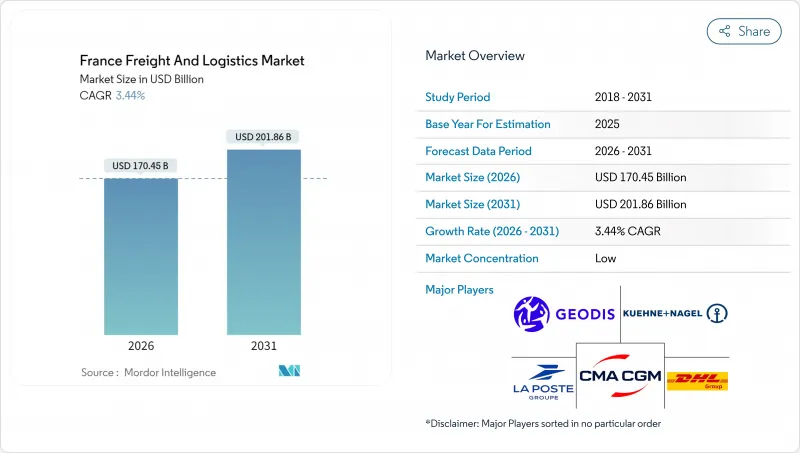
Sustained infrastructure upgrades, fast-rising e-commerce parcel flows, and full rollout of paperless customs procedures collectively reinforce the growth trajectory. The government's EUR 2 billion (USD 2.2 billion) Fonds vert program accelerates decarbonization projects across all modes, offering direct grants and tax credits that lower the cost of new green assets. Consolidation moves-most notably CMA CGM's EUR 5.2 billion (USD 5.7 billion) purchase of Bollore Logistics-create vertically integrated providers able to sell truly end-to-end services. Digital fleet telematics, hydrogen handling equipment, and AI-enabled risk engines raise asset utilization while shrinking emissions footprints, underpinning competitive advantage as Fit-for-55 obligations tighten.
France Freight And Logistics Market Trends and Insights
Digitalization of Customs Procedures
Full deployment of electronic declarations under the Union Customs Code has cut clearance times for compliant cargo by up to 30%, benefiting high-value automotive and aerospace supply chains. AI-driven risk engines enable selective inspections, freeing scarce border officers for complex checks and reducing truck dwell times at Calais and Le Havre. Freight forwarders report smoother document workflows and lower brokerage fees, enhancing the overall competitiveness of the France freight and logistics market.
Surge in E-commerce Parcel Volumes
Domestic parcel flows grew more than 20% year-on-year in 2024 as consumers demanded tighter delivery windows; operators like Chronopost opened urban micro-hubs and expanded cargo-bike fleets to comply with low-emission zones. Automated sortation and AI route optimization improve stop density, keeping cost per parcel in check even as network complexity rises.
Driver Shortage and Ageing Workforce
An estimated 60% of driving posts could remain vacant by 2026 as retirements outpace new entrants; licensing costs exceed EUR 3,000 (USD 3,310), discouraging younger applicants. Wage inflation erodes margins, forcing small fleets to subcontract or exit, reshaping the competitive fabric of the France freight and logistics industry.
Other drivers and restraints analyzed in the detailed report include:
- Green Tax Incentives for Intermodal Shift
- Near-Shoring of EU Supply Chains
- CAPEX Burden of Fit-for-55 Compliance
For complete list of drivers and restraints, kindly check the Table Of Contents.
Segment Analysis
Manufacturing held 31.21% of the France freight and logistics market share in 2025 as automotive, aerospace, and pharmaceuticals depended on high-precision just-in-time deliveries. Inbound sequencing and vendor-managed inventory keep warehouse dwell times low, favoring providers with sophisticated IT interfaces. Wholesale and retail trade rises the fastest at 3.62% CAGR (2026-2031), with omnichannel models favoring micro-fulfillment locations near dense populations.
Defense re-armament spending sustains demand for classified storage and escorted convoys, while agri-food volumes stay resilient on food-security priorities. Energy-transition policies reduce fossil-fuel traffic, reshaping lane profitability within the France freight and logistics market.
Freight transport delivered 59.58% of the France freight and logistics market size in 2025, supported by integrated road-rail-sea networks that cater to heavy industrial flows and cross-border trade. IoT-enabled fleet platforms cut empty-running and boost asset turns, preserving margins as diesel prices rise. CEP, though smaller, is the fastest-growing slice, with a 3.88% CAGR between 2026-2031, reflecting same-day delivery expectations in major cities. Inventory repositioning closer to consumers fuels warehousing demand, while freight forwarding retains relevance for customs and multimodal coordination.
Customer pressure for end-to-end visibility compels providers to bundle transport, storage, and returns services into single contracts. Players that master data analytics and eco-optimized routing gain share in the fiercely contested France freight and logistics market.
The France Freight and Logistics Market Report is Segmented by End User Industry (Agriculture, Fishing, and Forestry, Construction, Manufacturing, Oil and Gas, Mining and Quarrying, Wholesale and Retail Trade, and Others) and by Logistics Function (Courier, Express, and Parcel (CEP), Freight Forwarding, Freight Transport, Warehousing and Storage, and Other Services). The Market Forecasts are Provided in Terms of Value (USD).
List of Companies Covered in this Report:
- Balguerie Group
- CLASQUIN
- CMA CGM Group (Including CEVA Logistics)
- DACHSER
- DHL Group
- Dimotrans Group
- DSV A/S (Including DB Schenker)
- FedEx
- FM Logistic
- GEODIS
- Groupe CAT
- Kuehne+Nagel
- La Poste Group
- Rhenus Group
- Savino Del Bene SpA
- SEKO Logistics
- STEF Group
- United Parcel Service of America, Inc. (UPS)
- XPO, Inc.
- Ziegler Group
Additional Benefits:
- The market estimate (ME) sheet in Excel format
- 3 months of analyst support
TABLE OF CONTENTS
1 Introduction
- 1.1 Study Assumptions and Market Definition
- 1.2 Scope of the Study
2 Research Methodology
3 Executive Summary
4 Market Landscape
- 4.1 Market Overview
- 4.2 Demographics
- 4.3 GDP Distribution by Economic Activity
- 4.4 GDP Growth by Economic Activity
- 4.5 Inflation
- 4.6 Economic Performance and Profile
- 4.6.1 Trends in E-Commerce Industry
- 4.6.2 Trends in Manufacturing Industry
- 4.7 Transport and Storage Sector GDP
- 4.8 Export Trends
- 4.9 Import Trends
- 4.10 Fuel Price
- 4.11 Trucking Operational Costs
- 4.12 Trucking Fleet Size by Type
- 4.13 Major Truck Suppliers
- 4.14 Logistics Performance
- 4.15 Modal Share
- 4.16 Maritime Fleet Load Carrying Capacity
- 4.17 Liner Shipping Connectivity
- 4.18 Port Calls and Performance
- 4.19 Freight Pricing Trends
- 4.20 Freight Tonnage Trends
- 4.21 Infrastructure
- 4.22 Regulatory Framework (Road and Rail)
- 4.23 Regulatory Framework (Sea and Air)
- 4.24 Value Chain and Distribution Channel Analysis
- 4.25 Market Drivers
- 4.25.1 Digitalization of Customs Procedures
- 4.25.2 Surge in E-Commerce Parcel Volumes
- 4.25.3 Green Tax Incentives for Intermodal Shift
- 4.25.4 Near-Shoring of EU Supply Chains
- 4.25.5 Defence Re-Armament Logistics Demand
- 4.25.6 Hydrogen Refuelling Corridor Investments
- 4.26 Market Restraints
- 4.26.1 Driver Shortage and Ageing Workforce
- 4.26.2 CAPEX Burden of EU Fit-For-55 Compliance
- 4.26.3 Rail Network Capacity Bottlenecks (Passenger Priority)
- 4.26.4 Saturated Urban Last-Mile Delivery Zones
- 4.27 Technology Innovations in the Market
- 4.28 Porter's Five Forces Analysis
- 4.28.1 Threat of New Entrants
- 4.28.2 Bargaining Power of Buyers
- 4.28.3 Bargaining Power of Suppliers
- 4.28.4 Threat of Substitutes
- 4.28.5 Competitive Rivalry
5 Market Size and Growth Forecasts (Value, USD)
- 5.1 End User Industry
- 5.1.1 Agriculture, Fishing, and Forestry
- 5.1.2 Construction
- 5.1.3 Manufacturing
- 5.1.4 Oil and Gas, Mining and Quarrying
- 5.1.5 Wholesale and Retail Trade
- 5.1.6 Others
- 5.2 Logistics Function
- 5.2.1 Courier, Express, and Parcel (CEP)
- 5.2.1.1 By Destination Type
- 5.2.1.1.1 Domestic
- 5.2.1.1.2 International
- 5.2.1.1 By Destination Type
- 5.2.2 Freight Forwarding
- 5.2.2.1 By Mode of Transport
- 5.2.2.1.1 Air
- 5.2.2.1.2 Sea and Inland Waterways
- 5.2.2.1.3 Others
- 5.2.2.1 By Mode of Transport
- 5.2.3 Freight Transport
- 5.2.3.1 By Mode of Transport
- 5.2.3.1.1 Air
- 5.2.3.1.2 Pipelines
- 5.2.3.1.3 Rail
- 5.2.3.1.4 Road
- 5.2.3.1.5 Sea and Inland Waterways
- 5.2.3.1 By Mode of Transport
- 5.2.4 Warehousing and Storage
- 5.2.4.1 By Temperature Control
- 5.2.4.1.1 Non-Temperature Controlled
- 5.2.4.1.2 Temperature Controlled
- 5.2.4.1 By Temperature Control
- 5.2.5 Other Services
- 5.2.1 Courier, Express, and Parcel (CEP)
6 Competitive Landscape
- 6.1 Market Concentration
- 6.2 Key Strategic Moves
- 6.3 Market Share Analysis
- 6.4 Company Profiles (Includes Global Level Overview, Market Level Overview, Core Segments, Financials as Available, Strategic Information, Market Rank/Share for Key Companies, Products and Services, and Recent Developments)
- 6.4.1 Balguerie Group
- 6.4.2 CLASQUIN
- 6.4.3 CMA CGM Group (Including CEVA Logistics)
- 6.4.4 DACHSER
- 6.4.5 DHL Group
- 6.4.6 Dimotrans Group
- 6.4.7 DSV A/S (Including DB Schenker)
- 6.4.8 FedEx
- 6.4.9 FM Logistic
- 6.4.10 GEODIS
- 6.4.11 Groupe CAT
- 6.4.12 Kuehne+Nagel
- 6.4.13 La Poste Group
- 6.4.14 Rhenus Group
- 6.4.15 Savino Del Bene SpA
- 6.4.16 SEKO Logistics
- 6.4.17 STEF Group
- 6.4.18 United Parcel Service of America, Inc. (UPS)
- 6.4.19 XPO, Inc.
- 6.4.20 Ziegler Group
7 Market Opportunities and Future Outlook
- 7.1 White-Space and Unmet-Need Assessment

