
PUBLISHER: Mordor Intelligence | PRODUCT CODE: 2043985

PUBLISHER: Mordor Intelligence | PRODUCT CODE: 2043985
South America Laundry Appliances - Market Share Analysis, Industry Trends & Statistics, Growth Forecasts (2026 - 2031)
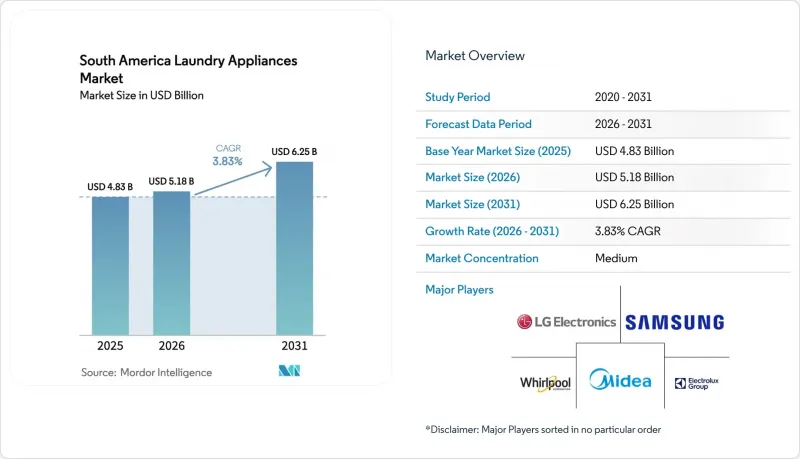
The South America laundry appliances market size reached USD 4.83 billion in 2025, is forecast at USD 5.18 billion in 2026, and is projected to reach USD 6.25 billion by 2031, reflecting a 3.83% CAGR during 2026-2031.
The spending shift to embedded financing and instant payments moves browsing into purchases, which is most visible in Brazil, where PIX and retailer BNPL options compress checkout friction and expand approval rates for households with thin credit files. Argentina's sharp unit upswing in 2025 came from import liberalization and tariff swings that deflated retail prices in dollar terms, which undermined local production economics and forced closures even as volumes rose. Chile pairs high per-capita e-commerce use with rapid 5G adoption and real-time payments to lift conversion and support cross-border buying behavior that exploits retail price gaps in neighboring markets. Peru's strong import flows in 2025 point to opportunistic restocking as the exchange rate reduced landed costs and incentivized earlier orders ahead of expected 2026 policy reviews .
South America Laundry Appliances Market Trends and Insights
Urban Housing Build-Out and Social Housing Programs Accelerating Appliance Purchases
Housing programs are translating handovers into immediate laundry-appliance purchases, which shortens the consideration cycle and advances demand from future periods into the present. In Brazil, the reinstated Minha Casa Minha Vida delivered 117,000 units during H1 2025, and each handover has been associated with financed appliance baskets in the USD 505.8 (BRL 2,800) range, which retailers attach to mortgages and social housing subsidies to increase conversion. In Chile, ministry-backed subsidies support first-time buyers who include front-load washers within renovation or move-in financing, and large chains coordinate zero-interest installments at the point of sale to close the loop. In Colombia, social-interest projects layer in water-connection incentives that strengthen the household case for an automatic washer rather than laundromat usage, which lifts penetration in secondary cities. The coupling of grid and water access upgrades with retail branch openings has increased stock pre-positioning around new housing clusters, which compresses delivery from weeks to days and improves sell-through of compliant models as labeling rules push buyers to formal channels .
Rising Washing-Machine Ownership with Headroom in Underserved Regions and Andean Markets
Penetration gaps across Peru's interior and Bolivia's urban cores leave large volumes untapped, and this gap remains despite falling entry prices due to import competition. Northeast Brazil also trails coastal metros on saturation, although targeted transfers and infrastructure investments are closing the distance and expanding the base for the South America laundry appliances market. If lagging regions close even part of the penetration gap by 2031, annual unit demand would skew to entry-tier machines that favor mechanical simplicity and low service costs. Logistics and last-mile costs constrain coverage in remote municipalities, which is why platforms have tested hub-and-spoke aggregation models to bring down per-order shipping costs and serve towns above specific population thresholds. Paraguay's sales mix shows the persistence of semi-automatic models where water pressure and voltage instability still pose barriers for fully automatic machines, which underscores how utility reliability shapes purchase choices in the South America laundry appliances market.
Tariff Volatility, Anti-Dumping Actions, and CET Exceptions Elevating Costs and Assortment Risk
Argentina's Decree 513/2025 raised tariffs on many washing machines below a capacity threshold and introduced a cumulative duty burden that reshaped price ladders and spurred cross-border purchases through personal-use channels. The mid-year change stranded inventory and forced re-export or loss-taking in some cases, which reduced assortment depth and delayed new-model introductions for the South America laundry appliances market. Mercosur's CET framework still allows many exceptions and domestic adjustments, and the mix of unilateral tariff moves and defensive petitions raises sourcing risk and margin volatility. Duty policy, exchange swings, and interstate tax interpretations have flipped planned margins into losses for some retailers, which has fueled a more conservative approach to SKU commitments for seasonal events. Manufacturers have also disclosed tax and legacy regime contingencies that weigh on investment planning, which further raises the hurdle for local expansions while duty regimes remain fluid.
Other drivers and restraints analyzed in the detailed report include:
- E-Commerce Scale and Omnichannel Financing Unlocking Major Domestic Appliance Purchases
- Energy-Efficiency and Safety Regulations Catalyzing Replacement Cycles and Premiumization
- Cultural Preference for Line-Drying and Very Low Dryer Penetration Suppresses Adoption
For complete list of drivers and restraints, kindly check the Table Of Contents.
Segment Analysis
Washing machines accounted for 71.34% of the 2025 value, which equates to USD 3.64 billion within the South America laundry appliances market, while dryer volumes remained far smaller, even as the dryer segment is projected to grow at a 5.00% CAGR through 2031. In Brazil, shorter replacement cycles reflect stock rotations around new labeling rules and active trade-in programs that move households into inverter models with better energy profiles. Chile's pollution alerts and urban construction codes raised the practical need for dryers in certain districts, but this remains a city-specific effect rather than a nationwide shift. Argentina's preference for washer-dryer combos aligns with space constraints and price parity, yet field-use data suggests the dryer function is used only occasionally as insurance during wet weather. Small laundry devices such as irons and garment steamers represent a modest slice of value and are driven more by impulse placement and promotions than by durable replacement cycles.
The manufacturing footprint follows the volume reality, since washers justify localized assembly and automation investments while dryer lines remain import-based and carry longer lead times for promotional windows. Midea's Pouso Alegre site came online in December 2024 and supports fast lead times for refrigerators and washing machines, which improve flexibility during high-demand events. Whirlpool disclosed significant automation capex to improve throughput and stabilize costs, and LG announced a large Parana investment for 2026 to cut reliance on imports. These moves position major OEMs to navigate labeling changes, tariff variability, and promotions with shorter cycles from factory to store. The trajectory keeps washers at the center of scale strategies in the South America laundry appliances market, while dryers build from a smaller base .
Fully automatic models held 65.12% of the 2025 value, while semi-automatic units are expected to grow at a 5.50% CAGR and outpace automatics as utility instability shapes preferences in certain subregions. The semi-automatic segment benefits from resilience to voltage dips and water pressure swings, along with lower upfront prices and easier field repairs. Northeast Brazil and parts of Andean markets still record a strong semi-automatic mix, while large metros skew to fully automatic models with higher inverter penetration and longer motor warranties. Labeling rules and impending washer-efficiency updates are set to support inverter adoption in automatics, since they deliver faster paybacks where electricity tariffs remain high. This split implies parallel supply and service models that keep semi-automatic products in the portfolio while fully automatic lines anchor replacement and premiumization in the South America laundry appliances market.
Manufacturers support inverter sales with extended motor guarantees and reliability messages, which reduce service-call costs and increase buyer confidence. Grid constraints and underdeveloped technician networks in interior cities preserve the rationale for manual or twin-tub designs and sustain demand for gravity-fed cycles. Draft RETIQ extensions in Colombia draw sharper lines between labeled automatics and exempt semi-automatics, which could indirectly lock low-income cohorts into less efficient formats unless targeted subsidies close the gap. OEMs balance tooling and logistics by pairing regional assembly for automatics with import flows for semi-automatics from high-volume Asian lines. This dual-track posture supports coverage breadth while aligning with compliance in the South America laundry appliances market.
The South America Laundry Appliances Report is Segmented by Product Type (Washing Machines, Clothes Dryers, and Others), Technology (Fully Automatic and Semi-Automatic / Manual), Load Capacity (Below 6 Kg, 6-8 Kg, and Above 8 Kg), Distribution Channel (Multi-Brand Stores, Exclusive Brand Outlets, Online, and Other Distribution Channels), and Geography. The Market Forecasts are Provided in Terms of Value (USD).
List of Companies Covered in this Report:
- Whirlpool Corporation
- Electrolux Group
- LG Electronics
- Samsung Electronics
- Midea Group
- BSH Hausgerate (Bosch)
- Haier Group
- Candy Hoover (Haier Europe)
- Hisense (incl. Gorenje)
- Mabe
- Arcelik (Beko)
- Panasonic
- TCL
- Groupe SEB (Arno)
- Philips Domestic Appliances
- Black+Decker
- Oster (Newell Brands)
- Mondial Eletrodomesticos
- Britania Eletrodomesticos
- Mallory
- Cadence
- Philco
- Drean (Alladio S.A.)
- Indurama
Additional Benefits:
- The market estimate (ME) sheet in Excel format
- 3 months of analyst support
TABLE OF CONTENTS
1 Introduction
- 1.1 Study Assumptions & Market Definition
- 1.2 Scope of the Study
2 Research Methodology
3 Executive Summary
4 Market Landscape
- 4.1 Market Overview
- 4.2 Market Drivers
- 4.2.1 Urban housing build-out and social housing programs accelerating appliance purchases
- 4.2.2 Rising washing-machine ownership with headroom in underserved regions and Andean markets
- 4.2.3 E-commerce scale and omnichannel financing unlocking major domestic appliance purchases
- 4.2.4 Energy-efficiency and safety regulations catalyzing replacement cycles and premiumization
- 4.2.5 Reverse logistics/EPR systems enabling trade-in promotions and take-back at scale
- 4.2.6 Energy and water stress tilting demand to inverter washers and heat-pump dryers
- 4.3 Market Restraints
- 4.3.1 Tariff volatility, anti-dumping actions, and CET exceptions elevating costs and assortment risk
- 4.3.2 Cultural preference for line-drying and very low dryer penetration suppress adoption
- 4.3.3 Compliance load from Inmetro 148/2022 recertification and evolving labeling/testing
- 4.3.4 Intra-Mercosur customs complexities and logistics raise delivered costs for bulky goods
- 4.4 Industry Value Chain Analysis
- 4.5 Porter's Five Forces Analysis
- 4.5.1 Threat of New Entrants
- 4.5.2 Bargaining Power of Suppliers
- 4.5.3 Bargaining Power of Buyers
- 4.5.4 Threat of Substitutes
- 4.5.5 Competitive Rivalry
- 4.6 Insights into the Latest Trends and Innovations in the Market
- 4.7 Insights on Recent Developments (New Product Launches, Strategic Initiatives, Investments, Partnerships, JVs, Expansion, M&As, etc.) in the Industry
5 Market Size & Growth Forecasts
- 5.1 By Product Type
- 5.1.1 Washing Machines
- 5.1.2 Clothes Dryers
- 5.1.3 Others (Garment Steamers, Electric Irons, Laundry Dehumidifiers)
- 5.2 By Technology
- 5.2.1 Fully Automatic
- 5.2.2 Semi-Automatic / Manual
- 5.3 By Load Capacity
- 5.3.1 Below 6 kg
- 5.3.2 6-8 kg
- 5.3.3 Above 8 kg
- 5.4 By Distribution Channel
- 5.4.1 Multi-brand Stores
- 5.4.2 Exclusive Brand Outlets
- 5.4.3 Online
- 5.4.4 Other Distribution Channels
- 5.5 By Region
- 5.5.1 Brazil
- 5.5.2 Argentina
- 5.5.3 Chile
- 5.5.4 Colombia
- 5.5.5 Peru
- 5.5.6 Rest of South America
6 Competitive Landscape
- 6.1 Market Concentration
- 6.2 Strategic Moves
- 6.3 Market Share Analysis
- 6.4 Company Profiles {(includes Global level Overview, Market level overview, Core Segments, Financials as available, Strategic Information, Market Rank/Share for key companies, Products & Services, and Recent Developments)}
- 6.4.1 Whirlpool Corporation
- 6.4.2 Electrolux Group
- 6.4.3 LG Electronics
- 6.4.4 Samsung Electronics
- 6.4.5 Midea Group
- 6.4.6 BSH Hausgerate (Bosch)
- 6.4.7 Haier Group
- 6.4.8 Candy Hoover (Haier Europe)
- 6.4.9 Hisense (incl. Gorenje)
- 6.4.10 Mabe
- 6.4.11 Arcelik (Beko)
- 6.4.12 Panasonic
- 6.4.13 TCL
- 6.4.14 Groupe SEB (Arno)
- 6.4.15 Philips Domestic Appliances
- 6.4.16 Black+Decker
- 6.4.17 Oster (Newell Brands)
- 6.4.18 Mondial Eletrodomesticos
- 6.4.19 Britania Eletrodomesticos
- 6.4.20 Mallory
- 6.4.21 Cadence
- 6.4.22 Philco
- 6.4.23 Drean (Alladio S.A.)
- 6.4.24 Indurama
7 Market Opportunities & Future Outlook
- 7.1 Heat-pump dryers and ventless condenser upgrades for humid, space-constrained urban homes
- 7.2 OEM-certified refurb/recommerce via reverse logistics credits and retailer take-back
- 7.3 Embedded financing and marketplace bundles to trade up to inverter/AI washers and washer-dryer combos

