PUBLISHER: Mordor Intelligence | PRODUCT CODE: 2061750

PUBLISHER: Mordor Intelligence | PRODUCT CODE: 2061750
United States Corrugated Packaging - Market Share Analysis, Industry Trends & Statistics, Growth Forecasts (2026 - 2031)
According to Mordor Intelligence, the united states corrugated packaging market size was valued at USD 35.90 billion in 2025 and estimated to grow from USD 37.02 billion in 2026 to reach USD 42.05 billion by 2031, at a CAGR of 2.58% during the forecast period (2026-2031).
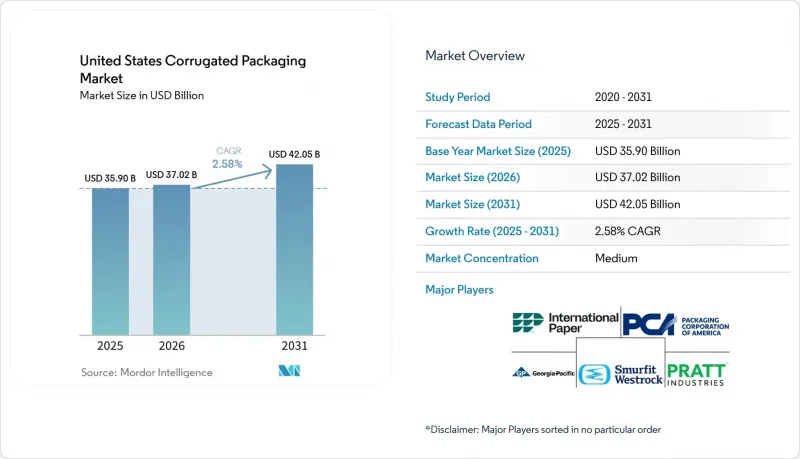
This report is Segmented by Material (Virgin Kraft Linerboard, Recycled Linerboard, and More), Flute Type (A Flute, and More), Packaging Type (Regular Slotted Containers, and More), Wall Type (Single, Double, and More), Printing Technology (Flexographic, and More), and End-User Industry (Processed Foods, and More). The Market Forecasts are Provided in Terms of Value (USD).
United States Corrugated Packaging Market Trends and Insights
E-Commerce Fulfilment Demand Surge
The United States corrugated packaging market is expanding fastest, where parcel networks promise same-day delivery. Amazon, Walmart, and third-party logistics firms added more than 50 million square feet of fulfillment space in 2025, each facility requiring automation-compatible boxes that hold precise caliper tolerances. Dimensional-weight fees from parcel carriers push shippers toward right-sized packaging, which lifts demand for custom die-cut formats. Smurfit Westrock's Track Vision platform traced over 1.3 million packages in 2025 and illustrated how digital twins reduce empty-mile trucking. International Paper responded by committing USD 225 million to a greenfield plant in Mississippi, scheduled for late 2027, to stay within a one-day delivery radius of major southeastern metros. Fulfillment density is therefore reinforcing regional capacity clusters and shortening lead times across the United States corrugated packaging market.
Shift Toward Plastic Substitution And Circular Economy Mandates
Extended producer responsibility rules in California, Colorado, Maine, Maryland, Minnesota, Oregon, and Vermont require brand owners to finance collection and sorting systems, creating a policy tailwind for fiber substrates. California Senate Bill 54 alone mandates a 65% recycling rate for single-use packaging by 2032, tilting material selection toward corrugated grades, which already have a 71-76% recovery rate. Pratt Industries opened a USD 120 million recycled-content plant in Warner Robins, Georgia, in 2025 to capture demand from these mandates. Federal STEWARD Act deliberations in Congress could harmonize rules nationwide and compress compliance costs. As policy momentum accelerates, the United States corrugated packaging market benefits from its closed-loop fibre infrastructure.
Ongoing Kraft Pulp Supply Chain Volatility
China's short-fiber pulp benchmark for 2026 rose to roughly USD 570 per ton, while domestic northern bleached softwood kraft held near USD 730 per ton in January 2026. Domtar's January 2026 closure of its 380,000-ton Crofton mill removed swing capacity and forced U.S. linerboard mills to source higher-cost Scandinavian pulp. Ocean freight from Northern Europe to the Gulf Coast exceeded USD 3,200 per forty-foot container early in 2026, pushing landed costs higher. These dynamics threaten margins for non-integrated converters inside the United States corrugated packaging market and encourage vertical integration or long-term supply contracts.
Other drivers and restraints analyzed in the detailed report include:
- Expansion Of Same-Day Grocery Delivery Networks
- Technological Integration Of RFID-Embedded Smart Corrugated Boxes
- Rising Energy Costs Impacting Boxboard Production Economics
For complete list of drivers and restraints, kindly check the Table Of Contents.
Segment Analysis
Recycled linerboard maintained 61.57% share in 2025, anchoring cost leadership, yet virgin kraft linerboard is forecast to pace material growth at a 3.03% CAGR. Print-quality requirements in cosmetics and electronics are pulling demand toward the smoother surface that virgin fiber delivers. Domtar's mill closure tightened virgin supply, nudging spot pulp toward USD 730 per ton, a level that narrows traditional recycled discounts. Many brands now specify Forest Stewardship Council certificates, so mills balancing recycled and virgin fiber can win contracts. Consequently, premium graphics applications are injecting fresh value pools into the United States corrugated packaging market.
Rising circular-economy mandates favor high recycled content, a space where Pratt Industries operates exclusively. Yet blended options such as white-top linerboard are gaining traction in point-of-purchase displays. International Paper already processes 7 million tons of old corrugated containers annually, reducing exposure to imported pulp and reinforcing internal fiber loops. The resulting two-tier material ecosystem ensures that performance and branding demands, rather than price alone, govern fiber choice across the United States corrugated packaging market.
C flute commanded 39.10% of 2025 shipments, but E flute is projected to outpace all others at a 4.13% CAGR through 2031 as consumer electronics and cosmetics seek lighter packs that remain protective. Thinner calipers cut dimensional weight and suit robotic packing lines, giving E flute a functional edge. Digital inkjet presses also print more cleanly on micro flutes, aligning with the trend toward personalized packaging. For fragile glassware and ceramics, A flute still offers the highest cushioning, yet its share is declining as converters redesign inserts rather than over-specify board. These mix shifts keep innovation pressure high within the United States corrugated packaging market.
Robot-friendly boxes need tight caliper control, which favors large integrated facilities running advanced process monitors. Smurfit Westrock and BHS Corrugated have tailored corrugators and press lines for micro flutes, helping big players defend their share. Smaller sheet feeders fill niche runs but must absorb higher scrap risk when shifting between flute profiles. The battle for unit economics at thin calipers will therefore shape equipment investment cycles across the United States corrugated packaging market.
List of Companies Covered in this Report:
- International Paper Company
- Smurfit Westrock plc
- Packaging Corporation of America
- Georgia-Pacific LLC
- Pratt Industries Inc.
- Sonoco Products Company
- Cascades Inc.
- The BoxMaker Inc.
- Mondi Group
- Jamestown Container Companies
- Graphic Packaging Holding Company
- R&R Corrugated Packaging Group
- Great Little Box Company Ltd.
- Liberty Corrugated LLC
Additional Benefits:
- The market estimate (ME) sheet in Excel format
- 3 months of analyst support
TABLE OF CONTENTS
1 INTRODUCTION
- 1.1 Study Assumptions and Market Definition
- 1.2 Scope of the Study
2 RESEARCH METHODOLOGY
3 EXECUTIVE SUMMARY
4 MARKET LANDSCAPE
- 4.1 Market Overview
- 4.2 Market Drivers
- 4.2.1 E-commerce Fulfillment Demand Surge
- 4.2.2 Shift Toward Plastic Substitution and Circular Economy Mandates
- 4.2.3 Expansion of Same-Day Grocery Delivery Networks
- 4.2.4 Technological Integration of RFID-Embedded Smart Corrugated Boxes
- 4.2.5 Growth of Direct-to-Consumer Subscription Services
- 4.2.6 Accelerating Nearshoring of Manufacturing to the United States
- 4.3 Market Restraints
- 4.3.1 Ongoing Kraft Pulp Supply Chain Volatility
- 4.3.2 Rising Energy Costs Impacting Boxboard Production Economics
- 4.3.3 Increasing Adoption of Reusable Plastic Containers in Produce Supply Chains
- 4.3.4 Regulatory Pressure on Forest Stewardship Certifications
- 4.4 Industry Value Chain Analysis
- 4.5 Regulatory Landscape
- 4.6 Technological Outlook
- 4.7 Impact of Macroeconomic Factors on the Market
- 4.8 Porter's Five Forces Analysis
- 4.8.1 Threat of New Entrants
- 4.8.2 Bargaining Power of Buyers
- 4.8.3 Bargaining Power of Suppliers
- 4.8.4 Threat of Substitute Products
- 4.8.5 Intensity of Competitive Rivalry
5 MARKET SIZE AND GROWTH FORECASTS (VALUE)
- 5.1 By Material
- 5.1.1 Virgin Kraft Linerboard
- 5.1.2 Recycled Linerboard
- 5.1.3 Corrugating Medium
- 5.1.4 Semi-Chemical Fluting
- 5.1.5 Other Materials
- 5.2 By Flute Type
- 5.2.1 A Flute
- 5.2.2 B Flute
- 5.2.3 C Flute
- 5.2.4 E Flute
- 5.2.5 F Flute
- 5.3 By Packaging Type
- 5.3.1 Regular Slotted Containers
- 5.3.2 Die-Cut Custom Boxes
- 5.3.3 Folding Cartons
- 5.3.4 Point-of-Purchase Displays
- 5.3.5 Pallet Boxes
- 5.3.6 Other Packaging Types
- 5.4 By Wall Type
- 5.4.1 Single-Wall
- 5.4.2 Double-Wall
- 5.4.3 Triple-Wall
- 5.4.4 Single Face
- 5.5 By Printing Technology
- 5.5.1 Flexographic Printing
- 5.5.2 Digital Inkjet Printing
- 5.5.3 Litho-Lamination
- 5.5.4 Screen Printing
- 5.5.5 Other Printing Technologies
- 5.6 By End-User Industry
- 5.6.1 Processed Foods
- 5.6.2 Fresh Food and Produce
- 5.6.3 Beverages
- 5.6.4 Paper Products
- 5.6.5 Electrical Products
- 5.6.6 Personal Care and Cosmetics
- 5.6.7 E-commerce Fulfillment Centers
- 5.6.8 Pharmaceuticals
- 5.6.9 Other End-User Industries
6 COMPETITIVE LANDSCAPE
- 6.1 Market Concentration
- 6.2 Strategic Moves
- 6.3 Market Share Analysis
- 6.4 Company Profiles (includes Global Level Overview, Market Level Overview, Core Segments, Financials as available, Strategic Information, Market Rank/Share, Products and Services, Recent Developments)
- 6.4.1 International Paper Company
- 6.4.2 Smurfit Westrock plc
- 6.4.3 Packaging Corporation of America
- 6.4.4 Georgia-Pacific LLC
- 6.4.5 Pratt Industries Inc.
- 6.4.6 Sonoco Products Company
- 6.4.7 Cascades Inc.
- 6.4.8 The BoxMaker Inc.
- 6.4.9 Mondi Group
- 6.4.10 Jamestown Container Companies
- 6.4.11 Graphic Packaging Holding Company
- 6.4.12 R&R Corrugated Packaging Group
- 6.4.13 Great Little Box Company Ltd.
- 6.4.14 Liberty Corrugated LLC
7 MARKET OPPORTUNITIES AND FUTURE OUTLOOK
- 7.1 White-Space and Unmet-Need Assessment

