PUBLISHER: Mordor Intelligence | PRODUCT CODE: 2063649

PUBLISHER: Mordor Intelligence | PRODUCT CODE: 2063649
South America Corrugated Packaging - Market Share Analysis, Industry Trends & Statistics, Growth Forecasts (2026 - 2031)
According to Mordor Intelligence, the south america corrugated packaging market size is expected to increase from USD 16.19 billion in 2025 to USD 16.83 billion in 2026 and reach USD 19.91 billion by 2031, growing at a CAGR of 3.42% over 2026-2031.
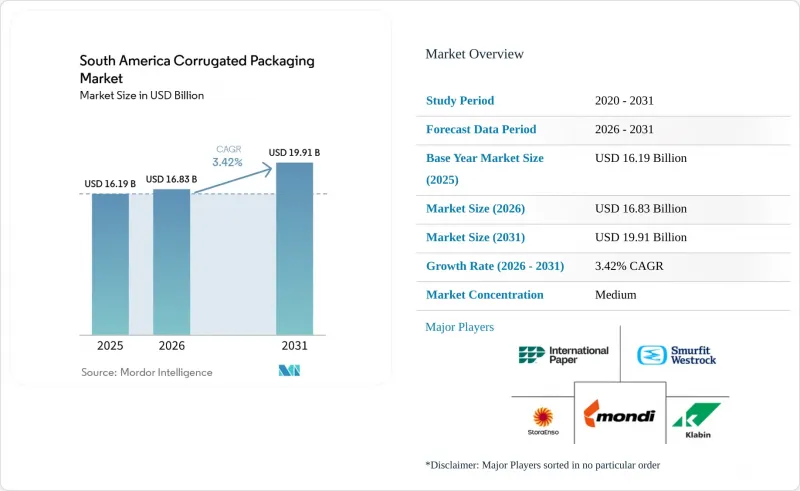
This report is Segmented by Material (Virgin Kraft Linerboard, Recycled Linerboard, and More), Flute Type (A Flute, and More), Packaging Type (Regular Slotted Containers, and More), Wall Type (Single-Wall, and More), Printing Technology (Flexographic Printing, and More), End-User Industry (Processed Foods, and More) and Geography. The Market Forecasts are Provided in Terms of Value (USD).
South America Corrugated Packaging Market Trends and Insights
E-Commerce Expansion Accelerating Corrugated Demand
Online retail in Brazil generated 1.2 million tons of packaging in 2023, marking a 22% year-on-year jump that directly lifted the South America corrugated boxes market. Fulfillment centers increasingly favor modular 300 mm X 200 mm X 150 mm regular slotted containers that glide through automated sorters, cutting void-fill material and operator touches. Colombia's e-commerce sector posted 15% growth in 2024, adding steady corrugated volume around the distribution hubs of Bogota and Medellin. Cross-border marketplaces that ship Argentine orders from Brazilian inventories extend the same packaging standards across Mercosur lanes, embedding structural demand into the South America corrugated boxes market. Implementation across secondary cities should accelerate over the next two to three years as last-mile infrastructure matures.
Shift Toward Lightweighting for Logistics Cost Savings
Regional freight carriers enforce dimensional-weight tariffs that penalize bulky packaging, prompting shippers to move from single-wall B flute at 450 g m-2 to double-wall E flute or F flute at 380 gm-2, slashing airfreight bills by as much as 18%. Chilean cherry exporters cut per-unit mass 12% during the 2024-2025 season after adopting F flute cartons, while pallet cube efficiency improved 8%. Peruvian avocado shippers employed ventilated E flute boxes that meet ISPM 15 pallet protocols and maintain airflow across 35-day transits, further boosting the South America corrugated boxes market profile. Upgrading to micro-flute corrugators requires capital expenditure exceeding USD 15 million, creating an adoption gap between major converters and smaller regional plants. Nonetheless, high aviation fuel surcharges keep the payback period short for firms operating large airfreight programs.
Volatility in Recovered Paper Prices
Brazilian old-corrugated-container prices spiked 90% year-on-year in October 2024, elevating recycled linerboard costs 24.6% and compressing converter margins by roughly 400 basis points. Argentina's supply tightened sharply when Celulosa Argentina closed in September 2025, stripping 120,000 tons of domestic capacity and lifting import prices 17% above regional benchmarks. While integrated mills hedge volatility through captive collection networks, independent plants remain exposed until price cycles normalize inside 18 months, affecting profitability across the South America corrugated boxes market. Industry consolidation could accelerate if margin stress repeats in future peaks.
Other drivers and restraints analyzed in the detailed report include:
- Growth of Fresh Produce Exports Requiring Ventilated Boxes
- Increasing Adoption of Digital Printing for Short Runs
- Intensifying Competition from Flexible Packaging Formats
For complete list of drivers and restraints, kindly check the Table Of Contents.
Segment Analysis
Virgin kraft linerboard captured 38.15% share in 2025, and its 5.62% CAGR implies enduring preference among exporters that ship cherries, avocados, and roasted coffee to distant buyers. The South America corrugated boxes market for virgin grades is expanding as importers inspect cartons for water absorption and crush resistance after five weeks at sea. Recycled linerboard remains essential for local distribution, yet recovered-paper volatility that drove 90% price swings in late 2024 pressures converters that lack captive collection networks. Specialty coatings, including water-repellent barriers for salmon exports, are gaining traction as converters chase higher-margin niches aligned with sustainability goals.
Klabin's Piracicaba II plant, inaugurated in April 2026, adds 300,000 tons of recycled board and anchors domestic supply security. Exporters tolerate 12-15% higher unit costs for virgin substrates to avoid USD 50,000 rejection claims at destination ports, reinforcing the premium's economic logic within the South America corrugated boxes market. ANVISA and MAPA rules on food-contact migration further align specifications with certified virgin kraft, simplifying compliance for meat, coffee, and fresh-produce shippers while signaling a steady shift in material mix through 2031.
B flute accounted for 34.63% of shipments in 2025, remaining the historical workhorse for balanced stacking strength and cushioning. However, the F flute's predicted 5.23% CAGR highlights a migration to slimmer walls that cut dimensional weight fees and maximize pallet cube, especially in rapidly scaling fulfillment centers. Switching from single-wall B flute at 450 g m-2 to a B-E double-wall at 380 g m-2 reduces airfreight charges up to 18%, a saving that resonates across the South America corrugated boxes market.
C flute remains vital for appliance packaging where load capacities exceed 1,000 psi, while A flute maintains a low share due to its cube inefficiency. Colombian converter Papelsa retooled corrugators to produce B and E flute combos, giving agro-export customers vented designs that protect blueberries and grapes during long-haul transport. F flute's sub-1.5 mm height also unlocks offset-like graphics, attracting cosmetics and electronics brands that help diversify revenue streams inside the South America corrugated boxes market.
List of Companies Covered in this Report:
- Smurfit Westrock plc
- International Paper Company
- Mondi plc
- Klabin S.A.
- Georgia-Pacific LLC
- Rengo Co., Ltd.
- Oji Holdings Corporation
- Pratt Industries, Inc.
- Packaging Corporation of America
- Cascades Inc.
- Stora Enso Oyj
- Cartones America S.A.
- Papeles y Cartones S.A.
- Consorcio Papelero Mexicano, S.A. de C.V.
Additional Benefits:
- The market estimate (ME) sheet in Excel format
- 3 months of analyst support
TABLE OF CONTENTS
1 INTRODUCTION
- 1.1 Study Assumptions and Market Definition
- 1.2 Scope of the Study
2 RESEARCH METHODOLOGY
3 EXECUTIVE SUMMARY
4 MARKET LANDSCAPE
- 4.1 Market Overview
- 4.2 Market Drivers
- 4.2.1 E-commerce Expansion Accelerating Corrugated Demand
- 4.2.2 Shift Toward Lightweighting for Logistics Cost Savings
- 4.2.3 Growth of Fresh Produce Exports Requiring Ventilated Boxes
- 4.2.4 Increasing Adoption of Digital Printing for Short Runs
- 4.2.5 Resurgence of Near-shoring Manufacturing in South America
- 4.2.6 Sustainability-Linked Financing Boosting Green Packaging Capex
- 4.3 Market Restraints
- 4.3.1 Volatility in Recovered Paper Prices
- 4.3.2 Intensifying Competition from Flexible Packaging Formats
- 4.3.3 Capital Intensity of High-Speed Corrugators
- 4.3.4 Port Congestion Disrupting Containerboard Supply
- 4.4 Industry Value Chain Analysis
- 4.5 Regulatory Landscape
- 4.6 Technological Outlook
- 4.7 Porter's Five Forces Analysis
- 4.7.1 Threat of New Entrants
- 4.7.2 Bargaining Power of Suppliers
- 4.7.3 Bargaining Power of Buyers
- 4.7.4 Threat of Substitutes
- 4.7.5 Competitive Rivalry
5 MARKET SIZE AND GROWTH FORECASTS (VALUE)
- 5.1 By Material Type
- 5.1.1 Virgin Kraft Linerboard
- 5.1.2 Recycled Linerboard
- 5.1.3 Corrugating Medium
- 5.1.4 Semi-Chemical Fluting
- 5.1.5 Other Materials
- 5.2 By Flute Type
- 5.2.1 A Flute
- 5.2.2 B Flute
- 5.2.3 C Flute
- 5.2.4 E Flute
- 5.2.5 F Flute
- 5.3 By Packaging Type
- 5.3.1 Regular Slotted Containers
- 5.3.2 Die-Cut Custom Boxes
- 5.3.3 Folding Cartons
- 5.3.4 Point-of-Purchase Displays
- 5.3.5 Pallet Boxes
- 5.3.6 Other Packaging Types
- 5.4 By Wall Type
- 5.4.1 Single-Wall
- 5.4.2 Double-Wall
- 5.4.3 Triple-Wall
- 5.4.4 Single Face
- 5.5 By Printing Technology
- 5.5.1 Flexographic Printing
- 5.5.2 Digital Inkjet Printing
- 5.5.3 Litho-Lamination
- 5.5.4 Screen Printing
- 5.5.5 Other Printing Technologies
- 5.6 By End-User Industry
- 5.6.1 Processed Foods
- 5.6.2 Fresh Food and Produce
- 5.6.3 Beverages
- 5.6.4 Electrical Products
- 5.6.5 Personal Care and Cosmetics
- 5.6.6 E-commerce Fulfillment Centers
- 5.6.7 Pharmaceuticals
- 5.6.8 Other End-User Industries
- 5.7 By Geography
- 5.7.1 Brazil
- 5.7.2 Argentina
- 5.7.3 Colombia
- 5.7.4 Chile
- 5.7.5 Peru
- 5.7.6 Rest of South America
6 COMPETITIVE LANDSCAPE
- 6.1 Market Concentration
- 6.2 Strategic Moves
- 6.3 Market Share Analysis
- 6.4 Company Profiles (includes Global level Overview, Market level overview, Core Segments, Financials as available, Strategic Information, Market Rank/Share for key companies, Products and Services, and Recent Developments)
- 6.4.1 Smurfit Westrock plc
- 6.4.2 International Paper Company
- 6.4.3 Mondi plc
- 6.4.4 Klabin S.A.
- 6.4.5 Georgia-Pacific LLC
- 6.4.6 Rengo Co., Ltd.
- 6.4.7 Oji Holdings Corporation
- 6.4.8 Pratt Industries, Inc.
- 6.4.9 Packaging Corporation of America
- 6.4.10 Cascades Inc.
- 6.4.11 Stora Enso Oyj
- 6.4.12 Cartones America S.A.
- 6.4.13 Papeles y Cartones S.A.
- 6.4.14 Consorcio Papelero Mexicano, S.A. de C.V.
7 MARKET OPPORTUNITIES AND FUTURE OUTLOOK
- 7.1 White-Space and Unmet-Need Assessment

