
PUBLISHER: Mordor Intelligence | PRODUCT CODE: 2063297

PUBLISHER: Mordor Intelligence | PRODUCT CODE: 2063297
Marine And Shipping TIC - Market Share Analysis, Industry Trends & Statistics, Growth Forecasts (2026 - 2031)
According to Mordor Intelligence, the marine and Shipping TIC market size was valued at USD 2.08 billion in 2025 and is estimated to grow from USD 2.17 billion in 2026 to USD 2.68 billion by 2031, at a CAGR of 4.31% from 2026 to 2031.
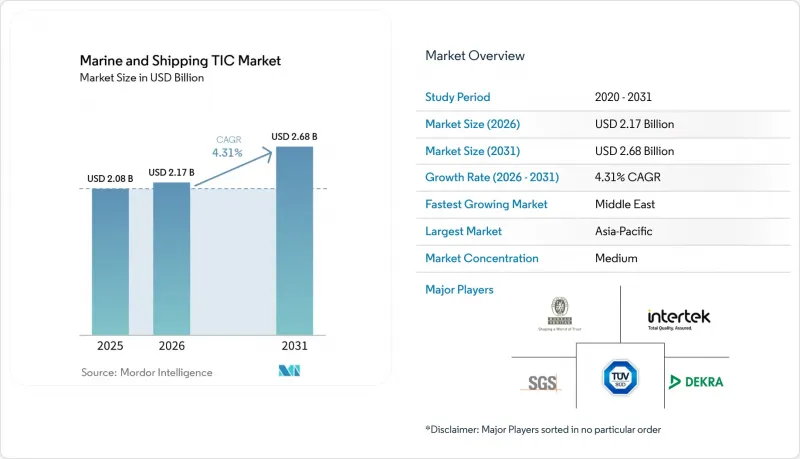
This report is Segmented by Service Type (Testing, Inspection, and Certification), Sourcing Type (In-House, and Outsourced), Mode of Service Delivery (On-Site, Off-site/Laboratory, and Remote/Digital), and Geography (North America, Europe, Asia-Pacific, Middle East, Africa, and South America). The Market Forecasts are Provided in Terms of Value (USD).
Global Marine And Shipping TIC Market Trends and Insights
Decarbonization Mandates Driving Alternative Fuel Testing
The International Maritime Organization has set carbon-intensity reduction milestones that escalate from 11% in 2026 to 21.5% by 2030, obligating owners to validate ammonia, methanol, and hydrogen propulsion systems before commercial deployment. DNV's EU-funded Ammonia24 program has already issued safety guidance enabling an orderbook of 39 ammonia-fueled vessels to proceed, demonstrating how standardization accelerates capital commitments. Each alternative-fuel newbuild triggers commissioning tests, mid-term surveys, and retrofit validations, creating recurring revenue streams previously absent from diesel fleets. Lloyd's Register complemented the shift by publishing hydrogen fuel-cell installation guidelines in 2025, giving shipyards clear reference points for ventilation, leak detection, and explosion-proof design. As goal-based standards replace prescriptive rules, classification societies are free to offer proprietary testing packages at premium rates for early adopters.
Accelerated Offshore Wind Installations Necessitating Marine Warranty Surveys
Europe's 75 gigawatt installed offshore wind base and 380 gigawatt pipeline demand requires continuous marine warranty verification for jack-up vessels, dynamic positioning systems, and subsea cable equipment. DNV's compliance certificates for Orsted's 4.2 gigawatt Hornsea 3 and 4 projects, issued in February 2026, exemplify the elevated technical rigor now applied to crane load curves and weather-window modeling. Bureau Veritas and American Bureau of Shipping issued similar approvals to heavy-lift vessels in early 2026, reinforcing a competitive race for high-margin survey work. Novel requirements such as blade-tolerance checks in 50-meter seas extend well beyond conventional cargo inspections, boosting fee potential. Bureau Veritas's Marine and Offshore division reported EUR 1.16 billion (USD 1.24 billion) revenue in 2023, with offshore wind contributing a rising portion, underscoring the segment's material impact on earnings.
Shortage of Qualified Marine Surveyors in Emerging Economies
Southeast Asia, Africa, and South America lack sufficient surveyors certified in alternative-fuel systems, digital twin validation, and advanced non-destructive testing. Training pipelines remain thin despite programs from the International Institute of Marine Surveying and Lloyd's Register Maritime Academy. China and South Korea control more than 80% of global shipbuilding orders, yet regional workforces struggle to master IACS unified requirements, stretching approval lead times. Indian Register of Shipping relies on expatriate experts for complex inspections, raising project costs. Without mandated continuous education on AI-driven diagnostics under the STCW Convention, the skills gap persists, especially in African ports where detention rates stay elevated.
Other drivers and restraints analyzed in the detailed report include:
- Expanding Digital Twin Adoption for Predictive Maintenance Verification
- Growth in Autonomous Shipping Raising Certification Demand
- High Cost of Advanced Non-Destructive Testing Equipment
For complete list of drivers and restraints, kindly check the Table Of Contents.
Segment Analysis
Certification accounted for the fastest expansion, with a 4.47% CAGR, reflecting owners' need to prove autonomous navigation and alternative-fuel safety. Inspection remained the largest slice at 45.23% in 2025, anchored by statutory hull-thickness and ballast-water checks. The Marine and Shipping TIC market size for certification services is projected to grow steadily as digital twin and software validation mature. The rising uptake of ClassNK's AUTO-Nav2 (All) notation and Bureau Veritas's Augmented Surveyor 3D platform underscores how real-time data flows blur the boundaries between Inspection and certification. Owners increasingly bundle lab tests within integrated survey contracts, compressing administration and tilting revenue toward full-scope providers.
Testing services expand more slowly, yet fuel-quality analysis and emissions sampling remain indispensable for compliance. Continuous monitoring subscriptions tied to drone imagery and LiDAR scans expand recurring revenue, reinforcing the structural shift from one-off reports to data-driven lifecycle assurance. As remote tools proliferate, certification's strategic importance grows because regulators and insurers rely on class approvals to accept algorithmic or sensor-based evidence.
Geography Analysis
Asia-Pacific held 34.41% of 2025 revenue, propelled by China's 52.8% share of global shipbuilding orders and South Korea's 28.1% orderbook leadership. ClassNK rose to first place by vessel count, and China Classification Society climbed into the top five by gross tonnage, evidencing robust regional activity. Japan's MEGURI2040 program certified four autonomous vessels in early 2026, spurring demand for novel testing frameworks. Indian Register of Shipping delivered 115 vessels since January 2025 and opened a Saudi Arabia office, extending Asia-Pacific know-how into adjacent markets. Korean Register's revenue advanced 4% year over year to KRW 206 billion (USD 155 million) in 2025 and targets further gains in 2026, in line with rising domestic construction activity.
The Middle East is forecast to post the fastest regional CAGR at 5.61% through 2031. Saudi Arabia's port investments and the United Arab Emirates' logistics expansion attract classification societies seeking proximity to greenfield terminals and offshore energy projects. Survey demand also heightens when geopolitical flare-ups raise war-risk premiums in the Strait of Hormuz, intensifying calls for independent hull and machinery inspections. Indian Register of Shipping's Riyadh branch illustrates strategic positioning to capture these opportunities.
Europe and North America exhibit below-average growth due to mature fleets, but they dominate high-margin niches such as offshore wind, marine warranty surveys, and digital-twin certifications. DNV's Bremerhaven Offshore Wind Competence Center, with 100 engineers, and Lloyd's Register's Houston office underline continued investment in advanced capabilities. Africa and South America lag due to limited surveyor pools and testing infrastructure, though remote inspection and training partnerships are gradually unlocking latent potential.
- Bureau Veritas SA
- Intertek Group plc
- SGS SA
- TUV SUD AG
- DEKRA SE
- Lloyd's Register Group Limited
- DNV AS
- American Bureau of Shipping
- Nippon Kaiji Kyokai (ClassNK)
- RINA S.p.A.
- China Classification Society
- Korean Register
- Indian Register of Shipping
- Tasneef (Emirates Classification Society)
- Russian Maritime Register of Shipping
- Polish Register of Shipping
- Hellenic Register of Shipping
- Vietnam Register
- Croatian Register of Shipping
Additional Benefits:
- The market estimate (ME) sheet in Excel format
- 3 months of analyst support
TABLE OF CONTENTS
1 INTRODUCTION
- 1.1 Study Assumptions and Market Definition
- 1.2 Scope of the Study
2 RESEARCH METHODOLOGY
3 EXECUTIVE SUMMARY
4 MARKET LANDSCAPE
- 4.1 Market Overview
- 4.2 Market Drivers
- 4.2.1 Decarbonization Mandates Driving Alternative Fuel Testing
- 4.2.2 Expanding Digital Twin Adoption for Predictive Maintenance Verification
- 4.2.3 Growth in Autonomous Shipping Raising Certification Demand
- 4.2.4 Stricter Ballast Water Treatment Compliance Testing
- 4.2.5 Accelerated Offshore Wind Installations Necessitating Marine Warranty Surveys
- 4.2.6 Insurance Premium Incentives for Verified Hull Integrity
- 4.3 Market Restraints
- 4.3.1 Shortage of Qualified Marine Surveyors in Emerging Economies
- 4.3.2 High Cost of Advanced Non-Destructive Testing Equipment
- 4.3.3 Fragmented Regulatory Framework Across Flag States
- 4.3.4 Geopolitical Tensions Impacting Cross-Border Inspection Access
- 4.4 Industry Value-Chain Analysis
- 4.5 Regulatory Landscape
- 4.6 Technological Outlook
- 4.7 Impact of Macroeconomic Factors on the Market
- 4.8 Porter's Five Forces Analysis
- 4.8.1 Threat of New Entrants
- 4.8.2 Bargaining Power of Suppliers
- 4.8.3 Bargaining Power of Buyers
- 4.8.4 Threat of Substitutes
- 4.8.5 Competitive Rivalry
5 MARKET SIZE AND GROWTH FORECASTS (VALUE)
- 5.1 By Service Type
- 5.1.1 Testing
- 5.1.2 Inspection
- 5.1.3 Certification
- 5.2 By Sourcing Type
- 5.2.1 In-house
- 5.2.2 Outsourced
- 5.3 By Mode of Service Delivery
- 5.3.1 On-site
- 5.3.2 Off-site / Laboratory
- 5.3.3 Remote / Digital
- 5.4 By Geography
- 5.4.1 North America
- 5.4.1.1 United States
- 5.4.1.2 Canada
- 5.4.1.3 Mexico
- 5.4.2 Europe
- 5.4.2.1 United Kingdom
- 5.4.2.2 Germany
- 5.4.2.3 France
- 5.4.2.4 Italy
- 5.4.2.5 Rest of Europe
- 5.4.3 Asia-Pacific
- 5.4.3.1 China
- 5.4.3.2 Japan
- 5.4.3.3 India
- 5.4.3.4 South Korea
- 5.4.3.5 Rest of Asia-Pacific
- 5.4.4 Middle East
- 5.4.4.1 Israel
- 5.4.4.2 Saudi Arabia
- 5.4.4.3 United Arab Emirates
- 5.4.4.4 Turkey
- 5.4.4.5 Rest of Middle East
- 5.4.5 Africa
- 5.4.5.1 South Africa
- 5.4.5.2 Egypt
- 5.4.5.3 Rest of Africa
- 5.4.6 South America
- 5.4.6.1 Brazil
- 5.4.6.2 Argentina
- 5.4.6.3 Rest of South America
- 5.4.1 North America
6 COMPETITIVE LANDSCAPE
- 6.1 Market Concentration
- 6.2 Strategic Moves
- 6.3 Market Share Analysis
- 6.4 Company Profiles (includes Global Level Overview, Market Level Overview, Core Segments, Financials as available, Strategic Information, Market Rank/Share, Products and Services, Recent Developments)
- 6.4.1 Bureau Veritas SA
- 6.4.2 Intertek Group plc
- 6.4.3 SGS SA
- 6.4.4 TUV SUD AG
- 6.4.5 DEKRA SE
- 6.4.6 Lloyd's Register Group Limited
- 6.4.7 DNV AS
- 6.4.8 American Bureau of Shipping
- 6.4.9 Nippon Kaiji Kyokai (ClassNK)
- 6.4.10 RINA S.p.A.
- 6.4.11 China Classification Society
- 6.4.12 Korean Register
- 6.4.13 Indian Register of Shipping
- 6.4.14 Tasneef (Emirates Classification Society)
- 6.4.15 Russian Maritime Register of Shipping
- 6.4.16 Polish Register of Shipping
- 6.4.17 Hellenic Register of Shipping
- 6.4.18 Vietnam Register
- 6.4.19 Croatian Register of Shipping
7 MARKET OPPORTUNITIES AND FUTURE OUTLOOK
- 7.1 White-Space and Unmet-Need Assessment

