PUBLISHER: Mordor Intelligence | PRODUCT CODE: 2063359

PUBLISHER: Mordor Intelligence | PRODUCT CODE: 2063359
United Kingdom Food Logistics - Market Share Analysis, Industry Trends & Statistics, Growth Forecasts (2026 - 2031)
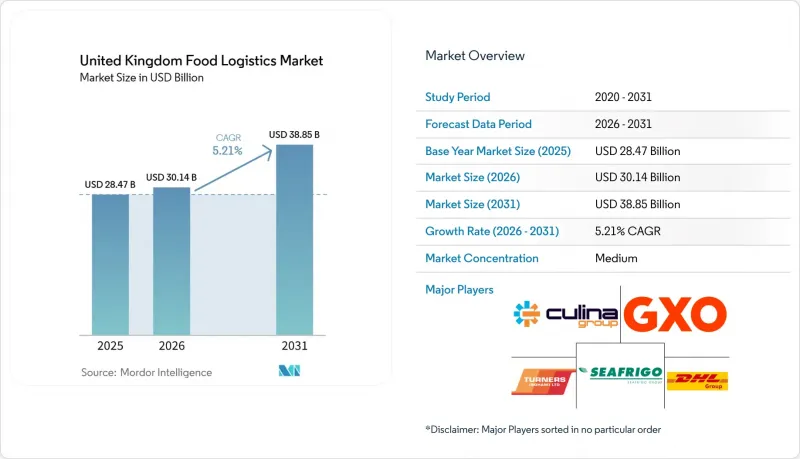
According to Mordor Intelligence, the united kingdom food logistics market size was valued at USD 28.47 billion in 2025 and estimated to grow from USD 30.14 billion in 2026 to reach USD 38.85 billion by 2031, at a CAGR of 5.21% during the forecast period (2026-2031).
Intermodal refrigerated transport along the Felixstowe-Midlands corridor, mandatory digital waste-tracking, and regional processing hubs funded by the government's levelling-up program anchor this growth. This report is Segmented by Services (Transportation, Warehousing and Storage, Value-Added Services), by Temperature-Control Type (Cold Chain (Ambient, Chilled, Frozen), Non-Cold Chain), by End-Product Category (Meat/Seafood/Poultry, Dairy Products/Frozen Desserts, Horticulture, Processed Food Products, Pet Food, Others). The Market Forecasts are Provided in Terms of Value (USD).
United Kingdom Food Logistics Market Trends and Insights
Export-Oriented Chilled-Food Surge Amplifying Intermodal Demand
Record dairy export volumes in 2025 accompanied a double-digit rise in chilled meat and ready-to-eat products moving to Asia-Pacific markets, driving incremental demand for temperature-controlled containers and rail access to deep-water ports. Chilled items require tighter 2-8 °C windows and shorter transit times than frozen cargo, which pushes shippers toward integrated road-rail solutions that cut end-to-end journeys by up to 12 hours. GB Railfreight's dedicated reefer services on the Felixstowe-Midlands spine illustrate how rail captures long-haul volumes once carbon abatements and fuel savings are quantified. Exporters gain sustainability credentials as modal shift cuts 76% of associated emissions. However, widespread take-up relies on a larger refrigerated wagon fleet and automated container-tracking to pre-empt temperature excursions.
Mandatory Digital Waste-Tracking Expanding Reverse-Logistics Flows
Compulsory food-waste reporting from April 2025 has formalized reverse-logistics requirements for every major grocer and food-service player. Separate household food-waste collection mandated by March 2026 is adding collection routes that mirror forward distribution lanes, boosting fleet utilization. Retailers such as Tesco now pair last-mile deliveries with surplus pick-ups, routing them to redistribution NGOs aided by QR-coded data trails. Operators with mixed-load refrigerated vans and API-linked scheduling tools can turn what was once empty back-haul into a revenue-generating service, trimming emissions and securing regulatory credits. Early adopters enjoy first-mover advantage as compliance audits increasingly demand end-to-end digital visibility.
Tightening F-Gas and Ammonia Regulations Inflating Cold-Store Retrofit Costs
HFC quotas fall 79% by 2030, forcing two-thirds of the United Kingdom cold stores still running legacy refrigerants to retrofit or replace systems at USD 0.6-2.5 million per site. Ammonia and CO2 designs slash energy bills but require leak-detection, ventilation upgrades, and skilled engineers. For cash-constrained independents the capex outlay is prohibitive, incentivizing sale-and-leaseback deals with REITs such as Lineage Logistics that bundle financing, build, and long-term operating contracts.
Other drivers and restraints analyzed in the detailed report include:
- Regional Processing Hubs under Levelling-Up Agenda Boosting Mid-Mile Reefer Routes
- Predictive-Maintenance Deployment for Refrigerated Assets Cutting Downtime
- Shortage of Refrigerated Rail Wagons Constraining Modal-Shift Capacity
For complete list of drivers and restraints, kindly check the Table Of Contents.
Segment Analysis
In service type, transportation commanded 46.77% of the United Kingdom food logistics market share in 2025. Road remains indispensable for last-mile coverage, but labor shortages and diesel costs compress margins, steering operators toward higher-yield ancillary work. Value-added services such as blast freezing, inventory management, co-packing, and organised reverse-logistics are on track for a 7.78% CAGR, almost 2 percentage points above the overall United Kingdom food logistics market CAGR. Clients reward providers capable of native WMS-TMS integration, SKU-level visibility, and multi-temperature order assembly. Sea and inland-water moves tie closely to port-centric chill-tunnel storage, while rail's share inches forward on intermodal corridors once capacity bottlenecks ease.
Automation is the performance equalizer. NewCold's automated AS/RS facility in Wakefield lifts pallet-throughput per square meter 40% above manual designs, compressing energy per unit handled and meeting near-zero-touch safety protocols. As supermarkets renew logistics tenders, bundled contracts that fuse transport, warehousing, and compliance reporting beat siloed offerings. DFDS Logistics illustrates the pivot: cross-dock redesigns now include blast-freezers, order-assembly robots, and RFID-enabled waste-capture gates. Over the forecast horizon, earnings growth will be skewed toward fleets that convert traditional "haul and store" models into data-rich, compliance-embedded service platforms.
List of Companies Covered in this Report:
- DHL Group
- GXO Logistics
- Culina Group
- Seafrigo Group
- Turners (Soham) Ltd
- Kuehne+Nagel
- DFDS Logistics
- XPO Logistics
- DACHSER
- Lineage, Inc.
- NewCold
- La Poste Group (Including DPD UK)
- DSV A/S
- Hellmann Worldwide Logistics
- Constellation Cold Logistics
- Kammac
- McCulla Refrigerated Transport
- Rhenus Logistics
- Certa Logistics
- Supply Chain Solution Ltd.
Additional Benefits:
- The market estimate (ME) sheet in Excel format
- 3 months of analyst support
TABLE OF CONTENTS
1 Introduction
- 1.1 Study Assumptions and Market Definition
- 1.2 Scope of the Study
2 Research Methodology
3 Executive Summary
4 Market Landscape
- 4.1 Market Overview
- 4.2 Market Drivers
- 4.2.1 Export-Oriented Chilled-Food Surge Amplifying Intermodal Demand
- 4.2.2 Mandatory Digital Waste-Tracking Expanding Reverse-Logistics Flows
- 4.2.3 Regional Processing Hubs Under "Levelling-Up" Agenda Boosting Mid-Mile Reefer Routes
- 4.2.4 Predictive-Maintenance Deployment for Refrigerated Assets Cutting Downtime
- 4.2.5 Expansion of Rail-Based Refrigeration Services on Felixstowe-Midlands Corridor
- 4.2.6 Insurer-Led Temperature-Compliance Requirements Creating Premium Service Tiers
- 4.3 Market Restraints
- 4.3.1 Tightening F-Gas and Ammonia Regulations Inflating Cold-Store Retrofit Costs
- 4.3.2 Shortage of Refrigerated Rail Wagons Constraining Modal Shift Capacity
- 4.3.3 Currency Volatility Elevating Fuel and Equipment Import Costs
- 4.3.4 Rising Insolvency Risk Among SME Food Hauliers Due to Customs-Linked Cash-Flow Stress
- 4.4 Value / Supply-Chain Analysis
- 4.5 Regulatory Landscape
- 4.6 Technological Outlook
- 4.7 Porter's Five Forces Analysis
- 4.7.1 Threat of New Entrants
- 4.7.2 Bargaining Power of Buyers
- 4.7.3 Bargaining Power of Suppliers
- 4.7.4 Threat of Substitutes
- 4.7.5 Industry Rivalry
5 Market Size and Growth Forecasts
- 5.1 By Services
- 5.1.1 Transportation
- 5.1.1.1 Road
- 5.1.1.2 Rail
- 5.1.1.3 Sea and Inland Water
- 5.1.1.4 Air
- 5.1.2 Warehousing and Storage
- 5.1.3 Value-added Services (Blast Freezing, Labeling, Inventory Management, etc.)
- 5.1.1 Transportation
- 5.2 By Temperature-Control Type
- 5.2.1 Cold Chain
- 5.2.1.1 Ambient (15-25 °C)
- 5.2.1.2 Chilled (2-8 °C)
- 5.2.1.3 Frozen (Less than 0 °C)
- 5.2.2 Non Cold Chain
- 5.2.1 Cold Chain
- 5.3 By End-Product Category
- 5.3.1 Meat, Seafood, and Poultry
- 5.3.2 Dairy Products and Frozen Deserts (Milk, Ice-cream, Butter, etc.)
- 5.3.3 Horticulture (Fresh Fruits and Vegetables)
- 5.3.4 Processed Food Products
- 5.3.5 Pet Food
- 5.3.6 Others (Spreads, Seasoning, Dressing, Specialty and Functional Foods, etc.)
6 Competitive Landscape
- 6.1 Market Concentration
- 6.2 Strategic Moves
- 6.3 Market Share Analysis
- 6.4 Company Profiles (Includes Global Level Overview, Market Level Overview, Core Segments, Financials as Available, Strategic Information, Market Rank/Share for Key Companies, Products and Services, Recent Developments)
- 6.4.1 DHL Group
- 6.4.2 GXO Logistics
- 6.4.3 Culina Group
- 6.4.4 Seafrigo Group
- 6.4.5 Turners (Soham) Ltd
- 6.4.6 Kuehne+Nagel
- 6.4.7 DFDS Logistics
- 6.4.8 XPO Logistics
- 6.4.9 DACHSER
- 6.4.10 Lineage, Inc.
- 6.4.11 NewCold
- 6.4.12 La Poste Group (Including DPD UK)
- 6.4.13 DSV A/S
- 6.4.14 Hellmann Worldwide Logistics
- 6.4.15 Constellation Cold Logistics
- 6.4.16 Kammac
- 6.4.17 McCulla Refrigerated Transport
- 6.4.18 Rhenus Logistics
- 6.4.19 Certa Logistics
- 6.4.20 Supply Chain Solution Ltd.
7 Market Opportunities and Future Outlook
- 7.1 White-space and Unmet-need Assessment

