PUBLISHER: Mordor Intelligence | PRODUCT CODE: 2063486

PUBLISHER: Mordor Intelligence | PRODUCT CODE: 2063486
Indonesia Corrugated Packaging - Market Share Analysis, Industry Trends & Statistics, Growth Forecasts (2026 - 2031)
According to Mordor Intelligence, the indonesia corrugated packaging market size is expected to increase from USD 2.14 billion in 2025 to USD 2.27 billion in 2026 and reach USD 3.16 billion by 2031, growing at a CAGR of 6.85% over 2026-2031.
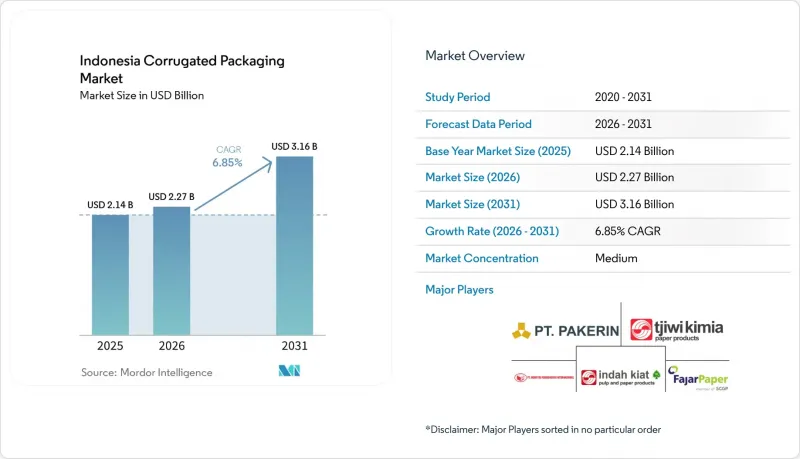
This report is Segmented by Material (Virgin Kraft Linerboard, Recycled Linerboard, Corrugating Medium, and More), Flute Type (A Flute, and More), Packaging Type (Regular Slotted Containers, and More), Wall Type (Single, Double, and More), Printing Technology (Flexographic, and More), and End-User Industry (Processed Foods, and More). The Market Forecasts are Provided in Terms of Value (USD).
Indonesia Corrugated Packaging Market Trends and Insights
Surge in E-Commerce Shipments
Indonesia's booming parcel economy is redefining box design as platforms optimize packaging to avoid dimensional-weight tariffs and improve last-mile efficiency. Daily sales on major social-commerce channels now spawn millions of micro-orders that favor thinner E and F flutes, right-sized die-cuts, and rapid art changes. Fulfillment centers are installing automated cutters that reduce void space by up to 20 percent, compelling converters to provide on-demand blanks rather than pre-made regular slotted containers. The absence of a unified national recyclability standard adds compliance complexity for cross-border sellers, so outsized parcels often revert to heavier gauges to guarantee intact returns. As the internet economy expands beyond Java, converters that synchronize just-in-time deliveries with regional hubs are best placed to ride the e-commerce wave.
Plastic-Reduction Policies Accelerating Fiber Adoption
Extended Producer Responsibility rules and localized plastic bans are nudging brands toward fiber-based secondary packaging. The government's circular roadmap aims to achieve complete waste management by 2029, prompting retailers in Jakarta and Bali to switch from shrink wrap to corrugated trays and folding cartons. Multinationals now require ISO 14001 certification from suppliers, lifting entry barriers for smaller box plants. Adoption, however, is uneven, as only 60 percent of urban residents have access to formal waste collection, limiting effective recycling in secondary cities. This regulatory mosaic creates openings for converters that pair green credentials with region-specific supply chains.
Volatility in OCC / Pulp Prices
In January 2026, old-corrugated-container exports from the United States reached USD 130 per short ton, and Indonesia's compulsory inspections added extra cost to spot purchases. Bleached hardwood kraft pulp tracked near USD 530 per tonne late in 2025, yet looming Chinese demand weakness threatens another dip. Every USD 50 swing in pulp pricing materially alters the profit trajectories of converters without vertical integration. Such volatility forces many mid-tier players to delay automation or digital-printing upgrades, locking them into low-margin commodity segments.
Other drivers and restraints analyzed in the detailed report include:
- Expansion of Indonesia's Processed Food Industry
- Growth of Domestic Pulp and Paper Capacity
- Rising Energy and Logistics Costs
For complete list of drivers and restraints, kindly check the Table Of Contents.
Segment Analysis
The Indonesia corrugated packaging market drew 61.86% of 2025 material revenue from recycled linerboard, validating domestic investments in old-corrugated-containers recovery. Virgin Kraft grades remain mandatory for export-oriented food and pharma shippers wanting moisture resistance, yet rising carbon reporting costs keep their share modest. Corrugating medium, the backbone of flute structure, is on track for a 7.20% CAGR, paced by converters trimming basis weight while protecting box compression. Semi-chemical fluting still secures premium appliance and pallet cases due to its superior stiffness-to-weight, though its larger energy footprint limits mainstream adoption. Mills now mix imported and local scrap to hit burst-strength targets after contamination issues reduced fiber yield in several urban collection streams. The Indonesian corrugated packaging market, therefore, rewards mills that install advanced drum pulpers that achieve higher yields and freshwater savings.
Second-order effects ripple through converter buying. Chain-of-custody-certified linerboard is now featured in bids from multinational customers seeking Scope 3 cuts, increasing documentation requirements for smaller sheet plants. Meanwhile, specialty moisture-barrier coatings, priced 10-15% above uncoated stock, gain ground in tropical export lanes despite budget pushback from domestic food producers. Integrated players leveraging biomass power and solar arrays further widen cost gaps as grid tariffs climb, underscoring why scale plus in-house fiber remains the long-term hedge within the Indonesia corrugated packaging market.
C flute supplied 42.50% of 2025 volume because its 4 mm caliper balances stacking and cushioning for noodles, oils, and beverages. E flute, at roughly 1.6 mm, is sprinting ahead at an 8.08% CAGR as e-commerce hubs chase dimensional-weight savings per parcel. Digital printers praise E and F flutes for smoother surfaces that improve image resolution, enabling brands to print social media graphics directly on shipping cases.
B flute, historically favored for retail displays, is under pressure as marketers migrate to lighter walls and engineered inserts that handle shock separately from the corrugated structure. A flute remains a niche guardrail for fragile glassware, while microflute designs slot into folding carton hybrids that merge graphics with shipping protection. Because converting E flute needs tighter gaps and cleaner liner, integrated producers with on-site testliner enjoy fewer crush rejects, sharpening their edge in the Indonesia corrugated packaging market.
List of Companies Covered in this Report:
- PT Indah Kiat Pulp & Paper Tbk
- PT Pabrik Kertas Tjiwi Kimia Tbk
- PT Pabrik Kertas Indonesia (Pakerin)
- PT Fajar Surya Wisesa Tbk
- PT Industri Pembungkus Internasional
- PT Surabaya Mekabox
- PT Satyamitra Kemas Lestari Tbk
- PT Gema Putra Abadi
- PT Sapta Warna Cemerlang
- PT Kedawung Setia Corrugated Carton Box Industrial
- PT Edpack Karunia Persada
- PT Indo Packaging
- Rengo Co., Ltd.
- Oji Holdings Corporation
Additional Benefits:
- The market estimate (ME) sheet in Excel format
- 3 months of analyst support
TABLE OF CONTENTS
1 INTRODUCTION
- 1.1 Study Assumptions and Market Definition
- 1.2 Scope of the Study
2 RESEARCH METHODOLOGY
3 EXECUTIVE SUMMARY
4 MARKET LANDSCAPE
- 4.1 Market Overview
- 4.2 Market Drivers
- 4.2.1 Surge in E-Commerce Shipments
- 4.2.2 Plastic-Reduction Policies Accelerating Fiber Adoption
- 4.2.3 Expansion of Indonesia's Processed Food Industry
- 4.2.4 Growth of Domestic Pulp & Paper Capacity
- 4.2.5 Advances in Digital & Flexographic Printing for Short Runs
- 4.2.6 Investment in Automated Fulfilment Boosting Right-Sized Boxes
- 4.3 Market Restraints
- 4.3.1 Volatility in OCC / Pulp Prices
- 4.3.2 Rising Energy & Logistics Costs
- 4.3.3 Humidity-Driven Strength Loss Requiring Costly Barriers
- 4.3.4 Fragmented Scrap-Collection & Low Recycling Rates
- 4.4 Industry Ecosystem Analysis
- 4.5 Impact of Macroeconomic Factors on the Market
- 4.6 Regulatory Landscape
- 4.7 Porter's Five Forces Analysis
- 4.7.1 Bargaining Power of Suppliers
- 4.7.2 Bargaining Power of Buyers
- 4.7.3 Threat of New Entrants
- 4.7.4 Threat of Substitutes
- 4.7.5 Competitive Rivalry
5 MARKET SIZE AND GROWTH FORECASTS (VALUE)
- 5.1 By Material
- 5.1.1 Virgin Kraft Linerboard
- 5.1.2 Recycled Linerboard
- 5.1.3 Corrugating Medium
- 5.1.4 Semi-Chemical Fluting
- 5.1.5 Other Materials
- 5.2 By Flute Type
- 5.2.1 A Flute
- 5.2.2 B Flute
- 5.2.3 C Flute
- 5.2.4 E Flute
- 5.2.5 F Flute
- 5.3 By Packaging Type
- 5.3.1 Regular Slotted Containers
- 5.3.2 Die-Cut Custom Boxes
- 5.3.3 Folding Cartons
- 5.3.4 Point-of-Purchase Displays
- 5.3.5 Pallet Boxes
- 5.3.6 Other Packaging Types
- 5.4 By Wall Type
- 5.4.1 Single-Wall
- 5.4.2 Double-Wall
- 5.4.3 Triple-Wall
- 5.4.4 Single Face
- 5.5 By Printing Technology
- 5.5.1 Flexographic Printing
- 5.5.2 Digital Inkjet Printing
- 5.5.3 Litho-Lamination
- 5.5.4 Screen Printing
- 5.5.5 Other Printing Technologies
- 5.6 By End-User Industry
- 5.6.1 Processed Foods
- 5.6.2 Fresh Food and Produce
- 5.6.3 Beverages
- 5.6.4 Electrical Products
- 5.6.5 Personal Care and Cosmetics
- 5.6.6 E-Commerce Fulfilment Centers
- 5.6.7 Pharmaceuticals
- 5.6.8 Other End-User Industries
6 COMPETITIVE LANDSCAPE
- 6.1 Market Concentration
- 6.2 Strategic Moves
- 6.3 Market Share Analysis
- 6.4 Company Profiles (includes Global Level Overview, Market Level Overview, Core Segments, Financials as available, Strategic Information, Market Rank/Share, Products and Services, Recent Developments)
- 6.4.1 PT Indah Kiat Pulp & Paper Tbk
- 6.4.2 PT Pabrik Kertas Tjiwi Kimia Tbk
- 6.4.3 PT Pabrik Kertas Indonesia (Pakerin)
- 6.4.4 PT Fajar Surya Wisesa Tbk
- 6.4.5 PT Industri Pembungkus Internasional
- 6.4.6 PT Surabaya Mekabox
- 6.4.7 PT Satyamitra Kemas Lestari Tbk
- 6.4.8 PT Gema Putra Abadi
- 6.4.9 PT Sapta Warna Cemerlang
- 6.4.10 PT Kedawung Setia Corrugated Carton Box Industrial
- 6.4.11 PT Edpack Karunia Persada
- 6.4.12 PT Indo Packaging
- 6.4.13 Rengo Co., Ltd.
- 6.4.14 Oji Holdings Corporation
7 MARKET OPPORTUNITIES AND FUTURE OUTLOOK
- 7.1 White-Space and Unmet-Need Assessment

