PUBLISHER: Mordor Intelligence | PRODUCT CODE: 2063971

PUBLISHER: Mordor Intelligence | PRODUCT CODE: 2063971
North America HCM Software - Market Share Analysis, Industry Trends & Statistics, Growth Forecasts (2026 - 2031)
According to Mordor Intelligence, the north america hCM software market size is projected to expand from USD 16.02 billion in 2025 to USD 17.27 billion in 2026 and USD 25.09 billion by 2031, registering a CAGR of 7.78% between 2026 and 2031.
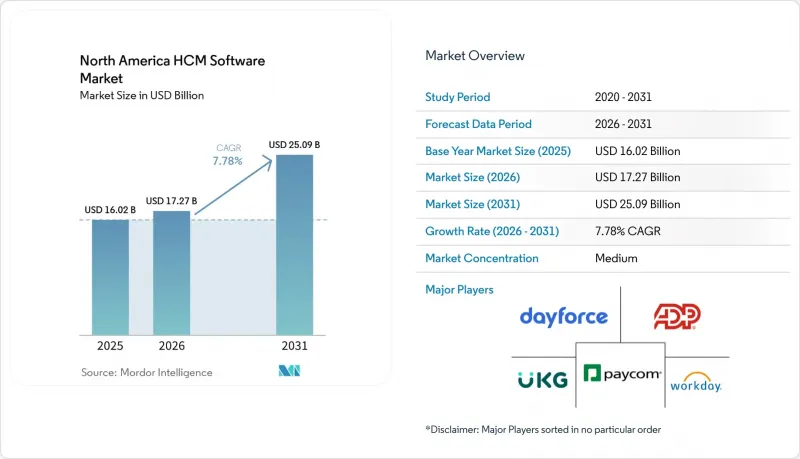
This report is Segmented by Component (Software, and Services), Deployment Mode (Cloud, On-Premises, and Hybrid), Organization Size (Large Enterprises, and Small and Medium Enterprises), Application (Core HR, Talent Management, and More), End-User Industry (IT and Telecommunications, BFSI, Industrial Manufacturing, and More), and Geography. The Market Forecasts are Provided in Terms of Value (USD).
North America HCM Software Market Trends and Insights
Cloud Migration of HR Systems
Enterprises continue to replace on-premises infrastructure with cloud platforms to gain real-time analytics, mobile self-service, and continuous feature releases. Hybrid adoption grows faster than pure cloud adoption because banking and healthcare firms keep payroll processing in private environments to meet data residency mandates. The U.S. HR 2.0 program is migrating 2.2 million civilian employees to shared cloud service centers, while Canada's federal rollout of Dayforce confirms the complexity of converting union pay rules to standardized workflows. These marquee projects validate the economics of the cloud and encourage state and provincial agencies to follow suit.
Rise of AI-Driven Talent Analytics
A 2026 SHRM survey showed 39% of organizations using AI for recruiting or performance management, up sharply in three years. Predictive attrition models now flag flight risks six to nine months in advance, and skills-inference engines surface internal candidates who would otherwise stay invisible. Yet change management is critical; 64% of frontline staff fear displacement, forcing vendors to supply transparency and reskilling pathways. Workday's 2025 purchase of Paradox embedded conversational assistants that book interviews without recruiter input, demonstrating how AI can remove low-value tasks while enhancing candidate experience.
Data-Privacy and Cyber-Security Concerns
Recent breaches at Paychex and Workday, plus Oracle's critical CVE-2024-21287 patch, highlight how centralized employee data attracts threat actors. State privacy laws grant workers broad rights to access and delete data, while Mexico's LFPDPPP levies fines up to 2% of revenue. Enterprises, therefore, delay cloud migrations until vendors demonstrate encryption, access controls, and rapid incident response. Providers now publish SOC 2 reports and zero-trust roadmaps to rebuild confidence.
Other drivers and restraints analyzed in the detailed report include:
- Compliance Mandates on Payroll and Tax
- Skills-Based Hiring Framework Adoption
- Algorithmic Bias and AI-Audit Exposure
For complete list of drivers and restraints, kindly check the Table Of Contents.
Segment Analysis
Software held a 72.86% share in 2025, reflecting the dominance of licensing revenue from core HR, payroll, and talent management modules, yet services are expanding at 8.94% through 2031 as enterprises require specialized expertise to integrate HCM platforms with legacy ERP systems, configure algorithmic audit trails, and train managers on AI-assisted decision tools. Services revenue is rising faster than software revenue as enterprises seek support for migrating data, configuring AI governance, and integrating legacy ERP systems. Implementation projects often span 12-24 months and involve multi-country payroll harmonization. Managed services adoption is also increasing among small employers that prefer to outsource payroll and benefits administration.
Software sales remain robust because cloud architectures enable incremental module purchases. Vendors monetize innovation through subscription tiers, yet services capture greater wallet share when compliance mandates or skills frameworks require customized workflows. The interplay of product and consulting revenue underscores why the North America HCM software market size continues to expand even as license growth moderates.
Cloud deployments commanded a 63.42% share in 2025, driven by lower upfront capital expenditure, automatic updates, and mobile-first employee experiences that on-premises systems cannot match, yet hybrid configurations are growing fastest at 9.21% as enterprises balance agility with data residency and audit requirements. Cloud remains the primary choice for talent and learning modules, but hybrid deployments grow fastest as banks and hospitals keep sensitive payroll data on private infrastructure. This split configuration allows rapid innovation without breaching data sovereignty rules.
On-premises adoption in the North America HCM software market is gradually shrinking, though defense contractors and some Canadian ministries still maintain standalone environments. Small businesses gravitate toward pure cloud for cost predictability, whereas global enterprises choose hybrid to meet divergent jurisdictional mandates, reinforcing hybrid as the pivotal growth engine in the North America HCM software market.
List of Companies Covered in this Report:
- Workday, Inc.
- Ultimate Kronos Group
- Dayforce, Inc.
- Automatic Data Processing, Inc.
- Paycom Software, Inc.
- Paylocity Holding Corporation
- Cornerstone OnDemand, Inc.
- BambooHR LLC
- Namely Inc.
- TriNet Zenefits Inc.
- Gusto, Inc.
- Rippling People Center Inc.
- HiBob Ltd.
- Deel Inc.
- Factorial HR Software SL
- Personio GmbH
- Ramco Systems Limited
- SumTotal Systems LLC
- PeopleStrategy, Inc.
- Lattice, Inc.
- ClearCompany, Inc.
- iSolved HCM LLC
- Zoho Corporation Pvt. Ltd.
- 15Five, Inc.
- TriNet Group, Inc.
- Saba Software LLC
Additional Benefits:
- The market estimate (ME) sheet in Excel format
- 3 months of analyst support
TABLE OF CONTENTS
1 INTRODUCTION
- 1.1 Study Assumptions and Market Definition
- 1.2 Scope of the Study
2 RESEARCH METHODOLOGY
3 EXECUTIVE SUMMARY
4 MARKET LANDSCAPE
- 4.1 Market Overview
- 4.2 Market Drivers
- 4.2.1 Cloud Migration of HR Systems
- 4.2.2 Rise of AI-Driven Talent Analytics
- 4.2.3 Compliance Mandates on Payroll and Tax
- 4.2.4 Skills-Based Hiring Framework Adoption
- 4.2.5 Generative AI Copilots for HR Workflows
- 4.2.6 Expansion of Total Workforce Management for Gig Labor
- 4.3 Market Restraints
- 4.3.1 Data-Privacy and Cyber-Security Concerns
- 4.3.2 High Implementation Costs for SMEs
- 4.3.3 Algorithmic Bias and AI-Audit Exposure
- 4.3.4 Legacy ERP-HCM Integration Complexity
- 4.4 Industry Value Chain Analysis
- 4.5 Regulatory Landscape
- 4.6 Technological Outlook
- 4.7 Porter's Five Forces Analysis
- 4.7.1 Threat of New Entrants
- 4.7.2 Bargaining Power of Buyers
- 4.7.3 Bargaining Power of Suppliers
- 4.7.4 Threat of Substitutes
- 4.7.5 Competitive Rivalry
- 4.8 Impact of Macroeconomic Factors on the Market
5 MARKET SIZE AND GROWTH FORECASTS (VALUE)
- 5.1 By Component
- 5.1.1 Software
- 5.1.2 Services
- 5.2 By Deployment Mode
- 5.2.1 Cloud
- 5.2.2 On-Premises
- 5.2.3 Hybrid
- 5.3 By Organization Size
- 5.3.1 Large Enterprises
- 5.3.2 Small and Medium Enterprises
- 5.4 By Application
- 5.4.1 Core HR
- 5.4.2 Talent Management
- 5.4.3 Workforce Management
- 5.4.4 Payroll Management
- 5.4.5 Learning and Development
- 5.5 By End-User Industry
- 5.5.1 IT and Telecommunications
- 5.5.2 BFSI
- 5.5.3 Industrial Manufacturing
- 5.5.4 Healthcare and Lifesciences
- 5.5.5 Retail and E-commerce
- 5.5.6 Government and Public Sector
- 5.5.7 Other End-User Industries
- 5.6 By Geography
- 5.6.1 United States
- 5.6.2 Canada
- 5.6.3 Mexico
6 COMPETITIVE LANDSCAPE
- 6.1 Market Concentration
- 6.2 Strategic Moves
- 6.3 Market Share Analysis
- 6.4 Company Profiles (includes Global Level Overview, Market Level Overview, Core Segments, Financials as available, Strategic Information, Market Rank/Share, Products and Services, Recent Developments)
- 6.4.1 Workday, Inc.
- 6.4.2 Ultimate Kronos Group
- 6.4.3 Dayforce, Inc.
- 6.4.4 Automatic Data Processing, Inc.
- 6.4.5 Paycom Software, Inc.
- 6.4.6 Paylocity Holding Corporation
- 6.4.7 Cornerstone OnDemand, Inc.
- 6.4.8 BambooHR LLC
- 6.4.9 Namely Inc.
- 6.4.10 TriNet Zenefits Inc.
- 6.4.11 Gusto, Inc.
- 6.4.12 Rippling People Center Inc.
- 6.4.13 HiBob Ltd.
- 6.4.14 Deel Inc.
- 6.4.15 Factorial HR Software SL
- 6.4.16 Personio GmbH
- 6.4.17 Ramco Systems Limited
- 6.4.18 SumTotal Systems LLC
- 6.4.19 PeopleStrategy, Inc.
- 6.4.20 Lattice, Inc.
- 6.4.21 ClearCompany, Inc.
- 6.4.22 iSolved HCM LLC
- 6.4.23 Zoho Corporation Pvt. Ltd.
- 6.4.24 15Five, Inc.
- 6.4.25 TriNet Group, Inc.
- 6.4.26 Saba Software LLC
7 MARKET OPPORTUNITIES AND FUTURE OUTLOOK
- 7.1 White-Space and Unmet-Need Assessment

