PUBLISHER: Mordor Intelligence | PRODUCT CODE: 2063976

PUBLISHER: Mordor Intelligence | PRODUCT CODE: 2063976
Japan HCM Software - Market Share Analysis, Industry Trends & Statistics, Growth Forecasts (2026 - 2031)
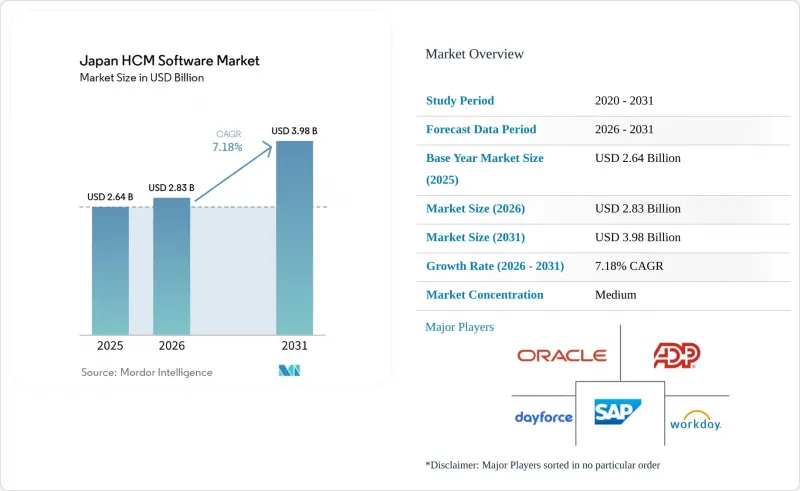
According to Mordor Intelligence, the japan hCM software market size is expected to increase from USD 2.64 billion in 2025 to USD 2.83 billion in 2026 and reach USD 3.98 billion by 2031, growing at a CAGR of 7.18% over 2026-2031.
This report is Segmented by Component (Software, and Services), Deployment Mode (Cloud, On-Premises, and Hybrid), Organization Size (Large Enterprises, and Small and Medium Enterprises), Application (Core HR, Talent Management, Workforce Management, Payroll Management, and More), End-User Industry (IT and Telecommunications, BFSI, and More). The Market Forecasts are Provided in Terms of Value (USD).
Japan HCM Software Market Trends and Insights
Digital Transformation Initiatives Across Japanese Enterprises
Tax incentives unveiled in 2025 are nudging enterprises to treat HR systems as revenue-enabling assets rather than back-office utilities. Large conglomerates that once ran dozens of standalone HR databases are consolidating onto unified suites to unlock real-time analytics and reduce onboarding cycle time. Mitsui and Co. deployed Oracle Fusion Cloud HCM across 40,000 employees in 2025, integrating payroll, time, and talent modules to eliminate fragmented regional systems and enable real-time workforce analytics. Multi-year cloud rollouts by conglomerates in manufacturing, advertising, and chemicals demonstrate a shift from bespoke on-premise builds toward standardized, upgradeable platforms. The return on these projects is increasingly quantified in terms of workforce agility, with firms citing faster redeployment of skilled labor as a direct contributor to new-business wins.
Rising Adoption of Cloud-Based HR Solutions by SMEs
Subsidies covering up to three-quarters of first-year subscription fees have lowered entry barriers for firms that historically relied on spreadsheets. Freemium pricing, two-week implementation templates, and app-store connectors are shortening sales cycles and allowing vendors to convert large pools of micro-enterprises into recurring-revenue accounts. Interoperability pacts between payroll and attendance specialists eliminate duplicate data entry, positioning cloud HCM as a low-risk upgrade for owners with limited IT staff. The addressable SME base remains vast, and vendors that master automated onboarding are poised to collect outsized share of future growth.
Data Residency and Security Concerns Among Traditional Industries
More stringent cross-border data rules are compelling banks, hospitals, and ministries to retain personnel records within national borders. Although sovereign clouds and dedicated regions now exist, limited vendor certification under government security programs constrains product choice and lengthens procurement cycles. Hybrid models that split payroll from ancillary functions offer a workaround, yet many legacy buyers still default to on-premise installations, slowing full cloud penetration.
Other drivers and restraints analyzed in the detailed report include:
- Government Mandate on Work Style Reform and Labor Law Compliance
- Aging Workforce Driving Demand for Strategic Workforce Planning Tools
- Shortage of HR Tech Skilled Professionals for Implementation and Maintenance
For complete list of drivers and restraints, kindly check the Table Of Contents.
Segment Analysis
Software commanded 74.12% of Japan's HCM market revenue in 2025, reflecting the dominance of license and subscription fees for core HR, payroll, and time-and-attendance modules. However, Services are forecast to grow at 8.26% CAGR during 2026-2031. Works Human Intelligence highlights the shift by packaging quarterly rule updates and managed payroll with its core suite, capturing margin in the operational layer.
Demand for business-process outsourcing further elevates service intake. A joint payroll-and-attendance offering from JOE and SmartHR bundles cloud software with certified BPO labor, attracting clients who prefer to transfer compliance risk. The Japan HCM Software market size captured by services is therefore expected to climb steadily as vendors monetize ongoing administration rather than one-time licenses.
Cloud deployment held 65.38% market share in 2025, driven by SME adoption and the cost advantages of multi-tenant SaaS. Yet Hybrid models are expanding at 8.74% CAGR through 2031, the fastest rate among deployment modes, as large enterprises and regulated industries demand data residency without sacrificing scalability. Oracle's dedicated-region expansion lets clients run full-stack OCI services behind their own firewalls while synchronizing with public-cloud modules, a design tailored to stringent data-sovereignty rules.
On-Premises deployments, though declining in share, persist among heavy manufacturers and public-sector entities that prioritize air-gapped security and customization depth, but new adoption tilts toward hybrid deployments that keep sensitive payroll data locally and push learning or engagement tools offsite. Cloud will remain the largest slice by absolute revenue, yet its share inches down as large enterprises retrofit hybrid blueprints for mission-critical workloads.
List of Companies Covered in this Report:
- Workday Inc.
- Oracle Corporation
- SAP SE
- ADP, Inc.
- Dayforce, Inc.
- UKG Inc.
- Cornerstone OnDemand, Inc.
- Paycom Software, Inc.
- Paylocity Holding Corporation
- BambooHR LLC
- Zoho Corporation Private Limited
- PeopleStrong Technologies Private Limited
- Rippling People Center Inc.
- Infor, Inc.
- SmartHR, Inc.
- freee K.K.
- OBIC Business Consultants Co., Ltd.
- Works Human Intelligence Co., Ltd.
- NEC Corporation
- Fujitsu Limited
- CYDAS Inc.
Additional Benefits:
- The market estimate (ME) sheet in Excel format
- 3 months of analyst support
TABLE OF CONTENTS
1 INTRODUCTION
- 1.1 Study Assumptions and Market Definition
- 1.2 Scope of the Study
2 RESEARCH METHODOLOGY
3 EXECUTIVE SUMMARY
4 MARKET LANDSCAPE
- 4.1 Market Overview
- 4.2 Market Drivers
- 4.2.1 Digital Transformation Initiatives Across Japanese Enterprises
- 4.2.2 Rising Adoption of Cloud-Based HR Solutions by SMEs
- 4.2.3 Government Mandate on Work Style Reform and Labor Law Compliance
- 4.2.4 Aging Workforce Driving Demand for Strategic Workforce Planning Tools
- 4.2.5 Integration of AI and Analytics in HR Processes Enhancing Value Proposition
- 4.2.6 Growing Gig Economy Necessitating Flexible Talent Management Platforms
- 4.3 Market Restraints
- 4.3.1 Data Residency and Security Concerns Among Traditional Industries
- 4.3.2 Shortage of HR Tech Skilled Professionals for Implementation and Maintenance
- 4.3.3 High Upfront Costs for On-Premise Custom Solutions for Large Enterprises
- 4.3.4 Resistance to Organisational Change in Conservative Corporate Culture
- 4.4 Industry Value Chain Analysis
- 4.5 Regulatory Landscape
- 4.6 Technological Outlook
- 4.7 Porter's Five Forces Analysis
- 4.7.1 Threat of New Entrants
- 4.7.2 Bargaining Power of Suppliers
- 4.7.3 Bargaining Power of Buyers
- 4.7.4 Threat of Substitutes
- 4.7.5 Intensity of Competitive Rivalry
- 4.8 Impact of Macroeconomic Factors on the Market
5 MARKET SIZE AND GROWTH FORECASTS
- 5.1 By Component
- 5.1.1 Software
- 5.1.2 Services
- 5.2 By Deployment Mode
- 5.2.1 Cloud
- 5.2.2 On-Premises
- 5.2.3 Hybrid
- 5.3 By Organization Size
- 5.3.1 Large Enterprises
- 5.3.2 Small and Medium Enterprises
- 5.4 By Application
- 5.4.1 Core HR
- 5.4.2 Talent Management
- 5.4.3 Workforce Management
- 5.4.4 Payroll Management
- 5.4.5 Learning and Development
- 5.5 By End-User Industry
- 5.5.1 IT and Telecommunications
- 5.5.2 BFSI
- 5.5.3 Industrial Manufacturing
- 5.5.4 Healthcare and Lifesciences
- 5.5.5 Retail and E-commerce
- 5.5.6 Government and Public Sector
- 5.5.7 Other End-User Industries
6 COMPETITIVE LANDSCAPE
- 6.1 Market Concentration
- 6.2 Strategic Moves
- 6.3 Market Share Analysis
- 6.4 Company Profiles (includes Global Level Overview, Market Level Overview, Core Segments, Financials as available, Strategic Information, Market Rank/Share, Products and Services, Recent Developments)
- 6.4.1 Workday Inc.
- 6.4.2 Oracle Corporation
- 6.4.3 SAP SE
- 6.4.4 ADP, Inc.
- 6.4.5 Dayforce, Inc.
- 6.4.6 UKG Inc.
- 6.4.7 Cornerstone OnDemand, Inc.
- 6.4.8 Paycom Software, Inc.
- 6.4.9 Paylocity Holding Corporation
- 6.4.10 BambooHR LLC
- 6.4.11 Zoho Corporation Private Limited
- 6.4.12 PeopleStrong Technologies Private Limited
- 6.4.13 Rippling People Center Inc.
- 6.4.14 Infor, Inc.
- 6.4.15 SmartHR, Inc.
- 6.4.16 freee K.K.
- 6.4.17 OBIC Business Consultants Co., Ltd.
- 6.4.18 Works Human Intelligence Co., Ltd.
- 6.4.19 NEC Corporation
- 6.4.20 Fujitsu Limited
- 6.4.21 CYDAS Inc.
7 MARKET OPPORTUNITIES AND FUTURE OUTLOOK
- 7.1 White-space and Unmet-Need Assessment

