PUBLISHER: Mordor Intelligence | PRODUCT CODE: 2063973

PUBLISHER: Mordor Intelligence | PRODUCT CODE: 2063973
South America HCM Software - Market Share Analysis, Industry Trends & Statistics, Growth Forecasts (2026 - 2031)
According to Mordor Intelligence, the south america hCM software market size was valued at USD 2.13 billion in 2025 and estimated to grow from USD 2.34 billion in 2026 to reach USD 3.71 billion by 2031, at a CAGR of 9.64% during the forecast period (2026-2031).
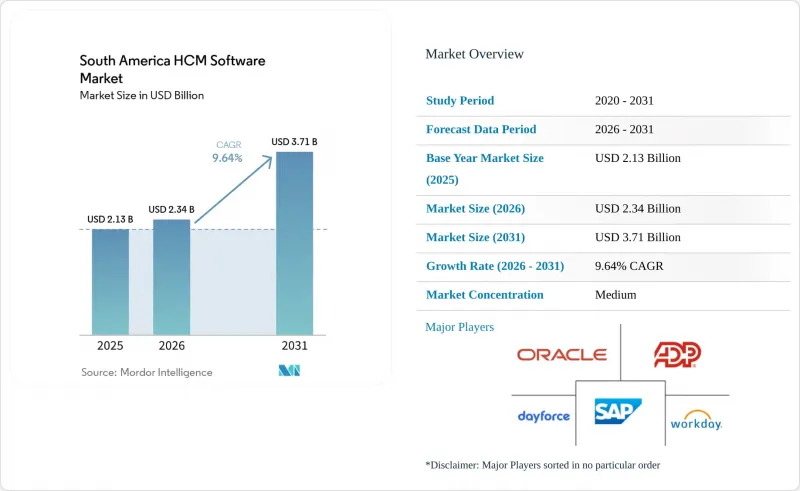
This report is Segmented by Component (Software, and Services), Deployment Mode (Cloud, On-Premises, and Hybrid), Organization Size (Large Enterprises, and Small and Medium Enterprises), Application (Core HR, Talent Management, Workforce Management, Payroll Management, and More), End-User Industry (IT and Telecommunications, BFSI, and More). The Market Forecasts are Provided in Terms of Value (USD).
South America HCM Software Market Trends and Insights
Rising Adoption of Cloud-Based HCM Suites Among Mid-Sized Firms
Mid-sized companies are shifting to the cloud because quarterly compliance patches overwhelm on-premise teams, not because of headline cost savings. Oracle's HCM Now rollout in March 2024 cut implementation to six months for firms with 500-2,000 workers. Chile's 15-day REL filing cycle eliminated batch payroll, converting real-time synchronization from a convenience to a requirement. As a result, cloud growth outpaces the South America HCM software market by 166 basis points. Vendors now secure recurring revenue that once drifted to local system integrators. The trend consolidates pricing power and is expected to reshape mid-market negotiations by 2028.
Increasing Regulatory Compliance Demands for Labor Laws Digitization
Brazil's DET mandate obliges electronic contract submission within 24 hours of hiring, locking enterprises into platforms with automated workflows. Argentina's Law 27.802 centralizes payroll under ARCA starting March 2026, forcing engine overhauls that decentralized systems cannot meet. Chile's REL fines for late filings make cloud-native architecture the only viable option. Parallel equal-pay analytics under Brazil's Law 14.611/2023 require dashboards that legacy databases do not support. Together, these statutes convert compliance from periodic audits to always-on monitoring and accelerate retirement of on-premise deployments.
High Initial Integration Costs for Legacy ERP Environments
Manufacturers running SAP or Oracle ERP from the 1990s face 18-24-month integrations with budgets that exceed license spend by up to 300%. Middleware solves technical mapping issues, yet re-engineering decades-old workflows strains the project's scope. CFOs view cloud HCM ROI skeptically, opening doors for incumbent ERP vendors to cross-sell native HCM at a discount. Unless standalone vendors invest in ready connectors, their addressable share of the South America HCM software market may plateau among large enterprises.
Other drivers and restraints analyzed in the detailed report include:
- Growing Remote and Hybrid Workforces Necessitating Digital HR Tools
- AI-Driven Analytics Enhancing Talent Acquisition Efficiency
- Data Privacy Concerns Amidst Cross-Border Cloud Hosting Regulations
For complete list of drivers and restraints, kindly check the Table Of Contents.
Segment Analysis
Services revenue is projected to rise at a 10.82% CAGR to 2031, as enterprises pay for integration, customization, and change management. In 2025, software contributed 71.32% of the South America HCM software market, yet mounting deployment friction suggests total cost of ownership is shifting toward services contracts. Vendors with in-house professional services thus gain margin resilience, whereas pure-play software firms reliant on partners may concede deal control.
The South America HCM software market for services is expanding as mid-sized buyers require guided configuration to meet rapidly changing payroll regulations. Meanwhile, larger enterprises allocate incremental budgets to post-go-live optimization as analytics modules mature. This spending evolution in the South America HCM software market underpins the sustained gap between services growth and overall market averages.
Cloud held 64.18% of the South America HCM software market in 2025 and is forecast to grow at a 11.24% CAGR, outstripping on-premises and hybrid solutions by more than 200 basis points. Brazil's DET and Argentina's ARCA compel real-time submission, invalidating batch uploads typical of on-premise tools. Hybrid remains a transitional choice for payroll data sovereignty, but its expansion lags because firms eventually migrate entire stacks once controls mature.
Cloud's share of the South America HCM software market is expected to grow substantially well before 2031, supported by vendor-managed updates that help organizations quickly adapt to frequent payroll, tax, and labor compliance changes across regional jurisdictions. The model is also gaining traction due to lower upfront infrastructure requirements, faster deployment cycles, and easier scalability for expanding enterprises.
List of Companies Covered in this Report:
- Workday, Inc.
- Dayforce, Inc.
- Automatic Data Processing, Inc.
- Oracle Corporation
- SAP SE
- Cornerstone OnDemand, Inc.
- Ultimate Kronos Group Inc.
- Paycom Software, Inc.
- YourPeople Inc.
- The Sage Group plc
- Rippling People Center Inc.
- Darwinbox Digital Solutions Private Limited
- Odoo SA
- Ramco Systems Limited
- Meta4 Spain S.A.U.
- Cegid Group SA
- Neeyamo Enterprise Solutions Private Limited
- Deel Inc.
- HiBob Ltd.
- Factorial HR, S.L.
- Visma AS
Additional Benefits:
- The market estimate (ME) sheet in Excel format
- 3 months of analyst support
TABLE OF CONTENTS
1 INTRODUCTION
- 1.1 Study Assumptions and Market Definition
- 1.2 Scope of the Study
2 RESEARCH METHODOLOGY
3 EXECUTIVE SUMMARY
4 MARKET LANDSCAPE
- 4.1 Market Overview
- 4.2 Market Drivers
- 4.2.1 Rising Adoption of Cloud-Based HCM Suites Among Mid-Sized Firms
- 4.2.2 Increasing Regulatory Compliance Demands for Labor Laws Digitization
- 4.2.3 Growing Remote and Hybrid Workforces Necessitating Digital HR Tools
- 4.2.4 Expansion of Gig Economy Accelerating Demand for Flexible Workforce Management Platforms
- 4.2.5 AI-Driven Analytics Enhancing Talent Acquisition Efficiency
- 4.2.6 Localization of Payroll and Tax Modules for South American Jurisdictions Attracting SMEs
- 4.3 Market Restraints
- 4.3.1 High Initial Integration Costs for Legacy ERP Environments
- 4.3.2 Data Privacy Concerns Amidst Cross-Border Cloud Hosting Regulations
- 4.3.3 Shortage of HR Tech Implementation Expertise in Secondary Cities
- 4.3.4 Economic Volatility Reducing IT Budgets for Non-Core Projects
- 4.4 Industry Value Chain Analysis
- 4.5 Regulatory Landscape
- 4.6 Technological Outlook
- 4.7 Impact of Macroeconomic Factors on the Market
- 4.8 Porter's Five Forces Analysis
- 4.8.1 Threat of New Entrants
- 4.8.2 Bargaining Power of Suppliers
- 4.8.3 Bargaining Power of Buyers
- 4.8.4 Threat of Substitutes
- 4.8.5 Intensity of Competitive Rivalry
5 MARKET SIZE AND GROWTH FORECASTS (VALUE)
- 5.1 By Component
- 5.1.1 Software
- 5.1.2 Services
- 5.2 By Deployment Mode
- 5.2.1 Cloud
- 5.2.2 On-Premises
- 5.2.3 Hybrid
- 5.3 By Organization Size
- 5.3.1 Large Enterprises
- 5.3.2 Small and Medium Enterprises
- 5.4 By Application
- 5.4.1 Core HR
- 5.4.2 Talent Management
- 5.4.3 Workforce Management
- 5.4.4 Payroll Management
- 5.4.5 Learning and Development
- 5.5 By End-User Industry
- 5.5.1 IT and Telecommunications
- 5.5.2 BFSI
- 5.5.3 Industrial Manufacturing
- 5.5.4 Healthcare and Lifesciences
- 5.5.5 Retail and E-commerce
- 5.5.6 Government and Public Sector
- 5.5.7 Other End-User Industries
- 5.6 By Geogrpahy
- 5.6.1 Brazil
- 5.6.2 Argentina
- 5.6.3 Colombia
- 5.6.4 Chile
- 5.6.5 Peru
- 5.6.6 Rest of South America
6 COMPETITIVE LANDSCAPE
- 6.1 Market Concentration
- 6.2 Strategic Moves
- 6.3 Market Share Analysis
- 6.4 Company Profiles (includes Global Level Overview, Market Level Overview, Core Segments, Financials as available, Strategic Information, Market Rank/Share, Products and Services, Recent Developments)
- 6.4.1 Workday, Inc.
- 6.4.2 Dayforce, Inc.
- 6.4.3 Automatic Data Processing, Inc.
- 6.4.4 Oracle Corporation
- 6.4.5 SAP SE
- 6.4.6 Cornerstone OnDemand, Inc.
- 6.4.7 Ultimate Kronos Group Inc.
- 6.4.8 Paycom Software, Inc.
- 6.4.9 YourPeople Inc.
- 6.4.10 The Sage Group plc
- 6.4.11 Rippling People Center Inc.
- 6.4.12 Darwinbox Digital Solutions Private Limited
- 6.4.13 Odoo SA
- 6.4.14 Ramco Systems Limited
- 6.4.15 Meta4 Spain S.A.U.
- 6.4.16 Cegid Group SA
- 6.4.17 Neeyamo Enterprise Solutions Private Limited
- 6.4.18 Deel Inc.
- 6.4.19 HiBob Ltd.
- 6.4.20 Factorial HR, S.L.
- 6.4.21 Visma AS
7 MARKET OPPORTUNITIES AND FUTURE OUTLOOK
- 7.1 White-Space and Unmet-Need Assessment

