PUBLISHER: Mordor Intelligence | PRODUCT CODE: 2063974

PUBLISHER: Mordor Intelligence | PRODUCT CODE: 2063974
India HCM Software - Market Share Analysis, Industry Trends & Statistics, Growth Forecasts (2026 - 2031)
According to Mordor Intelligence, the india hCM software market size is expected to increase from USD 1.87 billion in 2025 to USD 2.09 billion in 2026 and reach USD 3.68 billion by 2031, growing at a CAGR of 11.84% over 2026-2031.
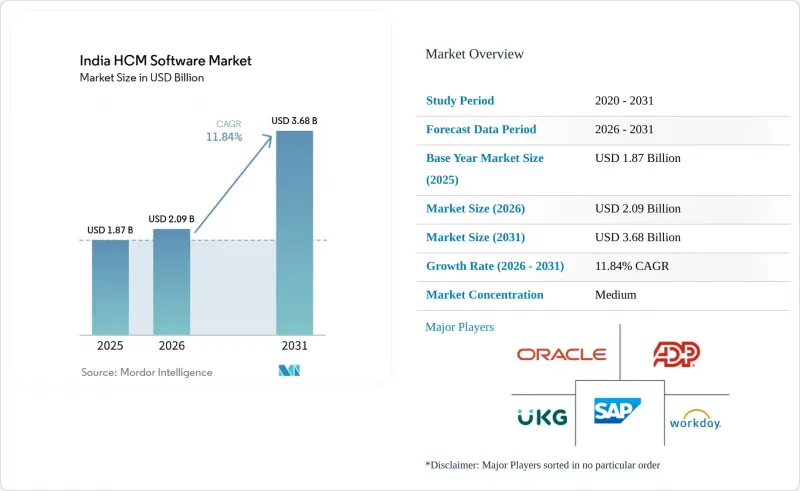
This report is Segmented by Component (Software, and Services), Deployment Mode (Cloud, On-Premises, and Hybrid), Organization Size (Large Enterprises, and Small and Medium Enterprises), Application (Core HR, Talent Management, Workforce Management, Payroll Management, and More), End-User Industry (IT and Telecommunications, BFSI, and More). The Market Forecasts are Provided in Terms of Value (USD).
India HCM Software Market Trends and Insights
Rapid Adoption of Cloud-Based HCM Platforms
Cloud deployment already holds a 62.91% foothold in the India HCM software market and is on a 13.54% CAGR path because pay-per-employee pricing eliminates hardware outlays. Workday's AWS-hosted data center in Chennai gives multinational clients sovereign data storage while keeping a single global instance. Oracle HCM Now bundles core HR, payroll, and time tracking on one cloud stack, and Wipro cut payroll-cycle time by 60% after migration. Domestic challenger Keka processes 1.5 million payrolls each month with geo-fencing and regional-language screens that resonate with field workers. Falling budgets for on-premises customization push spending toward API ties with portals such as EPFO and ESIC, reinforcing cloud momentum.
Growing Demand for Automation and AI-Driven HR Processes
Talent management suites are embedding resume parsing, interview scheduling, and attrition prediction that shorten time-to-hire by 30%. SAP SuccessFactors stitched in G-P's Gia agent in December 2025 so clients can reconcile payroll across 50 countries in one view. ADP's healthcare trends report shows 84% of providers expect AI to relieve paperwork, even as 65% struggle with upskilling. Hunar.AI engaged 10 million candidates through WhatsApp and voice bots to tackle 103% attrition in frontline banking roles. The market now splits between enterprises adopting predictive analytics and SMEs opting for chatbots that automate leave requests and roster swaps.
Data Privacy and Cybersecurity Concerns
The Personal Data Protection Act sets 72-hour breach disclosure, one-year audit logs, and hefty penalties, stretching legal reviews and lengthening procurement cycles. Workday opened an India data center in December 2025 to satisfy localization demands, but vendors lacking ISO 27001 or SOC 2 attestations are now routinely cut from enterprise shortlists. BFSI and healthcare buyers conduct more in-depth penetration tests because employee files contain financial and medical data. As a result, discount platforms that skip two-factor logins may win price-sensitive SMEs but rarely break into regulated verticals.
Other drivers and restraints analyzed in the detailed report include:
- Increasing Regulatory Compliance Complexity
- Expanding SME Digitization and SaaS Affordability
- High Total Cost of Ownership for Full-Suite HCM
For complete list of drivers and restraints, kindly check the Table Of Contents.
Segment Analysis
Services revenue is growing at a 13.12% CAGR and will account for a growing share of the India HCM software market as enterprises outsource statutory mapping and API integration. Software retained a 70.84% share in 2025, anchored by license and subscription revenue, yet the rising share of services revenue signals that vendors are monetizing post-sale value delivery rather than relying solely on per-seat pricing. Oracle's Wipro case study, where payroll cycle time fell by 60% after cloud migration, required a 6-month implementation phase with dedicated consultants to map state-specific professional tax rules and integrate EPFO facial-authentication APIs.
Domestic vendors copy this playbook. greytHR's post-sale team retrofits labor-code updates, and Keka bundles onboarding support into subscription tiers. The strategic implication is that vendors with robust partner ecosystems and certified consultants are capturing a disproportionate share of mid-market and enterprise deals, while those offering software-only licenses are confined to self-service SME segments.
Cloud deployments commanded a 62.91% share in 2025 and are forecast to grow at a 13.54% CAGR through 2031, while hybrid rollouts are gaining ground when sensitive payroll data must reside on-prem, while talent modules run in the cloud. Workday's local data center lets global instances coexist with sovereign storage, while Oracle HCM Now removes many on-prem customizations through an integrated stack. On-premises deployments, though declining in share, persist in government and public-sector organizations where procurement rules favor capital expenditure over operating expenditure and where legacy ERP systems lack cloud-migration pathways.
Hybrid architectures, which combine on-premises core HR with cloud-based talent acquisition and workforce analytics, are emerging as a compromise for mid-market manufacturers that operate in multiple states and need centralized compliance engines but decentralized shift-scheduling tools. Manufacturers with patchy connectivity use edge devices that sync attendance data later, proving that hybrid is less about architecture dogma and more about matching site realities with compliance rules.
List of Companies Covered in this Report:
- Oracle Corporation
- SAP SE
- Workday Inc.
- ADP, Inc.
- UKG Inc.
- Spine Technologies India Private Limited
- Cornerstone OnDemand Inc.
- Zoho Corporation Pvt. Ltd.
- Ramco Systems Limited
- Darwinbox Digital Solutions Private Limited
- ZingHR Techno India Private Limited
- Greytip Software Private Limited
- Keka Technologies Private Limited
- PeopleStrong Technologies Private Limited
- Freshworks Inc.
- Paycom Software, Inc.
- The Sage Group plc
- Rippling Technologies, Inc.
- HiBob Ltd.
- Eightfold AI, Inc.
- Spine Technologies India Private Limited
Additional Benefits:
- The market estimate (ME) sheet in Excel format
- 3 months of analyst support
TABLE OF CONTENTS
1 INTRODUCTION
- 1.1 Study Assumptions and Market Definition
- 1.2 Scope of the Study
2 RESEARCH METHODOLOGY
3 EXECUTIVE SUMMARY
4 MARKET LANDSCAPE
- 4.1 Market Overview
- 4.2 Market Drivers
- 4.2.1 Rapid Adoption of Cloud-Based HCM Platforms
- 4.2.2 Growing Demand for Automation and AI-Driven HR Processes
- 4.2.3 Increasing Regulatory Compliance Complexity
- 4.2.4 Expanding SME Digitization and SaaS Affordability
- 4.2.5 Integration of HCM with Government Digital Portals
- 4.2.6 Rise of Vernacular Mobile HR Apps for Gig Workforce
- 4.3 Market Restraints
- 4.3.1 Data Privacy and Cybersecurity Concerns
- 4.3.2 High Total Cost of Ownership for Full-Suite HCM
- 4.3.3 Fragmented State-Level Labour Regulations
- 4.3.4 Shortage of HR Analytics Talent
- 4.4 Industry Value Chain Analysis
- 4.5 Regulatory Landscape
- 4.6 Technological Outlook
- 4.7 Impact of Macroeconomic Factors on the Market
- 4.8 Porter's Five Forces Analysis
- 4.8.1 Threat of New Entrants
- 4.8.2 Bargaining Power of Buyers
- 4.8.3 Bargaining Power of Suppliers
- 4.8.4 Threat of Substitutes
- 4.8.5 Intensity of Competitive Rivalry
5 MARKET SIZE AND GROWTH FORECASTS (VALUE)
- 5.1 By Component
- 5.1.1 Software
- 5.1.2 Services
- 5.2 By Deployment Mode
- 5.2.1 Cloud
- 5.2.2 On-Premises
- 5.2.3 Hybrid
- 5.3 By Organization Size
- 5.3.1 Large Enterprises
- 5.3.2 Small and Medium Enterprises
- 5.4 By Application
- 5.4.1 Core HR
- 5.4.2 Talent Management
- 5.4.3 Workforce Management
- 5.4.4 Payroll Management
- 5.4.5 Learning and Development
- 5.5 By End-User Industry
- 5.5.1 IT and Telecommunications
- 5.5.2 BFSI
- 5.5.3 Industrial Manufacturing
- 5.5.4 Healthcare and Lifesciences
- 5.5.5 Retail and E-commerce
- 5.5.6 Government and Public Sector
- 5.5.7 Other End-User Industries
6 COMPETITIVE LANDSCAPE
- 6.1 Market Concentration
- 6.2 Strategic Moves
- 6.3 Market Share Analysis
- 6.4 Company Profiles (includes Global Level Overview, Market Level Overview, Core Segments, Financials as available, Strategic Information, Market Rank/Share, Products and Services, Recent Developments)
- 6.4.1 Oracle Corporation
- 6.4.2 SAP SE
- 6.4.3 Workday Inc.
- 6.4.4 ADP, Inc.
- 6.4.5 UKG Inc.
- 6.4.6 Spine Technologies India Private Limited
- 6.4.7 Cornerstone OnDemand Inc.
- 6.4.8 Zoho Corporation Pvt. Ltd.
- 6.4.9 Ramco Systems Limited
- 6.4.10 Darwinbox Digital Solutions Private Limited
- 6.4.11 ZingHR Techno India Private Limited
- 6.4.12 Greytip Software Private Limited
- 6.4.13 Keka Technologies Private Limited
- 6.4.14 PeopleStrong Technologies Private Limited
- 6.4.15 Freshworks Inc.
- 6.4.16 Paycom Software, Inc.
- 6.4.17 The Sage Group plc
- 6.4.18 Rippling Technologies, Inc.
- 6.4.19 HiBob Ltd.
- 6.4.20 Eightfold AI, Inc.
- 6.4.21 Spine Technologies India Private Limited
7 MARKET OPPORTUNITIES AND FUTURE OUTLOOK
- 7.1 White-Space and Unmet-Need Assessment

