PUBLISHER: Mordor Intelligence | PRODUCT CODE: 2073276

PUBLISHER: Mordor Intelligence | PRODUCT CODE: 2073276
Middle East and Africa HCM Software - Market Share Analysis, Industry Trends & Statistics, Growth Forecasts (2026 - 2031)
According to Mordor Intelligence, the middle east and Africa HCM Software market size is projected to expand from USD 2.56 billion in 2025 to USD 2.83 billion in 2026 and USD 4.63 billion by 2031, registering a CAGR of 10.36% between 2026 and 2031.
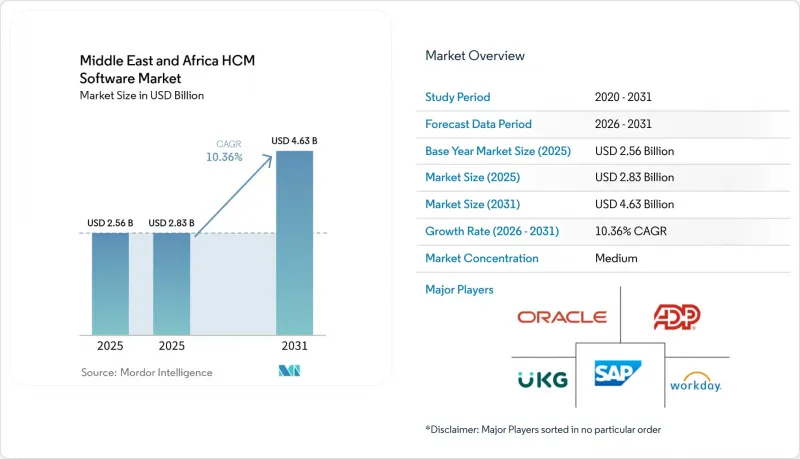
This report is Segmented by Component (Software, and Services), Deployment Mode (Cloud, On-Premises, and Hybrid), Organization Size (Large Enterprises, and Small and Medium Enterprises), Application (Core HR, Talent Management, Workforce Management, and More), End-User Industry (IT and Telecommunications, and More), and Geography. The Market Forecasts are Provided in Terms of Value (USD).
Middle East and Africa HCM Software Market Trends and Insights
Accelerating Cloud Adoption Across GCC Enterprises
Gulf employers are rapidly modernizing legacy HR databases to meet real-time reporting standards embedded in national transformation plans. Saudi Arabia reached 95% digitization of government services in 2024, and private-sector boards now benchmark against those standards, creating a halo effect for cloud HCM rollouts. The United Arab Emirates integrated its labor-market compliance APIs with private HCM suites, cutting audit cycles from quarterly to monthly and rewarding firms that maintain seamless cloud connectivity. Qatar's Civil Service and Government Development Bureau partnered with SAP SuccessFactors in 2025 for more than 85,000 workers, publishing configuration blueprints that private companies now reuse. Vendors that operate sovereign-cloud nodes inside Saudi Arabia and the United Arab Emirates have shortened sales cycles by reducing data-residency objections. As hyperscaler regions come online, hybrid security policies are easing concerns among banks and utilities, unlocking postponed migrations.
Regulatory Push for Wage Protection and Compliance Automation
Wage-protection frameworks have turned payroll into a mission-critical compliance process. The United Arab Emirates' Wage Protection System 2.0 obliges employers to transfer salaries within 10 working days through accredited institutions, with hefty fines and work-permit suspensions for repeat breaches. Saudi Arabia's Mudad platform cross-references payroll with social-insurance and immigration records, delivering 85-90% contract compliance in 2025 and forcing companies to replace siloed HR modules with integrated suites that automatically feed Qiwa. Kuwait now mandates biometric attendance capture, while Oman requires digital contract filings within 30 days of hire, further expanding the compliance footprint that HCM must cover.
Data Privacy and Residency Regulations Increasing Deployment Complexity
Sovereign data-protection acts oblige vendors to localize employee records, fragmenting what could be a single multi-tenant cloud into jurisdiction-specific instances. The United Arab Emirates maintains a whitelist of data-export mechanisms, extending procurement by up to 6 months as buyers await regulatory clearance. South Africa's Information Regulator has begun issuing enforcement notices, raising liability concerns that are stalling migrations among conservative banks. Nigeria now requires data-protection impact assessments for high-risk HR processing, a burden that small employers pass through to vendors by demanding turnkey compliance services. The resulting patchwork forces suppliers to maintain multiple infrastructure footprints, inflating the cost of goods sold and slowing roadmap delivery.
Other drivers and restraints analyzed in the detailed report include:
- Growing Demand for Workforce Analytics and AI-Powered Insights
- Rising Mobile and Remote Workforce Requiring Unified HCM Platforms
- Limited Cloud-Skilled Talent Pool in Several African Markets
For complete list of drivers and restraints, kindly check the Table Of Contents.
Segment Analysis
Services are forecast to outpace software growth, expanding at an 11.24% CAGR through 2031. The Middle East and Africa HCM Software market is expanding, driven by implementation, integration, and managed services, as every Gulf country integrates payroll with unique pension rules, multi-lingual interfaces, and government gateway connections. Oracle's 2025 deal with e and embedded a three-year managed-services layer that covers compliance updates for 38 countries, illustrating how vendors lock in annuity streams once core modules go live. Start-ups such as Jisr secure recurring consulting fees by mapping Saudization thresholds into automated dashboards that executives can self-serve. As public-sector grants fund civil-service reforms in Ethiopia and Sierra Leone, local partners gain opportunities to deliver training and change-management work that global vendors do not staff locally.
Software still accounted for 73.48% of 2025 spending, as perpetual-license upgrades and SaaS subscriptions anchor every project. Nevertheless, price pressure intensifies as mid-market buyers weigh open API ecosystems against monolithic suites. Regional challengers bundle attendance scanners, insurance aggregation, and earned-wage access inside a single per-employee fee, prompting large platforms to unbundle specific micro-services to retain agility. Over the forecast window, the share of total services in the Middle East and Africa HCM Software market is expected to reach the low-30% range, confirming that productization alone cannot absorb the region's localization load.
Cloud solutions delivered 68.92% of the 2025 value and are set to grow at an 11.56% CAGR, yet legal and power-grid realities mean purely public architectures are uncommon beyond software-as-a-service talent modules. Buyers in banking and government increasingly opt for split-stack topologies that house payroll on sovereign nodes while pushing analytics to multiregion clouds. The Middle East and Africa HCM Software market share attributed to hybrid deployments will likely climb because Microsoft, Oracle, and SAP now offer region-specific instances that replicate sensitive tables to in-country storage.
On-premises footprints persist, particularly inside ministries that forbid external internet routes, but even these sites adopt containerized orchestration to gain patch automation. Kenya's suspended data-center project demonstrated that power scarcity can slow hyperscaler rollout, keeping standby diesel-based data rooms in play. Vendors that supply synchronization agents and zero-trust gateways capture wallet share because they let clients toggle between sovereign and public capacity without rewrites.
Complete Report Scope:
- By Component
- Software
- Services
- By Deployment Mode
- Cloud
- On-Premises
- Hybrid
- By Organization Size
- Large Enterprises
- Small and Medium Enterprises
- By Application
- Core HR
- Talent Management
- Workforce Management
- Payroll Management
- Learning and Development
- By End-User Industry
- IT and Telecommunications
- BFSI
- Industrial Manufacturing
- Healthcare and Lifesciences
- Retail and E-commerce
- Government and Public Sector
- Other End-User Industries
- By Geography
- Middle East
- Saudi Arabia
- United Arab Emirates
- Qatar
- Kuwait
- Oman
- Bahrain
- Rest of Middle East
- Africa
- South Africa
- Nigeria
- Egypt
- Kenya
- Rest of Africa
- Middle East
List of Companies Covered in this Report:
- Automatic Data Processing, Inc.
- BambooHR LLC
- Bayzat Technology LLC
- Dayforce, Inc.
- Cornerstone OnDemand, Inc.
- GulfHR FZ LLC
- HiBob Ltd.
- Infor, Inc.
- MenAITech for Information Technology
- Oracle Corporation
- Paycom Software, Inc.
- Paycor HCM, Inc.
- Paylocity Holding Corporation
- Ramco Systems Limited
- Rippling People Center Inc.
- Sage Group plc
- SeamlessHR Ltd.
- SAP SE
- UKG, Inc.
- Workday, Inc.
- ZenHR Solutions LLC
- Zoho Corporation Pvt. Ltd.
Additional Benefits:
- The market estimate (ME) sheet in Excel format
- 3 months of analyst support
TABLE OF CONTENTS
1 INTRODUCTION
- 1.1 Study Assumptions and Market Definition
- 1.2 Scope of the Study
2 RESEARCH METHODOLOGY
3 EXECUTIVE SUMMARY
4 MARKET LANDSCAPE
- 4.1 Market Overview
- 4.2 Market Drivers
- 4.2.1 Accelerating Cloud Adoption Across GCC Enterprises
- 4.2.2 Regulatory Push for Wage Protection and Compliance Automation
- 4.2.3 Growing Demand for Workforce Analytics and AI-Powered Insights
- 4.2.4 Rising Mobile and Remote Workforce Requiring Unified HCM Platforms
- 4.2.5 Saudi NEOM Mega-Projects Driving Labor-Tracking Digitization Demand
- 4.2.6 Africa's Fintech-Led Payroll Infrastructure Leapfrogging Legacy HR Systems
- 4.3 Market Restraints
- 4.3.1 Data Privacy and Residency Regulations Increasing Deployment Complexity
- 4.3.2 Limited Cloud-Skilled Talent Pool in Several African Markets
- 4.3.3 Fragmented Arabic Dialects Hindering NLP Adoption in HCM Software
- 4.3.4 High Cost of Regional Data Center Power Impacting SaaS Pricing
- 4.4 Industry Value Chain Analysis
- 4.5 Regulatory Landscape
- 4.6 Technological Outlook
- 4.7 Impact of Macroeconomic Factors on the Market
- 4.8 Porter's Five Forces Analysis
- 4.8.1 Bargaining Power of Suppliers
- 4.8.2 Bargaining Power of Buyers
- 4.8.3 Threat of New Entrants
- 4.8.4 Threat of Substitutes
- 4.8.5 Intensity of Competitive Rivalry
5 MARKET SIZE AND GROWTH FORECASTS (VALUE)
- 5.1 By Component
- 5.1.1 Software
- 5.1.2 Services
- 5.2 By Deployment Mode
- 5.2.1 Cloud
- 5.2.2 On-Premises
- 5.2.3 Hybrid
- 5.3 By Organization Size
- 5.3.1 Large Enterprises
- 5.3.2 Small and Medium Enterprises
- 5.4 By Application
- 5.4.1 Core HR
- 5.4.2 Talent Management
- 5.4.3 Workforce Management
- 5.4.4 Payroll Management
- 5.4.5 Learning and Development
- 5.5 By End-User Industry
- 5.5.1 IT and Telecommunications
- 5.5.2 BFSI
- 5.5.3 Industrial Manufacturing
- 5.5.4 Healthcare and Lifesciences
- 5.5.5 Retail and E-commerce
- 5.5.6 Government and Public Sector
- 5.5.7 Other End-User Industries
- 5.6 By Geography
- 5.6.1 Middle East
- 5.6.1.1 Saudi Arabia
- 5.6.1.2 United Arab Emirates
- 5.6.1.3 Qatar
- 5.6.1.4 Kuwait
- 5.6.1.5 Oman
- 5.6.1.6 Bahrain
- 5.6.1.7 Rest of Middle East
- 5.6.2 Africa
- 5.6.2.1 South Africa
- 5.6.2.2 Nigeria
- 5.6.2.3 Egypt
- 5.6.2.4 Kenya
- 5.6.2.5 Rest of Africa
- 5.6.1 Middle East
6 COMPETITIVE LANDSCAPE
- 6.1 Market Concentration
- 6.2 Strategic Moves
- 6.3 Market Share Analysis
- 6.4 Company Profiles (includes Global Level Overview, Market Level Overview, Core Segments, Financials as available, Strategic Information, Market Rank/Share, Products and Services, Recent Developments)
- 6.4.1 Automatic Data Processing, Inc.
- 6.4.2 BambooHR LLC
- 6.4.3 Bayzat Technology LLC
- 6.4.4 Dayforce, Inc.
- 6.4.5 Cornerstone OnDemand, Inc.
- 6.4.6 GulfHR FZ LLC
- 6.4.7 HiBob Ltd.
- 6.4.8 Infor, Inc.
- 6.4.9 MenaITech for Information Technology
- 6.4.10 Oracle Corporation
- 6.4.11 Paycom Software, Inc.
- 6.4.12 Paycor HCM, Inc.
- 6.4.13 Paylocity Holding Corporation
- 6.4.14 Ramco Systems Limited
- 6.4.15 Rippling People Center Inc.
- 6.4.16 Sage Group plc
- 6.4.17 SeamlessHR Ltd.
- 6.4.18 SAP SE
- 6.4.19 UKG, Inc.
- 6.4.20 Workday, Inc.
- 6.4.21 ZenHR Solutions LLC
- 6.4.22 Zoho Corporation Pvt. Ltd.
7 MARKET OPPORTUNITIES AND FUTURE OUTLOOK
- 7.1 White-Space and Unmet-Need Assessment

