PUBLISHER: Mordor Intelligence | PRODUCT CODE: 2065727

PUBLISHER: Mordor Intelligence | PRODUCT CODE: 2065727
Hospitality - Market Share Analysis, Industry Trends & Statistics, Growth Forecasts (2026 - 2031)
According to Mordor Intelligence, the global hospitality market was valued at USD 7.47 trillion in 2025 and estimated to grow from USD 9.11 trillion in 2026 to reach USD 13.95 trillion by 2031, at a CAGR of 8.9% during the forecast period (2026-2031).
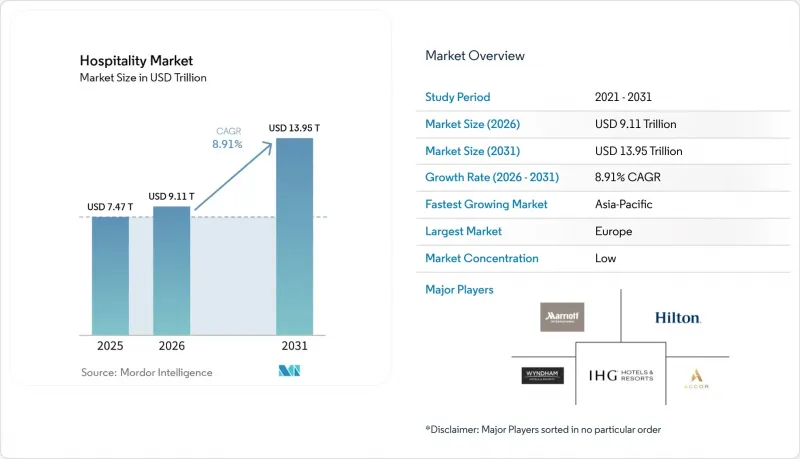
This report is Segmented by Hospitality Type (hotels, Vacation Rentals, Serviced Apartments, and More), by Property Type, (chain or Branded and Independent Formats), by Booking Channel, (direct, Otas, and More), by Revenue Stream, (room, Food and Beverage, and More), by Traveler Type, (leisure, Business, and More), and by Geography, (north America, South America, Europe, and More). Forecasts are in Value, in USD.
Global Hospitality Market Trends and Insights
Expansion of Experiential and Lifestyle-Led Hospitality Concepts
Experiential and lifestyle-led formats are reshaping the global hospitality market as travelers increasingly prefer properties that integrate design, local identity, and flexible social spaces. This trend gained traction with notable chain activities, including Marriott's acquisition of citizenM, IHG's purchase of Ruby Hotels, and Hilton's launch of its Select by Hilton platform through an exclusive agreement. Operators are prioritizing conversions over new builds, particularly in high-cost development areas. IHG reported that conversions significantly contributed to room openings and signings in Europe, reflecting a shift toward brand migration instead of greenfield expansion. This approach accelerates the refresh of older assets and enhances the appeal of the hospitality market across urban and resort locations.
Rising Bleisure and Flexible Work-Driven Travel Demand
The global hospitality market is adapting to the rise of "bleisure" travel and flexible work patterns, particularly in urban, mixed-use, and long-stay formats. "Bleisure" and long-stay travelers represent the fastest-growing segment, reflecting a shift in business travel beyond short weekday trips. Hotels, serviced apartments, and alternative accommodations are redesigning rooms, workspaces, food services, and connectivity to attract longer stays and increase ancillary spending. Airbnb reported growth in nights booked from Latin America, supporting the trend of blended work and leisure travel expanding beyond traditional North Atlantic business hubs. This shift is driving mid-week demand stability in some cities while causing sharper short-term occupancy fluctuations in others.
High Operating and Labor Costs Across Hospitality Properties
High operating and labor costs remain a significant short-term challenge for the global hospitality market, as room-rate increases do not directly translate into higher profit margins. Labor costs per occupied room have risen, with full-service hotel wage costs experiencing notable year-over-year growth. These pressures affect both branded chains and independent operators, particularly those with labor-intensive formats, limited pricing power, or inadequate digital systems. Regional disparities further complicate the issue, prompting more selective approaches to pricing, staffing, and service design. Without advancements in efficiency tools and process redesign, a portion of the recovering demand will likely be absorbed by wages, utilities, and supplies instead of contributing to operating profits.
Other drivers and restraints analyzed in the detailed report include:
- Growth in Wellness, Medical, and Regenerative Tourism Stays
- Digital Transformation Through AI-Based Revenue & Guest Management
- Economic Slowdowns Impacting Discretionary Travel Spending
For complete list of drivers and restraints, kindly check the Table Of Contents.
Segment Analysis
Hotels & Resorts held 56.63% of 2025 value, which kept them as the largest format in the global hospitality market. Their scale advantage came from broad brand distribution, stronger corporate contracting, loyalty ecosystems, and more consistent service delivery across regions. These strengths remain important in urban centers, airport markets, business corridors, and large mixed-demand destinations where reliability still matters to both travelers and procurement teams. The global hospitality market also continues to favor hotel operators that can use central reservation systems and member programs to keep more bookings in direct channels. This gives formal hotel groups a structural advantage when costs rise or when demand becomes less predictable.
Vacation Rentals & Alternative Accommodations are projected to expand at a 6.83% CAGR through 2031, which makes them the fastest-growing hospitality type in the supplied draft. Airbnb's 2026 footprint of more than 9 million active listings across more than 220 countries and regions shows the scale that alternative accommodation has achieved in the global hospitality market. Demand for space, privacy, and home-like amenities is supporting this segment, especially for families, extended stays, and blended work-leisure travel. Serviced apartments also benefit from this shift because they offer longer-stay functionality with a more formal operating model. At the same time, tighter short-term rental enforcement in several cities may redirect some demand back to licensed hotel inventory, which keeps the competitive balance in the global hospitality market fluid rather than one-directional.
Chain and branded properties held 61.94% of the global hospitality market share in 2025, reflecting the dominance of formal brand systems. This strength is attributed to loyalty programs, reservation networks, operational standards, procurement advantages, and appeal to owners in various financing scenarios. Companies like Marriott, Hilton, and IHG expanded their presence without relying solely on owned assets, reducing capital intensity while increasing brand reach. Marriott's 2025 pipeline included 4,056 properties and nearly 610,000 rooms, with over half in international markets, highlighting the distribution advantage of major chains. Branded scale benefits owners by enabling efficient conversions, access to loyalty demand, and improved commercial visibility.
Independent lifestyle and boutique properties are projected to grow at a 6.36% CAGR through 2031, making them the fastest-growing segment. Large chains are adapting to this trend through acquisitions and new platforms, such as Marriott's citizenM deal, IHG's Ruby acquisition, and Hilton's launch of its 'Select by Hilton' platform through an exclusive franchise agreement with YOTEL. China's hotel construction pipeline reached a record high of 3,608 projects and 644,938 rooms at the close of 2025, emphasizing the importance of branded supply in global hospitality development. Conversions are gaining traction due to shorter opening timelines and reduced development risks. Operators capable of repositioning assets under brand banners while preserving localized identity are well-positioned to capitalize on this shift.
Geography Analysis
Europe accounted for 31.15% of the global hospitality market in 2025, making it the largest regional contributor by value. Europe recorded 793 million international tourist arrivals that year, representing a 4% increase from 2024 and 6% above 2019 levels. The region's dominance stems from dense air connectivity, multi-country travel ease, diverse lodging options, and strong city and leisure demand. Europe is projected to grow at 4.1% through 2031, reflecting a mature yet steady trajectory. North America maintains significant revenue, while South America is expected to expand faster at a 6.4% CAGR, driven by rising tourism and regional travel flows.
Asia-Pacific is the fastest-growing region in the global hospitality market, with a forecast CAGR of 7.57% through 2031. A recent report says that, India's hotel pipeline at 940 projects and 124,011 rooms in Q1 2026, while Vietnam had 258 projects and 87,077 rooms. China led with 3,602 projects and 640,328 rooms in Q1 2026, with 1,111 new hotels expected in 2026. This growth reflects strong domestic travel, regional mobility, and outbound travel capacity. Oceania is forecast to grow at 4.9% through 2031, indicating steady progress.
The Middle East and Africa are among the highest-growth regions. The Middle East's hotel pipeline reached 717 projects and 177,110 rooms in Q1 2026, led by Saudi Arabia with 385 projects and 105,598 rooms. Growth forecasts are 7.5% for the Middle East and 7.2% for Africa through 2031. Africa saw 81 million tourist arrivals in 2025, up 8% year-over-year, with North Africa growing 11%. These regions offer opportunities in religious tourism, mid-market lodging, and underdeveloped urban areas.
- Marriott International
- Hilton Worldwide Holdings
- Accor S.A.
- InterContinental Hotels Group (IHG)
- Wyndham Hotels & Resorts
- Hyatt Hotels Corporation
- Choice Hotels International
- Airbnb Inc.
- Sonder Holdings Inc.
- Extended Stay America
- OYO Rooms
- Jin Jiang International
- Melia Hotels International
- NH Hotel Group (Minor International)
- Radisson Hotel Group
- Best Western Hotels & Resorts
- Louvre Hotels Group
- TUI Group
- MGM Resorts International
- Caesars Entertainment Corp.
Additional Benefits:
- The market estimate (ME) sheet in Excel format
- 3 months of analyst support
TABLE OF CONTENTS
1 Introduction
2 Research Methodology
3 Executive Summary
4 Market Landscape
- 4.1 Market Overview
- 4.2 Market Drivers
- 4.2.1 Expansion of Experiential and Lifestyle-Led Hospitality Concepts
- 4.2.2 Rising Bleisure and Flexible Work-Driven Travel Demand
- 4.2.3 Growth in Wellness, Medical, and Regenerative Tourism Stays
- 4.2.4 Digital Transformation Through AI-Based Revenue & Guest Management
- 4.2.5 Rapid Expansion of Alternative Accommodation and Hybrid Stay Models
- 4.2.6 Increasing Middle-Class International Travel from Emerging Economies
- 4.3 Market Restraints
- 4.3.1 High Operating and Labor Costs Across Hospitality Properties
- 4.3.2 Economic Slowdowns Impacting Discretionary Travel Spending
- 4.3.3 Regulatory and Licensing Challenges in Short-Term Accommodation Markets
- 4.3.4 Seasonal Demand Volatility and Occupancy Fluctuations
- 4.4 Value / Supply-Chain Analysis
- 4.5 Regulatory Landscape
- 4.6 Technological Outlook
- 4.7 Porter's Five Forces
- 4.7.1 Threat of New Entrants
- 4.7.2 Bargaining Power of Suppliers
- 4.7.3 Bargaining Power of Buyers
- 4.7.4 Threat of Substitutes
- 4.7.5 Competitive Rivalry
5 Market Size & Growth Forecasts (Value)
- 5.1 By Hospitality Type
- 5.1.1 Hotels & Resorts
- 5.1.2 Vacation Rentals
- 5.1.3 Serviced Apartments
- 5.1.4 Hostels & Budget Accommodation
- 5.1.5 Boutique & Lifestyle Hotels
- 5.1.6 Luxury Hospitality Properties
- 5.2 By Property Type
- 5.2.1 Chain / Branded Properties
- 5.2.2 Independent Properties
- 5.3 By Booking Channel
- 5.3.1 Direct Booking Channels
- 5.3.2 Online Travel Agencies (OTAs)
- 5.3.3 Corporate / Travel Management Companies
- 5.3.4 Offline Travel Agents
- 5.4 By Revenue Stream
- 5.4.1 Room Revenue
- 5.4.2 Food & Beverage Revenue
- 5.4.3 Events & Conference Revenue
- 5.4.4 Wellness & Recreation Revenue
- 5.4.5 Other Ancillary Revenue
- 5.5 By Traveler Type
- 5.5.1 Leisure Travelers
- 5.5.2 Business Travelers
- 5.5.3 Bleisure Travelers
- 5.5.4 Long-Stay / Digital Nomad Travelers
- 5.6 By Geography
- 5.6.1 North America
- 5.6.1.1 United States
- 5.6.1.2 Canada
- 5.6.1.3 Mexico
- 5.6.2 South America
- 5.6.2.1 Brazil
- 5.6.2.2 Peru
- 5.6.2.3 Chile
- 5.6.2.4 Argentina
- 5.6.2.5 Rest of South America
- 5.6.3 Europe
- 5.6.3.1 United Kingdom
- 5.6.3.2 Germany
- 5.6.3.3 France
- 5.6.3.4 Spain
- 5.6.3.5 Italy
- 5.6.3.6 BENELUX (Belgium, Netherlands, Luxembourg)
- 5.6.3.7 NORDICS (Denmark, Finland, Iceland, Norway, Sweden)
- 5.6.3.8 Rest of Europe
- 5.6.4 Asia-Pacific
- 5.6.4.1 India
- 5.6.4.2 China
- 5.6.4.3 Japan
- 5.6.4.4 Australia
- 5.6.4.5 South Korea
- 5.6.4.6 South-East Asia (Singapore, Malaysia, Thailand, Indonesia, Vietnam, and Philippines)
- 5.6.4.7 Rest of Asia-Pacific
- 5.6.5 Middle East and Africa
- 5.6.5.1 United Arab Emirates
- 5.6.5.2 Saudi Arabia
- 5.6.5.3 South Africa
- 5.6.5.4 Nigeria
- 5.6.5.5 Rest of Middle East and Africa
- 5.6.1 North America
6 Competitive Landscape
- 6.1 Market Concentration
- 6.2 Strategic Moves
- 6.3 Market Share Analysis
- 6.4 Company Profiles (includes Global level Overview, Market level overview, Core Segments, Financials as available, Strategic Information, Market Rank/Share for key companies, Products & Services, and Recent Developments)
- 6.4.1 Marriott International
- 6.4.2 Hilton Worldwide Holdings
- 6.4.3 Accor S.A.
- 6.4.4 InterContinental Hotels Group (IHG)
- 6.4.5 Wyndham Hotels & Resorts
- 6.4.6 Hyatt Hotels Corporation
- 6.4.7 Choice Hotels International
- 6.4.8 Airbnb Inc.
- 6.4.9 Sonder Holdings Inc.
- 6.4.10 Extended Stay America
- 6.4.11 OYO Rooms
- 6.4.12 Jin Jiang International
- 6.4.13 Melia Hotels International
- 6.4.14 NH Hotel Group (Minor International)
- 6.4.15 Radisson Hotel Group
- 6.4.16 Best Western Hotels & Resorts
- 6.4.17 Louvre Hotels Group
- 6.4.18 TUI Group
- 6.4.19 MGM Resorts International
- 6.4.20 Caesars Entertainment Corp.
7 Market Opportunities & Future Outlook
- 7.1 Adaptive re-use of vacant retail and office assets into lifestyle hotels
- 7.2 Expansion of long-stay, co-living & hybrid lodging aimed at digital nomads
- 7.3 Monetising carbon-neutral, eco-certified properties via green premiums & ESG funds

