PUBLISHER: Mordor Intelligence | PRODUCT CODE: 2073532

PUBLISHER: Mordor Intelligence | PRODUCT CODE: 2073532
United Kingdom Hospitality - Market Share Analysis, Industry Trends & Statistics, Growth Forecasts (2026 - 2031)
According to Mordor Intelligence, the UK hospitality market size is valued at USD 63.80 billion in 2026 and is projected to reach USD 78.28 billion by 2031, reflecting a 4.18% CAGR.
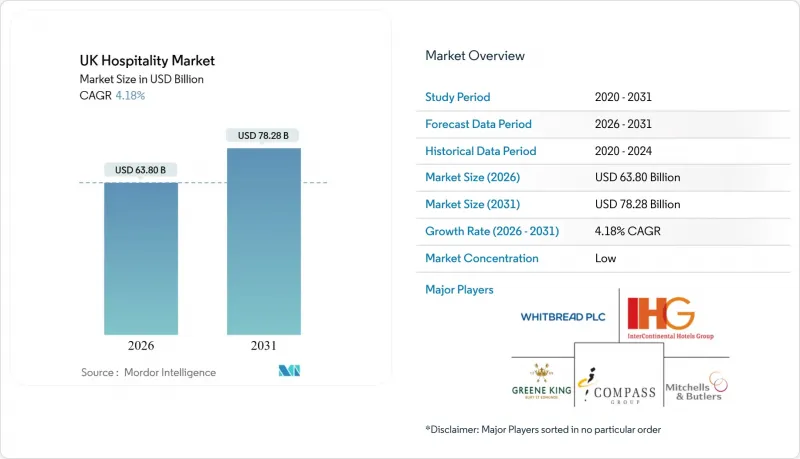
This report is Segmented by Type (Chain Hotels, and Independent Hotels), by Accommodation Class (Luxury, Mid & Upper-Midscale Hotels, Budget & Economy, and Service Apartments), by Booking Channel (Direct Digital, Otas, Corporate/MICE, and Wholesale & Traditional Agents), and by Geography (England, Scotland, Wales, Northern Ireland). The Market Forecasts are Provided in Terms of Value (USD).
United Kingdom Hospitality Market Trends and Insights
Expansion of Digital Ordering & Booking
Contactless payment reached 94.6% of all eligible in-store card transactions in 2024, with each consumer averaging 236 contactless purchases at USD 20.14, and hospitality categories like hotels and entertainment posted stronger gains than foodservice peers, signaling durable behavior that supports digital-first operating models in the United Kingdom hospitality market. Operators plan technology investment at scale, as 85% of restaurant leaders expect to deploy AI and automation in 2025 for staff marketing, inventory management, and menu optimization, which underpins throughput and margin control as labor costs rise. The competitive gap is widening because large chains can roll out AI revenue management, self-service kiosks, and app-based loyalty programs while 60% of independents lack the capital or skills to implement comparable systems, reinforcing a structural advantage for scaled operators in the United Kingdom hospitality market. Real-world examples show measurable savings, with Edinburgh Zoo's Time2Eat table-ordering app saving USD 168.97 per day and USD 61,328 annually through lower labor requirements, an impact that compounds across high-volume venues. Consumer adoption supports these tools, as QR code ordering and mobile wallets are preferred by significant cohorts of Gen Z and Millennials for higher-ticket transactions, placing convenience and speed at the center of purchase journeys. The differentiator is not just payments, but platforms that unify point-of-sale, inventory, and customer data to enable dynamic pricing and personalized upsells, which is where chain brands can scale faster than smaller venues in the UK hospitality industry.
Government VAT Relief and Incentive Programs
The Autumn Budget 2025 announced a USD 5.38 billion package for retail, hospitality, and leisure in England, anchored by permanently lower business-rate multipliers from April 2026 that are intended to ease operating costs during a period of persistent wage and input inflation in the United Kingdom hospitality market. Permanent reductions in business-rate multipliers and preferential treatment for smaller and mid-sized properties are improving short-term cash flow and providing relief during a period of elevated wage and input cost inflation. Transitional relief mechanisms are also helping smooth the impact of revaluations by limiting abrupt increases in tax liabilities, allowing operators greater visibility in budgeting and investment planning. While these measures provide meaningful near-term support, they do not fully offset broader cost headwinds, including rising labor expenses and the gradual removal of transitional protections over time. In parallel, the introduction of visitor levies in parts of the United Kingdom adds complexity to destination-level cost structures and underscores how local policy decisions can either reinforce or constrain pricing power. Overall, government relief and incentive schemes act as a stabilizing driver for the UK hospitality industry in the near term, even as structural cost pressures persist.
Severe Labour Shortages and Rising Wages
The United Kingdom hospitality market continues to face significant cost pressures from rising wages and labor shortages. Increases to the minimum wage and related payroll obligations have substantially raised staffing costs, particularly for entry-level and part-time roles, tightening already thin margins. Employer contributions and regulatory changes have further intensified cost exposure for a sector that relies heavily on seasonal and part-time labor. Staffing shortages remain a challenge, with persistent vacancies for chefs, waitstaff, and kitchen teams, compounded by tighter immigration and skilled-worker requirements that limit the labor pipeline. Operators are responding through workforce management technology, scheduling tools, and retention initiatives to mitigate turnover and improve efficiency. Despite these measures, elevated labor costs and constrained staffing continue to act as a key restraint on profitability and growth in the United Kingdom hospitality market.
Other drivers and restraints analyzed in the detailed report include:
- Increased Inbound Tourism Supported by a Weaker Currency
- Mid-Week Leisure Stays Driven by Hybrid Work
- Volatility in Food and Energy Costs
For complete list of drivers and restraints, kindly check the Table Of Contents.
Segment Analysis
Chain hotels in the United Kingdom are expected to grow at a 7.88% CAGR from 2026-2031, outpacing the wider hospitality market as scale delivers centralized procurement, stronger brand visibility, and loyalty programs that boost repeat bookings. Premier Inn maintained a notable RevPAR advantage over the United Kingdom midscale and economy segment, while Whitbread's statutory revenue in the United Kingdom and Ireland declined due to deliberate changes in food and beverage strategy, highlighting how larger portfolios preserve pricing power and operational efficiency. IHG recorded growth in both RevPAR and occupancy, supported by net system expansion that drives pipeline conversions and supply-led growth. Leading hotel groups are increasingly adopting digital tools, including room selection technology, AI assistants, automated scheduling, and invoice processing, which help improve asset utilization amid elevated wage and energy costs. In contrast, independent operators controlled a majority of market share, but a significant portion operated at a loss, reflecting the financial pressures they face without the benefits of scale procurement and brand-led distribution.
The investment cycle now favors owners and brands that can execute conversions and use balance-sheet flexibility to renew assets for higher returns, with private equity activity rising in 2025, targeting premium independents for roll-ups or asset-light platforms, and distressed sales accelerating via pre-pack administrations and quick portfolio realignments. Budget chains like Travelodge continued site additions through H1 2025, aiming to consolidate share as mid-market independents exit. Complex policy issues such as tip allocation rules and business-rate revaluation increase compliance costs that larger groups absorb with centralized HR/finance systems, while independents manage changes property-by-property. Overall, the United Kingdom hospitality market is shifting to a more scalable structure, expanding franchise and management contracts across branded portfolios, while owner-operators pivot to differentiated concepts or location-driven advantages. For investors and lenders, cash-flow visibility and diversified distribution now weigh more heavily than before 2020, driving a stronger appetite for brands with proven direct channels and loyalty economics.
Complete Report Scope:
- By Type
- Chain Hotels
- Independent Hotels
- By Accommodation Class
- Luxury
- Mid & Upper-Midscale Hotels
- Budget & Economy
- Service Apartments
- By Booking Channel
- Direct Digital
- OTAs
- Corporate/MICE
- Wholesale & Traditional Agents
- By Geography (Value)
- England
- Scotland
- Wales
- Northern Ireland
List of Companies Covered in this Report:
- Whitbread PLC
- InterContinental Hotels Group (IHG)
- Compass Group PLC
- Greene King
- Mitchells & Butlers
- J D Wetherspoon
- Travelodge Hotels Limited
- Accor S.A.
- Hilton Worldwide
- Marriott International
- Stonegate Pub Company
- Young & Co.'s Brewery
- Loungers PLC
- Greggs PLC
- Domino's Pizza Group
- Costa Coffee (Coca-Cola)
- Wagamama (The Restaurant Group)
- Sodexo UK & Ireland
- Aramark UK
- Center Parcs UK
- Merlin Entertainments
Additional Benefits:
- The market estimate (ME) sheet in Excel format
- 3 months of analyst support
TABLE OF CONTENTS
1 Introduction
- 1.1 Study Assumptions & Market Definition
- 1.2 Scope of the Study
2 Research Methodology
3 Executive Summary
4 Market Landscape
- 4.1 Market Overview
- 4.2 Market Drivers
- 4.2.1 Accelerating Digital Ordering & Booking
- 4.2.2 Government VAT Relief & Incentive Schemes
- 4.2.3 Rising Inbound Tourism On Weak Currency
- 4.2.4 Hybrid-Work-Fuelled Mid-Week Leisure Stays
- 4.2.5 Outsourcing Surge in Institutional Catering
- 4.3 Market Restraints
- 4.3.1 Acute Labour Shortages & Wage Inflation
- 4.3.2 Food & Energy Cost Volatility
- 4.3.3 Stringent Planning / Licensing Rules
- 4.3.4 High Reservation No-Show Rates
- 4.4 Value / Supply-Chain Analysis
- 4.5 Regulatory Landscape
- 4.6 Technological Outlook
- 4.7 Porter's Five Forces
- 4.7.1 Threat of New Entrants
- 4.7.2 Bargaining Power of Suppliers
- 4.7.3 Bargaining Power of Buyers
- 4.7.4 Threat of Substitutes
- 4.7.5 Competitive Rivalry
5 Market Size & Growth Forecasts
- 5.1 By Type
- 5.1.1 Chain Hotels
- 5.1.2 Independent Hotels
- 5.2 By Accommodation Class
- 5.2.1 Luxury
- 5.2.2 Mid & Upper-Midscale Hotels
- 5.2.3 Budget & Economy
- 5.2.4 Service Apartments
- 5.3 By Booking Channel
- 5.3.1 Direct Digital
- 5.3.2 OTAs
- 5.3.3 Corporate/MICE
- 5.3.4 Wholesale & Traditional Agents
- 5.4 By Geography (Value)
- 5.4.1 England
- 5.4.2 Scotland
- 5.4.3 Wales
- 5.4.4 Northern Ireland
6 Competitive Landscape
- 6.1 Market Concentration
- 6.2 Strategic Moves
- 6.3 Market Share Analysis
- 6.4 Company Profiles (includes Global-level Overview, Market-level Overview, Core Segments, Financials as available, Strategic Information, Market Rank/Share for key companies, Products & Services, and Recent Developments)
- 6.4.1 Whitbread PLC
- 6.4.2 InterContinental Hotels Group (IHG)
- 6.4.3 Compass Group PLC
- 6.4.4 Greene King
- 6.4.5 Mitchells & Butlers
- 6.4.6 J D Wetherspoon
- 6.4.7 Travelodge Hotels Limited
- 6.4.8 Accor S.A.
- 6.4.9 Hilton Worldwide
- 6.4.10 Marriott International
- 6.4.11 Stonegate Pub Company
- 6.4.12 Young & Co.'s Brewery
- 6.4.13 Loungers PLC
- 6.4.14 Greggs PLC
- 6.4.15 Domino's Pizza Group
- 6.4.16 Costa Coffee (Coca-Cola)
- 6.4.17 Wagamama (The Restaurant Group)
- 6.4.18 Sodexo UK & Ireland
- 6.4.19 Aramark UK
- 6.4.20 Center Parcs UK
- 6.4.21 Merlin Entertainments
7 Market Opportunities & Future Outlook
- 7.1 White-space & Unmet-Need Assessment

