PUBLISHER: Mordor Intelligence | PRODUCT CODE: 2073614

PUBLISHER: Mordor Intelligence | PRODUCT CODE: 2073614
South America Specialty Fertilizer - Market Share Analysis, Industry Trends & Statistics, Growth Forecasts (2026 - 2031)
According to Mordor Intelligence, the south america specialty fertilizer market size was valued at USD 2.81 billion in 2025 and estimated to grow from USD 3.01 billion in 2026 to reach USD 4.09 billion by 2031, at a CAGR of 6.30% during the forecast period (2026-2031).
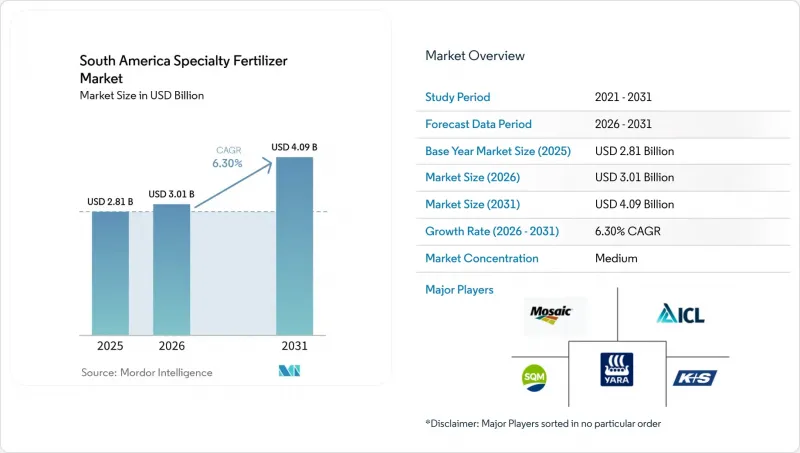
This report is Segmented by Speciality Type (CRF, Liquid Fertilizer, SRF, and Water Soluble), by Application Mode (Fertigation, Foliar, and Soil), by Crop Type (Field Crops, Horticultural Crops, and Turf and Ornamental), and by Country (Argentina, Brazil, and Rest of South America). The Market Forecasts are Provided in Terms of Value (USD) and Volume (Metric Tons).
South America Specialty Fertilizer Market Trends and Insights
Surge in Drip-Irrigated Acreage
Brazil's irrigated land expanded 12% between 2019 and 2024, reaching 8.2 million ha, with drip systems the fastest-growing share. Drip technology requires fully soluble inputs, making specialty fertilizers essential to prevent emitter clogging and to match nutrient pulses with crop demand. Argentina added 1.8 million ha, chiefly in Mendoza vineyards and northern citrus groves, reinforcing liquid and water-soluble uptake. Regional equipment manufacturers posted 15-20% annual sales growth, reinforcing the feedback loop between precision irrigation and fertilizer innovation. Yield data show 8-10% gains when fertigation combines soluble NPK with micronutrient chelates, validating investment even under volatile commodity prices. Local agronomic service providers now bundle irrigation kits with nutrition advisories, speeding farmer learning curves. As drip lines penetrate Paraguay and Uruguay, cross-border demand for soluble blends climbs, widening the addressable base of the South America specialty fertilizer market.
Government Tax Incentives on Enhanced-Efficiency Fertilizers
Brazil's 2024 reform cut PIS/COFINS on controlled-release and slow-release fertilizers from 9.25% to 3.65%, trimming retail prices about 6%. Argentina matched with lower import duties on polymer-coated urea and biostimulant additives, aligning with ISO 14001 certification rebates. Early market data show controlled-release tonnage up 23% just six months after rollout. The policy tightens the link between environmental stewardship and profitability, accelerating market penetration beyond high-value horticulture into broadacre soybean, corn, and cotton. Local blenders rapidly shifted portfolios toward coated products, leveraging transitional inventory credits. As fiscal benefits sunset in 2026, manufacturers expect demand stickiness given demonstrable yield boosts and lower labor costs per hectare. Neighboring governments monitor the Brazilian model, foreshadowing a broader incentive wave across South America specialty fertilizer market economies.
High Upfront Cost versus Commodity Fertilizers
Specialty fertilizers sell at 25-40% premiums to conventional NPK, a hurdle for Brazil's 3.9 million smallholders who comprise 77% of farm units. When crop prices soften, growers revert to cheaper bulk nutrients. Peso depreciation in Argentina magnifies price gaps because many inputs are dollar-denominated. Distributors counter with seasonal credit plans and grain-barter programs, but repayment risk keeps interest rates high. Without cost-sharing incentives, adoption lags in zones where labor is abundant and yield ceilings are lower. Government voucher schemes remain pilot-scale, limiting near-term relief. Consequently, price sensitivity chops an estimated 1.8% from the South America specialty fertilizer market CAGR forecast over the next two years.
Other drivers and restraints analyzed in the detailed report include:
- Increasing Soybean and Corn Double-Cropping Intensity
- Tightening Water-Quality Regulations on Nitrate Leaching
- Limited Distribution Infrastructure in Interior Brazil
For complete list of drivers and restraints, kindly check the Table Of Contents.
Segment Analysis
Liquid fertilizers held a dominant 36.6% share of the South America specialty fertilizer market in 2025, boosted by integration with fertigation and foliar equipment used in citrus, coffee, and sugarcane plantations. Rapid absorption, uniform mixing, and compatibility with crop-protection tank mixes underpin adoption. Controlled-release fertilizers, though smaller, are forecast to deliver a 7.4% CAGR during 2026-2031, reflecting Brazil's tax cuts and mandatory nitrate caps that make enhanced-efficiency options cost-competitive.
Operational gains also favor liquids, such as fewer passes, reduced labor, and better shelf stability after recent innovations that slow crystallization. Conversely, polymer-coated granules thrive in broadacre grains where single-application convenience offsets higher upfront cost. Sulfur-coated urea finds traction in cotton and corn, while polymer-sulfur hybrids serve cost-sensitive soy areas. Slow-release organo-mineral blends occupy a niche among organic-certified growers. Overall, product portfolio diversification allows suppliers to hedge against weather, price swings, and policy shifts, sustaining revenue robustness across specialty categories.
Complete Report Scope:
- Specialty Type
- Controlled-Release Fertilizer (CRF)
- Polymer-Coated
- Polymer-Sulfur-Coated
- Others
- Liquid Fertilizer
- Slow-Release Fertilizer (SRF)
- Water-Soluble Fertilizer
- Controlled-Release Fertilizer (CRF)
- Application Mode
- Fertigation
- Foliar
- Soil
- Crop Type
- Field Crops
- Horticultural Crops
- Turf and Ornamental
- Country
- Argentina
- Brazil
- Rest of South America
List of Companies Covered in this Report:
- EuroChem Group
- SQM S.A.
- The Mosaic Company
- ICL Group Ltd.
- K+S Aktiengesellschaft
- Yara International ASA
- Grupa Azoty S.A. (Compo Expert GmbH)
- Haifa Group
- TIMAC Agro Brasil (Groupe Roullier)
- Nutrien
- Compass Minerals International Inc.
- Koch Agronomic Services LLC (Koch Industries)
- Valagro (Syngenta Group)
- AgroLiquid
- Omex Agrifluids Ltd.
Additional Benefits:
- The market estimate (ME) sheet in Excel format
- 3 months of analyst support
TABLE OF CONTENTS
1 INTRODUCTION
- 1.1 Study Assumptions and Market Definition
- 1.2 Scope of the Study
- 1.3 Research Methodology
2 REPORT OFFERS
3 EXECUTIVE SUMMARY AND KEY FINDINGS
4 KEY INDUSTRY TRENDS
- 4.1 Acreage of Major Crop Types
- 4.1.1 Field Crops
- 4.1.2 Horticultural Crops
- 4.2 Average Nutrient Application Rates
- 4.2.1 Micronutrients
- 4.2.1.1 Field Crops
- 4.2.1.2 Horticultural Crops
- 4.2.2 Primary Nutrients
- 4.2.2.1 Field Crops
- 4.2.2.2 Horticultural Crops
- 4.2.3 Secondary Macronutrients
- 4.2.3.1 Field Crops
- 4.2.3.2 Horticultural Crops
- 4.2.1 Micronutrients
- 4.3 Agricultural Land Equipped for Irrigation
- 4.4 Regulatory Framework
- 4.5 Value Chain and Distribution Channel Analysis
- 4.6 Market Drivers
- 4.6.1 Surge in drip-irrigated acreage
- 4.6.2 Government tax incentives on enhanced-efficiency fertilizers
- 4.6.3 Increasing soybean and corn double-cropping intensity
- 4.6.4 Tightening water-quality regulations on nitrate leaching
- 4.6.5 Biostimulant-fertilizer premix integration
- 4.6.6 Blockchain-based traceability premiums
- 4.7 Market Restraints
- 4.7.1 High upfront cost vs. commodity fertilizers
- 4.7.2 Limited distribution infrastructure in interior Brazil
- 4.7.3 Lack of crop-specific field trial data for tropical soils
- 4.7.4 Currency-exchange volatility impacting import costs
5 MARKET SIZE AND GROWTH FORECASTS (VALUE AND VOLUME)
- 5.1 Specialty Type
- 5.1.1 Controlled-Release Fertilizer (CRF)
- 5.1.1.1 Polymer-Coated
- 5.1.1.2 Polymer-Sulfur-Coated
- 5.1.1.3 Others
- 5.1.2 Liquid Fertilizer
- 5.1.3 Slow-Release Fertilizer (SRF)
- 5.1.4 Water-Soluble Fertilizer
- 5.1.1 Controlled-Release Fertilizer (CRF)
- 5.2 Application Mode
- 5.2.1 Fertigation
- 5.2.2 Foliar
- 5.2.3 Soil
- 5.3 Crop Type
- 5.3.1 Field Crops
- 5.3.2 Horticultural Crops
- 5.3.3 Turf and Ornamental
- 5.4 Country
- 5.4.1 Argentina
- 5.4.2 Brazil
- 5.4.3 Rest of South America
6 COMPETITIVE LANDSCAPE
- 6.1 Key Strategic Moves
- 6.2 Market Share Analysis
- 6.3 Company Landscape
- 6.4 Company Profiles (includes Global-level Overview, Market-level Overview, Core Segments, Financials as available, Strategic Information, Market Rank/Share, Products and Services, Recent Developments)
- 6.4.1 EuroChem Group
- 6.4.2 SQM S.A.
- 6.4.3 The Mosaic Company
- 6.4.4 ICL Group Ltd.
- 6.4.5 K+S Aktiengesellschaft
- 6.4.6 Yara International ASA
- 6.4.7 Grupa Azoty S.A. (Compo Expert GmbH)
- 6.4.8 Haifa Group
- 6.4.9 TIMAC Agro Brasil (Groupe Roullier)
- 6.4.10 Nutrien
- 6.4.11 Compass Minerals International Inc.
- 6.4.12 Koch Agronomic Services LLC (Koch Industries)
- 6.4.13 Valagro (Syngenta Group)
- 6.4.14 AgroLiquid
- 6.4.15 Omex Agrifluids Ltd.
7 KEY STRATEGIC QUESTIONS FOR FERTILIZER CEOs

