PUBLISHER: Mordor Intelligence | PRODUCT CODE: 2100729

PUBLISHER: Mordor Intelligence | PRODUCT CODE: 2100729
Middle East and Africa Specialty Fertilizer - Market Share Analysis, Industry Trends & Statistics, Growth Forecasts (2026 - 2031)
According to Mordor Intelligence, the Middle East and Africa specialty fertilizer market size is projected to grow from USD 3.21 billion in 2025 to USD 3.58 billion in 2026 and is forecast to reach USD 5.48 billion by 2031, registering a CAGR of 8.89% during 2026-2031.
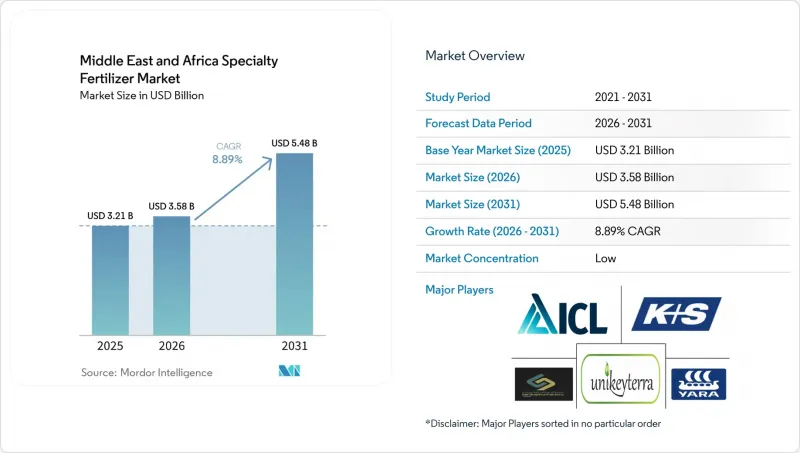
This report is Segmented by Specialty Type (Controlled-Release Fertilizer, Slow-Release Fertilizer, Liquid Fertilizer, and More), Application Mode (Soil, Foliar, and More), Crop Type (Field Crops, Horticultural Crops, and More), and Geography (South Africa, Nigeria, Saudi Arabia, and More). The Market Forecasts are Provided in Terms of Value (USD) and Volume (Metric Tons).
Middle East and Africa Specialty Fertilizer Market Trends and Insights
Surge in Protected Cultivation Acreage
Protected cultivation acreage in Saudi Arabia increased 35% between 2022 and 2024 as Vision 2030 targets self-sufficiency in high-value produce. These facilities depend on water-soluble and liquid grades that deliver precise nutrient ratios through automated systems, sharply raising premium fertilizer demand. South Africa mirrors this pattern in Western Cape greenhouse clusters, where specialty fertilizer consumption in such structures jumped 40% per year since 2023. Growers leverage optimal nutrient timing to maximize output per square meter, making price premiums viable and supporting continual uptake of controlled-release and chelated micronutrient blends.
Government Food-Security Programs
Saudi Arabia earmarked USD 20 billion for agricultural transformation initiatives that bundle subsidies, technology transfer, and specialty fertilizer adoption, reinforcing domestic value addition to safeguard food supply. Egypt's National Food Security Strategy and Nigeria's Agricultural Transformation Agenda introduce similar incentives, often tying input support to local content agreements. Morocco integrates its phosphate endowment into a downstream value chain that backs export-oriented specialty grades, strengthening regional supply resilience and attracting private-sector capital.
Price Volatility of Specialty Raw Materials
Polymer coatings essential for controlled-release fertilizers rose 45% in 2024 amid petrochemical supply disruptions, squeezing producer margins. Zinc sulfate and iron chelate costs followed similar trajectories due to mining consolidation and geopolitical constraints, forcing manufacturers to adopt flexible pricing clauses and hedge inventory exposure. Vertically integrated phosphate majors holding internal sulfuric acid and ammonia capacity maintain a competitive edge during volatile periods.
Other drivers and restraints analyzed in the detailed report include:
- Rising Adoption of Fertigation Systems
- Desalination-Linked Nutrient Delivery Pilots
- Limited Distributor Networks in Sub-Saharan Africa
For complete list of drivers and restraints, kindly check the Table Of Contents.
Segment Analysis
Liquid fertilizers account for 44.6% of the Middle East and Africa specialty fertilizer market size in 2025 because it integrates seamlessly with drip and sprinkler delivery hardware prevalent in modern farms. Growers appreciate quick nutrient uptake, uniform distribution, and reduced labor relative to granular products. Polymer-coated controlled-release fertilizers are projected to be the fastest-growing segment, with a forecast CAGR of 9.3% from 2026 to 2031, driven by polymer innovations that withstand high regional temperatures. These products cut application frequency and conserve water, benefits aligned with sustainability mandates. The specialty fertilizer market for controlled-release variants is on track to surpass USD 2.12 billion by 2031 if current adoption rates continue.
Liquid blends span balanced NPK solutions, calcium nitrate mixes, and trace-element chelates tailored to greenhouse vegetables, floriculture, and hydroponics. Demand surges during peak summer because liquids avoid salt precipitation that clogs emitters. Manufacturers also bundle biostimulants and acidifiers to differentiate offerings. Conversely, polymer-coated urea and polymer-sulfur-coated NPK products appeal to date palm, citrus, and broad-acre wheat growers by cutting weekly top-dressings to two or three seasonal applications. ICL Group's temperature-responsive coatings show 25% slower nutrient release at 40 °C versus legacy technology, meeting arid-zone needs. Suppliers anticipate integrating biodegradable coatings derived from lignin and polysaccharides within five years, though price competitiveness remains under review.
Complete Report Scope:
- By Specialty Type
- Controlled-Release Fertilizer (CRF)
- Polymer-Coated
- Polymer Sulfur-Coated
- Others
- Slow-Release Fertilizer (SRF)
- Liquid Fertilizer
- Water-Soluble Fertilizer
- Controlled-Release Fertilizer (CRF)
- By Application Mode
- Soil
- Foliar
- Fertigation
- By Crop Type
- Field Crops
- Horticultural Crops
- Turf and Ornamental
- By Geography
- South Africa
- Nigeria
- Saudi Arabia
- Turkey
- Rest of Middle East and Africa
List of Companies Covered in this Report:
- Yara International ASA
- ICL Group Ltd
- K+S Aktiengesellschaft
- The Mosaic Company
- Nutrien Ltd
- Haifa Group
- EuroChem Group AG
- Saudi Basic Industries Corporation (SABIC)
- OCI Global
- OCP Group
- SQM
- Grupa Azoty S.A.
- Arab Potash Company
- Ma'aden Phosphate Company
- Valagro S.p.A.
Additional Benefits:
- The market estimate (ME) sheet in Excel format
- 3 months of analyst support
TABLE OF CONTENTS
1 Introduction
- 1.1 Study Assumptions and Market Definition
- 1.2 Scope of the Study
- 1.3 Research Methodology
2 Report Offers
3 Executive Summary
4 Key Industry Trends
- 4.1 Acreage Of Major Crop Types
- 4.1.1 Field Crops
- 4.1.2 Horticultural Crops
- 4.2 Average Nutrient Application Rates
- 4.2.1 Micronutrients
- 4.2.1.1 Field Crops
- 4.2.1.2 Horticultural Crops
- 4.2.2 Primary Nutrients
- 4.2.2.1 Field Crops
- 4.2.2.2 Horticultural Crops
- 4.2.3 Secondary Macronutrients
- 4.2.3.1 Field Crops
- 4.2.3.2 Horticultural Crops
- 4.2.1 Micronutrients
- 4.3 Agricultural Land Equipped For Irrigation
- 4.4 Regulatory Framework
- 4.5 Value Chain & Distribution Channel Analysis
- 4.6 Market Drivers
- 4.6.1 Surge in protected cultivation acreage
- 4.6.2 Government food-security programs
- 4.6.3 Rising adoption of fertigation systems
- 4.6.4 Desalination-linked nutrient delivery pilots
- 4.6.5 Carbon-credit incentives for precision fertilization
- 4.6.6 Rapid expansion of controlled-environment date farming
- 4.7 Market Restraints
- 4.7.1 Price volatility of specialty raw materials
- 4.7.2 Limited distributor networks in Sub-Saharan Africa
- 4.7.3 Salinity build-up risks in arid soils
- 4.7.4 Regulatory delays on nano-nutrient registration
5 Market Size and Growth Forecasts (Value and Volume)
- 5.1 By Specialty Type
- 5.1.1 Controlled-Release Fertilizer (CRF)
- 5.1.1.1 Polymer-Coated
- 5.1.1.2 Polymer Sulfur-Coated
- 5.1.1.3 Others
- 5.1.2 Slow-Release Fertilizer (SRF)
- 5.1.3 Liquid Fertilizer
- 5.1.4 Water-Soluble Fertilizer
- 5.1.1 Controlled-Release Fertilizer (CRF)
- 5.2 By Application Mode
- 5.2.1 Soil
- 5.2.2 Foliar
- 5.2.3 Fertigation
- 5.3 By Crop Type
- 5.3.1 Field Crops
- 5.3.2 Horticultural Crops
- 5.3.3 Turf and Ornamental
- 5.4 By Geography
- 5.4.1 South Africa
- 5.4.2 Nigeria
- 5.4.3 Saudi Arabia
- 5.4.4 Turkey
- 5.4.5 Rest of Middle East and Africa
6 Competitive Landscape
- 6.1 Market Concentration
- 6.2 Strategic Moves
- 6.3 Market Share Analysis
- 6.4 Company Profiles (Includes Global Level Overview, Market Level Overview, Core Segments, Financials as Available, Strategic Information, Market Rank/Share, Products and Services, Recent Developments)
- 6.4.1 Yara International ASA
- 6.4.2 ICL Group Ltd
- 6.4.3 K+S Aktiengesellschaft
- 6.4.4 The Mosaic Company
- 6.4.5 Nutrien Ltd
- 6.4.6 Haifa Group
- 6.4.7 EuroChem Group AG
- 6.4.8 Saudi Basic Industries Corporation (SABIC)
- 6.4.9 OCI Global
- 6.4.10 OCP Group
- 6.4.11 SQM
- 6.4.12 Grupa Azoty S.A.
- 6.4.13 Arab Potash Company
- 6.4.14 Ma'aden Phosphate Company
- 6.4.15 Valagro S.p.A.
7 Key Strategic Questions For Specialty Fertilizer CEOS

