PUBLISHER: Mordor Intelligence | PRODUCT CODE: 2073660

PUBLISHER: Mordor Intelligence | PRODUCT CODE: 2073660
India Digital Transformation - Market Share Analysis, Industry Trends & Statistics, Growth Forecasts (2026 - 2031)
According to Mordor Intelligence, india digital transformation market size in 2026 is estimated at USD 144.48 billion, growing from 2025 value of USD 124.42 billion with 2031 projections showing USD 304.86 billion, growing at 16.12% CAGR over 2026-2031.
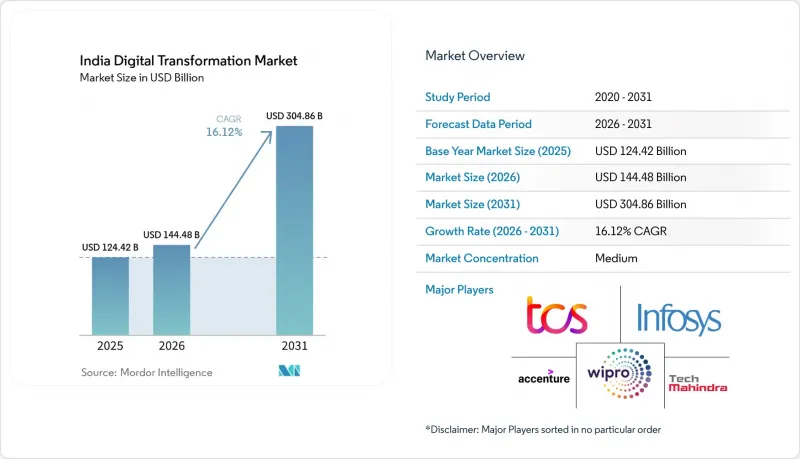
This report is Segmented by Type (Analytics AI & ML, Extended Reality, IoT, Industrial Robotics, Blockchain and More), Component (Solutions, Services), Deployment Mode (Cloud, Edge, On-Premises), Organisation Size (Large Enterprises, SMEs), End-User Industry (Manufacturing, Retail, Transportation, Healthcare, BFSI, Telecom, and More). The Market Forecasts are Provided in Terms of Value (USD).
India Digital Transformation Market Trends and Insights
Government-led Digital India and India Stack momentum
The central government extended Digital India funding to INR 14,903 crore through FY 2026, channeling resources toward digital public infrastructure, reskilling 625,000 IT professionals, and training 265,000 information-security specialists. India Stack layers, such as Aadhaar, UPI, and DigiLocker, standardize identity, payments, and data exchange, lowering integration costs for enterprises rolling out at a population scale. The Unified Payments Interface processed 38 billion transactions valued at INR 71.95 trillion in 2021, demonstrating transaction-layer maturity. State governments replicate platform thinking; Andhra Pradesh delivers 161 public services via "Mana Mitra" WhatsApp governance, widening last-mile reach. The Digital Personal Data Protection Rules 2025 introduce clear consent and data-fiduciary obligations, cementing regulatory certainty for private-sector investment, Press Information Bureau of India.
Rapid growth in mobile-internet and smartphone adoption
India added 120 million 4G subscribers between 2023 and 2025 as affordable handsets and aggressive data tariffs bridged the connectivity gap. With monthly average data consumption per user exceeding 19 GB in 2025, digital content, OTT video, and mobile gaming ecosystems flourish, propelling demand for cloud delivery networks and fintech micro-services. Smartphone penetration surpasses 73%, catalyzing inclusive digital-payment adoption in tier-3 towns and rural areas. E-commerce, ride-hailing, and food-delivery platforms leverage the expanding addressable base, while telcos monetize higher data-consumption tiers through bundled content and device financing. The positive spill-over benefits the India digital transformation market as enterprises redesign customer journeys for mobile-first engagement.
Escalating data-privacy & cyber-attack risks
India recorded more than 1.5 million cyber incidents in 2025, with projected losses of INR 20,000 crore to fraud, ransomware, and phishing scams. Banks reported 2,500 targeted attacks in H2 2024 alone, prompting a 30% rise in cybersecurity budgets across BFSI and healthcare. The government raised its national cybersecurity allocation to INR 1,900 crore for FY 2025, yet the attack surface expands as enterprises adopt multicloud and edge architectures. Brand-impersonation scams inflicted INR 9,000 crore losses in 2024, eroding consumer trust in digital channels. Heightened risk perception slows digital rollouts in sensitive sectors, tempering near-term growth for the India digital transformation market.
Other drivers and restraints analyzed in the detailed report include:
- Enterprise push for cloud, AI, and efficiency gains
- Large-scale 5G and broadband capital outlays
- Acute digital-skills shortage
For complete list of drivers and restraints, kindly check the Table Of Contents.
Segment Analysis
Cloud & Edge Computing contributed 27.35% of the India digital transformation market share in 2025, reflecting large-scale workload migration and sovereign-cloud adoption for regulated industries. Generative-AI-driven analytics posts a 23.25% CAGR, as language models automate customer service chatbots, code generation, and business-intelligence narrative insights. The India digital transformation market size for AI-centric analytics is forecast to surpass USD 29.3 billion by 2031, underpinned by hyperscaler GPU clusters in Maharashtra and Telangana. Industrial robotics gains traction in automotive facilities, where Hyundai integrated 2,000 smart robots, cutting maintenance downtime by 5%. IoT sensors over private 5G enable real-time asset monitoring, while extended-reality tools facilitate remote training for shop-floor workers. Blockchain adoption remains niche, focused on supply-chain traceability, whereas additive manufacturing scales in aerospace prototyping. Cybersecurity tools increasingly embed AI to counter advanced persistent threats, rounding out a converged technology stack.
New market entrants differentiate through domain-specific AI models, low-code IoT platforms, and pay-per-use robotic-as-a-service offerings. Pricing flexibility and outcome-based contracts resonate with mid-market manufacturers seeking rapid ROI. Synergies among these technologies compound business value, reinforcing India's position as a global testbed for integrated digital-transformation solutions.
Services represented 53.05% of the India digital transformation market size in 2025 and are positioned to grow at a 20.15% CAGR to 2031 as enterprises seek consulting, integration, and managed-service expertise. Large transformation programs span multicloud strategy, cybersecurity hardening, and composable ERP modernization, requiring cross-functional advisory capabilities. Solutions (software and platforms) account for the balance, with verticalized applications gaining traction in manufacturing execution systems, tele-health, and regulatory reporting for BFSI.
India's established IT-services ecosystem, led by TCS, Infosys, and Wipro, deepens alliances with hyperscalers to co-develop industry accelerators. Accenture's acquisition of TalentSprint augments its LearnVantage platform, fostering AI and data-engineering talent pipelines. Managed-services demand surges as Bharti Airtel's Pune center supports more than 2,000 enterprises on multicloud governance. Outcome-linked contracts tie vendor remuneration to KPIs such as process-scrap reduction and customer-churn minimization, shifting risk to providers yet increasing long-term wallet share.
Complete Report Scope:
- By Type
- Analytics, AI and ML
- Extended Reality (XR)
- Internet of Things (IoT)
- Industrial Robotics
- Blockchain
- Cloud and Edge Computing
- Others (Digital Twin, Mobility and Connectivity)
- By Component
- Solutions
- Services
- By Deployment Mode
- Cloud
- Edge
- On-Premises
- By Organisation Size
- Large Enterprises
- Small and Mid-Sized Enterprises
- By End-User Industry
- Manufacturing
- Oil, Gas and Utilities
- Retail and E-commerce
- Transportation and Logistics
- Healthcare
- BFSI
- Telecom and IT
- Government and Public Sector
- Others
List of Companies Covered in this Report:
- Accenture plc
- Google LLC
- Siemens AG
- International Business Machines Corporation
- Microsoft Corporation
- Cognex Corporation
- Hewlett Packard Enterprise Company
- SAP SE
- Dell Technologies Inc.
- Oracle Corporation
- Adobe Inc.
- Amazon Web Services, Inc.
- Apple Inc.
- Salesforce, Inc.
- Cisco Systems, Inc.
- Infosys Limited
- Tata Consultancy Services Limited
- Wipro Limited
- Tech Mahindra Limited
- HCL Technologies Limited
- Larsen & Toubro Infotech Limited
- Zoho Corporation Private Limited
- Reliance Jio Infocomm Limited
- Bharti Airtel Limited
Additional Benefits:
- The market estimate (ME) sheet in Excel format
- 3 months of analyst support
TABLE OF CONTENTS
1 INTRODUCTION
- 1.1 Study Assumptions and Market Definition
- 1.2 Scope of the Study
2 RESEARCH METHODOLOGY
3 EXECUTIVE SUMMARY
4 MARKET LANDSCAPE
- 4.1 Market Overview
- 4.2 Market Drivers
- 4.2.1 Government "Digital India" and India Stack momentum
- 4.2.2 Rapid mobile-internet and smartphone penetration
- 4.2.3 Enterprise cloud- and AI-led efficiency push
- 4.2.4 5G / broadband CAPEX boom
- 4.2.5 Hyperscale GPU datacentre build-out (IndiaAI clusters)
- 4.2.6 GST 2.0 e-invoicing mandate for >6 M SMEs
- 4.3 Market Restraints
- 4.3.1 Escalating data-privacy and cyber-attack risks
- 4.3.2 Acute digital-skills shortage
- 4.3.3 Legacy-system fragmentation in public sector
- 4.3.4 Power-grid instability in tier-3/4 cities
- 4.4 Regulatory Landscape
- 4.5 Technological Outlook
- 4.6 Porter's Five Forces Analysis
- 4.6.1 Bargaining Power of Buyers
- 4.6.2 Bargaining Power of Suppliers
- 4.6.3 Threat of New Entrants
- 4.6.4 Threat of Substitutes
- 4.6.5 Intensity of Competitive Rivalry
- 4.7 Current Market Scenario and Evolution of DX Practices
- 4.8 Key Metrics
- 4.8.1 Technology Spending Trends
- 4.8.2 Number of IoT Devices
- 4.8.3 Total Cyber-attacks
- 4.8.4 Technology Staffing
- 4.8.5 Internet Penetration
- 4.8.6 Digital Competitiveness
- 4.8.7 Broadband Coverage
- 4.8.8 Cloud Adoption
- 4.8.9 AI Adoption
- 4.8.10 E-commerce
5 MARKET SIZE AND GROWTH FORECASTS (VALUE)
- 5.1 By Type
- 5.1.1 Analytics, AI and ML
- 5.1.2 Extended Reality (XR)
- 5.1.3 Internet of Things (IoT)
- 5.1.4 Industrial Robotics
- 5.1.5 Blockchain
- 5.1.6 Cloud and Edge Computing
- 5.1.7 Others (Digital Twin, Mobility and Connectivity)
- 5.2 By Component
- 5.2.1 Solutions
- 5.2.2 Services
- 5.3 By Deployment Mode
- 5.3.1 Cloud
- 5.3.2 Edge
- 5.3.3 On-Premises
- 5.4 By Organisation Size
- 5.4.1 Large Enterprises
- 5.4.2 Small and Mid-Sized Enterprises
- 5.5 By End-User Industry
- 5.5.1 Manufacturing
- 5.5.2 Oil, Gas and Utilities
- 5.5.3 Retail and E-commerce
- 5.5.4 Transportation and Logistics
- 5.5.5 Healthcare
- 5.5.6 BFSI
- 5.5.7 Telecom and IT
- 5.5.8 Government and Public Sector
- 5.5.9 Others
6 COMPETITIVE LANDSCAPE
- 6.1 Market Concentration
- 6.2 Strategic Moves
- 6.3 Market Share Analysis
- 6.4 Company Profiles (includes Global-level overview, Market-level overview, Core Segments, Financials, Strategic Info, Market Rank/Share, Products and Services, Recent Developments)
- 6.4.1 Accenture plc
- 6.4.2 Google LLC
- 6.4.3 Siemens AG
- 6.4.4 International Business Machines Corporation
- 6.4.5 Microsoft Corporation
- 6.4.6 Cognex Corporation
- 6.4.7 Hewlett Packard Enterprise Company
- 6.4.8 SAP SE
- 6.4.9 Dell Technologies Inc.
- 6.4.10 Oracle Corporation
- 6.4.11 Adobe Inc.
- 6.4.12 Amazon Web Services, Inc.
- 6.4.13 Apple Inc.
- 6.4.14 Salesforce, Inc.
- 6.4.15 Cisco Systems, Inc.
- 6.4.16 Infosys Limited
- 6.4.17 Tata Consultancy Services Limited
- 6.4.18 Wipro Limited
- 6.4.19 Tech Mahindra Limited
- 6.4.20 HCL Technologies Limited
- 6.4.21 Larsen & Toubro Infotech Limited
- 6.4.22 Zoho Corporation Private Limited
- 6.4.23 Reliance Jio Infocomm Limited
- 6.4.24 Bharti Airtel Limited
7 MARKET OPPORTUNITIES AND FUTURE OUTLOOK
- 7.1 White-Space and Unmet-Need Assessment

